


Fragrance families explained: unlock the art of scent selection
Walk into any department store fragrance counter and the sheer number of bottles can feel paralyzing. Hundreds of options, each with poetic names and vague descriptors like “mysterious” or “fresh and clean,” offer little real guidance. What most shoppers don’t realize is that beneath all that marketing language sits an evidence-based classification system used by perfumers, retailers, and fragrance experts worldwide. That system is built around fragrance families, and once you understand it, choosing a perfume becomes far less overwhelming and far more rewarding.
Table of Contents
- What is a fragrance family?
- Main fragrance classification systems
- Inside the Michael Edwards’ Fragrance Wheel
- Fragrance family nuances: Overlaps, trends, and breaking the rules
- Fragrance family and longevity: What lasts longest?
- How to use fragrance families for smarter purchases
- Discover your next signature scent with Aromatick
- Frequently asked questions
Key Takeaways
| Point | Details |
|---|---|
| Fragrance families demystified | Understanding fragrance families makes scent shopping easier and more satisfying. |
| Industry standards matter | Michael Edwards’ Fragrance Wheel is the go-to framework for buyers and retailers. |
| Longevity by family | Amber and Woody scents last longest, while Citrus and Fresh fade quickly. |
| Use families to find value | Explore adjacent or similar families for affordable alternatives and smart purchases. |
What is a fragrance family?
A fragrance family is a category that groups perfumes and colognes together based on their dominant scent characteristics. Think of it like a genre system for music. Just as you might gravitate toward jazz over heavy metal, your nose has preferences that align with specific olfactory profiles.
These categories didn’t emerge randomly. Perfumers and retailers needed a shared language to describe and organize thousands of products. As fragrance classification systems define it, fragrance families group perfumes and colognes based on dominant scent profiles, notes, and olfactory characteristics to help consumers identify preferences and make informed purchases.
“Understanding your fragrance family is the single fastest shortcut to finding a scent you’ll actually love and wear consistently.”
For shoppers, this knowledge is practical. Instead of testing 40 random bottles, you can narrow your search to one or two families and explore within them. Learning about using fragrance families to guide your choices is one of the most efficient strategies any fragrance buyer can adopt.
Main fragrance classification systems
Several frameworks exist for organizing fragrance families, and each reflects a different perspective on how scents relate to one another.
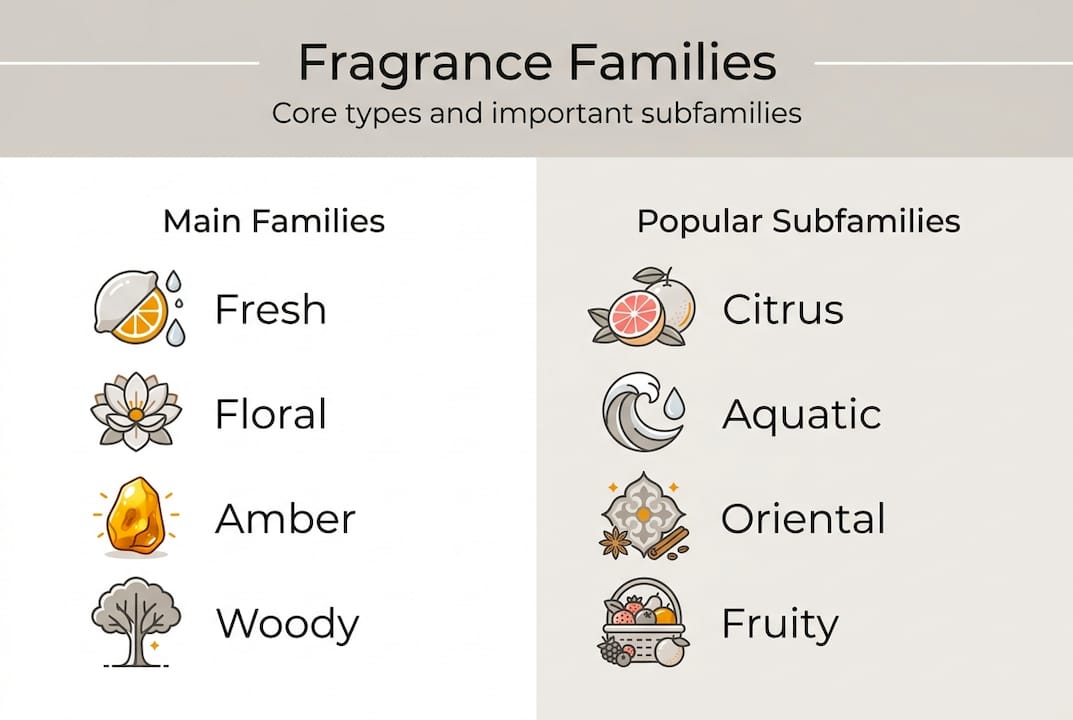
The predominant methodology is Michael Edwards’ Fragrance Wheel, which organizes scents into 4 main families and 14 subfamilies. It’s the system most commonly used in retail environments and buying guides. However, it’s not the only one.
Alternative systems include the French Society of Perfumers, which uses seven families rooted in classic French perfumery tradition, and the Perfume Society, which has developed its own distinct categories. Each system has merit, and the differences often come down to cultural history and how broadly or narrowly a category is defined.
Here’s a quick comparison of the major systems:
| System | Number of families | Best used for |
|---|---|---|
| Michael Edwards’ Fragrance Wheel | 4 main, 14 subfamilies | Retail, buying guides, personal discovery |
| French Society of Perfumers | 7 | Classic and European perfumery |
| Perfume Society | Varies | Education and enthusiast communities |
Key reasons multiple systems exist:
- Fragrances often blend characteristics from more than one family
- Cultural and historical perspectives shape how scents are grouped
- New ingredients and trends create categories that older systems didn’t anticipate
- Different audiences (professionals vs. consumers) have different needs
For most shoppers focused on finding affordable alternatives to designer scents, Edwards’ wheel is the most practical starting point.
Inside the Michael Edwards’ Fragrance Wheel
The Fragrance Wheel is a circular diagram that places scent families next to their closest relatives. Families that sit adjacent on the wheel share characteristics and blend well together. This visual structure makes it easy to see relationships between scents at a glance.

Edwards’ wheel shows olfactory relationships), blending compatibility, and practical subfamilies like Citrus, Aquatic, Soft Floral, and Floral Oriental. Here’s a breakdown of the four main families and their key subfamilies:
| Family | Character | Key subfamilies |
|---|---|---|
| Fresh | Light, clean, airy | Citrus, Aquatic, Green, Fruity |
| Floral | Soft to rich blooms | Soft Floral, Floral, Floral Oriental |
| Woody | Warm, earthy, grounded | Woods, Mossy Woods, Dry Woods |
| Amber | Warm, rich, sensual | Soft Amber, Amber, Woody Amber |
The wheel works because it reflects how scents actually behave in real life. A perfume sitting between Floral and Amber on the wheel will feel warmer and richer than a pure floral. A scent near Fresh and Woody will feel clean but grounded.
If you’re exploring woody and amber notes for the first time, the wheel helps you understand why those scents feel so different from a light citrus cologne. It also clarifies the perfume vs cologne distinction, since concentration levels interact with family characteristics to affect how a scent performs.
Pro Tip: If you love a specific designer fragrance, look up its family on the wheel. Then search for other perfumes in the same subfamily. You’ll often find affordable alternatives that share the same olfactory DNA.
Fragrance family nuances: Overlaps, trends, and breaking the rules
Not every perfume fits cleanly into one box. Modern perfumery has pushed boundaries, and many of today’s most popular scents are deliberate hybrids.
Classifications differ due to overlaps, evolving trends, and priorities, and no universal agreement exists, though Edwards’ wheel remains the industry standard. This is actually good news for consumers. It means the system is a guide, not a rigid rulebook.
Some important nuances to keep in mind:
- Gourmand scents (think vanilla, caramel, chocolate) have grown into a major subfamily under Amber, reflecting how food-inspired fragrances have surged in popularity
- Aquatic and green scents sometimes blur the line between Fresh and Woody
- Chypre fragrances (mossy, woody, citrus combinations) are a classic category that doesn’t fit neatly into any single modern family
- Unisex fragrances are increasingly common across all families
Gendered marketing in perfumery is a relatively recent development, and fragrance families themselves are entirely unisex. A woody scent isn’t inherently masculine, and a floral isn’t inherently feminine. These associations are cultural, not chemical.
“The best fragrance is the one that works on your skin and suits your personality, regardless of which gender the bottle was marketed toward.”
For a deeper look at how key differences in concentration and formulation interact with family characteristics, it’s worth exploring how the same family can smell dramatically different depending on the perfume’s strength. The Michael Edwards background) also provides useful context on how the wheel was developed and why it has become the global standard.
Pro Tip: Don’t let gender labels on a bottle limit your exploration. Test scents from any family on your own skin. Your skin chemistry is the final judge.
Fragrance family and longevity: What lasts longest?
If lasting power matters to you, fragrance family is one of the most important factors to consider before buying.
Amber and Woody families last longest, often 8 or more hours, while Citrus and Fresh notes disappear fastest due to their high volatility. This comes down to the molecular weight of the ingredients. Heavy base notes like resins, musks, and woods evaporate slowly. Light top notes like citrus and green accords evaporate quickly.
Here’s how note structure affects perfume longevity:
- Top notes are what you smell immediately after spraying. They last 15 to 30 minutes and are usually Fresh or Citrus in character.
- Heart notes emerge after the top notes fade. They form the core of the fragrance and last 2 to 4 hours. Floral and spice notes often live here.
- Base notes are the foundation. They anchor the entire scent and can last 6 to 12 hours or more. Woody, Amber, and musky notes dominate this layer.
For cost-conscious shoppers, this knowledge is directly tied to value. A Fresh citrus cologne may smell beautiful but require reapplication throughout the day. An Amber or Woody fragrance at the same price point may last all day on a single application. Exploring lasting luxury scents in the Woody and Amber families is often the smarter investment.
Skin chemistry also plays a role. Drier skin tends to absorb fragrance faster, reducing longevity across all families. Applying an unscented moisturizer before spraying can extend wear time noticeably.
How to use fragrance families for smarter purchases
Knowing the theory is useful. Applying it to your actual buying decisions is where the real value lies.
Here’s a practical framework for using fragrance families to shop smarter:
- Identify a scent you already love. Look up its fragrance family. This is your anchor point.
- Locate it on Edwards’ wheel. Note which subfamilies sit adjacent to it. These are your next best candidates.
- Search for alternatives in the same subfamily. Many affordable and niche options share the same olfactory profile as expensive designer bottles.
- Test on your skin, not paper strips. Skin chemistry changes how a fragrance develops. Always test before committing.
- Explore adjacent families for variety. If you love Soft Floral, try Floral Oriental for something warmer, or Soft Amber for something richer.
- Use family knowledge for layering. Adjacent families on the wheel tend to layer well together, letting you create a more personalized scent.
For niche perfume selection tips that go deeper into this process, there are structured workflows that can help you move from a vague preference to a confident purchase. The Edwards’ wheel approach is especially useful for navigating alternatives and similar scents when you’re shopping on a budget.
Discover your next signature scent with Aromatick
Now that you understand how fragrance families work, you have a real advantage when shopping for your next bottle. You know what to look for, how to compare options, and why certain scents will last longer or suit your skin better.

At Aromatick, you’ll find an extensive collection of authentic designer and niche fragrances spanning every major family, from light Fresh citrus colognes to rich Amber and Woody perfumes, all at up to 60% off retail prices. Whether you’re searching for a long-lasting signature scent or experimenting with a new family, the selection makes it easy to explore without overspending. Start with what you know, then use your new knowledge of choosing niche fragrances to branch out confidently.
Frequently asked questions
How do I identify my personal fragrance family?
Start with a scent you already enjoy, look up its fragrance family, and use Edwards’ wheel to find similar options or adjacent subfamilies worth testing. This method is faster and more reliable than random sampling.
Why do some fragrances last longer than others?
Amber and Woody families last 8 or more hours because their base notes are heavy and slow to evaporate, while Citrus and Fresh scents fade within an hour or two due to high molecular volatility.
Can men wear floral fragrances and women wear woody scents?
Absolutely. Gendered fragrance marketing is a relatively modern convention, and fragrance families themselves carry no inherent gender. Wear what works on your skin and suits your personality.
Is the Michael Edwards’ system the only way to classify scents?
No. The French Society of Perfumers uses seven families, and the Perfume Society has its own framework, but Edwards’ wheel remains the most widely used system in retail and consumer buying guides.

Leave a comment
This site is protected by hCaptcha and the hCaptcha Privacy Policy and Terms of Service apply.