
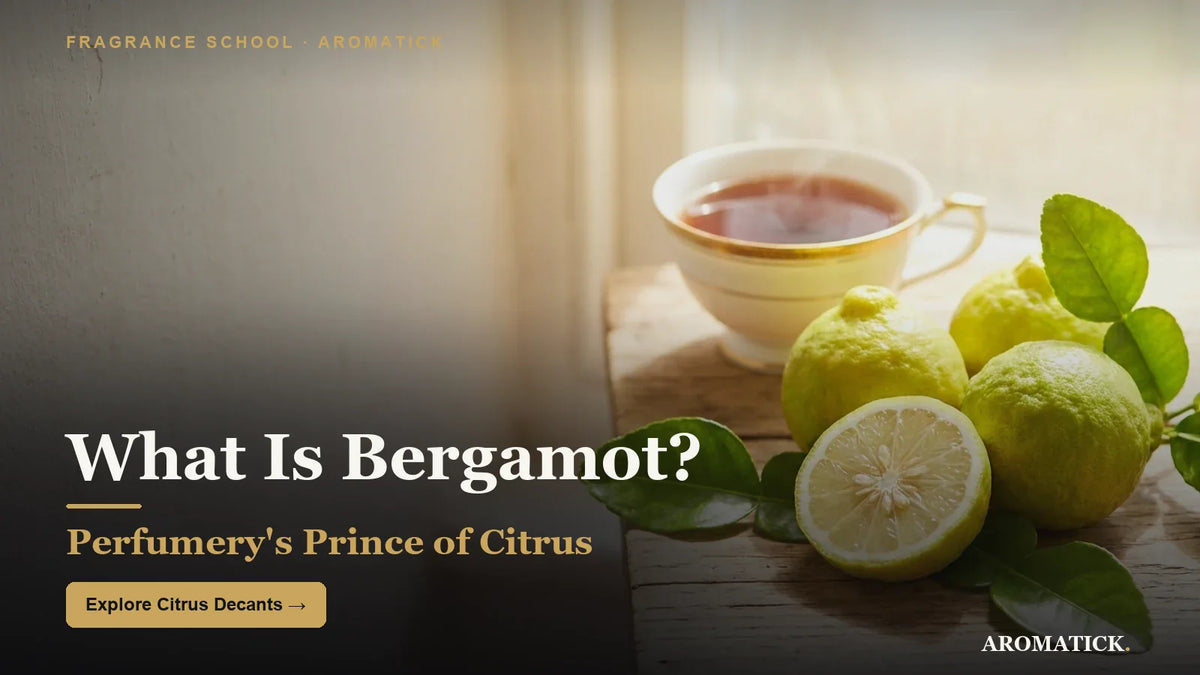
What Is Bergamot? Perfumery's Prince of Citrus Explained (2026)
If you've ever smelled the bright, fresh opening of almost any cologne, you've smelled bergamot. It's the single most common top note in perfumery — the elegant citrus that gives fragrances their clean, sparkling first impression. Here's what bergamot actually is, why perfumers can't live without it, and how to recognize it.

What is bergamot?
Bergamot is a small, round, fragrant citrus fruit — Citrus bergamia — roughly a cross between a lemon and a bitter orange. It's grown almost exclusively in the Calabria region of southern Italy, where the coastal climate is ideal. The fruit itself is too bitter to eat, but its peel is cold-pressed into an aromatic essential oil that's prized in both perfumery and tea. That oil is the star.
What does it smell like?
Bergamot smells bright, fresh and citrusy — but more refined and complex than a straight lemon or orange. Think a smoother, rounder citrus with a subtle bitter, floral and tea-like edge that reads clean, sparkling and quietly luxurious. It's fresh without being sour, elegant without being sweet — the 'posh citrus' that instantly makes a fragrance feel polished.
What it does in a fragrance
Bergamot is almost always a top note — the very first thing you smell — and it's a near-universal opener for a few reasons:
- Instant freshness — it gives a bright, clean, elegant hit that makes any opening feel polished.
- Blends with anything — florals, woods, ambers, spices; bergamot lifts them all, which is why it's everywhere.
- Leads the nose in — it sparkles at the top, then gracefully steps aside as the heart notes bloom.
It's the foundation of the classic eau de cologne, and a key player in fresh, fougère and chypre fragrances alike.
The Earl Grey connection
Here's the easiest way to know bergamot: it's the flavor of Earl Grey tea. Earl Grey is simply black tea scented with bergamot oil — that distinctive fragrant, citrusy, slightly floral character is bergamot doing its thing. So if you enjoy the smell of a fresh cup of Earl Grey, you already have a perfect reference for one of perfumery's most important notes.
Bergamot scents to try (as decants)
Bergamot leads the opening of countless fragrances — these fresh, citrus-forward decants show it off beautifully:

Creed Royal Water — crisp & citrusy
A bergamot-and-citrus aromatic with a cool minty edge — a masterclass in an elegant, bergamot-led fresh opening. Read our Royal Water review.
From $18.99 Shop the decant →
Creed Silver Mountain Water — fresh & green
Bergamot brightens the top of this serene green-tea fresh before the blackcurrant and tea take over. Read our SMW review.
From $19.99 Shop the decant →
Louis Vuitton L'Immensité — fresh-amber
Bergamot and grapefruit open this refined fresh-amber before its warm ambroxan base — bergamot lifting a luxury scent. Read our L'Immensité review.
From $29.99 Shop the decant →Find your fresh
Take the free 30-second scent quiz and we'll match you to fragrances (and decants) built on the notes you love — bright, elegant bergamot included. No purchase, no card.
FAQ
What is bergamot?
Bergamot is a small, fragrant citrus fruit (Citrus bergamia) grown almost entirely in the Calabria region of southern Italy. Its aromatic peel is cold-pressed into one of perfumery's most important oils — a bright, elegant, slightly bitter citrus that appears as a top note in an enormous share of fragrances. It's also the flavor that makes Earl Grey tea taste like Earl Grey.
What does bergamot smell like?
Bright, fresh and citrusy, but more elegant and complex than lemon or orange — a cross between them with a subtle bitter, floral and tea-like edge. It smells clean, sparkling and 'quietly luxurious' rather than sour or sugary. That refined, slightly bitter freshness is exactly why perfumers reach for it to open a fragrance.
What does bergamot do in a fragrance?
Bergamot is almost always used as a top note — it provides an instant hit of bright, fresh, elegant citrus that makes the opening feel clean and polished. It also blends beautifully with almost anything (florals, woods, ambers, spices), which is why it's a near-universal opener. It lifts and freshens a composition and leads the nose in before the heart develops.
Is bergamot in Earl Grey tea?
Yes — Earl Grey is simply black tea flavored with bergamot oil, which is where it gets its distinctive fragrant, citrusy character. So if you know the smell and taste of Earl Grey, you already know what bergamot smells like. That same oil is what perfumers use to brighten the top of countless fragrances.
What fragrances have bergamot?
Almost all of them, honestly — bergamot is one of the most common top notes in perfumery. You'll find it prominently in fresh Creeds like Royal Water and Silver Mountain Water, in refined ambers like Louis Vuitton L'Immensité, and in nearly every designer opening. Sampling a few fresh, citrus-led scents as decants is the best way to learn to spot it.
The bottom line
Bergamot is the bright, elegant Italian citrus — the flavor of Earl Grey tea — that opens a huge share of all fragrances as a fresh, polished top note. Refined, slightly bitter and endlessly blendable, it's the 'posh citrus' that makes a scent feel clean and expensive from the very first spray. The best way to learn it is to smell it — try a bergamot-led fresh like Royal Water or Silver Mountain Water as a decant and notice that sparkling opening.
Rodney Gallagher is the founder of Aromatick. Aromatick sells authenticated designer and niche fragrance decants — hand-poured from verified source bottles — so you can explore every note and material for a fraction of boutique pricing.

Leave a comment
This site is protected by hCaptcha and the hCaptcha Privacy Policy and Terms of Service apply.