

Fragrance Notes Explained: Unlocking Perfume's Secrets
Most people believe a perfume smells the same from the first spray to the final hour of wear. That’s a myth. The real artistry of perfumery lies in how fragrance notes define the evolving scent experience as a perfume unfolds on your skin. Understanding fragrance notes transforms how you choose, wear, and appreciate perfumes. These building blocks shape every scent you encounter, from the bright citrus burst when you first spray to the warm, lingering base that stays with you all day. This guide breaks down what fragrance notes are, how they work together, and why knowing them helps you find your perfect signature scent.
Table of Contents
- What are fragrance notes?
- The scent pyramid: Top, heart, and base notes
- How fragrance notes impact scent profiles
- Synthetic vs natural notes: Modern perfumery’s tools
- How knowing fragrance notes helps you choose a perfume
- Fragrance notes, longevity, and sillage: Beyond the first spray
- Find your signature scent with Aromatick
- Frequently asked questions
Key Takeaways
| Point | Details |
|---|---|
| Fragrance notes explained | Fragrance notes are layers of scent that develop and change as you wear perfume. |
| Scent pyramid structure | Each perfume is made of top, heart, and base notes that reveal themselves over time. |
| Choosing perfumes smarter | Knowing your preferred notes helps you select scents you’ll love and wear often. |
| Synthetic vs natural notes | Modern perfumery uses both natural and synthetic notes to create unique, lasting scents. |
| Notes affect longevity | Base notes are key to lasting power, while top notes deliver the initial impact. |
What are fragrance notes?
Fragrance notes are the individual scent impressions you perceive within a perfume. Think of a perfume as a musical composition. Just as a symphony combines violins, cellos, and flutes to create harmony, a perfume blends multiple notes to form a complete scent experience. Fragrance notes are descriptors used to categorize individual scent impressions in a perfume, helping you understand what you’re smelling at different stages of wear.
Here’s what makes notes different from accords in perfumery:
- Notes describe single scent impressions like bergamot, rose, or sandalwood
- Accords are deliberate blends of multiple notes creating a unified effect
- Notes often represent complex mixtures, not isolated chemicals
- Accords form the structural backbone of a fragrance composition
Many people assume a perfume labeled “rose” contains only rose extract. In reality, perfumers layer multiple ingredients to create what your nose recognizes as rose. A rose note might include geraniol, citronellol, and phenylethyl alcohol working together to replicate the flower’s natural complexity.
“Fragrance notes are the language perfumers use to communicate scent architecture, translating abstract aromas into recognizable categories that guide both creation and consumer understanding.”
The fragrance notes explained framework helps you decode perfume descriptions, predict how a scent will develop, and make smarter buying decisions. When you understand notes, you stop gambling on blind purchases and start choosing fragrances that truly match your preferences.
The scent pyramid: Top, heart, and base notes
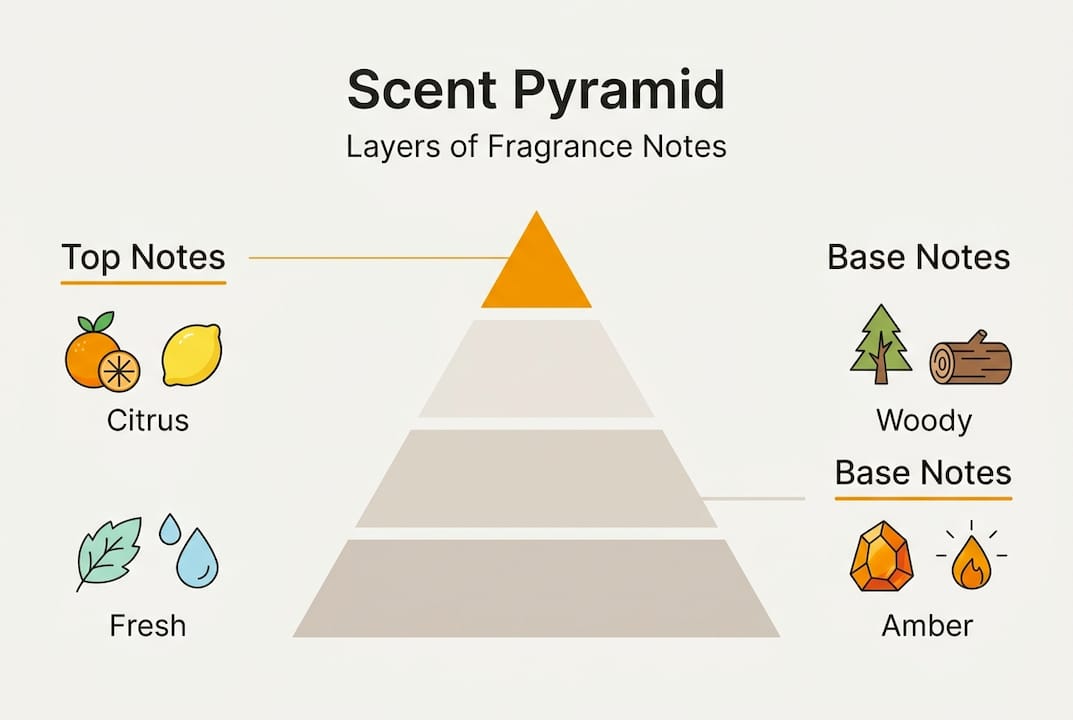
The scent pyramid organizes fragrance notes into three distinct layers that reveal themselves sequentially after application. The scent pyramid organizes fragrance notes into top, heart, and base layers, which unfold at different stages throughout the day. This structure of fragrance notes determines your entire wearing experience.
| Note Type | Duration | Typical Ingredients | Purpose |
|---|---|---|---|
| Top Notes | 5-15 minutes | Citrus, light fruits, herbs | Create first impression, attract attention |
| Heart Notes | 2-4 hours | Florals, spices, green notes | Define character, provide body |
| Base Notes | 4-8+ hours | Woods, musks, resins, vanilla | Anchor composition, ensure longevity |
Here’s how notes appear on your skin in sequence:
- Initial spray: Top notes dominate with bright, volatile molecules that evaporate quickly
- First 15 minutes: Top notes begin fading as heart notes emerge underneath
- 30 minutes to 4 hours: Heart notes take center stage, revealing the perfume’s true character
- 4 hours onward: Base notes anchor the scent, providing depth and perfume longevity
- Final hours: Only base notes remain, creating your lasting scent signature
The pyramid helps you understand what to expect when testing fragrances. That sparkling grapefruit you smell in the store will fade within minutes, replaced by the jasmine and patchouli that define the perfume’s actual identity. Many shoppers make the mistake of buying based solely on top notes, only to discover a completely different scent two hours later.
Pro Tip: When sampling a new perfume, wait at least 30 minutes before deciding. The heart and base notes reveal the scent you’ll actually wear, not the fleeting top notes that disappear almost immediately.
How fragrance notes impact scent profiles
Perfumers combine notes strategically to create distinct scent families and emotional signatures. The combination and interaction of notes defines the unique identity of each fragrance, separating fresh citrus colognes from warm oriental perfumes. The notes you choose determine whether a fragrance feels energizing, romantic, sophisticated, or comforting.
| Scent Family | Representative Notes | Mood/Character |
|---|---|---|
| Citrus | Bergamot, lemon, grapefruit, orange | Fresh, energizing, clean |
| Floral | Rose, jasmine, lily, violet | Romantic, feminine, elegant |
| Woody | Sandalwood, cedar, vetiver, patchouli | Warm, grounding, sophisticated |
| Oriental | Vanilla, amber, incense, spices | Sensual, rich, mysterious |
| Fresh | Marine notes, cucumber, green tea | Crisp, aquatic, modern |
Statistic: Floral fragrances account for approximately 35% of the global perfume market, making them the most popular scent family worldwide, followed by oriental compositions at 28%.
The balance between note families creates versatility. A perfume with citrus top notes, floral heart notes, and woody base notes can transition from office-appropriate freshness in the morning to sophisticated warmth by evening. This layered approach explains why certain fragrances work across seasons and occasions while others feel limited to specific contexts.

Perfumers also manipulate note ratios to evoke specific emotions. Heavy doses of vanilla and amber create comfort and sensuality. Sharp citrus and herbal notes project confidence and energy. Understanding these associations helps you choose niche fragrances that align with your personality and lifestyle.
Synthetic vs natural notes: Modern perfumery’s tools
Modern perfumery relies on both natural extracts and synthetic molecules to create the notes you smell in fragrances. Natural notes come from flowers, woods, resins, and other botanical sources through extraction processes like distillation or enfleurage. Synthetic notes are lab-created molecules that either replicate natural scents or introduce entirely new olfactory experiences.
Synthetics now allow perfumers to mimic natural ingredients that are difficult or impossible to extract, expanding creative possibilities beyond what nature alone provides.
Here’s how natural and synthetic notes compare:
Natural Notes:
- Extracted from real botanical sources
- Offer complexity and subtle variations
- Can be expensive and environmentally challenging
- Subject to crop variations and supply limitations
- Provide authenticity valued by traditionalists
Synthetic Notes:
- Created in laboratories through chemistry
- Ensure consistency across batches
- Often more affordable and sustainable
- Enable scents impossible to extract naturally
- Allow perfumers to avoid allergens or ethical concerns
Examples of groundbreaking synthetics include ionones, which create violet and iris effects more reliably than natural extracts, and calone, the molecule responsible for fresh oceanic notes that don’t exist in nature. Ambroxan replicates the warmth of rare ambergris without harming whales. These innovations demonstrate how synthetic notes are used to push perfumery forward.
Pro Tip: Don’t dismiss a perfume simply because it contains synthetics. Many modern masterpieces blend natural and synthetic notes to achieve effects impossible with either alone. Focus on how the final composition smells, not the ingredient source.
How knowing fragrance notes helps you choose a perfume
Understanding fragrance notes transforms shopping from guesswork into informed decision-making. Matching your fragrance choices to notes you enjoy increases daily satisfaction with your perfume and reduces expensive mistakes.
Follow these steps to decode fragrance descriptions and find your ideal scent:
- Identify your preferred note families: Review fragrances you already love and note recurring ingredients like vanilla, citrus, or woods
- Read the full pyramid: Don’t stop at top notes; heart and base notes determine your lasting impression
- Consider your lifestyle: Active days need lighter, fresher notes; evenings allow richer, heavier compositions
- Test on skin: Notes smell different on paper than on your body chemistry
- Wait for development: Give the perfume 30-60 minutes to reveal its true character before deciding
- Check for allergens: If you’re sensitive to certain ingredients, scan note lists for potential irritants
Heart and base notes dictate whether you’ll still enjoy a fragrance after the initial excitement fades. A perfume with appealing top notes but a cloying vanilla base will disappoint you hours into wear. Conversely, a subtle opening that develops into beautiful woods and musks rewards patience.
Note knowledge also helps you communicate preferences to sales associates or search online more effectively. Instead of vague requests for “something fresh,” you can specify “citrus top notes with woody base notes” and receive targeted recommendations. This precision saves time and leads you directly to choosing niche fragrances that match your taste.
Understanding notes also connects to practical concerns like longevity and projection. If you need a perfume that lasts through long workdays, prioritize compositions with substantial base notes. For subtle, close-to-skin scents, look for lighter note structures.
Fragrance notes, longevity, and sillage: Beyond the first spray
Fragrance notes directly determine how long a perfume lasts and how far its scent travels. Base notes, due to their heavier molecules, are key to longevity, while lighter top notes create the initial impression but fade quickly. Understanding this relationship helps you choose fragrances that perform according to your needs.
Factors affecting fragrance longevity and sillage in perfume:
- Molecular weight: Heavier base note molecules evaporate slowly, extending wear time
- Concentration: Higher perfume oil percentages amplify both longevity and projection
- Note composition: Woods, resins, and musks last longer than citrus or green notes
- Skin chemistry: Oily skin holds fragrance longer than dry skin
- Application method: Pulse points and moisturized skin enhance performance
- Environmental factors: Heat and humidity accelerate evaporation of lighter notes
Sillage, the scent trail you leave behind, depends heavily on note selection. Powerful base notes like oud, patchouli, and amber create strong sillage that announces your presence. Delicate florals and soft musks stay closer to your skin, creating intimate scents only noticeable up close.
Season and occasion should guide your note choices for optimal performance. Summer heat amplifies projection, making lighter citrus and aquatic notes more appropriate. Winter’s cold air mutes fragrances, calling for richer oriental and woody notes that cut through. Office environments benefit from moderate sillage with fresh or floral notes, while evening events allow bolder compositions with strong base notes.
The interplay between notes, longevity, and sillage explains why some fragrances feel appropriate for specific situations while others seem out of place. A perfume dominated by fleeting top notes works for quick refreshment but disappoints when you need all-day wear. Conversely, heavy base note compositions might overwhelm in close quarters but shine in open spaces.
Find your signature scent with Aromatick
Now that you understand how fragrance notes shape every aspect of a perfume, you’re ready to apply this knowledge to find your perfect scent. Whether you’re drawn to the bright citrus and musk pyramid of Dior Homme Cologne or prefer exploring the pure citrus freshness of modern compositions, understanding notes helps you choose with confidence.

At Aromatick, we offer authentic designer and niche fragrances at up to 60% off retail prices, giving you access to luxury scents without the department store markup. Our collection spans every note family and scent profile, from fresh aquatics to rich orientals, ensuring you’ll find fragrances that match your newly refined preferences. Explore our curated selection and use your knowledge of top, heart, and base notes to discover compositions that truly resonate with your style. Shop fragrances at Aromatick and transform your fragrance wardrobe with informed, satisfying choices.
Frequently asked questions
What are the main fragrance notes in perfume?
The main fragrance notes are top, heart (middle), and base notes, each revealing different aspects of a scent over time. Top, heart, and base notes compose the classic scent pyramid, unfolding sequentially to create the complete wearing experience.
Can synthetic notes smell better than natural ones?
Yes, modern synthetics can enhance or replicate natural aromas and often improve longevity or creativity in scent design. Synthetics allow for unique effects and replicate naturals that can’t be extracted, expanding perfumery beyond nature’s limitations.
Why does perfume smell different after a few hours?
Perfume evolves as lighter top notes fade, revealing heart and base notes designed for lasting impact. Notes unfold in sequence, changing a perfume’s scent throughout wear as volatile molecules evaporate at different rates.
How do I find which fragrance notes I like best?
Sample widely and note the recurring ingredients that you enjoy in your favorite perfumes. Understanding notes helps personalize and improve buying decisions, allowing you to identify patterns in your preferences and communicate them effectively when shopping.

Leave a comment
This site is protected by hCaptcha and the hCaptcha Privacy Policy and Terms of Service apply.