

Understand perfume longevity to choose lasting scents
Many fragrance lovers believe that expensive perfumes automatically last longer, but price alone doesn’t guarantee staying power. The truth is, perfume longevity depends on a complex mix of molecular chemistry, your unique skin type, and how you apply and store your scent. Understanding what makes a fragrance last can transform your buying decisions, helping you find perfumes that deliver hours of enjoyment without constant reapplication. This guide breaks down the science and practical strategies behind perfume longevity, equipping you to select fragrances that truly last and maximize the value of every bottle you buy.
Table of Contents
- Key takeaways
- What is perfume longevity and why does it matter?
- Key factors that influence perfume longevity
- Expert nuances: Understanding perfume composition and dry-down phases
- Practical tips for maximizing your perfume’s longevity and buying smarter
- Explore long-lasting designer and niche perfumes at Aromatick
- Frequently asked questions
Key Takeaways
| Point | Details |
|---|---|
| Skin type impact | Your skin type drives how long a fragrance lasts, with oily skin holding scent longer and dry skin letting it fade faster, and an unscented moisturizer can extend wear on dry skin. |
| Base notes longevity | Fragrances built around heavy base notes like musk amber sandalwood and vanilla tend to last longer than scents dominated by light top notes that evaporate quickly. |
| Molecular volatility | Molecular volatility and the slow evaporation during dry down explain why some scents linger for hours while others fade quickly. |
| Application technique | Applying fragrance to pulse points and avoiding rubbing wrists helps diffusion and preserves top notes for longer wear. |
| Layering and storage | Layering shorter lasting scents with longer wearing base fragrances and storing fragrances away from heat light and humidity can maximize duration and value. |
What is perfume longevity and why does it matter?
Perfume longevity is simply how long a fragrance remains detectable on your skin after application. Unlike projection, which measures how far your scent travels, or sillage, which describes the scent trail you leave behind, longevity refers to duration before the fragrance fades completely. This distinction matters because a perfume might project strongly for an hour but disappear entirely by lunchtime, leaving you disappointed and reaching for reapplication.
Understanding longevity transforms how you evaluate and purchase fragrances. For budget-conscious shoppers, a perfume that lasts eight hours delivers far more value than one requiring three applications throughout the day. Enthusiasts benefit by learning which compositions suit their lifestyle, whether they need all-day office wear or evening event impact. Longevity knowledge also helps with fragrance layering, as you can pair shorter-lasting top-heavy scents with longer-wearing base-rich perfumes for customized staying power.
Several factors explain why longevity varies dramatically between perfumes and individuals. Your skin’s natural oil content, the specific fragrance notes in a composition, application methods, environmental conditions, and storage practices all play crucial roles. A perfume that lasts twelve hours on one person might fade in four on another due to these variables. Recognizing this complexity prevents frustration and helps you make informed choices aligned with your body chemistry and daily routine.
For shoppers seeking perfume longevity secrets lasting luxury scents, understanding these fundamentals means avoiding bottles that disappoint. Key benefits of longevity knowledge include:
- Reducing waste by selecting fragrances that match your wear-time needs
- Saving money by avoiding frequent reapplication of short-lived perfumes
- Building confidence in your scent choices through predictable performance
- Enhancing satisfaction by knowing what to expect from each fragrance stage
Key factors that influence perfume longevity
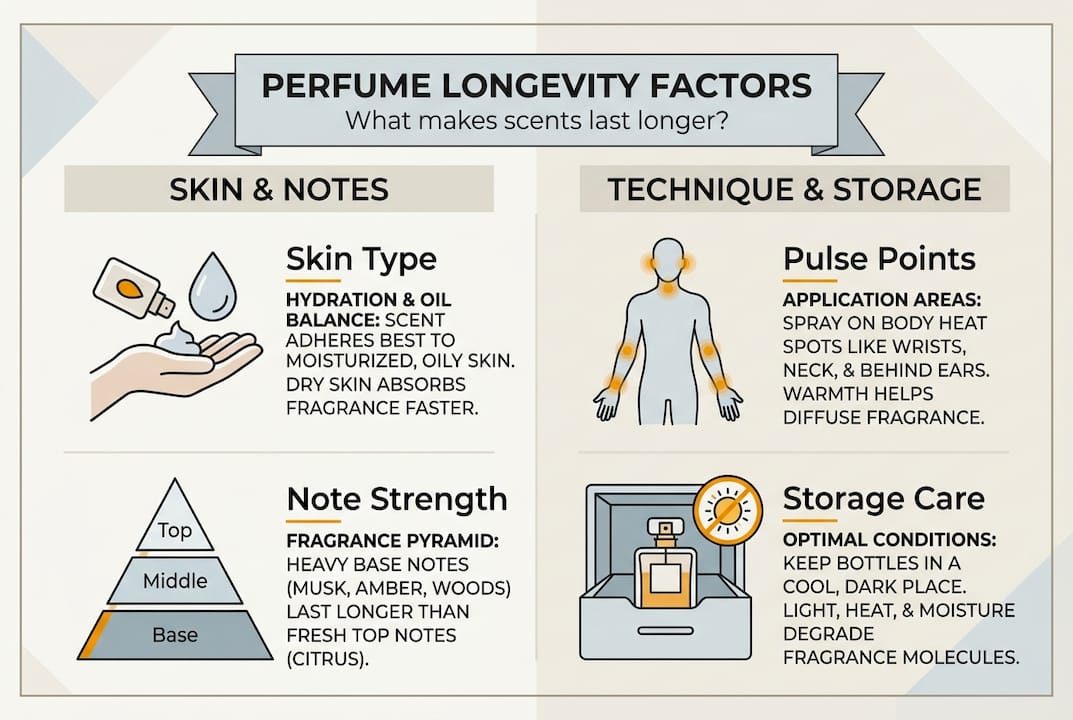
Your skin type creates the foundation for how long any perfume will last. Oily skin holds fragrance longer because natural oils trap and slow the evaporation of scent molecules, while dry skin allows molecules to escape quickly into the air. This explains why the same perfume can last ten hours on your friend but only five on you. If you have dry skin, applying an unscented moisturizer before your fragrance creates an oil barrier that mimics naturally oily skin, significantly extending wear time.
Fragrance composition determines longevity more than any other factor. Perfumes built around heavy base notes like musk, amber, sandalwood, and vanilla naturally persist for hours because these molecules evaporate slowly. In contrast, perfumes dominated by light top notes such as citrus, green herbs, and aldehydes fade within one to three hours as their volatile molecules quickly disperse. Understanding this note hierarchy helps you predict longevity before purchasing, especially when reading technical perspectives on perfume longevity.
| Note Type | Common Examples | Typical Longevity | Volatility |
|---|---|---|---|
| Top Notes | Citrus, bergamot, mint | 15 minutes to 2 hours | Very high |
| Heart Notes | Rose, jasmine, lavender | 2 to 4 hours | Moderate |
| Base Notes | Musk, vanilla, amber, woods | 5 to 12+ hours | Low |
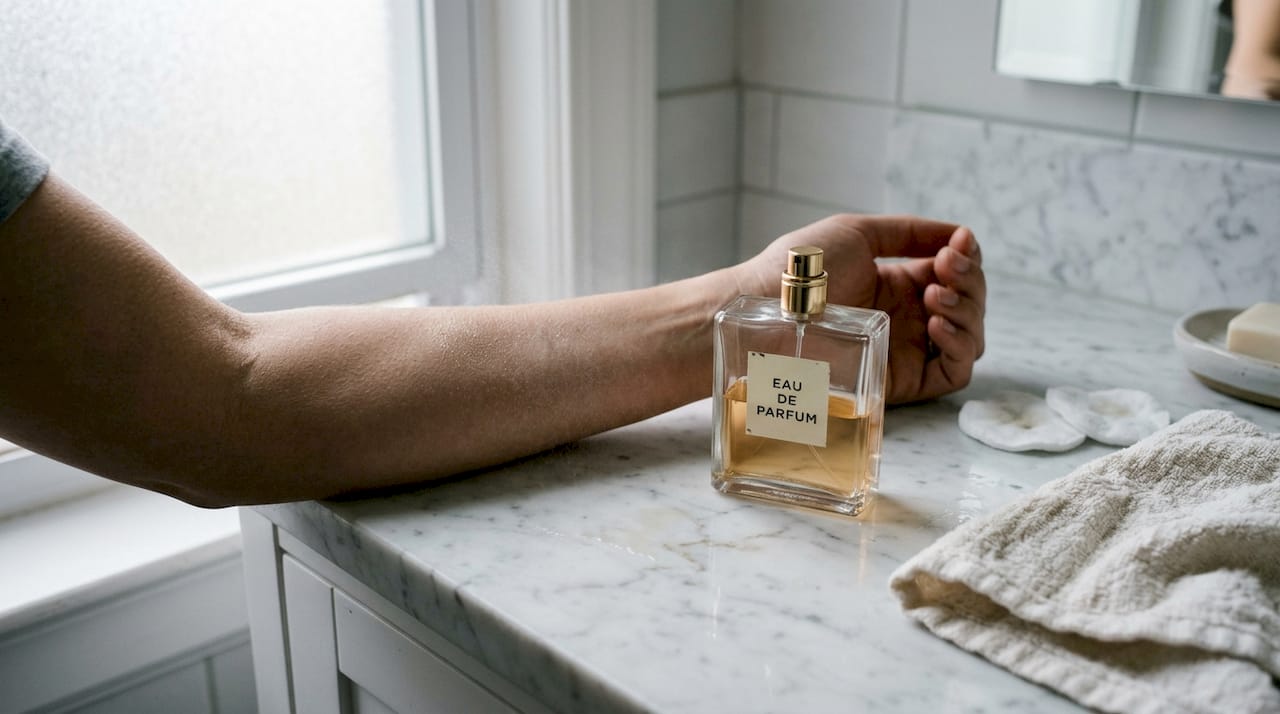
Application technique dramatically impacts how long your perfume lasts. Pulse points like wrists, neck, and behind ears generate warmth that helps diffuse fragrance, but rubbing wrists together crushes delicate top note molecules and shortens longevity. Instead, spray or dab perfume on moisturized pulse points and let it dry naturally. Layering fragrance on clothes extends duration since fabric holds scent longer than skin, though it may alter the fragrance profile slightly.
Environmental conditions accelerate or slow evaporation rates. Heat and humidity speed up molecular movement, causing perfumes to fade faster in summer or tropical climates. Cold, dry environments preserve scent molecules longer, which is why winter fragrances often seem to last all day. Air circulation from fans or outdoor breezes also disperses molecules quickly, reducing perceived longevity even if the scent remains on your skin.
Proper storage maintains a perfume’s longevity potential over months and years. Exposure to light, heat, and air degrades fragrance molecules, turning fresh scents stale and reducing their staying power. Store bottles in cool, dark places away from windows and bathrooms, where temperature fluctuations and humidity can damage compositions. Keeping caps tightly sealed prevents oxidation that weakens both projection and longevity.
Pro Tip: Apply unscented lotion or petroleum jelly to pulse points before spraying perfume to create an oil base that traps scent molecules and doubles wear time, especially on dry skin.
Expert nuances: Understanding perfume composition and dry-down phases
Molecular volatility is the scientific principle that governs every aspect of perfume longevity. Each fragrance molecule has a specific evaporation rate determined by its chemical structure and molecular weight. Light, small molecules like limonene in citrus oils evaporate within minutes, while heavy, complex molecules like synthetic musks can persist for days. Perfume longevity depends on molecular volatility, and perfumers carefully balance fast, medium, and slow-evaporating ingredients to create evolving scent experiences that unfold over hours.
Fixatives are ingredients that slow evaporation and anchor volatile molecules to your skin. Natural fixatives like benzoin, labdanum, and oakmoss have been used for centuries, while modern synthetics like Iso E Super and Ambroxan offer longer-lasting, more consistent performance. These materials don’t just extend longevity; they also smooth transitions between fragrance phases, preventing abrupt shifts from bright top notes to heavy bases. High-quality perfumes invest in sophisticated fixative blends that create seamless dry-down experiences.
The evaporation curve describes how a perfume evolves from application to final fade. Perfumers design these curves intentionally, orchestrating when each note family appears and disappears to tell a scent story. Understanding this progression helps you evaluate true longevity and appreciate how a fragrance transforms on your skin throughout the day. Learning to recognize authentic perfumes includes understanding their expected evaporation patterns.
The dry-down unfolds in three distinct phases:
-
Initial spray (0 to 15 minutes): Top notes dominate with bright, volatile molecules creating immediate impact. This phase showcases citrus, herbs, and light florals that grab attention but evaporate quickly. You experience maximum projection but minimal longevity.
-
Heart development (15 minutes to 4 hours): Middle notes emerge as top notes fade, revealing the perfume’s character. Florals, spices, and fruits create the main scent identity. This phase balances projection and longevity, offering the most recognizable version of the fragrance.
-
Base dry-down (4 to 12+ hours): Heavy base notes take over as lighter molecules disappear. Woods, musks, ambers, and vanillas provide lasting warmth close to skin. Projection decreases but longevity peaks, creating an intimate scent bubble that persists for hours.
“Perfumers meticulously craft evaporation curves to control how fragrances reveal themselves over time, balancing volatile top notes with persistent base notes to create compositions that evolve beautifully from first spray to final fade.”
Tracking your perfume’s dry-down reveals its true longevity and helps you assess whether it matches your needs. A fragrance that smells amazing initially but disappears after three hours might frustrate someone seeking all-day wear, while another that develops slowly into a gorgeous base might be perfect for evening events. Understanding these phases transforms how you test and evaluate perfumes, moving beyond first impressions to judge complete performance.
Pro Tip: When testing new perfumes, wear them for at least six hours and check the scent every two hours to map the complete dry-down. This reveals true longevity and helps you decide if the base notes justify the investment.
Practical tips for maximizing your perfume’s longevity and buying smarter
Extending your perfume’s longevity starts with proper skin preparation. Applying fragrance immediately after showering locks scent into hydrated, slightly damp skin for maximum retention. Layering with matching body lotions or unscented moisturizers creates an oil-rich base that holds molecules longer. Avoid applying perfume to completely dry skin, which absorbs and releases scent rapidly, shortening wear time significantly.
Application location matters more than most people realize. Pulse points generate warmth that diffuses fragrance, but strategic placement extends longevity. Spray behind knees, inside elbows, and at the nape of your neck in addition to traditional wrist and throat areas. These locations stay warmer and more protected from air exposure, preserving scent longer. Hair also holds fragrance exceptionally well, though direct application can dry strands; spray perfume into a brush and run it through your hair instead.
Common application mistakes sabotage longevity. Rubbing wrists together after spraying crushes delicate top note molecules and generates heat that speeds evaporation. Spraying into the air and walking through the mist wastes product and deposits fragrance on clothes rather than skin, where body heat activates scent. Over-applying doesn’t extend longevity; it just creates overwhelming initial projection that fades to the same base notes as a moderate application.
Buying fragrances with lasting power requires knowing what to look for. Perfumes labeled Eau de Parfum or Parfum contain higher concentrations of fragrance oils (15 to 40 percent) than Eau de Toilette or Cologne (5 to 15 percent), translating directly to longer wear. Reading note pyramids helps predict longevity: compositions heavy in base notes like oud, patchouli, and tonka bean naturally last longer than those dominated by citrus or aquatic notes. Verified customer reviews often mention longevity specifically, providing real-world data beyond marketing claims.
Storage practices preserve your perfume’s longevity potential over time. Keep bottles in their original boxes to block light exposure, and store them in cool, stable environments like bedroom drawers or closets. Avoid bathrooms, where temperature swings and humidity degrade fragrance molecules. Never store perfumes in cars or near windows, where heat and UV light rapidly break down compositions. Properly stored perfumes maintain their longevity characteristics for years, while poorly stored bottles lose staying power within months.
Testing perfumes properly reveals their true lasting potential. Sample fragrances for full days rather than making snap decisions at store counters. Apply test scents in the morning and evaluate them every few hours, noting when projection fades and how long base notes persist. This extended testing shows whether a perfume’s longevity matches your lifestyle needs, preventing buyer’s remorse from fragrances that smell amazing initially but disappear too quickly.
Practical longevity-enhancing behaviors include:
- Moisturizing thoroughly before fragrance application to create scent-holding oils
- Layering matching body products to build fragrance depth and duration
- Avoiding rubbing or touching application sites to preserve molecule integrity
- Reapplying strategically to pulse points rather than over-spraying initially
- Choosing perfumes with known long-lasting base notes for all-day wear
- Reading detailed reviews that specifically mention longevity performance
- Testing samples over multiple days to assess true staying power
For comprehensive guidance on extending wear time, explore resources on how to make cologne last longer and buying niche perfume online that covers longevity evaluation during the selection process.
Pro Tip: Test new perfumes over at least six hours, not just the initial spray. True longevity reveals itself in the base notes that emerge after three to four hours, and this dry-down phase determines whether a fragrance delivers lasting value.
Explore long-lasting designer and niche perfumes at Aromatick
Now that you understand the science and strategy behind perfume longevity, you’re ready to find fragrances that deliver lasting performance. Aromatick specializes in authentic designer and niche perfumes known for exceptional staying power, offering up to 60 percent off retail prices without compromising quality. Whether you’re seeking rich base-note compositions or expertly balanced evaporation curves, the curated selection helps you find perfumes that match your longevity needs.

The platform provides detailed fragrance information and expert guides to support confident purchases. Explore perfume longevity secrets lasting luxury scents for deeper insights into long-wearing compositions, or discover how to choose and wear long-lasting perfumes for application techniques that maximize every bottle’s potential. With free shipping, satisfaction guarantees, and transparent authenticity standards, Aromatick makes finding your perfect long-lasting fragrance both affordable and reliable.
Frequently asked questions
How long does perfume longevity typically last?
Perfume longevity varies widely based on composition and individual factors, but most fragrances last between four and eight hours on skin. High-quality Eau de Parfum concentrations with rich base notes can persist for twelve hours or longer, while lighter Eau de Toilette formulations typically fade within three to five hours. Environmental conditions, skin type, and application methods significantly impact these durations, so the same perfume may perform differently on different people.
Does skin type really change how long perfume lasts?
Yes, skin type dramatically affects perfume longevity because oily skin retains fragrance molecules longer than dry skin. Natural skin oils create a barrier that slows evaporation, extending wear time by several hours compared to dry skin that allows molecules to escape quickly. Moisturizing dry skin before applying perfume mimics the oil-rich environment of naturally oily skin, significantly improving fragrance retention and longevity.
What are the best perfume notes for long-lasting scent?
Base notes deliver the longest-lasting scent because their heavy molecules evaporate slowly over many hours. Musk, amber, sandalwood, cedarwood, patchouli, vanilla, and oud typically persist for eight to twelve hours or more. In contrast, top notes like citrus, bergamot, and green herbs fade within one to two hours due to their high volatility. Perfumes built around substantial base note compositions naturally offer superior longevity.
Can storage conditions affect perfume longevity?
Absolutely, improper storage degrades fragrance molecules and reduces longevity over time. Exposure to heat, direct sunlight, and air oxidizes delicate compounds, weakening both projection and staying power while altering the scent profile. Store perfumes in cool, dark locations away from temperature fluctuations and humidity to preserve their molecular integrity and maintain original longevity characteristics for years.

Leave a comment
This site is protected by hCaptcha and the hCaptcha Privacy Policy and Terms of Service apply.