
What Are Fragrance Decants — And Why Serious Collectors Buy Them
By Rodney Gallagher | Founder, Aromatick.com | April 16, 2026
Rodney Gallagher has been collecting fragrances for 12 years and owns 200+ bottles. He founded Aromatick.com, a independent market fragrance retailer based in Port St. Lucie, Florida, where he personally authenticates every bottle sold using batch code verification.
The first time someone offered to sell me a 5ml decant of a fragrance I had never heard of, I did not know what a decant was. I thought it was something people did with wine. That was about 10 years into my collecting and I still had a blind spot in the vocabulary. If you are in the same position — you keep seeing the word, you roughly understand it means a small amount of fragrance, but you are not clear on how it works or why people use them — this article is the one I wish I had found sooner.
Decants are one of the most practical tools in the fragrance collector's toolkit. They are also the source of some of the most common mistakes new buyers make when they first start spending real money on fragrance. Understanding what they are, how they work, and where the risk points are will save you money and help you build a better collection faster.
Table of Contents
- What Is a Fragrance Decant?
- How Decants Work in Practice
- Why Serious Collectors Buy Decants
- How Many Wears Does a Decant Give You?
- Understanding Decant Sizes
- Where to Buy Decants Safely
- Decants vs Samples: What Is the Difference?
- Decants vs Full Bottles: When Each Makes Sense
- Shop Authenticated Decants at Aromatick
- FAQ
What Is a Fragrance Decant?
A fragrance decant is a small quantity of fragrance transferred from a full retail bottle into a smaller container — typically a glass vial or spray bottle — for the purpose of testing or collecting without purchasing the full bottle.
The word decant comes from the practice of pouring liquid carefully from one vessel to another, leaving sediment behind. In wine that means transferring from bottle to carafe. In fragrance it means transferring from a 100ml retail bottle into a 2ml, 5ml, or 10ml vial. The fragrance is identical to what is in the full bottle. The only difference is the quantity and the container.
Decants exist because fragrance retail has a fundamental problem: the cost of entry for niche and luxury fragrances is high, the number of options is enormous, and the only way to know how a fragrance smells on your skin is to actually wear it. A paper strip at a counter tells you almost nothing about how something develops over 6 hours on your body. A 5ml decant tells you everything.

How Decants Work in Practice
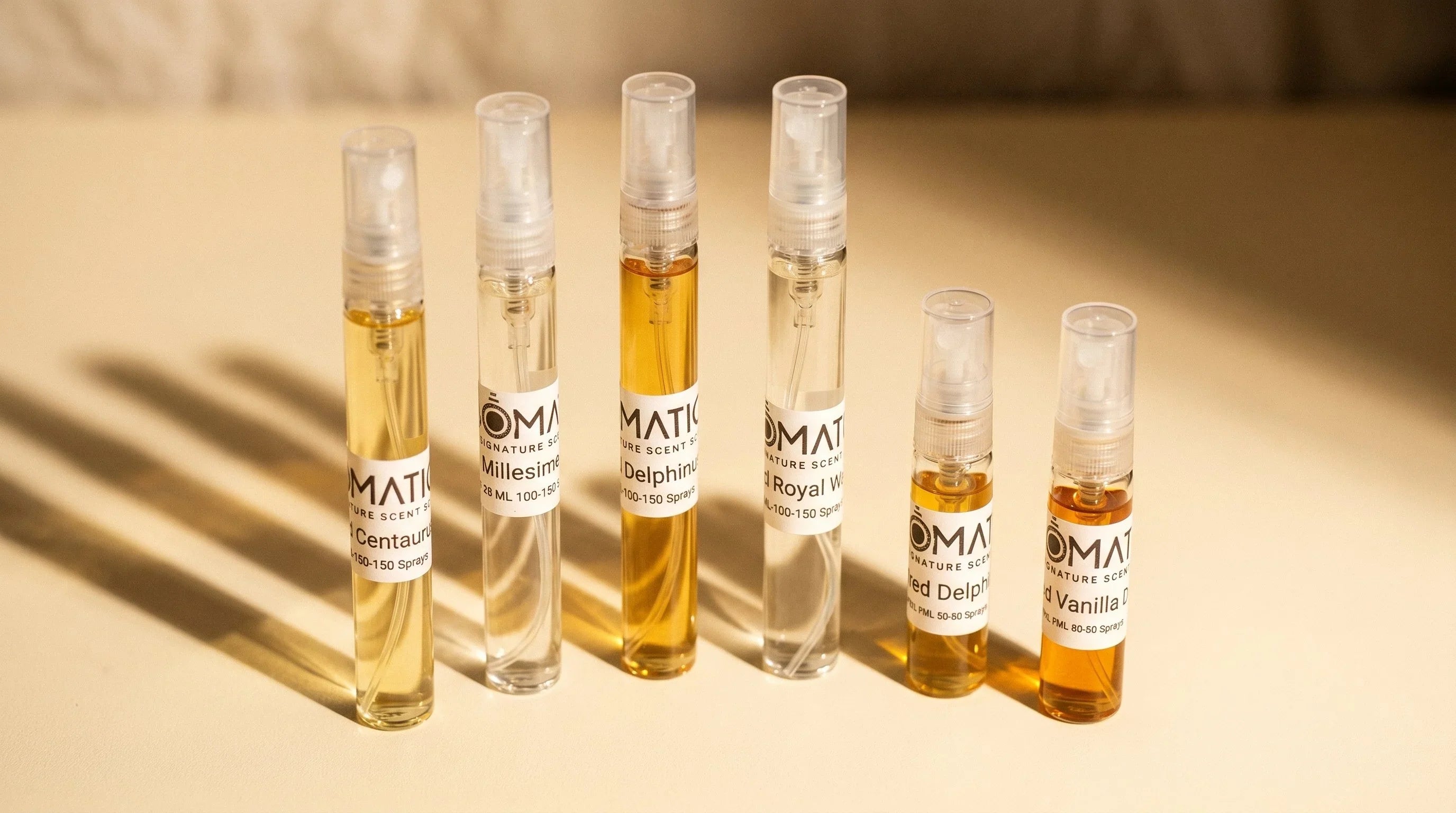
The mechanics are straightforward. A retailer or collector who owns a full bottle removes the cap and uses a thin decanting needle or spray nozzle adapter to draw fragrance from the bottle without permanently removing the spray head. The extracted liquid goes into a small glass vial — either a splash vial with a stopper or a miniature spray bottle — which is then sealed, labeled, and sold or traded.
Done correctly, the process is clean and the fragrance is unaltered. The transfer happens in an enclosed environment, the vial is filled quickly to minimize air exposure, and the fragrance chemistry is not affected. A well-decanted 5ml is identical to the same 5ml taken directly from the retail bottle.
Done carelessly — or fraudulently — the decant contains something other than what is labeled. This is where the risk in the decant market lives, and it is worth understanding before you buy from anyone.
The fragrance community has developed standards around decanting over the years. Reputable decant sellers source from verified retail or independent market bottles, use proper decanting equipment, label accurately with house and fragrance name, and often include batch code information so the buyer can verify the production date. Fragrantica and Basenotes both have active communities where decant sellers develop reputations over years of transactions. That reputation infrastructure matters.

Why Serious Collectors Buy Decants
After 12 years collecting and 200+ bottles, I can tell you that the experienced collectors I know are the heaviest decant buyers in the community. That is not a coincidence.
When you are new to fragrance you tend to buy full bottles based on short counter tests or YouTube reviews and hope for the best. Some of those purchases work out. A lot of them sit on a shelf after three wears because they smelled different on your skin than they did on a strip, or they smelled great in the store and tired quickly at home, or you liked them but did not love them enough to reach for them regularly. That is an expensive way to explore the category.
Experienced collectors have learned — usually through a few expensive mistakes — to test before committing. A decant is how you test. It is not a compromise or a lesser option. It is the correct way to evaluate whether a fragrance belongs in your permanent collection before spending $150, $250, or $400 on a full bottle.
The specific reasons collectors reach for decants
Skin chemistry testing. Fragrance smells different on different people. The same molecule interacts with different skin pH, skin oils, and body chemistry to produce genuinely different results. A fragrance that smells like warm sandalwood on one person can smell sour or flat on another. This is not a flaw in the fragrance — it is how fragrance works. The only way to know how something performs on your skin is to wear it for a full day, not smell it for 30 seconds at a counter.
Testing longevity in real conditions. Counter tests are useless for evaluating longevity. You spray, you smell, you walk away. That tells you nothing about whether the fragrance holds 6 hours or 2 hours, whether it survives humidity, whether it fades to a skin scent or disappears completely. A 5ml decant gives you enough wears to evaluate performance across different conditions — hot days, cold mornings, long work days, evenings out.
Exploring expensive fragrances without full bottle commitment. A 5ml decant of a $400 Creed fragrance costs a fraction of the full bottle. If you love it, you have confirmation the full bottle is worth buying. If you do not, you spent $20-30 instead of $400 to find that out. The math is straightforward and the collector community figured this out a long time ago.
Building a testing rotation. Some collectors buy decants with no intention of purchasing the full bottle — they use them to build familiarity with fragrances, houses, and note profiles across a wide range before deciding where their full bottle money goes. That kind of broad testing education is impossible to do at full bottle prices.
Traveling with fragrance. A 5ml or 10ml spray decant travels easily, passes TSA liquid limits without issue, and covers a week-long trip without carrying a 100ml bottle. Decants built specifically for travel use are a practical tool completely separate from their testing function.
How Many Wears Does a Decant Give You?
This depends on the size of the decant and how many sprays you apply per wear. Here is the honest math based on how I spray:
A standard spray from a fragrance bottle delivers approximately 0.1ml per spray. Most collectors apply 3-5 sprays per wear depending on the fragrance and occasion.
At 4 sprays per wear:
- 2ml decant — approximately 5 wears
- 5ml decant — approximately 12-13 wears
- 10ml decant — approximately 25 wears
A 5ml decant is the practical minimum for serious evaluation. Five wears from a 2ml gives you enough to form an initial impression but not enough to test across different conditions, temperatures, and occasions. Twelve to thirteen wears from a 5ml gives you a full season of evaluation if you are testing a warm-weather fragrance through spring, or enough evening wears to know whether a winter fragrance earns a permanent place.
For fragrance categories where skin chemistry variation is significant — heavy orientals, oud-based fragrances, anything with prominent vanilla or animalic notes — I recommend a 10ml before committing to a full bottle. Those categories are the ones that behave most unpredictably across different skin types.

Understanding Decant Sizes
Decants come in a range of sizes and two container formats. Knowing the difference before you buy saves confusion.
Splash vials
A small glass tube with a stopper. You remove the stopper and dab the fragrance onto your skin rather than spraying. Common for very small quantities — 1ml and 2ml. The limitation is that dab application does not replicate spray application accurately. The fragrance disperses differently and the opening phase can read slightly different. For initial impression testing a splash vial is fine. For serious longevity and projection testing, a spray decant is more accurate.
Spray decants
A miniature spray bottle — typically an atomizer — filled with the decanted fragrance. Replicates the retail application method exactly. The fragrance sprays as it would from the full bottle and performs identically. This is the format I use at Aromatick for all decants for exactly that reason. A spray decant at 5ml gives you the most accurate evaluation of how the fragrance actually performs.
Standard sizes and what they are best for
- 1-2ml: First impression only. Useful for eliminating fragrances quickly but not sufficient for serious evaluation.
- 5ml: The standard testing quantity. Enough for 10-15 wears across varied conditions. The right size for most purchase decisions under $300.
- 10ml: Serious evaluation or short-term regular use. Right for expensive full bottles ($300+), complex fragrances that take multiple wears to understand, and travel use.
- 30ml: Functionally a miniature bottle rather than a testing decant. Some retailers offer this size for fragrances that are hard to find in full-bottle quantities or where the full bottle is prohibitively expensive.
Where to Buy Decants Safely
This is the section that matters most for new buyers. The decant market is largely unregulated and the gap between a trustworthy source and a fraudulent one is not always obvious from the outside.
What a legitimate decant source looks like
They can identify the source bottle. A reputable decant seller knows exactly which bottle a decant came from. They can tell you the batch code, the production date, and where the bottle was sourced. If a seller cannot answer basic provenance questions about their decants, that is a problem.
They have a verifiable reputation. The fragrance community is small and reputation-driven. Established decant sellers have years of transaction history on Fragrantica forums, Basenotes, Reddit's r/fragrance, or their own retail platforms. New sellers with no history and too-good-to-be-true pricing are the ones to approach carefully.
They use proper equipment and labeling. Decants from serious sellers come in quality glass vials with accurate labels — house name, fragrance name, size, and ideally batch information. Unlabeled vials, misspelled labels, or fragrance names that do not match any known release are immediate red flags.
They stand behind their product. Legitimate decant retailers offer some form of recourse if a decant turns out to be mislabeled or incorrect. That might be a replacement, a refund, or at minimum an honest conversation about what went wrong. Sellers who disappear after a transaction or deflect quality concerns are not operating in good faith.
Where the risk actually lives
The real fraud risk in the decant market is not watered-down fragrance — it is mislabeled fragrance. Someone selling a cheap alternative or an unknown fragrance in a vial labeled as Creed Aventus or Maison Margiela Replica is a more common problem than diluted genuine product. The only protection against this is buying from sources with verifiable history and authentic sourcing, or buying from a retailer who batch-verifies the originating bottles.
At Aromatick, every decant comes from a bottle I have personally verified using batch code authentication before anything is decanted. The process I use for full-bottle authentication applies to every source bottle in my decant inventory. You can read more about how batch code verification works in the fragrance authentication guide on this blog.

Decants vs Samples: What Is the Difference?
These terms get used interchangeably in the fragrance community and they should not. They are different things.
Samples are produced by the fragrance house or retailer directly. They come in official branded packaging, are produced under controlled conditions, and are distributed through authorized channels — either with purchases, through sampling programs, or as standalone products from authorized retailers. Creed samples, for example, come in official branded vials from Creed directly or from authorized department store counters.
Decants are produced by third parties — collectors, retailers, or community members — from full bottles they own. They are not authorized by the fragrance house and do not come in official branded packaging. The quality and authenticity depend entirely on the source.
Official samples from authorized sources are the safest way to test a fragrance. The limitation is availability — official samples for niche and limited-release fragrances are often unavailable or require purchasing through an authorized retailer at full price. That gap is exactly what the decant market exists to fill.
In practice, a well-sourced decant from a reputable seller gives you an identical experience to an official sample. The fragrance is the same juice from the same production run. The difference is only in how it got into the vial and who put it there.
Decants vs Full Bottles: When Each Makes Sense
This is a question I get asked regularly and the answer is not always "buy the decant first." There are situations where going straight to a full bottle is the right call.
Buy a decant first when:
- You have never worn the fragrance on your skin before, regardless of how many reviews you have read or videos you have watched
- The full bottle costs more than $150 — at that price point the decant cost is trivially small relative to the risk of a wrong full bottle purchase
- You are exploring a new fragrance category or note profile you do not have much experience with
- The fragrance has significant skin chemistry variation reported in the collector community — heavy orientals, oud, heavy vanilla bases, and animalic fragrances all fall into this category
- You are building a rotation and want to compare multiple fragrances before deciding which earns a full bottle spot
Go straight to the full bottle when:
- You have worn the fragrance multiple times in real conditions and know it works on your skin
- The fragrance is a house you know well and the note profile is predictable based on your history with the house
- The independent market price brings the full bottle into a range where the decant cost is not worth the delay — at 30-60% below retail, the entry cost changes the calculation
- The fragrance is genuinely hard to find and stock is limited — some niche fragrances have intermittent availability and waiting to test a decant means potentially missing a purchase window
My personal rule after 12 years: I do not buy any full bottle over $200 without at least a 5ml decant first. That rule has saved me from at least a dozen purchases I would have regretted. The most recent example is a heavily reviewed niche fragrance I was certain I would love based on the note profile — smelled completely wrong on my skin, returned the decant memory to the shelf and moved on. That was a $300 mistake avoided for the cost of $25.

Shop Authenticated Decants at Aromatick
Every decant at Aromatick starts with a batch-verified source bottle. I do not decant from unverified stock. Before anything gets transferred into a vial, I check the batch code against the production database to confirm the originating bottle is authentic and to note the production date. That information is available if you ask.
The current decant catalog covers niche and designer houses across fresh, woody, oriental, and aquatic categories. If you are building a testing rotation or working toward a specific full bottle purchase, the most useful starting point is picking three to five fragrances in the category you are exploring and wearing them across a full season before deciding where your money goes.
A few starting points depending on where you are in your collection:
- If you are exploring Creed for the first time: Creed Himalaya, Creed Millésime Impérial, and Creed Royal Water give you the full range of what the house does in warm weather
- If you want to add a warm-weather fragrance: the niche fragrance collection has a range of fresh and aquatic options at different price points worth testing before committing
- If you are building a full four-season rotation: add Creed Original Santal to the above Creed trio and you have tested the full house range across all seasons
Browse All Decants at Aromatick

FAQ
Are fragrance decants legal to buy and sell?
In the United States, reselling fragrance that has been legitimately purchased is legal under the first sale doctrine. A retailer who buys an authentic bottle of fragrance and sells portions of it is operating in a legal gray area that has generally been upheld for personal and small-scale commercial resale. The fragrance houses themselves have no legal mechanism to prevent the secondary market in decants from legitimate bottles. Counterfeiting — selling fake fragrance labeled as genuine — is a separate and clearly illegal matter.
Does fragrance degrade in a decant vial?
Fragrance degrades through exposure to heat, light, and air. A properly filled and sealed glass decant vial stored away from direct light and heat will hold the fragrance in good condition for 1-3 years without meaningful degradation. The risk increases with splash vials that are opened frequently — each opening introduces oxygen. Spray vials maintain a better seal and degrade more slowly. Store decants upright, in a dark drawer or box, away from heat sources.
How do I know if a decant is authentic?
You buy from a source that can tell you exactly where the decant came from. Ask the seller for the batch code of the originating bottle. Ask where the bottle was sourced. Look at the seller's transaction history and reputation in the fragrance community. A seller who can answer provenance questions confidently and has a verifiable track record is operating transparently. A seller who deflects these questions is not.
What is the difference between a decant and a alternative?
A decant is genuine fragrance from an authentic bottle, transferred into a smaller container. A alternative is a different fragrance produced by a different manufacturer to approximate the smell of a popular fragrance. Alternatives are sold as alternatives by legitimate sellers and as the genuine article by fraudulent ones. If someone is selling what they describe as "Creed Aventus" at $5 for 5ml, it is almost certainly a alternative or a counterfeit, not a genuine decant.
Can I request a specific batch code when ordering a decant?
At Aromatick you can ask about the production date of the source bottle for any decant. I keep batch information on all stock and can tell you what you are getting before you order. For fragrances with known batch variation — Creed fragrances in particular — this information is worth asking about if production date matters to your purchase decision.
About the Author
Rodney Gallagher is the founder of Aromatick.com, a independent market fragrance retailer based in Port St. Lucie, Florida. He has been collecting fragrances for 12 years and has a personal collection of 200+ bottles. He personally authenticates every fragrance sold on the site using batch code verification. His focus is on making niche and designer fragrances accessible without the retail markup.

Leave a comment
This site is protected by hCaptcha and the hCaptcha Privacy Policy and Terms of Service apply.