
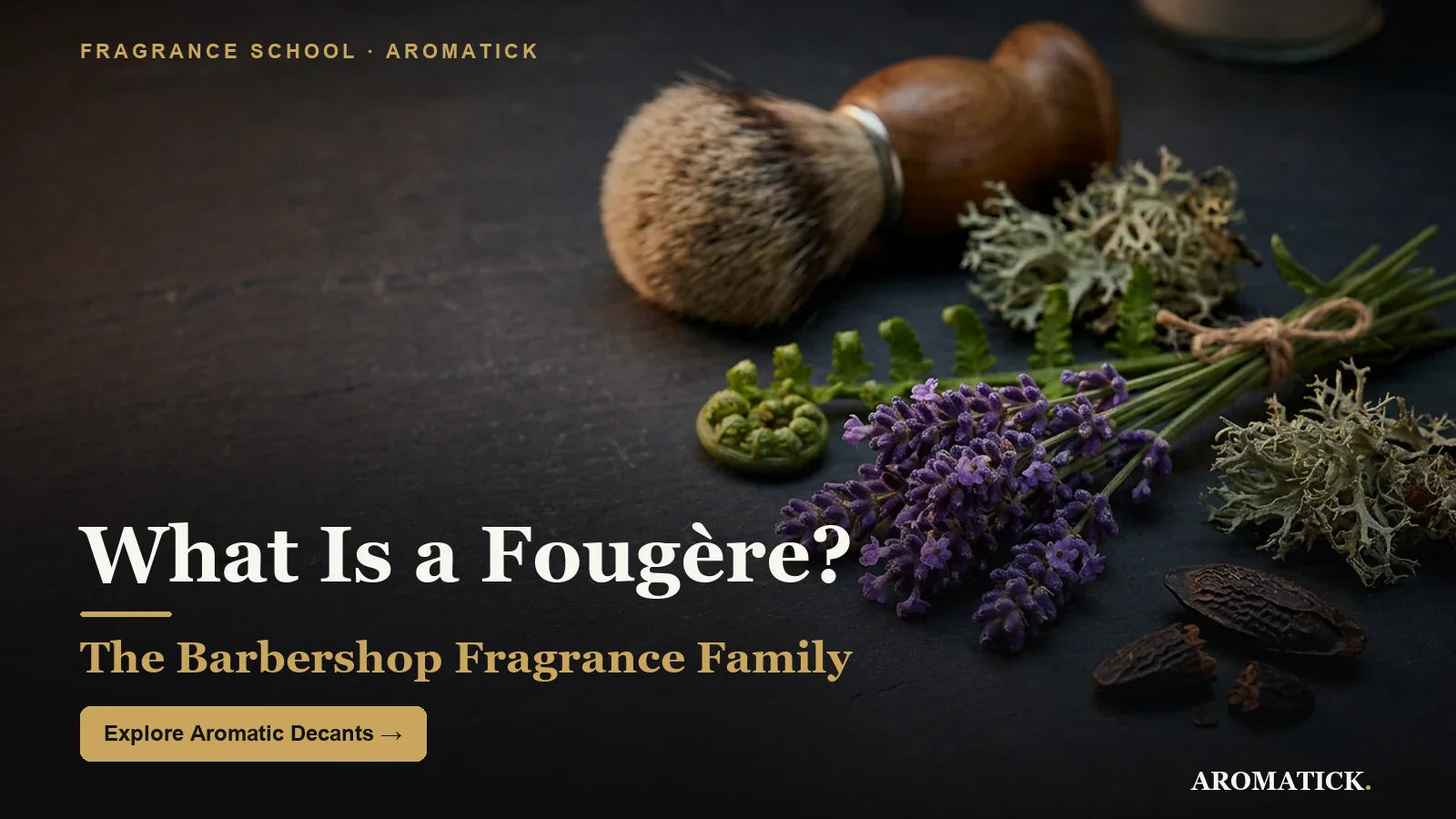
What Is a Fougère? The Barbershop Fragrance Family Explained (2026)
If you've ever smelled a classic cologne and thought "that smells like a barbershop" or "that smells like a proper, grown-up men's fragrance," you were almost certainly smelling a fougère. It's one of the four or five great fragrance families, and it quietly underpins a huge share of the colognes ever made. Here's what a fougère actually is, why it's named after a plant that has no scent, and how to recognize one.

What is a fougère?
A fougère (pronounced foo-ZHAIR) is a fragrance family — a way of classifying scents by their core structure. The word is French for "fern," and the family was born in 1882 with Houbigant's Fougère Royale, created by perfumer Paul Parquet. It was one of the first fragrances to use a synthetic material (coumarin) and it established an accord so successful that it became the default template for masculine perfumery for the next century.
What does it smell like?
A fougère smells clean, aromatic and herbaceous — the classic "barbershop" or "fresh shave" scent. Bright, camphorous lavender leads, a sweet, warm, hay-like quality (coumarin) fills the middle, and a mossy, woody, slightly bitter base grounds everything. The result is fresh and groomed rather than sweet or fruity — refined, confident and timeless.
The classic accord
At its heart, a traditional fougère is three materials in balance:
| Ingredient | Role |
|---|---|
| Lavender | The aromatic top — fresh, herbal, slightly camphorous. The unmistakable fougère signature. |
| Coumarin (tonka) | The sweet middle — warm, hay-like, almond-y. Softens and rounds the sharp lavender. |
| Oakmoss | The base — mossy, woody, earthy and slightly bitter. Gives depth and that "green" backbone. |
Perfumers usually add geranium, bergamot, and woods around this core, but lavender-coumarin-oakmoss is the DNA that makes a fragrance a fougère.
Classic vs modern fougères
Because real oakmoss is now restricted for allergen reasons, most modern fougères rebuild that mossy base with newer materials like ambroxan and synthetic mosses — creating the "aromatic fougère" that dominates today's designer shelf. The family now spans several sub-styles:
- Classic / barbershop fougère — the traditional lavender-moss-coumarin (think old-school colognes).
- Aromatic fougère — modernized with ambroxan and clean woods (e.g. Prada Luna Rossa).
- Oriental / ambery fougère — sweeter and warmer, with vanilla and spice (e.g. JPG Le Male).
- Fresh / aquatic fougère — brightened with citrus and watery notes for a modern-fresh spin.
Fougères to try (as decants)
The best way to understand the family is to smell its range — from sweet-ambery to crisp-aromatic. These decants are all fougères at heart:

JPG Le Male Elixir — ambery fougère
The sweet, cozy end of the family: lavender and mint over a rich honey-vanilla-tonka base. A textbook oriental fougère. Read our Le Male Elixir review.
From $12.99 Shop the decant →
Prada Luna Rossa Ocean — aromatic fougère
The modern end: aromatic lavender and clary sage over ambroxan and clean woods. A crisp, versatile aromatic fougère. Read our Ocean review.
From $12.99 Shop the decant →
YSL Y EDP — fresh fougère
The fresh-modern end: bright apple, ginger and sage over amberwood and a clean base. A contemporary fresh-fougère. Read our Y EDP review.
From $11.99 Shop the decant →Find your fougère
Take the free 30-second scent quiz and we'll match you to fragrances (and decants) built on the notes and families you love — aromatic fougères included. No purchase, no card.
FAQ
What is a fougère fragrance?
A fougère (pronounced foo-ZHAIR, French for 'fern') is one of the main fragrance families, built on a classic accord of lavender, oakmoss and coumarin (the sweet, hay-like note from tonka bean). It's the backbone of traditional 'masculine' perfumery and the reason so many colognes share that clean, aromatic, barbershop character. The genre dates to 1882 and Houbigant's Fougère Royale.
What does a fougère smell like?
Clean, aromatic and herbaceous — think of the smell of a classic barbershop or a fresh shave. Aromatic lavender sits on top, a sweet, hay-like warmth (coumarin) fills the middle, and a mossy, woody, slightly bitter base (oakmoss) grounds it. The overall effect is fresh, grown-up and 'groomed' rather than sweet or fruity.
Why is it called fougère if ferns don't smell?
Great question — ferns are essentially odorless, so a fougère doesn't literally smell like fern. The name is abstract and imaginative: when Houbigant created Fougère Royale in 1882, it was an invented, green, mossy-fresh idea of what a fern might smell like. The name stuck and came to define the whole family, even though it's a fantasy accord rather than a literal one.
Are fougères masculine?
Traditionally yes — the fougère family has been the default structure for 'masculine' fragrances for over a century, from classic barbershop colognes to modern designer scents. But that's convention, not rule. Plenty of fougères are unisex, and the clean, aromatic character suits anyone. It's more a style than a gender.
What are examples of fougère fragrances?
The family is huge. Modern designer fougères include Jean Paul Gaultier Le Male (a sweet, lavender-vanilla oriental fougère), Prada Luna Rossa (a fresh aromatic fougère with lavender and ambroxan), and YSL Y (a modern fresh-fougère with sage and amberwood). Sampling a few as decants is the best way to learn the family's range.
The bottom line
The fougère is the great backbone of classic and modern masculine perfumery — a clean, aromatic accord of lavender, coumarin and oakmoss that smells like a fresh shave and a proper barbershop. It doesn't literally smell like fern; it's an abstract, invented idea that has defined the genre since 1882. From sweet-ambery to crisp-aromatic, its range is enormous — and the best way to learn it is to smell it. Try an ambery fougère like Le Male Elixir and an aromatic one like Luna Rossa Ocean as decants and feel the family's two poles.
Rodney Gallagher is the founder of Aromatick. Aromatick sells authenticated designer and niche fragrance decants — hand-poured from verified source bottles — so you can explore every fragrance family for a fraction of boutique pricing.

Leave a comment
This site is protected by hCaptcha and the hCaptcha Privacy Policy and Terms of Service apply.