
What Is Ambergris? Perfume's 'Floating Gold' Explained (2026)
You'll spot the word ambergris in the base notes of some of the most beloved fragrances ever made — Creed Aventus among them. It sounds exotic and expensive, and it is: this is one of the strangest and most valuable ingredients in all of perfumery. Here's what it actually is, why it's called "floating gold," and why the ambergris in your bottle probably isn't ambergris at all.

What is ambergris?
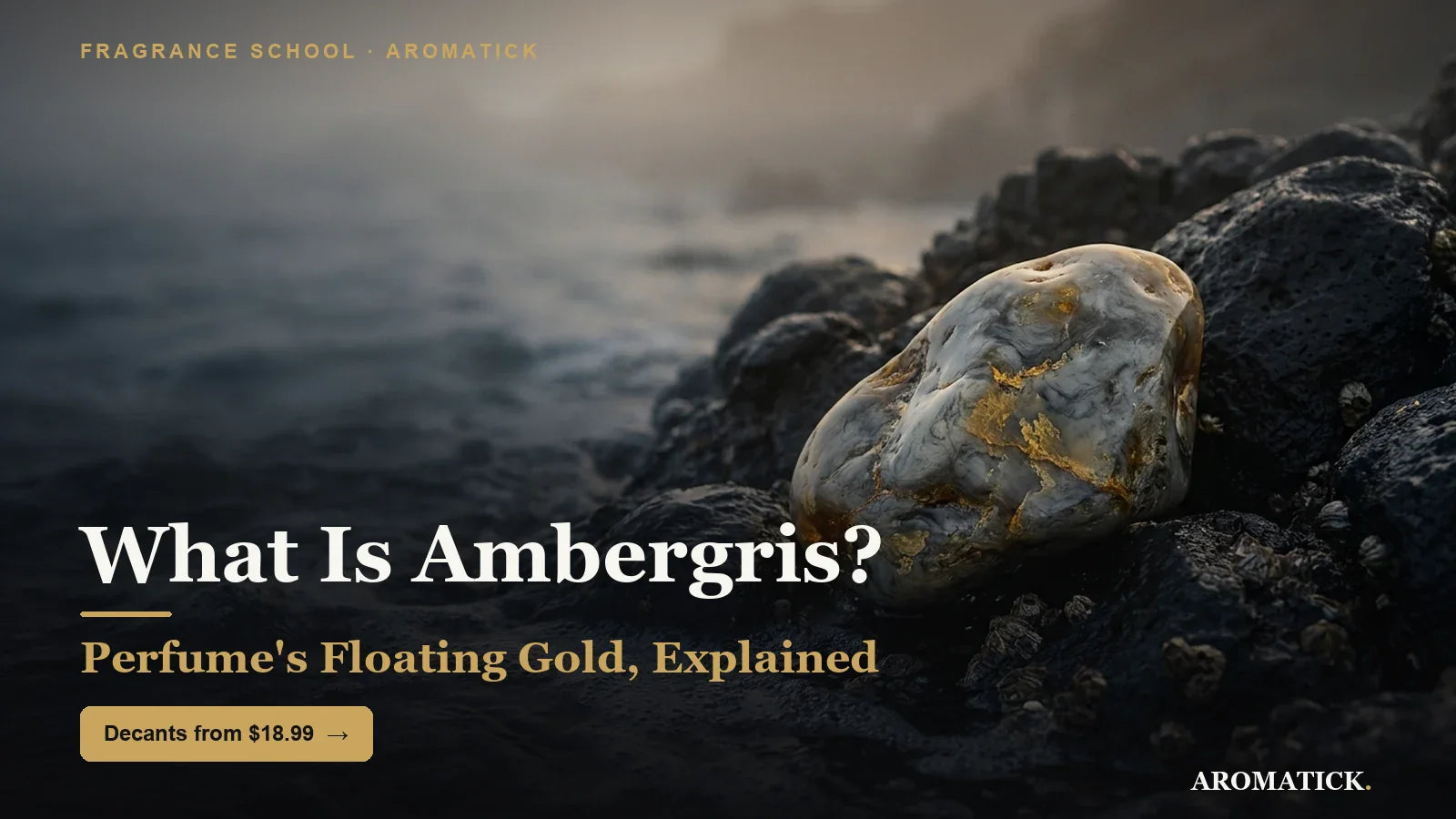
Ambergris is a waxy, solid substance that forms inside sperm whales. Sperm whales eat squid, and the sharp, indigestible squid beaks are thought to irritate the gut — so the whale coats them in a secretion that, over years, hardens into a mass of ambergris. Eventually it's expelled into the sea. It's not a perfume ingredient at that point; it needs the ocean.
Why 'floating gold'?
Once in the water, ambergris floats — sometimes for years — carried by currents and cured by sun and saltwater, until it washes up on a beach. That slow ocean-ageing is what transforms it from an unpleasant lump into a fragrant treasure. Combine that with extreme rarity (only some whales produce it, and you can't farm it) and you get a material so valuable it's earned the nickname "floating gold" — chunks have sold for tens of thousands, even millions, of dollars.
What does it smell like?
Aged ambergris is famously complex. One chemist described it as "humid, earthy, marine, tobacco-like, sandalwood-like, sweet, animal, musky and radiant" — all at once. In practice, in a fragrance it reads as a soft, warm, slightly salty-sweet marine glow with an animalic, skin-like warmth. It doesn't shout; it makes everything around it smell rounder, richer and more expensive.
Real ambergris vs synthetic (ambroxan)
Here's the twist: the "ambergris" in almost every modern fragrance isn't real ambergris. Genuine ambergris is too rare, too expensive and too ethically complicated (its trade is banned or restricted in many places to protect whales). So perfumers use synthetic recreations — above all Ambroxan (Ambrox), a molecule that captures ambergris's key warm-salty-radiant facet.
| Real ambergris | Ambroxan (synthetic) | |
|---|---|---|
| Source | Sperm whale, ocean-aged | Lab-made molecule |
| Cost | Extremely high | Affordable, consistent |
| Ethics | Restricted/banned in many countries | Cruelty-free |
| Use today | Very rare, niche/artisan | Everywhere — designer & niche |
That's genuinely good news: ambroxan gives you the gorgeous warm-radiant effect of ambergris, consistently and cruelty-free. Read our full guide to ambroxan →
What it does in a fragrance
Whether real or synthetic, ambergris's job is to be a fixative and an amplifier:
- Makes scents last longer — it anchors volatile top notes so a fragrance doesn't fade as fast.
- Smooths transitions — it softens the jump between top, heart and base.
- Adds warmth & radiance — that salty-sweet, skin-like glow that makes a scent feel unified and expensive.
Scents built on ambergris (try as decants)
Want to smell the ambergris/ambroxan effect for yourself? These decants show it off — from the iconic to the modern:

Creed Aventus — the icon
Its smoky, fruity brilliance is anchored by a famous ambergris-and-musk base — a textbook example of how ambergris adds warmth, radiance and staying power.
From $18.99 Shop the decant →
Creed Silver Mountain Water — the clean-luxury fresh
A crisp green-tea fresh that rests on Creed's signature clean musk-and-woods base — the ambergris warmth is what keeps it smelling refined and 'expensive.'
From $19.99 Shop the decant →Find your scent
Take the free 30-second scent quiz and we'll match you to fragrances (and decants) built on the notes you love — warm, radiant ambergris/ambroxan included. No purchase, no card.
FAQ
What is ambergris?
Ambergris is a rare, waxy substance that forms in the digestive system of sperm whales — thought to protect the whale from the sharp beaks of the squid it eats. Over years it builds into a solid mass, is expelled, and floats on the ocean (earning the nickname 'floating gold') until it washes ashore. Aged by sun and saltwater, it becomes one of the most prized fixatives in all of perfumery.
Why is ambergris so expensive?
Genuine ambergris is one of the most valuable natural raw materials on earth — chunks can sell for thousands or even millions of dollars. It's extraordinarily rare (only some sperm whales produce it, and supply is completely unpredictable), its trade is banned or restricted in many countries as part of whale-protection laws, and its scent takes years of ocean-ageing to develop. That rarity is why 'floating gold' is an apt name.
What does ambergris smell like?
It's complex and evolves as it ages. Freshly expelled it can smell unpleasant, but weathered ambergris becomes beautiful — a warm, radiant blend of marine (sea air), animalic, sweet, musky, earthy and slightly tobacco- or old-wood-like facets. In a fragrance it reads as a soft, salty, sweet warmth that makes everything smell richer, rounder and more 'skin-like.'
Is the ambergris in modern fragrances real?
Almost never. Genuine ambergris is far too rare, expensive and ethically fraught to use in most fragrances. Instead, perfumers use synthetic 'ambergris' accords — most famously Ambroxan (Ambrox), a molecule that recreates the key facet of ambergris. So when a fragrance lists 'ambergris,' it's usually a gorgeous, consistent, cruelty-free synthetic rather than the real thing — and that's a good thing.
What does ambergris do in a perfume?
It's primarily a fixative — it makes fragrances last longer and smell more unified. It extends volatile top notes (like citrus), softens the transitions between notes, and adds a warm, radiant, slightly salty-sweet glow that makes a scent feel expensive and 'complete.' Its modern stand-in, ambroxan, does the same job in countless designer and niche fragrances.
The bottom line
Ambergris is one of perfumery's great curiosities — a rare, ocean-aged material from sperm whales, nicknamed "floating gold," that adds warmth, radiance and staying power to a fragrance. But you almost certainly won't wear the real thing: modern scents recreate its magic with ambroxan, a cruelty-free synthetic that delivers the same expensive, skin-like glow. The best way to understand it is to smell it — try an ambergris-rich scent like Creed Aventus as a decant and notice that warm, radiant base.
Rodney Gallagher is the founder of Aromatick. Aromatick sells authenticated designer and niche fragrance decants — hand-poured from verified source bottles — so you can explore luxury notes and materials for a fraction of boutique pricing.

Leave a comment
This site is protected by hCaptcha and the hCaptcha Privacy Policy and Terms of Service apply.