
What Is Oud? A Beginner's Guide to Fragrance's 'Liquid Gold' (2026)
If you've spent any time in fragrance, you've heard the word oud — usually said with a certain reverence. It's the note behind some of the most luxurious (and expensive) perfumes in the world, and the backbone of Middle Eastern perfumery. But what actually is it, why does it cost more than gold, and how do you start wearing it? Here's the plain-English guide.

What is oud?
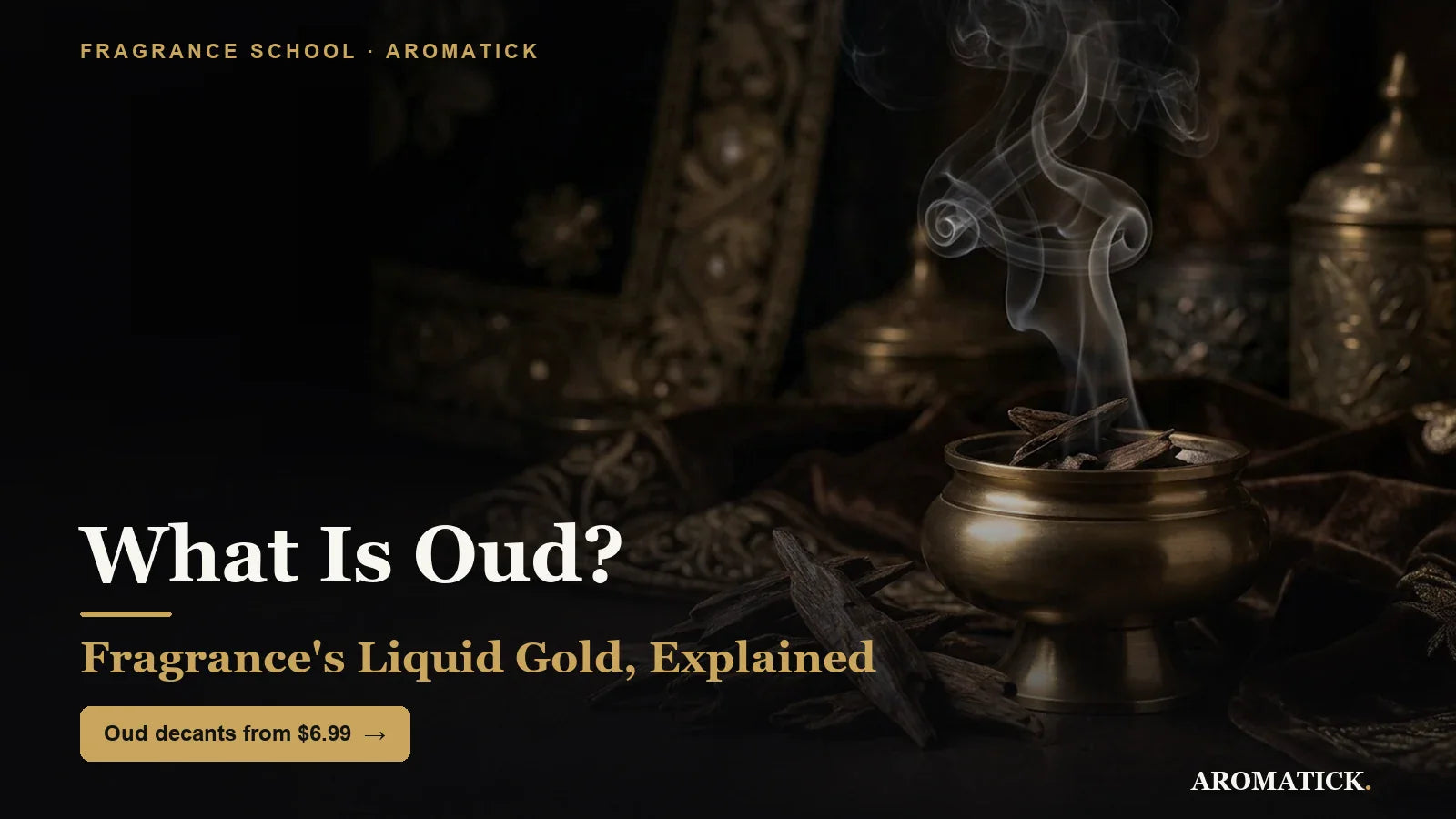
Oud — also spelled oudh and known as agarwood — is a dark, fragrant, resinous wood. It comes from Aquilaria trees, but not the healthy wood: oud only forms when the tree becomes infected by a specific type of mould. In defense, the tree floods the affected area with a dark aromatic resin, and it's that resin-saturated wood — not ordinary timber — that becomes oud. The wood is either burned as incense (bakhoor) or steam-distilled into precious oud oil used in perfumery.
Why is it so expensive?
Genuine oud is one of the most expensive natural raw materials on Earth — gram for gram, fine oud oil can cost more than gold, which is why it's nicknamed "liquid gold." Three things drive the price:
- Rarity — only a small percentage of wild Aquilaria trees ever develop the resin naturally.
- Time — the resin builds up over years, sometimes decades.
- Yield — it takes an enormous amount of wood to distill a tiny amount of oil.
That's why the vast majority of "oud" fragrances you'll smell don't use much (or any) wild oud — they use a beautifully crafted synthetic oud accord, sometimes blended with a touch of the real thing, to make the note affordable and wearable.
What does oud smell like?
It depends heavily on the type. Traditional, real oud is complex and can be intense — woody and smoky, with leathery, sweet-balsamic and even faintly animalic or "barnyard" facets at first, mellowing into a deep, warm, resinous wood. Western "oud" fragrances usually take that idea and smooth it into something cleaner, sweeter and more polished — a rich, luxurious woody-smoky note without the challenging edges.
Real oud vs Western "oud"
| Traditional / real oud | Western "oud" accord | |
|---|---|---|
| Source | Distilled agarwood oil | Mostly synthetic, sometimes a touch of real |
| Smell | Intense, smoky, leathery, animalic → warm wood | Smooth, sweet, refined woody-smoky |
| Cost | Very high | Accessible |
| Best for | Connoisseurs, Middle Eastern perfumery | Everyone — the easy way in |
Neither is "better" — they're different experiences. If you're new to oud, the Western, smoother style is the friendlier place to start.
How to wear oud
Oud is potent and long-lasting, so the golden rule is spray lightly — one or two sprays of an oud fragrance often outlasts and out-projects five sprays of something fresh. It shines in cool weather and the evening, where its deep warmth feels luxurious rather than heavy, and it's a natural fit for dressed-up occasions. Start with a smooth, approachable oud before working up to intense traditional oils.
Oud fragrances to try (as decants)
The smartest way to explore oud is with decants — sample the note across a few styles for a few dollars before committing to a bottle. Here's where to start, from refined to budget-friendly:

Tom Ford Oud Wood — the smooth classic
The definitive gateway oud: smooth, refined and approachable — creamy oud with sandalwood, rosewood and warm spice, none of the harsh edges. The one to start with.
From $22.99 Shop the decant →
Ahmed Al Maghribi Ignite Oud — the value pick
A rich, warm oud experience at a budget price — smoky-sweet woods with a Middle Eastern flair. A great, affordable way to try a bolder oud.
From $7.99 Shop the decant →
Ahmed Al Maghribi Summer Oud — the lighter take
A softer, more wearable oud that dials down the intensity — proof that oud doesn't have to be heavy. An easy, warm-weather-friendly introduction to the note.
From $6.99 Shop the decant →Find your oud
Take the free 30-second scent quiz and we'll point you to the oud (and the decants) that fit your taste — from smooth and refined to rich and bold. No purchase, no card.
FAQ
What is oud in fragrance?
Oud (also called agarwood or oudh) is a rare, precious fragrance material — a dark, resinous wood produced when Aquilaria trees become infected by a specific mould and defend themselves by saturating the wood with aromatic resin. That resin-soaked wood is distilled into oud oil or used directly. It's one of the oldest and most prized ingredients in perfumery, especially in the Middle East.
Why is oud so expensive?
Real oud is one of the most expensive raw materials on earth — sometimes called 'liquid gold.' Only a small fraction of wild Aquilaria trees develop the resin, the infection takes years or decades, and it takes a huge amount of wood to produce a tiny amount of oil. That rarity, plus intensive harvesting and distillation, makes genuine oud oil cost more per gram than gold. Most modern 'oud' fragrances use a blend of a little real oud with high-quality synthetic oud accords to make it affordable.
What does oud smell like?
It depends on the type. Real, traditional oud can be intense and complex — woody, smoky, leathery, sweet-balsamic and even a little animalic or 'barnyard' at first, mellowing into a rich, warm, resinous wood. Western 'oud' fragrances usually smooth this into a cleaner, sweeter, more refined woody-smoky note. In both cases the core impression is a deep, luxurious, warm wood.
Is the oud in Western fragrances real?
Usually it's a blend. Genuine oud oil is too rare and costly to use heavily in mass-market fragrances, so most designer and many niche 'oud' scents use a smooth synthetic oud accord — sometimes with a touch of the real thing. That's not a bad thing: synthetic oud accords are gorgeous, consistent and far more wearable (and affordable) than raw wild oud, which can be very intense.
How do I start wearing oud?
Start smooth and sample first. Begin with a refined, approachable oud fragrance rather than a heavy traditional oud oil, and try it as a decant so you can learn whether you love the note before committing. Wear it in cool weather and the evening, and spray lightly — oud is potent and long-lasting, so a little goes a long way.
The bottom line
Oud is agarwood — a rare, resinous, deeply luxurious wood that's been prized in perfumery for centuries and costs more than gold in its purest form. Most "oud" fragrances you'll wear are smooth, refined blends rather than raw wild oud, and that's a good thing: they're gorgeous and wearable. The best way to discover whether you love the note is to sample smooth ouds as decants — start with something like Tom Ford Oud Wood, spray lightly, and let that warm, expensive-smelling wood do the rest.
Rodney Gallagher is the founder of Aromatick. Aromatick sells authenticated designer and niche fragrance decants — including oud fragrances, hand-poured from verified source bottles — so you can explore luxury notes for a fraction of boutique pricing.

Leave a comment
This site is protected by hCaptcha and the hCaptcha Privacy Policy and Terms of Service apply.