
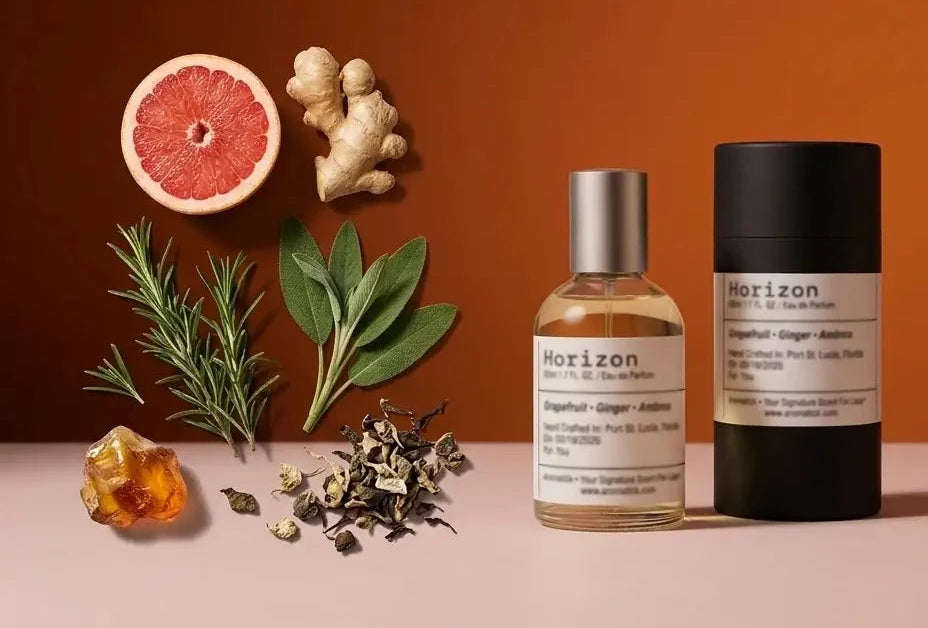

Choosing a Signature Scent That Truly Fits You
TL;DR:
- Choosing a signature scent requires patience and testing on your skin to understand its true long-term aroma. Base notes, skin chemistry, and consistency are key factors in selecting a fragrance that feels natural and personal. Proper evaluation over several hours and limiting tests to a few options help identify the scent that truly reflects your personality and lifestyle.
Most people pick a fragrance the same way: they spray it at the store, smell it for thirty seconds, and either buy it or move on. The problem is that what you smell in those first moments is rarely what you will smell three hours later. Choosing a signature scent requires patience and a little knowledge about how fragrances actually work. This guide walks you through fragrance structure, proper testing technique, and how to match a scent to your personality so you end up with something you will reach for automatically, day after day.
Table of Contents
- Key takeaways
- Choosing a signature scent starts with understanding fragrance structure
- How to test fragrances properly on your skin
- Matching scent families to your personality and lifestyle
- Building your shortlist and finding your true signature
- My honest take on finding the right scent
- Find your signature scent at Aromatick
- FAQ
Key takeaways
| Point | Details |
|---|---|
| Judge base notes, not top notes | Top notes fade within minutes); base notes define how a fragrance smells on you long-term. |
| Test on skin, not paper | Skin chemistry transforms a fragrance, so blotter strips cannot predict how a scent will perform on you. |
| Limit testing to 2-4 scents | Testing too many at once causes olfactory fatigue and makes accurate evaluation impossible. |
| Match your lifestyle to the scent family | Projection and longevity needs differ by environment, so align fragrance intensity to where you spend most of your time. |
| Repeatability is the real test | A signature scent is one you reach for instinctively, not one that earned the most compliments on one occasion. |
Choosing a signature scent starts with understanding fragrance structure
Before you can pick the right scent, you need to understand what you are actually smelling and when. Fragrances are built in layers, and each layer plays a different role in the story the scent tells.
The three notes explained
Fragrances have three note layers): top notes, heart notes, and base notes. Together they form what perfumers call the “fragrance pyramid.”
Top notes are the first impression. They are bright, airy, and attention-grabbing, but they evaporate quickly. Think citrus, light herbs, or green notes. They last roughly 5 to 15 minutes on skin. This is the layer most people judge a fragrance by, and it is the least reliable indicator of whether you will love wearing it.
Heart notes emerge as the top notes fade and typically last 2 to 4 hours. These form the core character of the fragrance. Florals like rose or jasmine, spices like cardamom, and soft woods like cedar tend to live here. Heart notes give a fragrance its mood and personality.
Base notes are the foundation. They appear after the heart settles and can last 4 to 12 hours or more. Base notes hold fixatives that slow evaporation and create what people often call “scent memory.” Sandalwood, vetiver, musks, vanilla, and amber are typical base ingredients. For a signature scent, base notes matter most because they are what others actually smell on you throughout the day.
Why skin chemistry changes everything
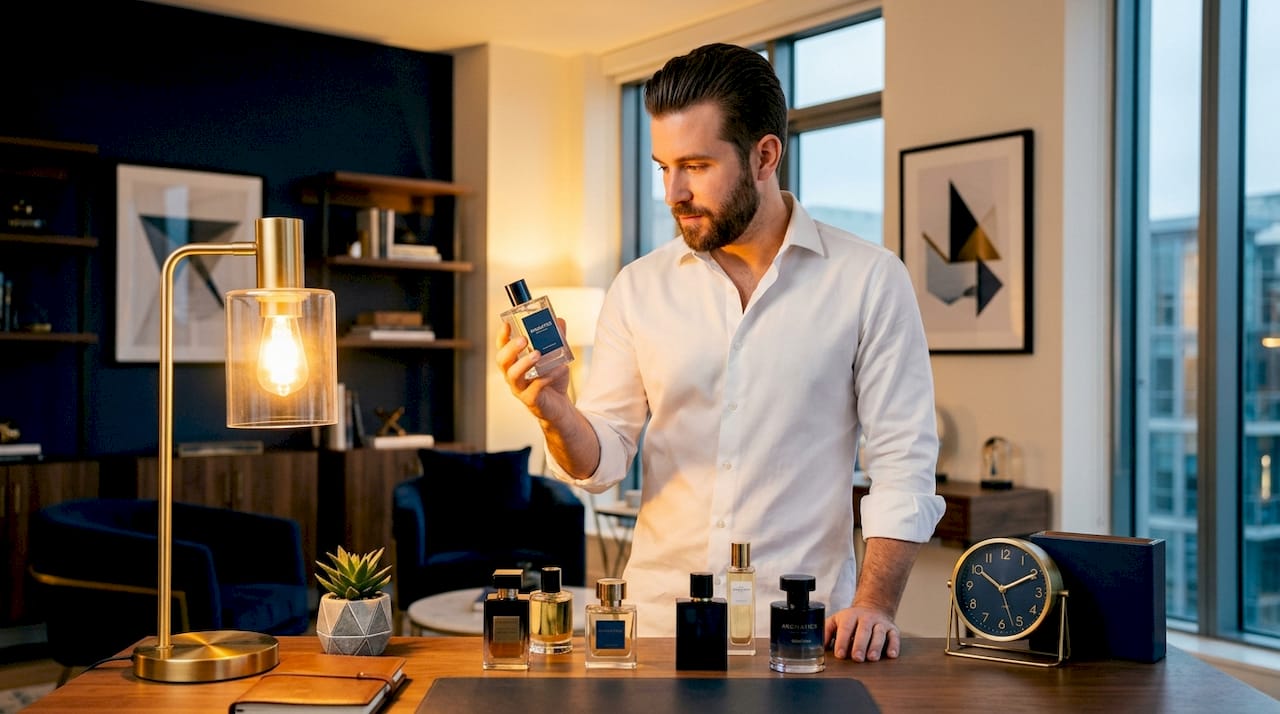
Two people can wear the same fragrance and smell completely different. Your skin’s pH, moisture level, and natural chemistry interact with every ingredient in the bottle. This is why fragrance becomes truly personal, and why no one else can tell you whether a scent is right for your skin. You have to test it yourself.
Pro Tip: If you find yourself consistently enjoying the base notes of several fragrances in the same family, that family is likely your natural direction. Pay attention to which dry-down stages make you want to keep smelling your own wrist.
How to test fragrances properly on your skin
Most fragrance mistakes come from skipping proper testing. Here is a method that removes guesswork and gives you an honest picture of how a scent behaves on your body.
-
Start with clean, unscented skin. Avoid moisturizers, scented soaps, or other fragrances on test areas before you go shopping or receive samples. Residual scent layers will distort your evaluation significantly.
-
Apply 1 to 2 sprays at a pulse point. The inner wrist and inner elbow are ideal because warmth accelerates diffusion. Apply at pulse points without rubbing. Rubbing breaks down the molecular structure of top notes and flattens the scent’s natural development.
-
Smell at the opening (0 to 5 minutes). Notice the initial burst. Bright? Sharp? Sweet? This is the top note stage. Do not make a decision here.
-
Check back at 15 to 20 minutes. The heart is beginning to emerge. The fragrance will feel noticeably different from the opening impression. This transition phase reveals whether the scent moves in a direction you enjoy.
-
Evaluate at the one-hour mark. By now you are firmly in dry-down territory. Wear test through the dry-down) to avoid what perfumers call a “false buy,” which happens when you commit based on the top notes alone.
-
Check again at 3 to 6 hours. Testing at multiple time points gives you the full picture. How does it perform when the base has fully settled? Is the projection appropriate? Does it still feel like you?
-
Limit yourself to 2 to 4 fragrances per session. Testing more than that leads to olfactory fatigue, where your nose becomes overwhelmed and stops distinguishing accurately. If you want to test efficiently, try two fragrances simultaneously, one per arm, and check them at the same intervals.
Pro Tip: Order samples before committing to a full bottle. A 1 ml perfume sample gives you roughly 10 to 15 sprays, which is enough for 3 to 5 days of real-world testing. That kind of extended wear reveals consistency across different weather, moods, and activities in a way a single store visit never can.
Matching scent families to your personality and lifestyle
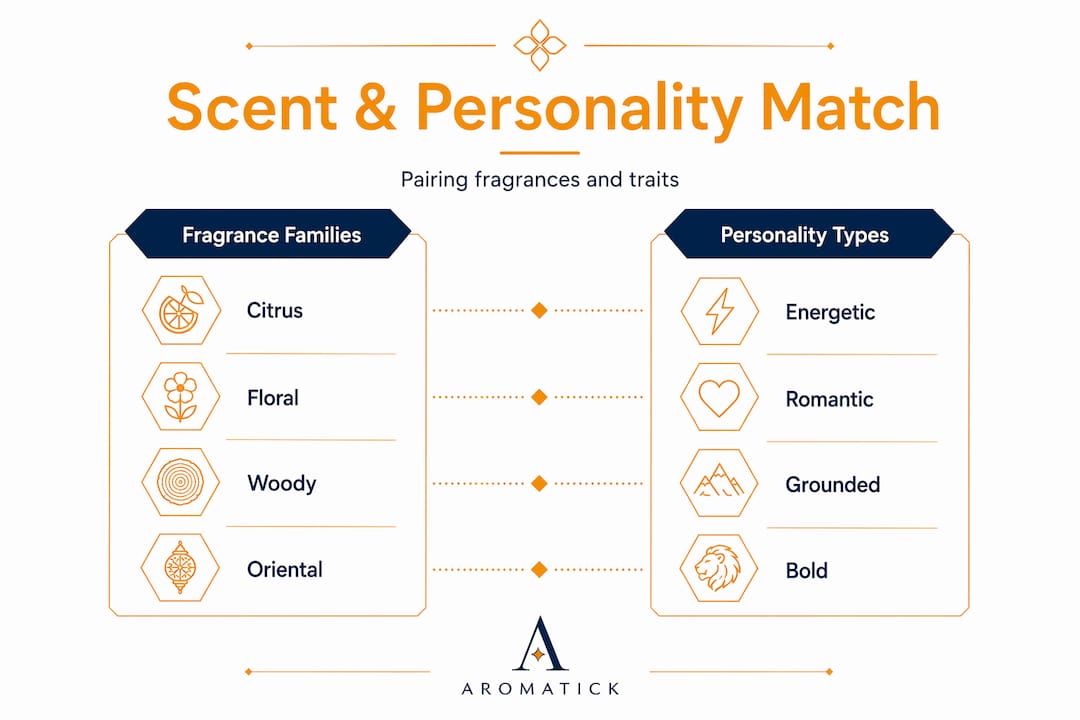
Understanding which fragrance families resonate with you is one of the most practical tips for choosing a signature scent. Think of scent families the way you think of genres in music. Each one has a mood, an atmosphere, and a type of person it tends to suit.
Here is a breakdown of the most common families and what they typically convey:
- Citrus: Fresh, energetic, clean. Works well for active lifestyles, office environments, and warm climates. Often shorter in longevity, so better suited to those who do not mind reapplying.
- Floral: Romantic, soft, expressive. Ranges from light (freesia, peony) to rich (tuberose, ylang-ylang). Appeals to people who want their scent to feel warm and approachable.
- Woody: Grounded, confident, natural. Sandalwood, cedar, oud, and vetiver anchor this family. Works beautifully across seasons and skews toward sophistication.
- Gourmand: Sweet, warm, edible. Notes of vanilla, caramel, and tonka bean. Strong and attention-getting. Best for evening wear or cooler months.
- Musky/clean: Skin-like, subtle, intimate. These are the “barely-there” scents. Perfect for close-quarters environments or people who prefer understated elegance.
- Oriental/amber: Spiced, resinous, opulent. Rich blends of resins, spices, and woods. High impact, long-lasting. Built for evenings and colder seasons.
Fragrance families align with mood and personality, and the quickest shortcut to narrowing your options is noticing what you already enjoy in everyday life. If you gravitate toward cedar candles and earthy teas, woody fragrances are worth prioritizing. If you love fresh laundry and clean spaces, a musky or citrus scent will feel natural on you.
Matching projection to your routine
Fragrance performance depends strongly on environment. A heavy oriental that projects powerfully in an open space can feel overwhelming in a small conference room. A light citrus that smells gorgeous in your bathroom might disappear entirely by midday. Think about where you spend most of your time and choose accordingly. Learn more about fragrance families and shopping to connect your daily context with the right type of scent.
| Fragrance family | Best for | Projection level |
|---|---|---|
| Citrus | Day wear, active, warm climates | Light to moderate |
| Floral | Work, social events, spring/summer | Moderate |
| Woody | Year-round, professional, casual | Moderate to strong |
| Gourmand | Evening, fall/winter | Strong |
| Musk/clean | Intimate settings, office | Subtle to light |
| Oriental/amber | Evening, cooler months | Strong to intense |
Building your shortlist and finding your true signature
Once you have identified one or two scent families that feel authentic, it is time to narrow down. Personal scent selection at this stage is less about discovery and more about elimination.
-
Select 3 to 5 candidates from related families. Staying within one or two adjacent families keeps your comparisons meaningful. Testing a light citrus against a heavy oriental tells you very little. Testing three different woody fragrances reveals genuine preference.
-
Wear each candidate at least twice in real conditions. Wear one on a regular workday, another on a weekend. Temperature, physical activity, and even stress levels affect how a fragrance develops on your skin. Wear-test candidates in relevant conditions before making any final decisions.
-
Watch for consistency and comfort. A signature scent should feel like a natural extension of yourself, not a performance. If you find yourself second-guessing whether a fragrance “works” halfway through the day, that is useful information. Discomfort is a clear signal.
-
Pay attention to what you reach for automatically. After a week of rotating candidates, notice which one you pick up first in the morning without thinking. That instinct is rarely wrong. Focus on repeatability and consistent comfort rather than chasing compliments or what is trending.
Pro Tip: Do not let other people’s reactions be the deciding factor. Compliments feel good, but a signature scent is what you wear for yourself. A scent should feel like identity, not performance. Choose the one that makes you feel most like yourself, even on ordinary days.
My honest take on finding the right scent
I have spent years helping people think through fragrance decisions, and the pattern I see most often is this: someone finds a scent they love in the store, buys the full bottle, and then gradually stops wearing it. Not because the fragrance changed. Because they judged it in the wrong context.
The impulse buy is the enemy of a true signature scent. When I test a fragrance now, I refuse to form an opinion until I have worn it for at least a full day. If it only feels good in the first twenty minutes but shifts into something flat or strange by the afternoon, it is not my signature. Patience is not optional here.
What I also know is that the emotional connection to a scent matters far more than its notes on paper. I have met people who wear unfashionable fragrances that somehow feel completely right on them. And I have seen people chase whatever is trending and never quite settle into anything. Your signature scent is not about what is popular. It is about what creates a feeling of arrival when you put it on.
The process is worth embracing. Finding your signature fragrance takes a few weeks, maybe longer. That is not a problem. That is how you end up with something that becomes genuinely yours, something people associate with you the way they associate handwriting with a person’s voice.
— Rodney
Find your signature scent at Aromatick
If you are ready to start testing, Aromatick makes it easier to find the right fragrance without the department store price tag. Aromatick specializes in authentic designer and niche fragrances for both men and women, with discounts of up to 60% off retail prices.

Browse the designer fragrance collection to explore hundreds of options organized by brand and family, making it straightforward to zero in on the citrus, woody, or floral category that matches your style. If you want something more distinctive, the niche fragrance collection offers curated options for those looking beyond mainstream choices. Every purchase comes with free shipping, secure payment, and a satisfaction guarantee so you can test with confidence. Your next signature scent is worth finding properly, and Aromatick gives you the access to do it.
FAQ
What is a signature scent?
A signature scent is a fragrance you wear consistently because it aligns with your personality, skin chemistry, and lifestyle. It is less about a specific note profile and more about the feeling and atmosphere it creates around you.
How long should I test a perfume before deciding?
Test a fragrance on skin for at least one full day, checking it at the opening, transition, dry-down, and several hours later. For a true signature, wear it across multiple days and conditions before committing.
How many sprays should I use when testing?
Apply 1 to 2 sprays on clean skin at a pulse point for accurate evaluation. Typical daily wear is 2 to 3 sprays; too many sprays will distort your perception of projection and longevity.
Can I have more than one signature scent?
Yes. Many people maintain a warmer, heavier scent for evenings or colder months and a lighter one for daytime or warm weather. The key is that each one feels instinctive and consistent within its context.
Why does perfume smell different on me than on someone else?
Your skin’s pH, temperature, and natural oils interact with fragrance ingredients in a unique way. This is why skin chemistry makes scent personal and why testing on your own skin is the only reliable way to evaluate a fragrance.

Leave a comment
This site is protected by hCaptcha and the hCaptcha Privacy Policy and Terms of Service apply.