
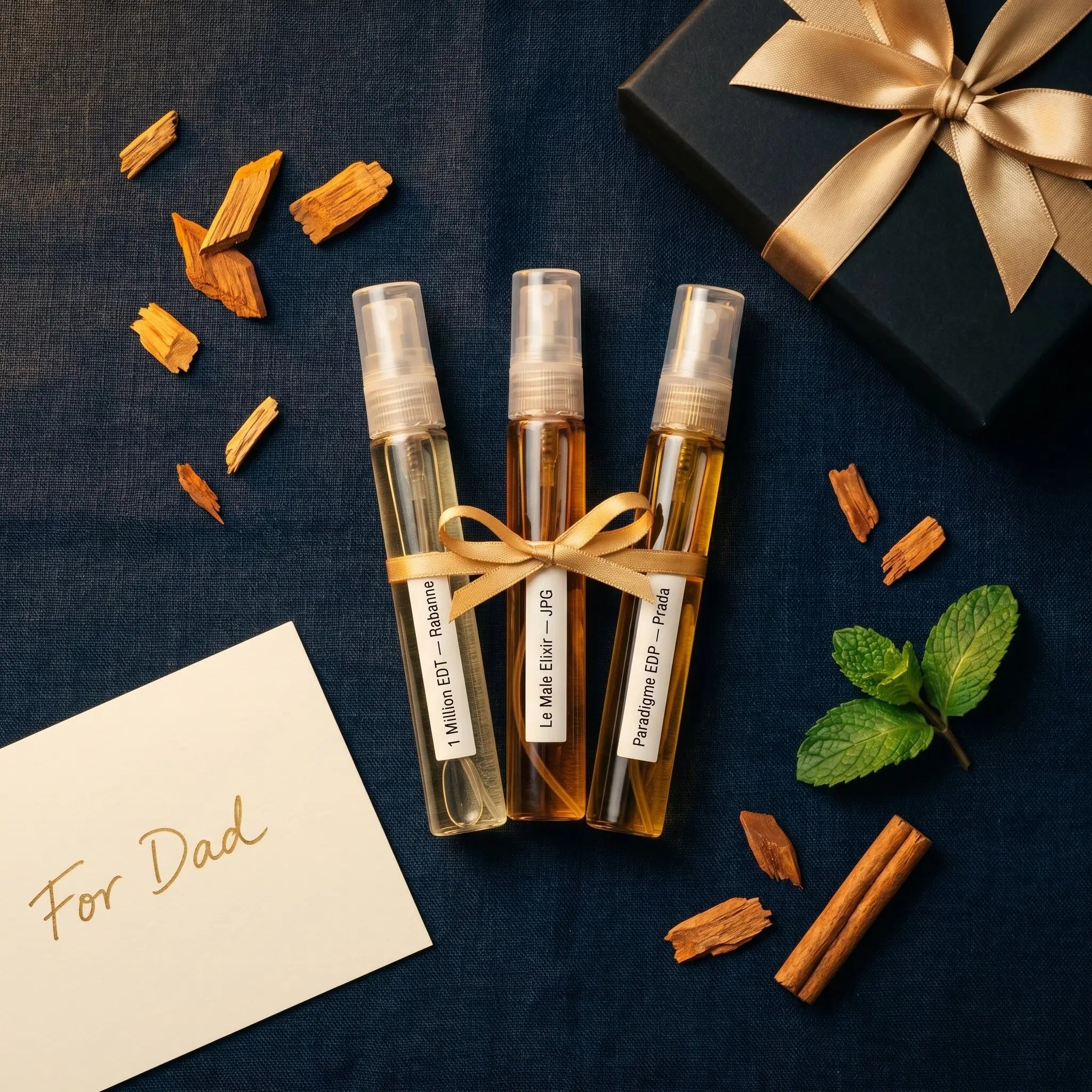

Stop Wasting Money: How to Blind Buy Perfume With a 4 Point Score
Blind buying is worth the risk only when you stack the odds in your favor first. The single best safety rule: never spend full price on a full bottle until you’ve sampled it or capped your loss at a decant price. Lean toward safe note families like clean musks and soft ambers, hunt for decants or discovery sets before committing, and buy only from sellers with real return protection. Sample-friendly sizing exists for exactly this reason.
TL;DR:
- Using your current collection to identify favored notes and drydown behavior significantly increases the chances of a successful blind buy.
- Fragrance families like clean musks, citrus, and soft ambers are safer options because they tend to be more universally appealing and less polarizing.
- Sampling with decants, discovery sets, or travel sizes and testing over multiple days helps mitigate skin chemistry risks and improves purchase confidence.
- Reviews should be examined for consistent performance details such as longevity and projection, rather than relying on single opinions or vague praise.
- Buying from sellers with clear return policies, authenticity guarantees, and testing options reduces financial and authenticity risks involved in blind fragrances.
Table of Contents
- What Does It Mean to Blind Buy Perfume?
- Check Your Collection First: What Your Bottles Already Tell You
- Which Note Families Are Safest to Blind Buy?
- How Do You Read Reviews for Longevity and Projection?
- Sampling Strategy: Turning a Guess Into a Controlled Test
- How Much Should You Spend on a Blind Buy?
- How to Choose a Seller Who Reduces Your Risk
- A Four-Point Checklist Before You Click Buy
- Does Season or Occasion Change the Blind-Buy Calculus?
- How Do You Research a Perfume House Before Buying Blind?
- Balancing the Thrill of Discovery With Discipline
- Sample Smart at Aromatick Before You Commit
- Sources
- FAQ
What Does It Mean to Blind Buy Perfume?
Blind buying means purchasing a fragrance you’ve never smelled, based only on notes lists, reviews, and reputation. It’s become the default way many fragrance enthusiasts shop, driven largely by online discounts that make full bottles too tempting to wait on. Academic research on e-commerce fragrance shoppers confirms that price discounts are the primary driver of blind buys, while the inability to test before purchase remains the biggest drawback shoppers report.
That tension is the whole game. You’re trading the certainty of a smell test for a better price and faster access. The risks are real: financial loss, buyer’s regret, and the wildcard of skin chemistry producing an unexpected result once the bottle actually touches your wrist. Learning how to blind buy perfume well means learning how to shrink those three risks before you ever click “add to cart.”
Check Your Collection First: What Your Bottles Already Tell You
Your existing bottles are the best data you have. Before you consider any blind buy, pull the three to five perfumes you reach for most often and look for what they share.
- Identify the repeating notes. If four of your five favorites lean on bergamot, cedar, or ambroxan, that’s your baseline. A new release built on the same skeleton is a safer bet than one built on none of it.
- Pay attention to drydown, not just opening. The first ten minutes of a fragrance are marketing. What lingers after two hours is the fragrance you actually live with, and that’s what predicts whether you’ll reach for it again.
- Build a dislike list. Note the accords that have burned you before, whether it’s a specific synthetic musk, a syrupy gourmand, or an aggressive aquatic note, and use that list to disqualify candidates fast.
Base notes and drydown behavior matter more than top-note copy because skin chemistry reshapes how a fragrance evolves over the hours you actually wear it, not the first spray. A wardrobe audit like this turns a guess into an educated bet, and it’s a habit worth revisiting every time you consider a new blind buy.
Which Note Families Are Safest to Blind Buy?
Some fragrance families are engineered to be crowd-pleasers. Others are built to divide a room, and that’s precisely why they’re risky when you can’t test first.
- Safer bets: clean musks, fresh citrus, soft woody ambers, and sheer florals. These families tend toward balance rather than extremity, which is why a conservative note profile shows up again and again in advice on minimizing blind-buy regret.
- Higher risk: oud, heavy animalics (think civet or castoreum-style notes), dense gourmands loaded with sugar and vanilla, and aggressive indolic florals. These notes read as either “love it” or “can’t stand it,” with very little middle ground.
- Concentration matters too. An eau de toilette diffuses more of its structure into the air and fades faster, giving you an easier exit if it doesn’t work. An eau de parfum or extrait concentrates the raw materials, which amplifies both the good and the bad. For a first blind buy of an unfamiliar house, the lighter concentration is the more forgiving choice.
Pro Tip: If a fragrance’s official description leans hard on words like “intense,” “daring,” or “provocative,” treat that as a flag to sample first, not a reason to skip it entirely.
How Do You Read Reviews for Longevity and Projection?
A single five-star review tells you almost nothing. A pattern across a dozen reviews tells you almost everything.
- Look for repetition, not opinion. If three unrelated reviewers independently mention “loud for the first hour, then disappears,” that’s a performance signal worth trusting more than any single glowing comment.
- Weigh context clues. A reviewer who mentions their climate, skin type, and the exact concentration they tested is giving you usable data. A review that just says “amazing” is not.
- Cross-reference vote-based accord data. Community fragrance databases track main-accord voting across thousands of wearers, which helps confirm whether a “fresh floral” really smells that way in practice rather than in a marketing description. Community and forum recommendations can point you toward consensus picks, but treat them as a starting list to verify, not a final answer.
Marketing copy describes the fragrance the brand wants you to imagine. Reviews, read in aggregate, describe the fragrance that actually landed on someone’s skin.
Sampling Strategy: Turning a Guess Into a Controlled Test
Sampling is the single most effective way to de-risk a blind buy, and it’s more accessible than most new buyers realize. Decants, discovery sets, and travel sizes each solve the same problem at a different price point and convenience level. Decants (small amounts poured from a full bottle) are the cheapest way to test a specific fragrance. Discovery sets bundle several scents from one house or family, ideal if you’re exploring rather than chasing one specific bottle. Travel sizes cost more per milliliter but come from the brand directly, which matters if authenticity concerns you.
Once you’ve got a sample, run this three-day test:
- Day one, blotter test. Spray a strip and note the opening and first hour. This tells you almost nothing about wearability, but it screens out anything you dislike immediately.
- Day two, skin patch. Apply a small amount to your wrist and track it through a full day, including how it holds up against your body heat and any daily activity.
- Day three, full-day wear across contexts. Wear it to work, to the gym, or on an errand run. Notice how it performs in different temperatures and how people react, if they do at all.
Pro Tip: Repeat the wear test at least once more before committing to a full bottle. Skin chemistry can shift slightly from day to day depending on diet, stress, and even the weather, so one good day isn’t proof.
If no sample exists anywhere, your fallback is buying the smallest available size or concentration, and only from a seller who explicitly allows returns on opened bottles.
How Much Should You Spend on a Blind Buy?
Match your spend to your confidence level, not to how exciting the reviews sound.
- Low confidence (unfamiliar brand, no anchor perfume overlap): cap spend at decant or sample-size pricing. Treat anything over that as a loss you’re willing to accept for the data.
- Medium confidence (shares notes with a known favorite, solid review pattern): a travel size or the smallest full bottle available is reasonable.
- High confidence (near-identical to a proven anchor, from a trusted house): a full-size bottle is defensible, though setting a firm price ceiling before you shop keeps enthusiasm from overriding judgment.
Premium niche releases deserve extra scrutiny before a full-size purchase. A $300 bottle demands more consistent review evidence than a $60 designer release, simply because the financial downside of getting it wrong is so much larger.
How to Choose a Seller Who Reduces Your Risk
The retailer you buy from matters almost as much as the fragrance you choose. Before checking out, confirm these basics.
- Return window and condition rules. Does the seller accept returns on opened bottles, or only unopened ones? What’s the time window, and are there restocking fees?
- Authenticity guarantees. A seller who states clearly how they verify authenticity is signaling that they’ve thought about the exact fear you have.
- Sampling or discovery programs. A retailer that sells decants or discovery sets alongside full bottles is telling you, indirectly, that they expect buyers to test before committing.
- Keep your proof. Photograph the packaging and save your order confirmation the moment it arrives, so you’re not scrambling for documentation if a return becomes necessary.
A Four-Point Checklist Before You Click Buy
Score every potential blind buy on four axes, one to five points each, for a total out of twenty.
| Axis | What to score | Low score signal | High score signal |
|---|---|---|---|
| Scent fit | Overlap with your anchor perfumes’ notes | Shares nothing with what you already wear | Nearly identical structure to a proven favorite |
| Note risk | Presence of polarizing notes (oud, heavy animalics, dense gourmands) | Multiple high-risk notes dominate | Built on safe, familiar families |
| Performance evidence | Consistency of longevity/projection reports across reviewers | Reviews conflict or are scarce | Multiple independent reviewers agree |
| Purchase protection | Return policy and seller reputation | No returns, unknown seller | Clear return window, verified authenticity |
A score of 15 or higher supports buying a full bottle. A score of 10 to 14 means buy a decant or travel size first. Anything under 10 means sample before spending another dollar. Copy this shorthand onto any product page you’re weighing: “Fit: _/5, Risk: _/5, Evidence: _/5, Protection: _/5.”
Does Season or Occasion Change the Blind-Buy Calculus?
Yes, and it’s one of the easiest ways to make a blind buy safer without changing anything about the fragrance itself. Matching a scent to the right season lowers the stakes because you’re not betting your only signature fragrance on an unfamiliar bottle.
Fresh citrus, light aquatics, and sheer musks tend to perform best in warm weather, when heat amplifies projection and heavier notes can turn cloying fast. Save experimental or intense blind buys, especially anything gourmand or amber-heavy, for cooler months when the same notes read as cozy rather than overwhelming. If you’re unsure how a scent will behave in extreme heat or cold, buying it as a decant lets you test across two seasons before deciding on a full bottle.
Occasion matters just as much as temperature. A blind buy intended for the office should skew conservative and lower in projection, since you can’t predict how loud it will run on your skin until you’ve worn it around other people. Save louder, more distinctive blind buys, the ones built on notes you’re genuinely curious about but haven’t verified, for weekends or evenings out where a stronger presence is welcome rather than distracting.
The safest approach is to buy your riskiest blind buys in seasons or for occasions where a miss costs you the least. A fragrance that turns out too strong for a work day is a minor problem on a Saturday night out.
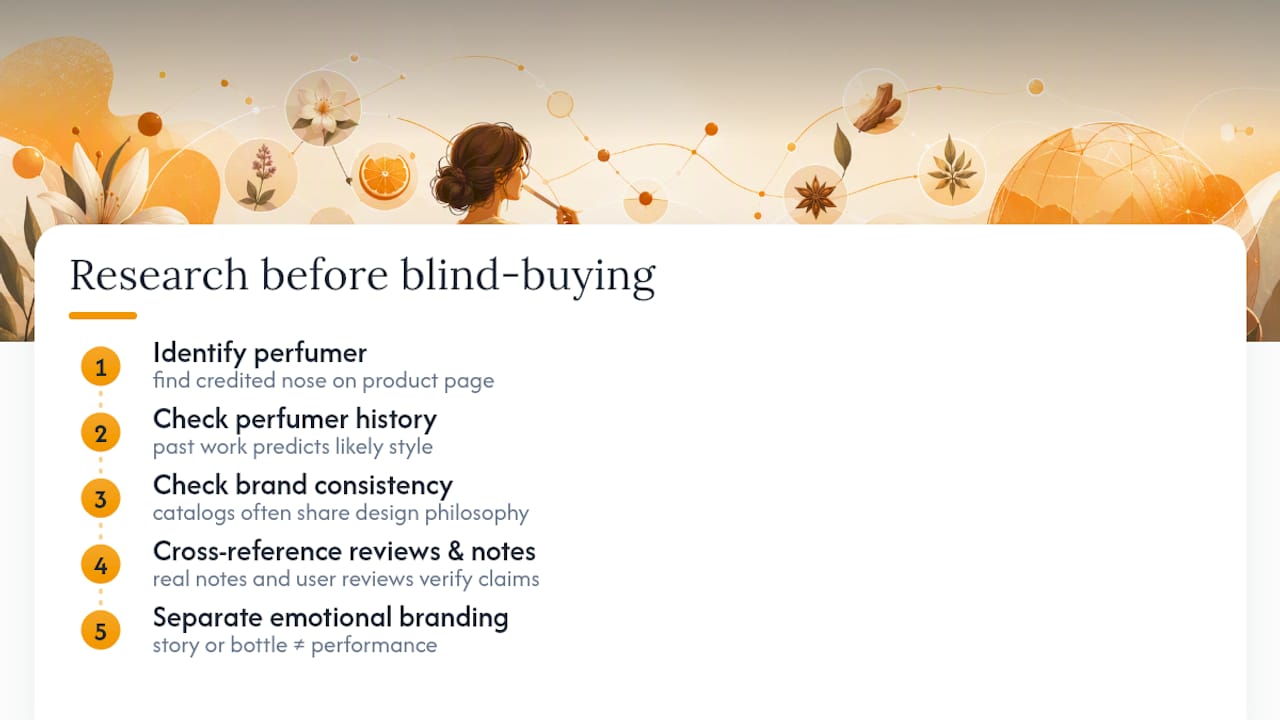
How Do You Research a Perfume House Before Buying Blind?
The house behind a fragrance tells you almost as much as the notes list. Perfumers and brands have signatures, just like authors have writing styles, and once you recognize a house’s habits, blind buying from them gets dramatically less risky.
Start by identifying which perfumer created the scent, when that information is available. Many niche houses list their in-house or freelance perfumer on the product page or press materials, and a perfumer whose past work you already love is a strong predictor of future satisfaction. If a specific nose consistently builds around soft woods and sheer musks across five different releases, a sixth release from the same person is a far safer blind buy than a random unknown brand.
Brand consistency matters even without a named perfumer. Some houses lean hard into gourmand sweetness across their entire catalog, while others stay committed to clean, minimalist structures. If you’ve tried and loved one release from a brand, later releases from that same brand tend to share the same design philosophy more often than not, particularly within the same collection or line.
Emotional branding, evocative bottle names, and origin stories genuinely shape what people choose to buy, but that pull toward an “ideal self” or a mood has nothing to do with how the fragrance actually performs on skin. A beautifully written product description has never once predicted longevity. Cross-reference the story with real notes, real reviews, and, wherever possible, the same perfumer’s other work before you let a name alone justify the purchase.
Balancing the Thrill of Discovery With Discipline
Blind buying is one of the few genuine thrills left in a hobby, and no checklist should kill that. But the enthusiasts who avoid repeated regret are the ones who track every blind buy afterward, updating their anchor perfumes and dislike list with each result. Treat every purchase as one more data point, and the guesswork shrinks with time. Discovery sets and decant options exist to make that discipline easy to practice rather than a chore.
— Rodney
Sample Smart at Aromatick Before You Commit
Aromatick sells authentic designer and niche fragrances at up to 60% off department store pricing, which changes the math on blind buying entirely: a lower price ceiling means your “experimental” cap can stretch further without the same financial sting.
Run the checklist from this guide directly on Aromatick’s product pages. Check the notes against your anchor perfumes, weigh the concentration, and use the site’s satisfaction guarantee as your purchase-protection score booster. If your scent-fit score is uncertain, start with a smaller size rather than skipping straight to a full bottle. Browse the designer fragrance collection for well-reviewed, familiar houses that fit a low-risk profile, or explore the niche fragrance collection once you’re ready to stretch into less familiar territory with a smaller size as your safety net.
Sources
For deeper detail on regret minimization and safe note families, see Blind buys: probability, regret minimization, returns. On financial and skin-chemistry risk specifically, Blind buying risks and how to mitigate breaks down the main failure points. For a step-by-step sampling and review-reading framework, How to Blind Buy Perfume Safely backs the checklist approach used above. On scoring scent family against performance evidence, see the Guide to Blind Buying Perfume Safely.
- Blind buying risks and how to mitigate
FAQ
What Is the Best Perfume for a Blind Buy?
There’s no single best fragrance for everyone. The safest blind buys share soft, familiar note families like clean musks, citrus, or gentle ambers rather than one universally recommended bottle.
What Is the 3:1:1 Rule for Cologne?
The 3:1:1 rule refers to a common application guideline, roughly three sprays for stronger scents, one for lighter ones, and one for extra-strong concentrations, though exact ratios vary by individual and fragrance strength. It’s an application heuristic, not a blind-buy safety rule.
What Perfume Is a Safe Blind Buy?
A safe blind buy is any fragrance built on the note families you already know work on your skin, verified through pattern-based reviews rather than a single recommendation. Cross-checking community suggestions against your own wardrobe audit gets you closer than any single “safe pick” list.
What Is the 50/30/20 Rule in Perfume?
There’s no established or widely recognized percentage-based rule specific to perfume; definitions circulating online vary and aren’t consistent. Readers are better served applying the scent fit, note risk, performance evidence, and purchase protection scoring method covered earlier in this guide.
Is Blind Buying Perfume Worth It?
Blind buying is worth it when you sample first or cap your spend, since the main risks are financial loss and buyer’s regret rather than the purchase itself. With a wardrobe audit, safe note families, and a seller offering real return protection, the odds shift firmly in your favor.

Leave a comment
This site is protected by hCaptcha and the hCaptcha Privacy Policy and Terms of Service apply.