
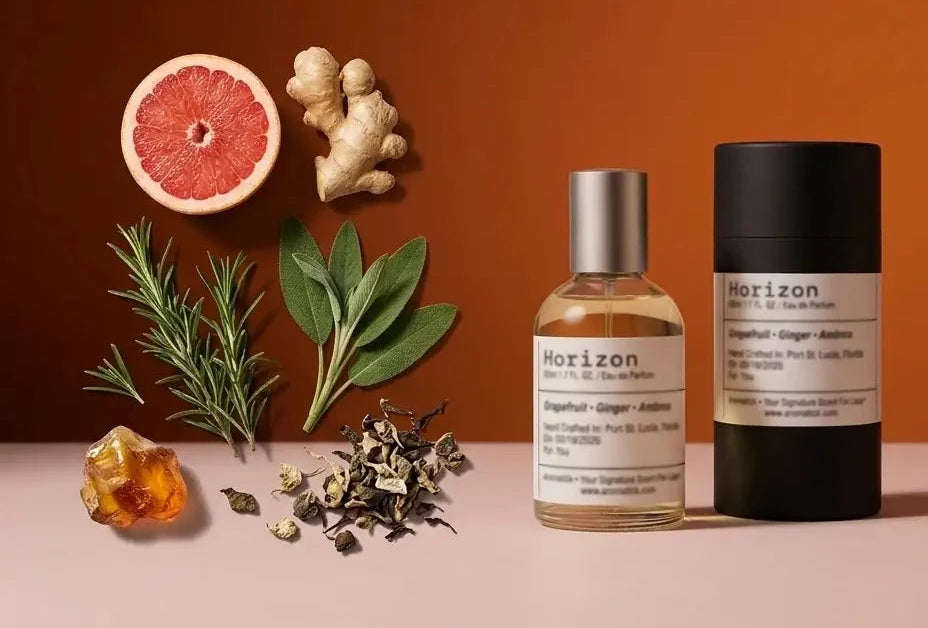

How to safely trust online fragrance stores and save
TL;DR:
- Authentic online fragrance shopping depends on verifying trust signals like clear policies, verifiable seller identity, and batch code support. Consumers should scrutinize reviews, compare prices, inspect packaging, and document every transaction to reduce counterfeit risk. Using samples and subscriptions further lowers the risk of counterfeit products and ensures satisfaction before committing to full purchases.
You’ve found a bottle of your favorite designer scent at 50% off on an unfamiliar website, and suddenly doubt creeps in. Is it real? Will it smell like the one at the department store? Could you be throwing money away on a convincing fake? This tension is one of the most common experiences for fragrance enthusiasts and budget-conscious shoppers alike. The good news is that legitimate discounts on authentic perfumes absolutely exist, and with the right knowledge, you can shop confidently online without sacrificing quality or getting burned by counterfeits. This guide walks you through every practical step.
Table of Contents
- Why trust matters when buying perfume online
- How to spot a trustworthy fragrance store
- Discounts and authenticity: What’s legitimate and what’s risky?
- From sample models to niche buying: Smart trust shortcuts
- Marketplace nuances: Trust is probabilistic, not guaranteed
- What most guides miss: Trust is a mix of evidence and practical habits
- Level up your fragrance shopping: Authentic deals and guarantees
- Frequently asked questions
Key Takeaways
| Point | Details |
|---|---|
| Verify store credentials | Check retailer identity, contact details, and policy transparency to minimize fake perfume risk. |
| Compare prices smartly | Assess discounts by referencing department stores, discounters, and brand MSRP to distinguish genuine savings. |
| Inspect product authenticity | Look for batch code and packaging consistency and avoid stores using only stock photos or vague descriptions. |
| Sample before buying | Choose sample or subscription models to test scent performance and authenticity, especially for niche fragrances. |
| Order-by-order vigilance | Treat trust as cumulative and verify authenticity and support with every purchase, especially on marketplaces. |
Why trust matters when buying perfume online
Online fragrance shopping has exploded in popularity, but so has the sophistication of counterfeit operations. The fragrance market is one of the most heavily counterfeited in the luxury goods category, which means discerning buyers need more than just a good price to feel confident. When a bottle arrives that smells slightly off or fades within an hour, the damage goes beyond money lost. It affects your confidence in the fragrance itself and makes future online purchases feel riskier.
“Budget-conscious shoppers should trust online fragrance stores more when they provide verifiable seller identity and clear policies, because anonymity and vague policies correlate with higher counterfeit and independent market risk.”
This is the foundation of everything. A store that clearly shows its name, physical address, phone number, and email has accountability built in. Anonymous storefronts, meanwhile, have no skin in the game.
Here is what genuine trust signals look like when evaluating any online fragrance retailer:
- Verifiable seller identity: A real business name, registered address, and multiple contact methods.
- Clear return policy: Specifies exactly what qualifies for a return, the time frame, and the process.
- Shipping transparency: States processing times, carriers used, and what happens if a package is delayed or lost.
- Customer support access: Live chat, email, or phone support that actually responds within a reasonable window.
- Product descriptions with specifics: Concentration (Eau de Parfum, Eau de Toilette), bottle size, and origin country listed clearly.
Using a designer perfume checklist before committing to any purchase can help you systematically evaluate each of these signals rather than relying on gut feeling alone.
How to spot a trustworthy fragrance store
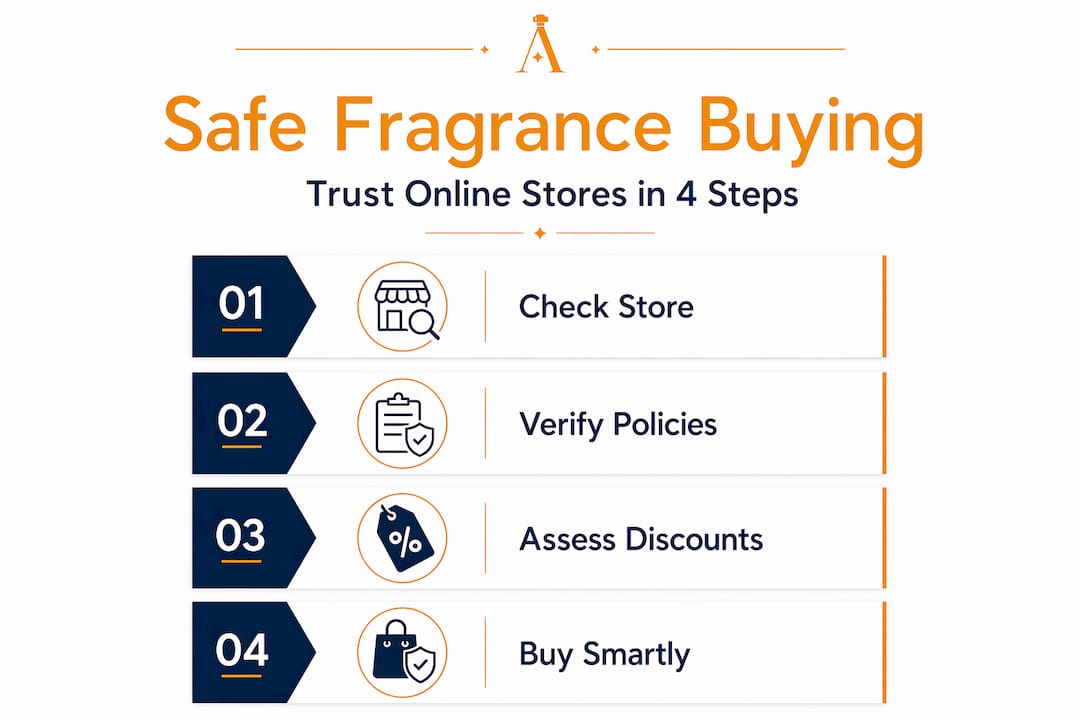
Now that you know what trust signals look like in theory, here is how to apply them in a practical, step-by-step way. Think of this as your pre-purchase routine before clicking “buy.”
- Search the store’s business name plus “reviews” and “complaints.” Real customer feedback on third-party platforms like Trustpilot or Google Reviews reveals patterns. One or two negative reviews are normal. A pattern of “fake smell” or “never received package” complaints is a warning sign.
- Read the return policy in full. Reputable stores explain their criteria plainly. Vague phrases like “returns handled case by case” without specifics are a red flag.
- Compare the listed price against at least two other references. Check the brand’s official website, a major department store, and one other discounter. A price that is dramatically lower than all others without explanation deserves scrutiny.
- Inspect packaging and batch codes upon arrival. Once the bottle arrives, check the batch code (usually printed on the box bottom or bottle base) using a free online tool. Genuine fragrances have consistent, verifiable codes. Counterfeits often have smudged, missing, or mismatched codes.
- Document everything. Screenshot order confirmations, save email threads, and photograph packaging on arrival. This protects you in any dispute.
The fragrance verification guide at Aromatick covers batch code verification in greater detail, which is worth bookmarking. For broader strategies, the fragrance shopping tips resource offers additional context on buying smart.
Here is a quick comparison to help you evaluate retailer types:
| Factor | Direct online retailer | Third-party marketplace seller |
|---|---|---|
| Seller identity | Usually clear and verifiable | Often anonymous or vague |
| Return policy | Defined and consistent | Varies by individual seller |
| Batch code support | More likely available | Rarely offered |
| Customer support | Direct and accountable | May route through platform |
| Authenticity risk | Lower | Higher |
Pro Tip: Always save screenshots of your seller’s product page and policies before ordering. Websites update frequently, and having a timestamped record protects you if a dispute arises later.
Discounts and authenticity: What’s legitimate and what’s risky?
Here is where many shoppers feel the most confusion. How can a retailer sell an $150 designer fragrance for $75 and still be legitimate? The answer lies in how fragrance distribution actually works.
Legitimate discounting mechanisms include overstock purchasing, parallel distribution (buying through authorized channels in markets where the product is cheaper), and selling older packaging versions of the same formula. None of these affect what is actually inside the bottle.
Suspicious discounting looks very different. It involves extreme markdowns with zero explanation, only stock photography instead of real product images, and no mention of batch codes or authenticity documentation. A useful rule: the deeper the discount, the more the seller should explain it.
Here is a breakdown of discount levels and what they typically signal:
| Discount level | Likely explanation | Trust level |
|---|---|---|
| 10 to 25% off | Retailer margin reduction | High |
| 25 to 40% off | Overstock or older packaging | Moderate to high |
| 40 to 60% off | Parallel import or clearance | Moderate, needs vetting |
| Over 60% off | Unusual, requires strong explanation | Low unless well-documented |
Understanding why fragrances are discounted in the first place removes a lot of anxiety from the process. It is genuinely possible to find luxury scents for less through reputable channels without compromising authenticity.
Beyond pricing, here are the red flags to watch for regardless of discount level:
- Only stock images, no real product photos
- No mention of batch codes or lot numbers
- Inconsistent packaging details (font errors, misaligned labels)
- No physical address or only a P.O. box
- Pressure tactics like “only 2 left” with no restock history
It is also worth checking cosmetic safety advice from Consumer Reports, since counterfeit fragrances have been found to contain harmful substitute ingredients. Authenticity is not just about getting the scent you paid for. It is also a safety concern. For a curated look at which brands offer the best verified savings, discounted fragrance brands is worth exploring.
From sample models to niche buying: Smart trust shortcuts
Even with a solid vetting process, some shoppers prefer to reduce risk before committing to a full bottle purchase. This is where sample and subscription models become genuinely useful tools, especially for enthusiasts exploring niche or lesser-known houses.
Here is how to use a sample-first approach strategically:
- Order a sample or decant of the specific fragrance you want. Many reputable retailers offer small vials or splits. This lets you verify that the scent matches what you remember from a store encounter or a trusted review.
- Wear it for a full day before evaluating. Fragrance performance depends on dry-down (the way a scent evolves over hours on skin). A 30-second sniff test tells you very little about longevity or sillage (how far the scent projects).
- Compare the sample against the full bottle once it arrives. If you can obtain a sample from a confirmed source first, you have a reference point for checking the full bottle when it arrives from the discounter.
- Use subscription services for consistent discovery. Monthly fragrance subscription services send curated samples that reduce risk by shifting the focus from “is this authentic?” to “does this actually perform like the real thing?” If performance matches the expected scent profile, authenticity concern drops significantly.
Pro Tip: Niche fragrances are generally less widely counterfeited than mass-market designer scents simply because the profit motive for faking a small-production house is lower. However, they still require vetting, especially if you find them at unexpectedly steep discounts from unfamiliar sellers.
Aromatick’s niche fragrance collection brings together verified offerings in one place, making it easier to shop for specialty fragrances without navigating the riskier parts of the broader market. If you want a deeper look at how to approach these purchases, luxury fragrance shopping tips breaks down the decision-making process clearly.
Marketplace nuances: Trust is probabilistic, not guaranteed
Even when you do everything right, it is important to be realistic about what trust can and cannot guarantee. No vetting process eliminates risk entirely, especially when purchasing through large third-party marketplace platforms where individual sellers list products alongside verified retailers.
Here is the key insight: trust is probabilistic, not binary. A retailer with strong policies, verified identity, and a consistent review history is far more likely to send you an authentic product than an anonymous marketplace lister. But “far more likely” is not the same as “guaranteed.”
The practical implications of this are:
- Buy direct from established retailers when possible. The supply chain is shorter and more traceable, which reduces the number of opportunities for substitution or mislabeling.
- Treat every new seller as a first-time test. Even if you have heard of a platform, an unfamiliar seller within that platform deserves the same scrutiny as an unknown storefront.
- Understand that even established retailers can have friction. Customer-service issues and supply-chain documentation gaps exist even at known discount fragrance operations, which reinforces the need for order-by-order verification.
- Keep your documentation habit consistent. Whether you have bought from a store ten times before or this is your first order, photograph the box, bottle, and batch code every single time.
“Trust should be treated as probabilistic and verified order by order, especially on third-party marketplace sourcing.”
Aromatick’s authenticity guarantee page lays out exactly how it handles verification, which is the kind of transparency that raises the probability of a trustworthy experience significantly.
What most guides miss: Trust is a mix of evidence and practical habits
Most fragrance shopping guides focus entirely on red flags and checklists. Those are useful, but they miss something important: trust is cumulative. A single batch code check or one positive review is not enough. What builds real confidence is a repeatable routine applied across every purchase.
The buyers who almost never get burned are not necessarily the most knowledgeable about fragrance chemistry. They are the ones who have built consistent verification habits. They photograph packaging every time. They save every order confirmation. They check batch codes as a matter of routine, not just when something feels suspicious. And they choose retailers that make authenticity and returns logistics legible through clear policy pages and explicit batch-code mentions.
There is also a sourcing discipline worth developing. Aggregator platforms and large marketplaces are convenient, but they introduce inventory layers where traceability gets murky. Buying directly from a retailer that owns its inventory and operates under a clear identity model eliminates several of those layers.
The authentic fragrance verification process is not just for experts. It is a learnable skill that becomes second nature after a few purchases. The shoppers who develop this skill spend less time worrying and more time enjoying the fragrances they actually wanted.
The real shift happens when you stop treating trust as something you either have or do not have with a given store, and start treating it as something you build evidence for, purchase by purchase. That mindset produces better outcomes than any single checklist.
Level up your fragrance shopping: Authentic deals and guarantees
You now have a practical, evidence-based framework for evaluating any online fragrance retailer. The next step is putting that knowledge to work with a store that already meets the standards you have learned to look for.
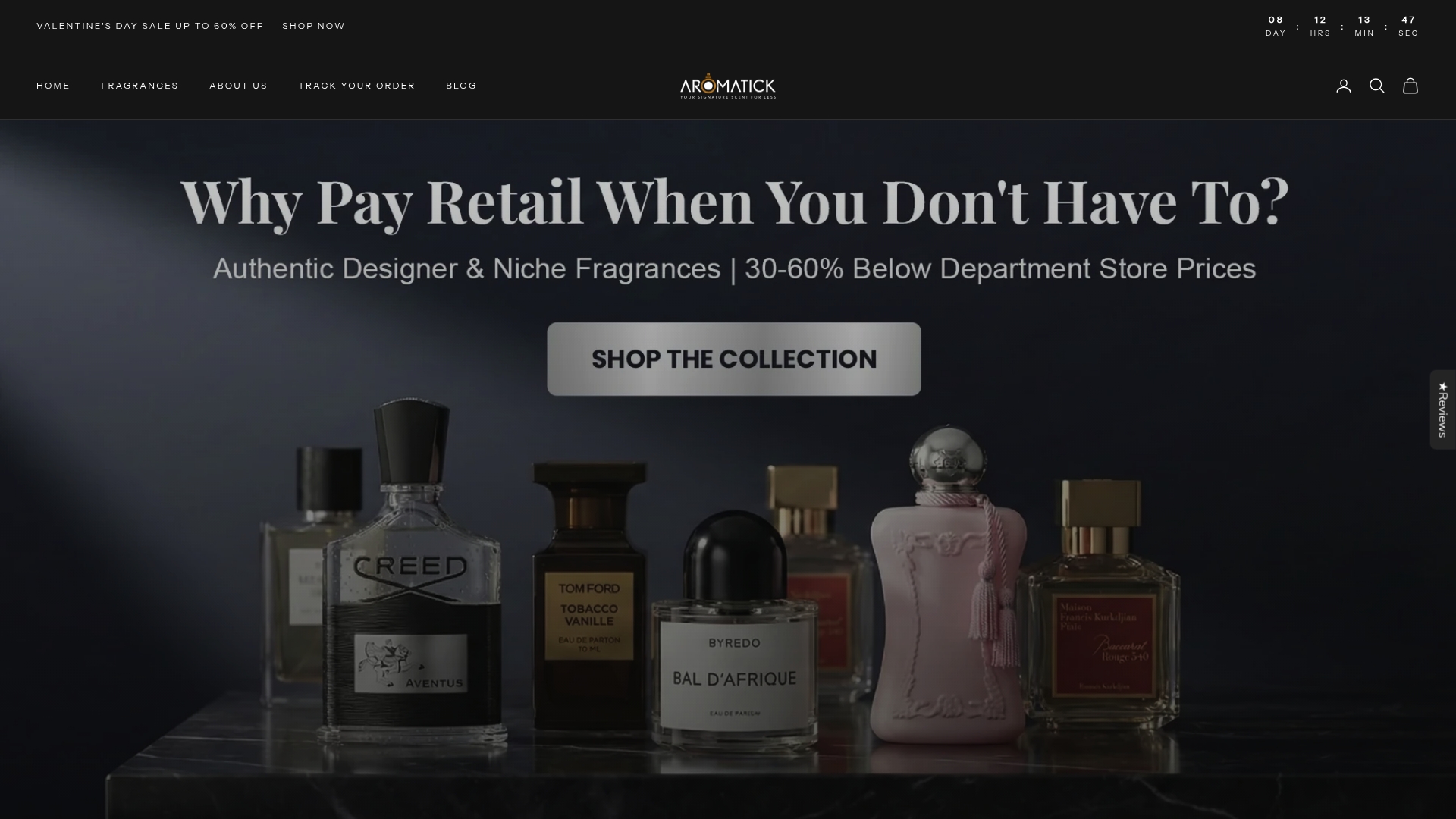
Aromatick specializes in authentic designer and niche fragrances at discounts of up to 60%, sourced through verifiable channels and backed by a clear authenticity guarantee. Every product in the designer fragrance collection and niche fragrance collection is supported by transparent policies on returns, shipping, and customer support. Free shipping, secure payments, and a satisfaction-focused approach mean you can apply your new verification habits confidently, knowing the retailer is working with you rather than against you.
Frequently asked questions
How do I know if an online perfume store is selling authentic products?
Reputable sellers support trust through batch code consistency, accurate packaging details, and clear store policies. Authenticity inspection is practical for any buyer: compare the received bottle against known packaging standards and verify the batch code using a free online checker.
What makes a discount legitimate versus risky on perfume websites?
Legitimate discounts are explained by the seller through mechanisms like overstock, parallel import, or older packaging versions. Extreme pricing with no rationale, no real product images, and no batch code information are the clearest red flags.
Can I safely buy perfumes from third-party marketplaces?
It is riskier than buying directly. Supply-chain documentation gaps and inconsistent customer support are more common with third-party sellers, even on well-known platforms. Direct retailers with verifiable identities offer significantly higher confidence.
Are sample or subscription models safer for trying niche perfumes?
Yes. Subscription and sample models let you evaluate both authenticity and scent performance before investing in a full bottle, shifting the trust question from theoretical to experiential with minimal upfront cost.

Leave a comment
This site is protected by hCaptcha and the hCaptcha Privacy Policy and Terms of Service apply.