

Gourmand Scent: Edible Fragrances Explained
A gourmand scent is a perfume designed to smell intentionally edible, built around notes that evoke desserts, baked goods, and sweet confections rather than flowers, woods, or fresh air. Think of it as an olfactory dessert) that you wear on your skin. Three perfumes define the category for most shoppers:
- Angel by Thierry Mugler (1992): The landmark modern gourmand, built on a patchouli-and-cotton-candy accord that changed how the industry thought about edible notes.
- La Vie Est Belle by Lancôme: A warm iris and praline composition that made gourmand accessible to mainstream buyers worldwide.
- Lolita Lempicka by Lolita Lempicka: A violet-and-licorice gourmand with a distinct anise-sweet character that sits somewhere between floral and dessert.
The family is constructed around synthetic aroma molecules, most notably vanillin (the primary vanilla compound) and maltol (a caramelized, cotton-candy sweetener), layered over structural base notes that keep the scent wearable rather than literally food-like.
Key Takeaways
Gourmand fragrances are defined by edible inspiration and specific aroma molecules, not simply by sweetness, and they wear best when tested properly on skin over time.
| Point | Details |
|---|---|
| Core definition | A gourmand scent mimics food or dessert aromas using synthetic molecules like vanillin, maltol, and coumarin. |
| Historical landmark | Angel by Thierry Mugler (1992) is credited as the first modern gourmand and established the category’s template. |
| Sweet vs. gourmand | Sweetness is a sensory impression; gourmand is a fragrance family defined by edible accords, which can include savory or bitter notes. |
| Testing rule | Wait 30–60 minutes on skin before judging a gourmand; the drydown reveals the true character of the base notes. |
| Aromatick | Aromatick carries authentic designer and niche gourmand fragrances, including decants and discovery sets, at significant discounts off retail. |
Table of Contents
- What makes a fragrance genuinely gourmand?
- Common edible notes and the molecules behind them
- Famous gourmand perfumes and what makes each one edible
- How gourmand fragrances typically wear on skin
- Is a sweet scent the same as a gourmand?
- How to choose and test a gourmand fragrance
- Why gourmands deserve more credit than they get
- Authentic gourmand fragrances at a real discount
- Useful sources
What makes a fragrance genuinely gourmand?
Sweetness alone does not make a perfume gourmand. A floral perfume can smell sugary without belonging to this family at all. The defining criterion is edible inspiration: the composition is built around notes that consciously mimic food, confections, or beverages, creating what perfumers call an “olfactory dessert” effect.
Thierry Mugler’s Angel, launched in 1992, is widely credited as the first modern gourmand perfume. Before Angel, the idea of building a fine fragrance around caramel and cotton candy was considered gimmicky. Angel proved the opposite, and the category has grown steadily ever since.
Structurally, a gourmand fragrance typically works in layers:
- Non-edible base notes: patchouli, musk, sandalwood, or amber that anchor the composition and prevent it from smelling like a bakery counter.
The interplay between the edible accord and the structural base is what separates a well-crafted gourmand from a cloying novelty. Without patchouli or musk underneath, a vanilla-heavy composition has nowhere to go and tends to feel flat or overwhelming after an hour.
Gourmands also carry a psychological dimension. Research from the Odeuropa encyclopedia notes that these scents are engineered to trigger comfort and craving, combining nostalgia for childhood treats with adult indulgence. That comfort signal is a significant part of why the category has remained commercially strong for three decades.
Common edible notes and the molecules behind them
Understanding the building blocks of a gourmand helps you read a note list with confidence. Most of the “edible” character in these perfumes comes from a small set of synthetic aroma molecules, each with a distinct sensory role.
- Caramel and maltol/ethyl maltol: Maltol and ethyl maltol are the workhorses of caramelized sweetness. Ethyl maltol in particular creates a cotton-candy effect at very low concentrations. Perfumers treat these molecules as “sweeteners” for scent: even a fraction of a percent can shift a composition from floral to dessert-like.
- Coconut and lactones: Gamma-decalactone and related lactones recreate creamy, milky coconut. They appear in gourmand blends as softening agents that add roundness without adding more sugar.
Most of these compounds are synthesized in a lab rather than extracted from food. That is not a shortcut: it is how perfumers create fantasy food accords that smell more idealized than any actual dessert could.
Pro Tip: When testing a new gourmand, scan the note list for maltol, coumarin, lactones, or tonka bean. Any two of those together almost guarantee a dessert-like drydown, even if the top notes open with something fruity or floral.
Famous gourmand perfumes and what makes each one edible
These are the reference points most fragrance lovers and industry professionals reach for when explaining the category.
- Angel, Thierry Mugler (1992): The original modern gourmand. Its accord of ethyl maltol (cotton candy), patchouli, and caramel created a template the industry has been riffing on ever since. The patchouli keeps it from reading as pure confection.
- A*Men, Thierry Mugler: The masculine counterpart to Angel, built on coffee, tar, and caramel over a woody base. It demonstrates that gourmand notes work just as effectively in darker, more resinous compositions.
- La Vie Est Belle, Lancôme: A praline and iris heart over a warm vanilla-patchouli base. It became one of the best-selling women’s fragrances globally by making the gourmand family feel elegant rather than playful.
- Lolita Lempicka, Lolita Lempicka: Violet, licorice, and vanilla over a woody base. The anise note gives it an unusual savory-sweet character that sits at the edge of the gourmand family.
- Euphoria, Calvin Klein: A darker, more sensual gourmand built on pomegranate, black orchid, and amber. The edible quality here is subtle, closer to a ripe fruit preserve than a dessert, which makes it a useful example of how gourmand notes can be restrained.
- Viktor & Rolf: The brand has launched several gourmand-forward compositions that push the category toward abstract sweetness, using high concentrations of ethyl maltol and musks to create a skin-like, edible warmth rather than a literal food accord.
For a broader look at which of these and similar popular designer scents are trending right now, Aromatick’s editorial guide covers recent launches across the category.
How gourmand fragrances typically wear on skin
Gourmands behave differently from florals or fresh scents, and knowing what to expect helps you wear them well.
- Seasonality: Fall and winter are the natural home of heavy gourmands. Cool air slows diffusion, which means the sweet base notes linger close to the skin and project gently rather than overwhelming a room. Lighter gourmands with fruity or watery top notes can work in spring or on cool evenings year-round.
- Projection and longevity: Vanillin and coumarin are fixative molecules, meaning they slow the evaporation of other compounds around them. As a result, gourmands often last longer on skin than comparable florals or citrus scents, and the base notes can persist for six to eight hours or more.
- Layering caution: Avoid applying a gourmand over heavily scented vanilla body lotion or sweet shower gel. The combined sweetness can tip from warm and inviting into cloying within an hour.
- Application points: Pulse points (wrists, inner elbows, base of the throat) work well. Because gourmands tend to be base-heavy, applying to warm skin helps the top notes open properly before the composition settles.
- Occasion guidance: A rich praline or chocolate gourmand reads as intimate and sensual, which makes it well-suited to evenings, date nights, or cooler weekend days. For office wear, look for lighter gourmands where the edible notes are balanced by citrus or clean musks. The gender-neutral fragrance trend has also brought more unisex gourmands to market, many of which are calibrated for daytime wear.
Is a sweet scent the same as a gourmand?
No, and the distinction is worth understanding before you shop. “Sweet” describes a sensory impression; “gourmand” describes a fragrance family defined by edible inspiration and specific aroma molecules.
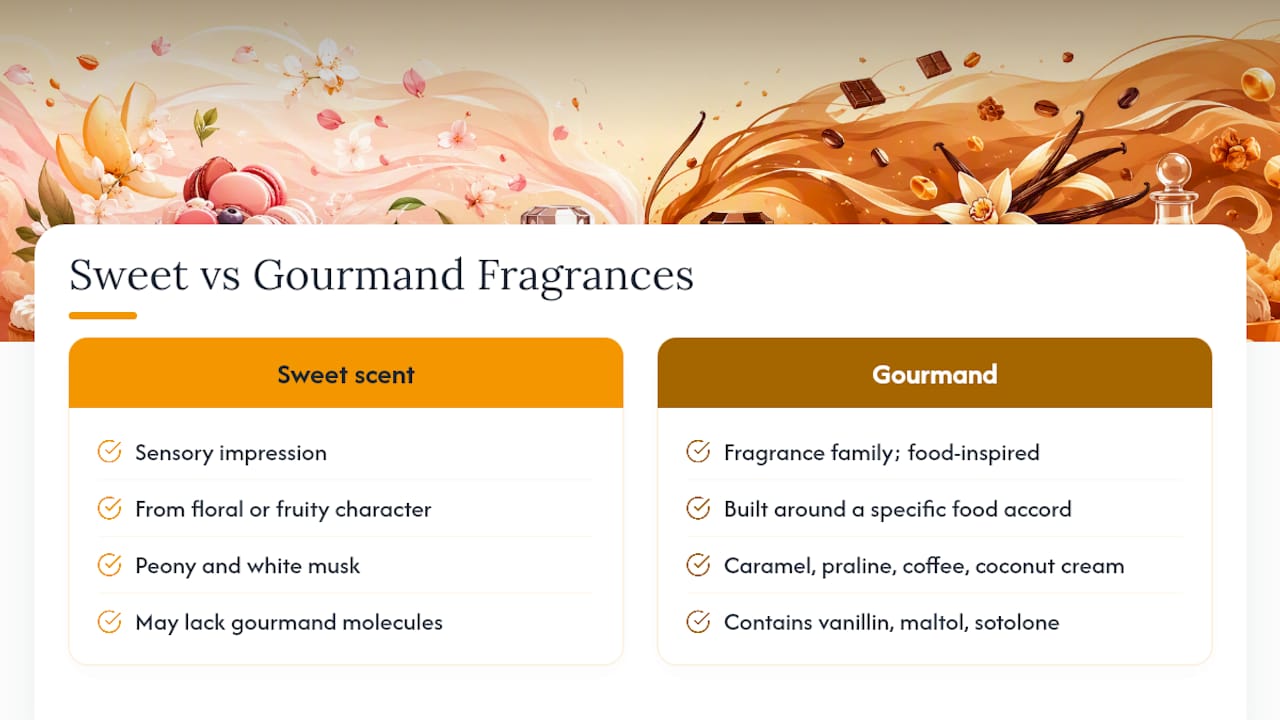
A floral perfume built around peony and white musk can smell sweet without containing a single gourmand molecule. The sweetness comes from the floral character itself, not from vanillin, maltol, or a praline accord. Conversely, some gourmands are not particularly sugary: a coffee-and-tobacco composition or a savory-maple accord built on sotolone qualifies as gourmand because its inspiration is edible, even though it reads as bitter or smoky rather than sweet.
Harper’s Bazaar Australia notes that modern gourmands increasingly include non-sugary edible profiles, including salty, savory, bitter, and spicy accords. The category is defined by food inspiration, not sugar content.
A useful shorthand: if the perfume is built around an accord that mimics a specific food or beverage (caramel, praline, coffee, coconut cream), it is gourmand. If it simply smells pleasant and sweet because of its floral or fruity character, it is not.
The same logic separates gourmand from oriental or amber fragrances. Orientals use vanilla and resins for warmth and depth, but the intent is not to smell edible. A gourmand takes that same vanilla and builds a composition around it as the primary food reference.
How to choose and test a gourmand fragrance
Testing a gourmand properly takes more time than testing a fresh or floral scent. The edible character often does not reveal itself fully until the base notes develop, which can take 30–60 minutes on skin.
- Wait at least 30–60 minutes before deciding. Blank Body Beauty specifically notes that gourmands can smell cloying at first application but settle into a wearable warmth once the heart and base notes develop. First impressions are often misleading.
Pro Tip: Vanilla-forward gourmands often smell stronger in warm weather because heat amplifies projection. If a fragrance feels too sweet on a warm day, try it again in cooler temperatures before writing it off.
The vanilla note’s cultural staying power extends beyond fine fragrance. The same comfort psychology that drives gourmand perfume sales also explains why vanilla scented candles remain a perennial home fragrance bestseller.
Why gourmands deserve more credit than they get
The gourmand family is probably the most misunderstood category in fine fragrance. Serious collectors sometimes dismiss these scents as commercial or unsophisticated, which misses the point entirely. Building a praline accord that smells genuinely luxurious rather than like a candy store requires real technical skill. The balance between ethyl maltol and patchouli in Angel, for example, is precise enough that a small formulation change in either direction would collapse the whole composition.
What the category actually represents is perfumery’s most direct engagement with human psychology. The Odeuropa encyclopedia documents how food-related scents trigger comfort and desire in ways that abstract florals or green accords simply do not. Perfumers working in this space are not taking the easy route; they are working with molecules that have very little margin for error.
The other underappreciated aspect is versatility. The assumption that gourmands are exclusively feminine, heavy, and seasonal is outdated. A*Men by Thierry Mugler has been a benchmark masculine gourmand for years. Niche houses are producing coffee, tobacco, and savory-grain compositions that qualify as gourmand without a trace of sugar. If you have avoided the category because you assumed it meant “smells like dessert,” it is worth revisiting with a broader definition in mind.
Authentic gourmand fragrances at a real discount
Knowing what a gourmand scent is and finding one you actually want to wear are two different challenges. Aromatick makes the second part straightforward: the site carries authentic designer fragrances at 30–60% off retail pricing, including many of the gourmand classics covered in this article.

Every bottle is guaranteed authentic, and Aromatick ships directly to customers, cutting out the department store markup without cutting corners on quality. Discovery sets and decants are available for shoppers who want to test a gourmand properly before buying a full bottle, which is exactly the approach this article recommends. Free shipping is available over the order threshold, and a satisfaction guarantee backs every purchase. Browse the niche fragrance collection if you want to go beyond the mainstream gourmand classics and find something less familiar.
Useful sources
- Gourmand Perfumery: Most Popular Fragrance Agents - olfactive aesthetics
- PubChem
- Gourmand - The Perfume Society
- What Are Gourmand Fragrances? The Perfume Trend Explained
- Gourmand - Note Profile | ScentVerdict
- What is Gourmand Fragrance? Definition, Key Notes, & Types
- Odeuropa encyclopedia

Leave a comment
This site is protected by hCaptcha and the hCaptcha Privacy Policy and Terms of Service apply.