
Gender-neutral fragrance: what it means and how to choose
TL;DR:
- Gender-neutral fragrances are transforming perfumery by focusing on personal preference rather than traditional gender labels. They emphasize creative freedom, emotional connection, and individual skin chemistry, resulting in diverse and unrestricted scent options. This shift reflects a broader cultural move toward inclusivity and authentic self-expression in fragrance choices.
Walk through any department store fragrance counter and you’ll still see shelves divided into neat categories: one side for women, the other for men. But that division is dissolving faster than a citrus top note on a warm summer day. Gender-neutral fragrance has moved from a niche curiosity into one of the most exciting conversations in perfumery, and if you’re a fragrance enthusiast looking to expand your collection beyond traditional categories, you’re in exactly the right place. This guide breaks down what gender-neutral fragrance actually means, how it works with your skin, and how to choose scents that feel genuinely personal.
Table of Contents
- What is gender-neutral fragrance?
- How gender-neutral fragrances work with your skin
- Why are gender-neutral fragrances trending?
- How perfumers design truly genderless scents
- Tips for choosing your next gender-neutral scent
- A fresh perspective on gender-neutral fragrance
- Discover your next gender-neutral signature scent
- Frequently asked questions
Key Takeaways
| Point | Details |
|---|---|
| Not just a blend | Gender-neutral fragrances are crafted for anyone and focus on creativity, not compromise. |
| Chemistry matters | How a scent interacts with your skin is more important than traditional gender labels. |
| Trend with staying power | Consumer demand and market data show gender-neutral fragrance is here to stay. |
| Sampling is key | Always test on your own skin for a personal, authentic experience. |
What is gender-neutral fragrance?
The fragrance industry has marketed scent by gender for well over a century. Floral, powdery, and sweet notes were packaged as feminine. Woody, smoky, and leather accords were labeled masculine. Bottle shapes, color palettes, and advertising reinforced these divisions until they felt natural, even logical. They aren’t.
As the why unisex fragrances matter conversation has grown, so has the awareness that these categories were always a marketing construct rather than a chemical reality. A rose can smell powerful and assertive. An oakmoss can feel intimate and soft. Notes don’t carry gender; the stories we tell around them do.
“Gender-neutral (unisex) fragrance generally means a perfume formulated without a target gender, designed to be worn based on preference rather than whether the wearer is ‘male’ or ‘female.’”
The practical implication is significant. When a perfumer creates a gender-neutral fragrance, the creative brief doesn’t include questions like “will this appeal to women aged 25 to 40?” It focuses on the scent itself: its balance, its emotional effect, its evolution on skin.
Here’s a clear comparison of how gendered and gender-neutral fragrances differ across key dimensions:
| Feature | Gendered fragrance | Gender-neutral fragrance |
|---|---|---|
| Target market | Defined by gender demographics | All wearers, based on preference |
| Design philosophy | Gender-coded note selection | Balance, emotion, and creativity |
| Marketing language | “For him” or “for her” | “For everyone” or simply the scent itself |
| Bottle and packaging | Strongly gendered visual cues | Abstract, architectural, or minimal design |
| Note palette | Restricted by gender convention | Broad and unrestricted |
| Pricing positioning | Often split into separate lines | Unified, single collection |
Several core motivations drive both brands and consumers toward this shift:
- Inclusivity: Fragrance is deeply personal, and limiting choices by gender excludes people from scents they might love.
- Creative freedom: Perfumers can draw from the full palette of ingredients without being constrained by market expectations.
- Skin chemistry focus: Because the same fragrance smells different on different people, the focus shifts to personal evolution rather than prescribed identity.
- Collector mentality: Enthusiasts seeking rare and niche options naturally gravitate toward fragrance libraries that ignore gender conventions entirely.
How gender-neutral fragrances work with your skin
Once you understand what defines gender-neutral fragrance, it’s key to see how these scents behave in real life, on your own skin.
Skin chemistry plays a central role in how any fragrance develops over time. Your skin’s pH level, natural oils, temperature, and even your diet can subtly alter how a fragrance opens, evolves through its heart, and settles into the base. This is why the same bottle of a woody musk can smell warm and resinous on one person and clean and airy on another. Gender-neutral fragrances often lean into this variability intentionally, choosing notes that are especially responsive to individual skin chemistry.

Here’s how common gender-neutral note families tend to evolve across different skin types:
| Note family | Dry/low-oil skin | Normal skin | Oily/warm skin |
|---|---|---|---|
| Citrus (bergamot, lemon) | Fades quickly, light opening | Bright and balanced | Amplified but short-lived |
| Woods (sandalwood, cedar) | Clean and subtle | Warm and present | Rich and intense |
| Musks (white musk, skin musk) | Soft and intimate | Smooth and wearable | Bold and long-lasting |
| Green/aromatic (vetiver, herbs) | Sharp and precise | Fresh and rounded | Earthy and deep |
| Resins/balsams (amber, benzoin) | Delicate and sweet | Warm and slightly sweet | Deeply warm, almost gourmand |
A few common questions fragrance lovers ask about gender-neutral scents and skin:
- Does skin type affect longevity? Yes. Oilier skin tends to hold fragrance longer because the natural oils bind with the aromatic molecules.
- Can two people wear the same gender-neutral scent and have it smell totally different? Absolutely, and this is part of the appeal.
- Do gender-neutral scents “lean” masculine or feminine on certain skin types? Some do. A woody base might project more intensely on warmer skin, while a floral heart might dominate on cooler, drier skin.
To explore how different note families settle across skin types, the fragrance families explained guide is an excellent starting point. For tips on maximizing how long a scent lasts on your specific skin, the fragrance longevity guide covers practical techniques in detail.
Pro Tip: Always test a gender-neutral fragrance on your skin rather than a paper blotter. Blotters only capture the opening accord; your skin reveals the full story from top to base notes.
Why are gender-neutral fragrances trending?
Understanding the personal appeal is one side. The boom in gender-neutral scents happens within a broader cultural and market context that’s worth knowing.
Consumer research indicates that 34% of consumers now prefer gender-neutral fragrance, with launch activity growing at a remarkable 57% compound annual growth rate over a recent five-year period, particularly across European markets.
Those are striking numbers. They reflect something more than a passing fashion. Several forces are converging to make this movement durable rather than fleeting:
-
Individuality as a purchasing driver. Today’s fragrance buyers, especially niche and designer enthusiasts, want scents that reflect who they are, not which demographic box they tick. A scent is a personal statement, not a uniform.
-
Social and cultural inclusivity. As conversations about gender identity evolve in mainstream culture, fragrance brands have found that gender-neutral positioning resonates with a wider audience and signals values around openness and respect.
-
Creative expansion in niche perfumery. Niche houses have long pushed boundaries that mass-market brands couldn’t. The benefits of niche perfumes include exactly this kind of creative daring: rare ingredients, unconventional accords, and formulations that don’t follow a commercial playbook.
-
Collector and enthusiast culture. Fragrance collecting has grown significantly. Collectors pursue depth, uniqueness, and rarity. A gender-neutral portfolio offers more to discover because the entire note palette is available.
-
Digital fragrance communities. Online communities dedicated to fragrance have accelerated awareness and sampling culture. Members share reviews without gendered framing, which normalizes wearing any scent regardless of how it was originally marketed.
The broader point is this: breaking free from gendered scents isn’t just a personal preference anymore. It’s where the most interesting creative work in perfumery is happening, and the market is recognizing it.
How perfumers design truly genderless scents
Curious how genderless scents are crafted? Let’s take a look at what perfumers are actually doing.
There’s an important distinction between two approaches to gender-neutral fragrance. The first is the blending approach: taking what’s perceived as a masculine element, like leather or tobacco, and pairing it with a feminine counterpart, like rose or iris, to find a supposed middle ground. This produces a scent that tries to appeal to everyone but often feels like a negotiation rather than a vision.
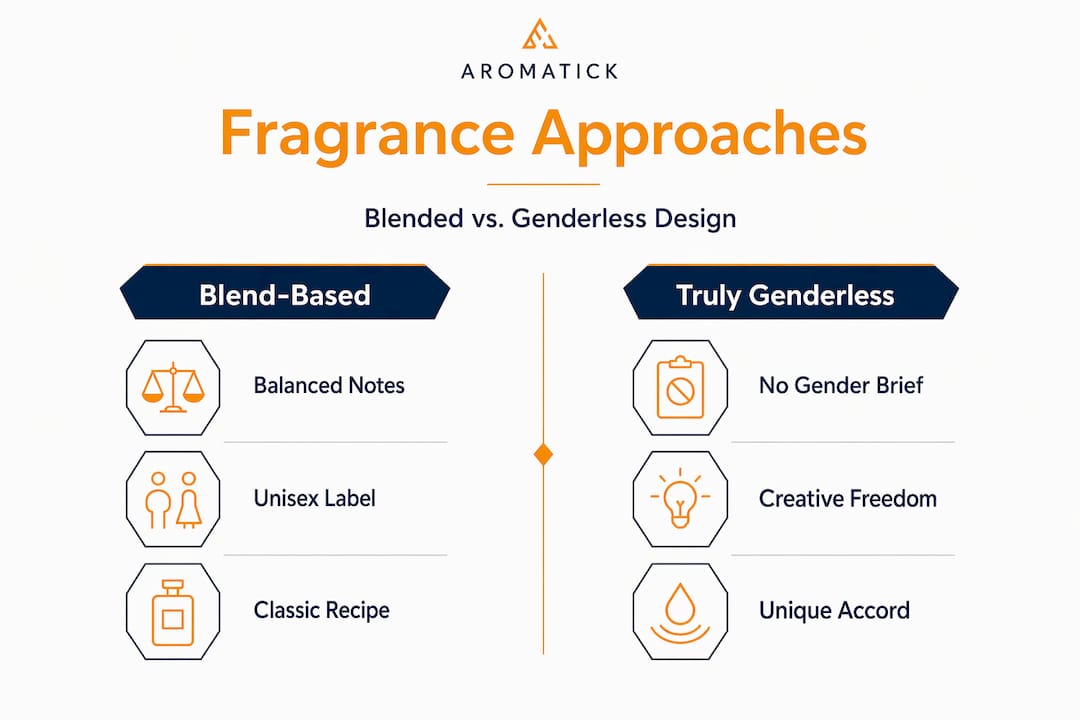
The second, more genuinely innovative approach involves designing around a creative brief that never considered gender at all. As one industry perspective notes, truly genderless fragrances “are positioned as more than a compromise blend; they may be designed around a different creative brief where gender cues do not enter the design decisions.” The starting point is coherence, emotion, or function: a scent that evokes morning light, ocean spray, a library filled with aged books, or the mineral sharpness after rain.
| Design approach | Starting point | Note philosophy | Result |
|---|---|---|---|
| Blend-based “unisex” | Balance masculine and feminine | Counterpoint: pair opposites | Middle-ground appeal |
| Genderless creative brief | Emotion, concept, or material | Follow the creative vision | Unique, unrestricted expression |
| Skin-focused design | Individual scent evolution | Reactive and personal notes | Different on every wearer |
Niche houses tend to embrace the second and third approaches more naturally. A niche perfumer designing around the smell of dry stone walls in Tuscany isn’t thinking about gender. The concept drives everything. Mainstream brands have followed, with several major houses launching dedicated genderless lines that operate under the same creative philosophy.
Pro Tip: When you’re shopping for a truly genderless experience, look for brands whose press materials and fragrance notes focus entirely on concept, material, or emotion. If the copy doesn’t mention gender at all, that’s often a good sign the brief didn’t either.
Exploring niche perfume benefits gives you a broader sense of what these independent creative houses bring to the category and why they often lead the conversation.
Tips for choosing your next gender-neutral scent
All this theory means little if you can’t apply it. Here’s how to make gender-neutral fragrance a successful addition to your collection.
-
Start with your favorite note families. If you already love sandalwood or vetiver, seek out gender-neutral fragrances built around those materials. Familiarity with a base note makes it easier to explore what surrounds it.
-
Research the creative brief. Read the brand’s description of what inspired the fragrance. If it focuses on place, texture, memory, or emotion rather than who should wear it, it’s likely genuinely genderless in its construction.
-
Always sample on skin. As noted earlier, paper blotters don’t tell the full story. Order a sample or travel size, wear it through the day, and pay attention to how it evolves from the opening brightness to the dry-down.
-
Consider the occasion. Some gender-neutral scents are bold and projecting, built for evenings or statement moments. Others are soft and intimate, ideal for daily wear. Knowing your context helps narrow the search.
-
Pay attention to the dry-down. The base notes, which emerge after 30 to 60 minutes on skin, tell you whether a fragrance will feel comfortable for extended wear. A dry-down that feels wrong is harder to ignore than an opening that takes time to warm up.
-
Don’t ignore projection and sillage. Skin-specific evolution means a scent that stays close to the skin on one person might project strongly on another. If you want a fragrance that others notice, test at arm’s length as well as close.
-
Layer and experiment. Gender-neutral scents are often excellent candidates for layering because they don’t carry the heavy gendered cues that can clash with other fragrances.
Pro Tip: Step fully outside your usual preferences at least once. Try a fragrance in a family you’ve never explored, whether that’s a smoky incense, a green aromatic, or a mineral chypre. The most memorable discoveries often come from unexpected directions.
The fragrance selection guide walks through a practical process for narrowing down choices, and the fragrance family guide gives you the vocabulary to describe what you’re looking for with precision.
A fresh perspective on gender-neutral fragrance
Here’s something the mainstream conversation about gender-neutral fragrance gets consistently wrong: the assumption that “genderless” means neutral. Not neutral in the sense of inoffensive or beige. That misreading leads people to expect a safe middle ground and then feel confused when a supposedly genderless fragrance is bold, polarizing, or deeply distinctive.
Genuinely genderless fragrance, the kind designed without gender cues entering the creative brief at all, is often more opinionated, not less. It stakes a position on a texture, a material, an emotional state, rather than on demographic appeal. That’s precisely why these creative briefs produce such memorable results. They’re not trying to satisfy a broad audience; they’re trying to realize a vision.
The practical lesson for the passionate collector: stop reading the label and start trusting your nose. A fragrance marked “pour femme” might be the most interesting woody smoke you’ve encountered. A classic men’s fougère might sit beautifully alongside your floral collection. The label describes the original marketing intent, not the scent’s actual personality or its potential on your skin.
The collectors who build the most interesting fragrance wardrobes approach every new scent with curiosity and openness, treating the nose as the only authority. Seeking out expert niche selection tips can help you refine that process and discover houses whose creative philosophy aligns with genuine genderless thinking.
Discover your next gender-neutral signature scent
If this guide has sparked your curiosity, the next step is finding the actual fragrances that match your vision.

At Aromatick, we carry an extensive range of authentic designer and niche fragrances, including a strong selection of gender-neutral and all-gender options, at discounts of up to 60% off retail prices. Whether you’re drawn to the creative complexity of our niche fragrances, the familiar prestige of our designer fragrance collection, or want to explore the distinctive creations in the Fragrance World collection, you’ll find genuine products with no compromise on quality. Free shipping, secure payments, and a satisfaction guarantee mean you can explore confidently and find your next signature scent.
Frequently asked questions
Are gender-neutral fragrances really unisex, or is there a difference?
“Gender-neutral” and “unisex” are often used interchangeably, but there is a meaningful distinction. Unisex traditionally meant blending masculine and feminine elements, while truly gender-neutral fragrances are designed without gender as a reference point at all.
How do I test a gender-neutral fragrance before buying?
Apply the fragrance to your wrist or inner elbow and wear it through the day, because the same fragrance evolves differently on each person’s skin due to individual chemistry, and the dry-down is what you’ll actually live in.
What notes are common in gender-neutral fragrances?
Citrus, white musks, woods like sandalwood and cedar, vetiver, and green aromatic notes appear most frequently, though the category is intentionally unrestricted and includes rich florals, resins, and smoke equally.
Are gender-neutral scents a trend or here to stay?
The sustained growth in launches and rising consumer preference figures point strongly toward lasting mainstream acceptance rather than a passing trend.

Leave a comment
This site is protected by hCaptcha and the hCaptcha Privacy Policy and Terms of Service apply.