
How fragrance longevity works: unlock lasting scents
TL;DR:
- Fragrance longevity depends on molecular chemistry, skin condition, environmental factors, and application methods.
- Well-hydrated skin and proper skincare routines significantly extend scent life and projection.
- Concentration, note composition, and layering strategies influence how long a fragrance lasts on skin or clothing.
You spray a luxury fragrance in the morning, and by noon it seems like it never existed. Yet your friend wearing what appears to be a simpler scent still smells incredible eight hours later. This puzzling experience frustrates even seasoned fragrance collectors. The truth is, lasting power is not purely about price or prestige. A quiet interaction between molecular chemistry, your skin biology, environmental conditions, and application technique governs every scent’s lifespan. Understanding these layers transforms how you choose, wear, and enjoy fragrances, turning a hit-or-miss experience into a genuinely satisfying one.
Table of Contents
- The science behind fragrance longevity
- The vital role of your skin
- Fragrance composition: Notes, concentration, and performance
- Environmental and application factors
- Why most longevity advice misses the real secret
- Explore our collections for lasting fragrances
- Frequently asked questions
Key Takeaways
| Point | Details |
|---|---|
| Molecule volatility rules | The life of your fragrance depends on how fast different aroma molecules evaporate from your skin. |
| Skin prep is crucial | Hydrated, conditioned skin can dramatically increase how long scents last. |
| Composition matters | Perfume note structure and oil concentration control the scent’s duration and evolution. |
| Environment impacts wear | Heat, humidity, and your application habits all influence longevity and sillage. |
The science behind fragrance longevity
Fragrance longevity, sillage, and projection are three terms that often get used interchangeably, but they mean very different things. Longevity refers to how long a scent persists on your skin or clothing. Sillage (pronounced see-yazh) is the scent trail you leave behind as you move through a room. Projection describes how strongly and how far a fragrance radiates outward from your body. As longevity and sillage are shaped by both molecular and environmental factors, understanding them separately gives you a real edge in choosing and wearing your scents smarter.
At the core of longevity is what chemists call the volatility curve. Every fragrance is built in layers: top notes, heart notes, and base notes. Top notes hit immediately after spraying. They are typically light, bright molecules like citrus or green herbs that evaporate within 15 to 30 minutes. Heart notes emerge next, lasting from one to four hours, and they form the true character of the fragrance. Base notes are the heaviest, most complex molecules. They anchor the composition and can persist for six hours or more.
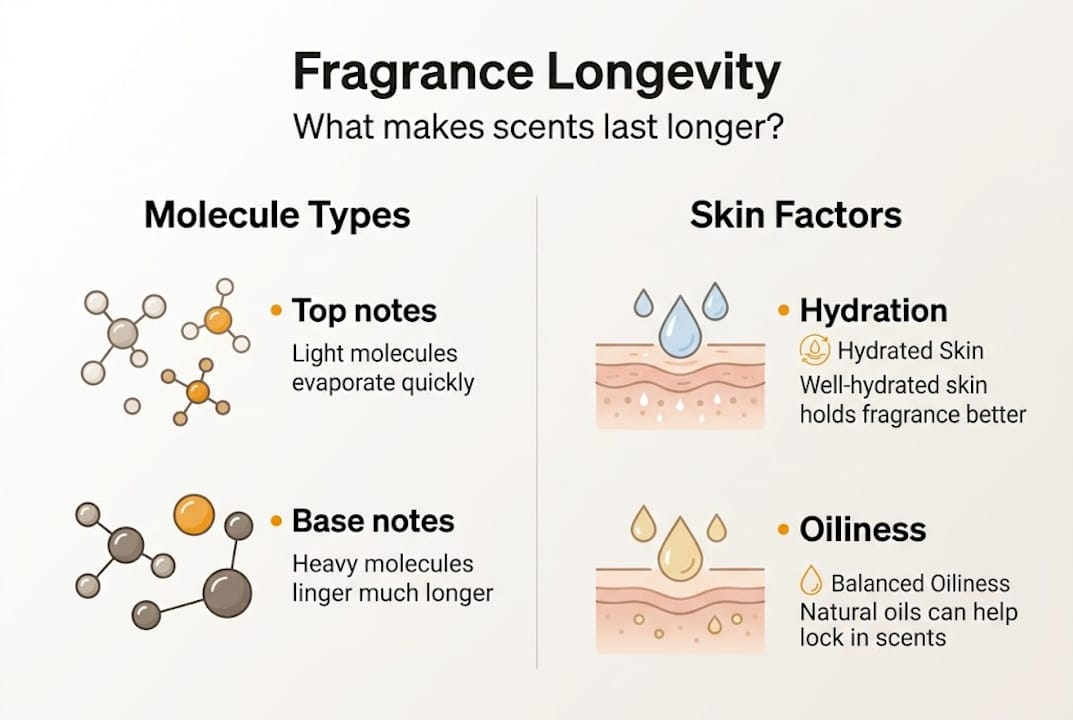
The volatility of aroma molecules determines how long each layer persists, with skin properties significantly affecting release profiles. Molecules with high lipophilicity (an affinity for oils and fats) tend to bond more readily with skin’s natural oils, extending their presence. Heavier molecules like musks, woods, and resins have low volatility and remain detectable long after lighter molecules have disappeared.
Major factors affecting molecule evaporation:
- Molecular weight: heavier molecules evaporate more slowly
- Lipophilicity: oil-loving molecules cling to skin longer
- Vapor pressure: lower vapor pressure means slower release into the air
- Skin temperature: warmer skin accelerates evaporation
- Skin surface moisture: affects how molecules bind and release
For a deeper look at how these principles translate into real-world choices, the guide on choosing lasting scents breaks it down practically. You can also find a broader overview in the fragrance longevity explained resource.
| Note type | Evaporation speed | Typical duration |
|---|---|---|
| Top notes | Fast | 15 to 30 minutes |
| Heart notes | Moderate | 1 to 4 hours |
| Base notes | Slow | 4 to 10+ hours |
The vital role of your skin
While the molecules set the stage, your skin dramatically changes the show. Skin is not a passive surface. It is a living, dynamic canvas that actively interacts with fragrance molecules in ways that significantly alter how a scent performs.
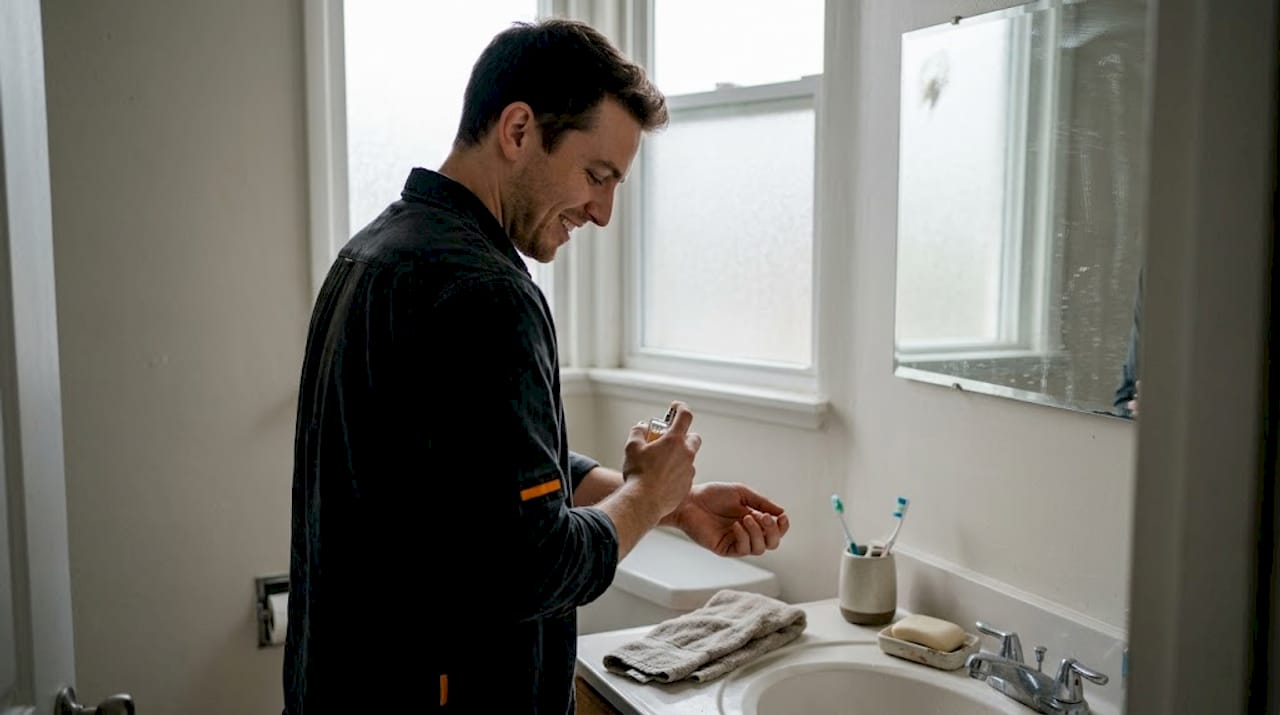
One of the most important variables is hydration. Well-hydrated skin decreases the rate of evaporation and increases scent longevity, while dry skin accelerates fade. This happens because dry skin has a compromised moisture barrier, increasing Trans-Epidermal Water Loss (TEWL), which is the rate at which water escapes through your skin. When TEWL is high, fragrance molecules are pulled away from the surface more quickly, shortening the overall scent life.
| Skin condition | TEWL rate | Fragrance longevity |
|---|---|---|
| Well-hydrated | Low | Extended, up to 30% longer |
| Dry/rough | High | Noticeably shorter |
| Oily | Moderate | Slightly improved grip |
Beyond hydration, skin oiliness plays a supporting role. Naturally oily skin tends to hold fragrance better because the lipophilic molecules in the scent bond with surface oils. Body temperature is another real factor: warmer pulse points like the neck, wrists, and inner elbows accelerate molecular diffusion, helping the fragrance radiate more effectively.
Pro Tip: Before applying fragrance, apply an unscented moisturizer to your pulse points. The added lipid layer gives aroma molecules something to grip, noticeably extending wear time. Avoid heavily scented lotions that compete with your fragrance.
Simple routines for preparing skin to maximize longevity:
- Shower before applying fragrance to open pores and clean the skin surface
- Apply an unscented body lotion or oil while skin is still slightly warm
- Focus moisturizer on pulse points: wrists, neck, inner elbows, and behind the knees
- Allow lotion to absorb fully before spraying fragrance
- Avoid excessively dry environments immediately after application
For more practical guidance, the resource on secrets to perfume longevity covers these preparation strategies in detail. You can also learn more from the article on applying perfume for longevity.
Fragrance composition: Notes, concentration, and performance
Equally important is what’s inside the bottle. The composition and concentration of a fragrance create its performance parameters before a single molecule ever touches your skin.
Concentration is where most people first look, and for good reason. Fragrances are classified by how much aromatic oil they contain. Eau de Cologne (EDC) typically contains 2 to 4% aromatic oil. Eau de Toilette (EDT) holds 5 to 15%. Eau de Parfum (EDP) ranges from 15 to 20%, and Parfum (or extrait) sits at 20 to 40%. Higher concentration means more fragrance material per spray, which generally translates to longer wear. The longevity and sillage of any scent are directly shaped by this concentration alongside its molecular composition.
“The volatility and lipophilicity of specific aroma molecules create different lifespans for top, middle, and base notes, making the formulation itself the primary driver of longevity.” (PMC Technical Paper)
Here is how a fragrance evolves from the moment of application:
- First spray (0 to 5 minutes): Top notes explode forward, bright and vivid
- Opening drydown (5 to 30 minutes): Top notes begin fading, heart notes emerge
- Heart phase (30 minutes to 3 hours): The core identity of the fragrance is fully present
- Late drydown (3 to 6 hours): Heart notes soften, base notes take full control
- Dry base (6 hours onward): Only the most persistent base molecules remain, often as a skin-close warmth
For a clear breakdown of concentration differences, the comparison of perfume vs cologne differences is worth reading before making your next purchase.
Niche fragrances often use higher concentrations of quality raw materials and carefully selected base ingredients like iso E super, Ambroxan, or natural musks, which have exceptional staying power. Many niche houses also prioritize formulations designed to evolve beautifully over many hours, making them exceptional performers for longevity.
Pro Tip: When testing a new fragrance for longevity, spray it in the morning and check back at the four and eight hour marks. That final base note character is often what you will live with most of the day.
Environmental and application factors
After understanding the structure of fragrance, consider what you can actually control day to day for better wear.
Your environment plays a bigger role than most people realize. Heat increases molecular activity, speeding up evaporation. Dry climates strip moisture from both skin and fragrance more aggressively than humid ones. Wind physically disperses fragrance molecules away from your body faster. In humid weather, scents tend to stay closer to the skin but can project differently.
Clothing is an interesting variable. Natural fibers like cotton and wool absorb fragrance better and hold it longer than synthetic fabrics. Spraying lightly on a scarf or collar can extend your scent experience significantly beyond what skin alone achieves.
Top application tips to extend scent life:
- Spray on pulse points where body heat boosts diffusion naturally
- Layer fragrance using matching shower gels or body creams from the same line
- Apply right after showering when skin is warm and pores are open
- Do not over-spray: two to four sprays is usually sufficient for most EDPs
- Spray lightly on clothing or hair for added longevity and sillage
- Store fragrances away from heat, light, and humidity to protect molecular integrity
The application effect on skin state acts as a performance multiplier, meaning that correct preparation and technique can dramatically extend wear without changing the fragrance itself. For more on how sillage and longevity interact, understanding sillage offers a clear explanation.
Pro Tip: Never rub your wrists together after applying fragrance. This friction generates heat that breaks apart the delicate top note molecules, collapsing the opening phase prematurely and distorting how the fragrance evolves.
Why most longevity advice misses the real secret
Here is the hard truth that most fragrance content avoids: the obsession with finding the most concentrated, most “beast mode” fragrance is often a distraction. Many fragrance enthusiasts chase EDP upgrades and niche house exclusives while ignoring the single biggest variable: their own skin condition.
Research consistently confirms that skin hydration and preparation matter enormously. A beautifully formulated fragrance applied to dry, unprepared skin will underperform compared to a simpler EDT applied to well-moisturized skin. The canvas shapes the painting.
Our position is this: invest as much thought in your skincare routine before fragrance application as you do in the fragrance itself. That shift in mindset, backed by what we know about choosing lasting scents, consistently produces better results than simply upgrading to a higher concentration. Longevity is a partnership between a well-made scent and well-prepared skin.
Explore our collections for lasting fragrances
Now that you understand how longevity really works, it’s time to put that knowledge into practice with fragrances that are genuinely built to last.

At Aromatick, we carry an extensive range of authentic designer fragrance collection options and carefully curated niche fragrance collection picks, all verified for authenticity and available at up to 60% off retail prices. Whether you are searching for a long-lasting signature scent or exploring the world of niche perfumery, our women’s perfume collection is a great place to start. Browse with confidence knowing every bottle ships with our satisfaction guarantee and secure payment protection.
Frequently asked questions
What is the difference between longevity, sillage, and projection in fragrance?
Longevity is how long the scent lasts on your skin or clothes, while sillage means scent trail and projection describes how strongly and far the scent radiates outward from your body.
How does skin type affect how long a perfume lasts?
Hydrated skin increases longevity by slowing evaporation, while dry or rough skin causes fragrance molecules to dissipate much faster. Oily skin typically holds scent slightly better than very dry skin.
Does perfume last longer on clothes or skin?
Perfume often lasts longer on fabric because clothing fibers create a slower evaporation environment than warm, moist skin, making it a smart layering strategy for extended wear.
What are the top ways to make fragrance last longer?
Apply to freshly moisturized skin, spray on pulse points, avoid rubbing the fragrance in, and consider layering with a matching body product from the same fragrance line.
Do all notes in a fragrance last the same amount of time?
No. Top notes evaporate fastest due to their high volatility, while base notes, which have much lower volatility and higher molecular weight, linger on the skin for many hours longer.

Leave a comment
This site is protected by hCaptcha and the hCaptcha Privacy Policy and Terms of Service apply.