
How to Store Fragrances and Preserve Their Quality
TL;DR:
- Properly storing fragrances in a cool, dark, and dry environment extends their shelf life and preserves scent quality. Heat, UV light, humidity, and oxygen are the primary enemies of perfume, so consistent habits like upright storage and avoiding bathrooms help maintain their integrity. The ideal storage places include bedroom closets or drawers, while refrigeration benefits citrus fragrances if done carefully, but heavy scents should be kept at room temperature.
Properly storing fragrances means keeping them in a cool, dark, and dry environment, away from heat, light, and humidity, to preserve their scent integrity and extend their shelf life. Fragrance preservation, as perfumers and chemists call it, is the single biggest controllable factor in how long your perfume lasts and how true it smells over time. Heat, UV light, humidity, and oxygen are the four primary enemies of any fragrance, whether you own a $30 drugstore cologne or a $400 niche perfume from Maison Margiela or Creed. The good news is that protecting your collection requires no special equipment. A few consistent habits make the difference between a scent that lasts years and one that turns sour in months.
How to store fragrances: what environmental factors matter most
Four environmental forces determine whether your fragrance degrades in months or stays vibrant for years. Understanding each one gives you a clear framework for every storage decision you make.
Heat is the most destructive force. Heat damages perfume within weeks when bottles sit in warm or sunny spots, accelerating the chemical breakdown of aromatic compounds. A bedroom windowsill in summer can reach temperatures that would ruin a delicate floral or citrus fragrance before the season ends.
UV light works more slowly but just as surely. UV light breaks down fragrance molecules, causing both scent alteration and visible color changes in the liquid. Even indirect sunlight filtering through a sheer curtain is enough to degrade a fragrance over several months. When you notice a perfume turning darker or more amber-toned than it originally was, UV exposure is usually the cause.
Humidity targets the delicate top notes first. Bathrooms accelerate degradation of citruses and florals faster than any other household environment, because steam and moisture promote oxidation and can physically damage labels and packaging. The irony is that most people store their perfume exactly where they apply it: on the bathroom shelf.
Oxygen is the fourth threat, and it operates from inside the bottle. Opening perfume bottles exposes the fragrance to oxygen, which triggers oxidation and scent degradation with every use. This does not mean you should never open your perfume. It means you should open it with purpose and close it firmly every time.
- Heat breaks down aromatic compounds and can ruin a fragrance within weeks
- UV light causes molecular degradation and visible color changes in the liquid
- Humidity promotes oxidation and is especially damaging to citrus and floral notes
- Oxygen exposure from opening bottles initiates slow, cumulative scent deterioration
Pro Tip: If you want a quick test for whether your storage spot is safe, leave a glass of water there for 24 hours. If it feels warm to the touch or shows condensation, find a different location for your fragrances.
Where should you store perfumes at home?
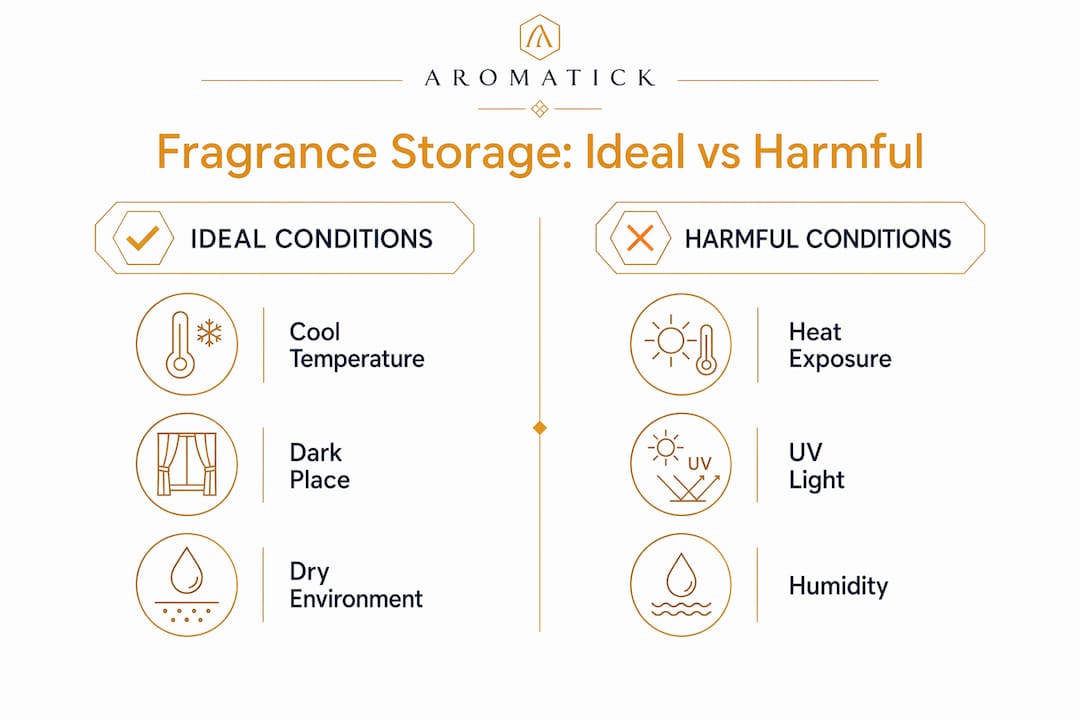
The ideal storage environment for most fragrances is a cool room between 59°F and 68°F (15°C to 20°C), with low humidity and no direct light exposure. That description fits a bedroom drawer, a closed wardrobe, or a dedicated cabinet far better than a bathroom shelf or a dressing table near a window.
Here is a practical priority order for choosing your storage location:
- Bedroom closet or wardrobe interior. Stable temperature, no light, low humidity. This is the gold standard for everyday storage and works for both designer and niche fragrances.
- Bedroom drawer. Slightly less airflow than a closet but equally dark and dry. Ideal for smaller bottles or travel sizes you reach for regularly.
- Closed cabinet in a room without direct sunlight. A living room cabinet or hallway cupboard works well, provided it stays away from radiators and heating vents.
- Original box inside any of the above. Storing bottles in their original packaging adds a physical layer of light protection and reduces temperature fluctuation. Storing upright in original boxes provides physical protection against environmental damage that no display shelf can match.
- Dedicated fragrance drawer with a cedar lining. Cedar naturally regulates humidity and repels insects, making it a practical upgrade for serious collectors.
| Storage location | Verdict |
|---|---|
| Bedroom closet or drawer | Best option: dark, cool, stable temperature |
| Closed living room cabinet | Good option if away from heat sources |
| Bathroom shelf | Avoid: high humidity and heat fluctuations |
| Windowsill or dressing table | Avoid: direct UV exposure and temperature swings |
| Kitchen counter | Avoid: heat from cooking and humidity from steam |
Keep bottles upright at all times. A bottle stored on its side puts constant pressure on the seal, which can lead to slow evaporation and leakage over time. For bottles you use infrequently, consider decanting to smaller atomizers to reduce the air-to-liquid ratio inside the original bottle and slow oxidation between uses.
Is refrigeration a good method for storing fragrances?
Refrigeration is not a universal solution, and applying it incorrectly does more harm than good. The answer depends on the fragrance type and how consistently you can maintain the cold environment.
Light, citrus-forward fragrances, such as Acqua di Gio by Giorgio Armani or Hermès Un Jardin sur le Nil, can benefit from refrigeration because their volatile top notes are more susceptible to heat degradation. Refrigeration helps citrus fragrances when done consistently in a dedicated compartment, away from food odors and the temperature cycling caused by frequent door opening.
Heavy, base-note-dominant fragrances, such as oud-based or amber-heavy compositions, do not benefit from cold storage. Chilling these fragrances can cause cloudiness in the liquid, a phenomenon called “chilling haze,” which occurs when certain aromatic compounds temporarily solidify at low temperatures. The haze usually clears when the bottle returns to room temperature, but repeated cycling stresses the formula.
- Use a dedicated mini-fridge or a separate compartment, not your main food refrigerator
- Avoid taking the bottle in and out repeatedly, since temperature cycling is more damaging than a consistently warmer environment
- Never store fragrances near strong-smelling foods, as some fragrance ingredients can absorb ambient odors through plastic caps
- Heavier, resinous fragrances are better served by a cool, dark drawer than by refrigeration
Pro Tip: If you live in a climate where summer temperatures regularly exceed 85°F indoors, a small wine cooler set to 59°F is one of the most effective long-term storage solutions for a serious fragrance collection.
Common mistakes that degrade fragrances faster
Most fragrance degradation is self-inflicted. These are the habits that consistently shorten a perfume’s lifespan, and each one is straightforward to correct.
- Storing in the bathroom. Steam from showers creates the exact humidity and heat combination that accelerates oxidation in delicate notes. Move your collection to the bedroom immediately.
- Leaving the cap off between uses. Even a few minutes of open-air exposure adds up over hundreds of applications. Replace the cap firmly after every use.
- Shaking the bottle. Shaking introduces air bubbles into the liquid, which speeds up oxidation. Fragrance does not need to be mixed before use. Frequent shaking accelerates degradation and is one of the most common but avoidable mistakes collectors make.
- Displaying bottles on a dresser or shelf. A beautiful display near a window looks appealing but exposes your collection to both UV light and temperature fluctuations throughout the day.
- Ignoring packaging quality. Certain closures and plastics can catalyze discoloration or absorb fragrance compounds over time. Glass bottles with tight caps outperform plastic alternatives for long-term stability. If a bottle has a loose or worn cap, transfer the fragrance to a glass atomizer with a secure seal.
- Buying in bulk without a storage plan. Purchasing large bottles or multiple fragrances without a proper storage setup accelerates degradation across your entire collection. Review the common collecting mistakes that experienced enthusiasts have learned the hard way before expanding your collection.
How long do fragrances last, and how do you know when one has gone bad?
Unopened perfumes stored properly can maintain their quality for 5 to 10 years or more, because oxidation is dramatically slower when the bottle remains sealed. Once opened, most fragrances perform well for 3 to 5 years with correct storage, though lighter compositions degrade faster than heavier ones.
Knowing when a fragrance has turned is a skill worth developing. Here are the clearest signs of degradation:
| Sign | What it indicates |
|---|---|
| Color darkening or cloudiness | UV damage or oxidation of aromatic compounds |
| Sour, vinegary, or flat smell | Oxidation has altered the top and heart notes |
| Weak projection on skin | Volatile compounds have evaporated or broken down |
| Oily residue or separation | Formula instability, often from heat exposure |
Batch codes offer a precise way to verify a fragrance’s manufacture date. Every commercial perfume bottle carries a batch code, typically embossed on the base or printed on the box. Sites like Checkfresh and Parfumo’s database allow you to decode these codes and confirm when your bottle was produced. A bottle manufactured more than five years ago deserves a careful smell test before you commit to wearing it.
For everyday users, the most practical habit is rotation. Using your fragrances regularly, rather than hoarding them, keeps the liquid moving and reduces the stagnant air pocket inside the bottle. For collectors building a long-term library, perfume longevity secrets go beyond storage location and include understanding how formula composition affects shelf life.
Pro Tip: Write the date you first opened each bottle on a small label and stick it to the base. This simple habit tells you exactly how old each open fragrance is and helps you prioritize which ones to use first.
Key takeaways
Proper storage is the single most controllable factor in fragrance longevity, and cool, dark, dry conditions protect scent integrity far more reliably than any formula or brand name alone.
| Point | Details |
|---|---|
| Temperature control | Store fragrances at 59°F to 68°F in a bedroom closet or drawer, away from heat sources. |
| Light protection | Keep bottles in original boxes or closed cabinets to block UV exposure and prevent molecular breakdown. |
| Humidity avoidance | Never store fragrances in bathrooms; steam and moisture accelerate oxidation of delicate notes. |
| Minimize air exposure | Replace caps firmly after every use and consider decanting to smaller atomizers for infrequent-use bottles. |
| Know when to discard | Watch for color darkening, sour smells, or weak projection as reliable signs of degradation. |
Why I stopped treating fragrance storage as an afterthought
For years, I kept my favorite bottles on a shelf above the bathroom sink. It looked great. Every morning, the collection was right there, lined up and ready. What I did not notice until much later was that a bottle of Dior Sauvage I had bought fresh was smelling noticeably flatter after eight months than it had on day one. The top notes were muted. The sillage had dropped. I assumed it was my nose adjusting to the scent.
It was not. It was the bathroom doing exactly what bathrooms do to fragrance.
Moving the collection to a bedroom drawer took five minutes. The difference in how my newer bottles have held up over the following two years is not subtle. The lesson I took from that experience is that fragrance storage feels like a minor detail until you have lost a bottle you genuinely loved to preventable degradation.
The other shift worth making is in how you think about opening and handling bottles. Treating each bottle with a bit of deliberate care, replacing the cap, keeping it upright, not shaking it out of habit, adds up to months or years of additional quality. If you want to protect your investment in authentic fragrances, storage is where that protection actually happens.
— Rodney
Explore Aromatick’s fragrance collections with confidence

At Aromatick, every fragrance in the collection arrives in its original, authentic packaging, which is the first line of defense in long-term scent preservation. Knowing how to store fragrances properly means your investment holds its value from the moment it arrives. Whether you are building a collection of niche fragrances from houses like Amouage and Xerjoff or adding a designer staple at up to 60% off retail, Aromatick sources only genuine products with intact seals and full manufacturer packaging. Browse the full collection and apply everything you have learned here from day one.
FAQ
What is the best temperature to store perfume?
The ideal storage temperature for most fragrances is between 59°F and 68°F (15°C to 20°C). Temperatures above this range accelerate chemical degradation, particularly for citrus and floral compositions.
Can you store perfume in the fridge?
Refrigeration works for light, citrus-forward fragrances when done consistently in a dedicated compartment. Avoid frequent temperature cycling, and never refrigerate heavy, resinous fragrances, as cold temperatures can cause cloudiness in the liquid.
How long does an opened perfume last?
Most opened fragrances maintain quality for 3 to 5 years with proper storage. Unopened bottles stored in cool, dark conditions can last 5 to 10 years or more.
Why does perfume change color over time?
Color darkening in a fragrance bottle is a sign of UV damage or oxidation. Even indirect sunlight breaks down aromatic molecules, causing visible discoloration that indicates scent degradation has already begun.
Is it bad to shake a perfume bottle?
Shaking a perfume bottle introduces air into the liquid, which speeds up oxidation and shortens the fragrance’s lifespan. There is no benefit to shaking; the formula does not need mixing before use.

Leave a comment
This site is protected by hCaptcha and the hCaptcha Privacy Policy and Terms of Service apply.