

Why fragrance quality matters: Authenticity, safety, scent
TL;DR:
- Buying low-priced perfumes may seem like a good deal, but counterfeit fragrances pose serious safety risks due to unverified ingredients. Authentic fragrances pass strict safety and quality standards, whereas counterfeits often contain contaminants and lack regulatory oversight, endangering your health. To shop confidently, verify retailer reputation, packaging quality, batch codes, and compliance with safety standards like IFRA.
Buying a perfume at a surprisingly low price can feel like a win, but that bargain may carry hidden costs you never expected. Counterfeit fragrances have been reported to contain unexpected and potentially dangerous contaminants, substances that no legitimate manufacturer would ever include in a tested formula. Quality in a fragrance is not just about how it smells on your skin. It is about what goes into the bottle, how long that scent lasts, and whether the product you are wearing has passed the safety checks that protect you. This article covers authenticity, safety, longevity, and practical shopping guidance so you can make confident, informed choices every time.
Table of Contents
- Fragrance quality versus price: What do you really get?
- How fragrance quality affects longevity and scent projection
- Why safety and compliance are part of fragrance quality
- How to shop for quality: Authenticity, safety, and satisfaction
- The uncomfortable truth: Why cutting corners on fragrance quality isn’t worth the risk
- Where to find authentic quality fragrances at discounted prices
- Frequently asked questions
Key Takeaways
| Point | Details |
|---|---|
| Authenticity protects you | Choosing authentic fragrances helps prevent exposure to unsafe ingredients and ensures a tested product. |
| Quality boosts longevity | Higher concentration and genuine formulas deliver longer-lasting scent and consistent projection. |
| Safety standards matter | Fragrance brands that follow IFRA standards reduce health risks by controlling ingredient safety. |
| Price isn’t everything | A high price tag doesn’t guarantee quality—focus on trusted sources and evidence of authenticity. |
| Smart shopping pays off | Knowing what details indicate quality helps you find safe, satisfying scents at great prices. |
Fragrance quality versus price: What do you really get?
It is tempting to assume that a lower price means a worse fragrance, or that a high price tag automatically signals superior quality. Neither assumption is entirely accurate. The real dividing line in fragrance quality is not price. It is authenticity.
Authentic designer and niche fragrances are produced under strict manufacturing controls. Their formulas are tested for skin safety, stability, and consistent scent performance. When you buy a genuine bottle of a well-known designer fragrance at a discount from a trusted retailer, you are still getting the same tested formula that passed those standards. The discount reflects the retailer’s lower overhead, not a compromise in the product itself.
Counterfeit fragrances are a different story. They are designed to look like the real thing, and sometimes they smell similar at first spray. But unsafe counterfeit products are not subject to the same safety checks, and they have been reported to contain unexpected contaminants ranging from bacteria to industrial solvents. These are not minor quality concerns. They are genuine health risks.
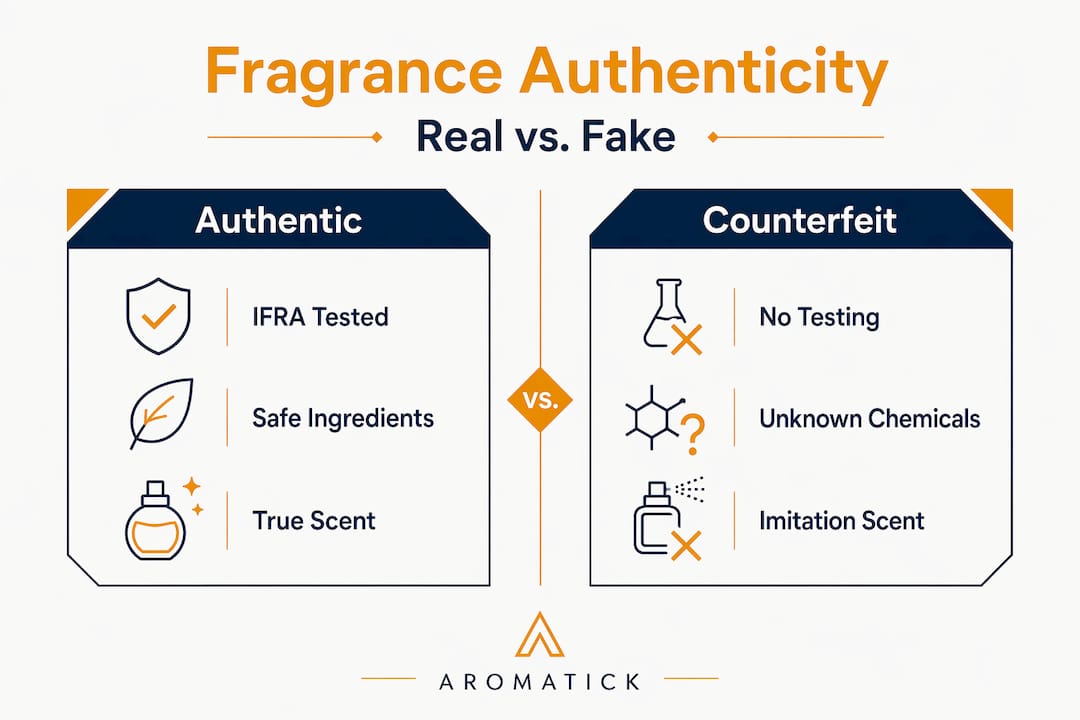
Here is a clear comparison of what separates authentic from counterfeit fragrances:
| Feature | Authentic fragrance | Counterfeit fragrance |
|---|---|---|
| Safety testing | Passed industry standards | Often absent or unknown |
| Ingredient transparency | Regulated and documented | Undisclosed and variable |
| Scent consistency | Stable across batches | Inconsistent, may degrade fast |
| Longevity | Predictable and reliable | Unpredictable, often poor |
| Skin safety | Assessed for irritants | Unknown risk level |
| Packaging quality | Precise, high-quality print | Often flawed or misaligned |
The key takeaway here is that price is not the problem. Where and how you buy is what matters. A genuine fragrance sold at a significant discount is still genuine. A counterfeit sold at full price is still dangerous. Understanding this distinction is the foundation of smart fragrance shopping.
When you read a solid authentic scents guide, you quickly realize that the markers of authenticity are consistent and learnable. Packaging precision, serial numbers, batch codes, and the reputation of the retailer are all reliable signals. The perfume authenticity guide breaks these signals down clearly, making it easier to shop with confidence rather than guesswork.
“Fakes may not be subject to the same safety checks and have been reported as containing unexpected contaminants.” This is not a hypothetical risk. It is a documented reality that every fragrance buyer should take seriously.
How fragrance quality affects longevity and scent projection
Once you understand authenticity, the next question is performance. How long will a fragrance last on your skin? How far will it project? These are the questions that separate a satisfying purchase from a disappointing one, and the answers are more nuanced than most people expect.
Fragrance longevity refers to how long a scent remains detectable after application. Projection, often called sillage (pronounced “see-yazh”), refers to how far the scent radiates from your body. Both are influenced by quality, but they are not controlled by the same factors.
Concentration is the most commonly discussed variable. Fragrances are classified by their concentration of aromatic compounds:
| Concentration type | Typical aromatic compound % | Expected longevity |
|---|---|---|
| Eau de Cologne (EDC) | 2 to 4% | 2 to 3 hours |
| Eau de Toilette (EDT) | 5 to 15% | 3 to 5 hours |
| Eau de Parfum (EDP) | 15 to 20% | 5 to 8 hours |
| Parfum / Extrait | 20 to 30%+ | 8 to 12+ hours |
Higher concentration does improve longevity. Moving from an EDT to an EDP version of the same fragrance will typically keep the scent detectable on your skin for longer. However, concentration and sillage do not follow the same rules. Concentration does not automatically increase projection because molecule volatility and how the scent launches from skin are what actually drive sillage.
This is an important distinction. Some light, volatile molecules create enormous projection in the first hour but fade rapidly. Heavier molecules, like musks and woods, cling to skin and fabric and provide longevity without necessarily projecting far. A well-crafted fragrance balances both types of molecules to deliver a satisfying arc from the first spray through the dry-down.
Counterfeit fragrances typically fail at this level of craftsmanship. Their aromatic compounds are often low-grade substitutes that lack the molecular structure needed for reliable longevity or projection. You might get a burst of scent at first, but it fades within an hour because the formula was never designed to perform.
Here are practical tips for choosing fragrances with better lasting power:
- Choose EDP or parfum concentrations when longevity is your priority
- Apply to pulse points such as wrists, neck, and inner elbows where body heat activates the fragrance
- Moisturize before applying because fragrance adheres better to hydrated skin than dry skin
- Layer with matching body products when available, as this extends the scent’s staying power
- Store fragrances away from heat and light to preserve the integrity of the aromatic compounds
Pro Tip: If you find that a fragrance fades quickly on your skin, try applying it to your hair or clothing. Fabric holds aromatic molecules longer than skin in many cases, which can extend your experience of the scent significantly.
For a deeper look at how these factors interact, the lasting scents guide and the longevity explained resource both offer practical, evidence-based guidance for making smarter choices.
Why safety and compliance are part of fragrance quality
Safety is not a separate topic from quality. It is woven into what quality actually means. A fragrance that smells beautiful but causes skin irritation or contains harmful substances is not a quality product. It is a liability.
The fragrance industry self-regulates through a body called IFRA, the International Fragrance Association. IFRA standards can ban, limit, or set criteria for fragrance ingredients based on rigorous scientific risk assessments. These standards are updated regularly as new safety data becomes available, and reputable fragrance houses comply with them as a baseline requirement.
Here is how the compliance process typically works for quality brands:
- Ingredient screening: Each aromatic compound used in a formula is evaluated against the current IFRA standards to identify any restrictions or prohibitions.
- Risk assessment: The formula is assessed for potential skin sensitization, phototoxicity (reactions triggered by sunlight), and other health risks at the concentrations used.
- Stability testing: The finished fragrance is tested to ensure it does not degrade in ways that could create harmful byproducts over time.
- Labeling compliance: Ingredients that require disclosure under regional regulations are listed accurately on the product.
- Ongoing review: As IFRA updates its standards, compliant brands reformulate as needed to maintain safety.
Counterfeit manufacturers skip every one of these steps. They are not accountable to any regulatory body, and their formulas are not reviewed for safety. This is why authentic perfume safety is a topic worth understanding before you shop.
Pro Tip: When evaluating a new fragrance brand, look for any mention of IFRA compliance on their website or product documentation. Reputable brands are transparent about their safety commitments. If this information is absent or difficult to find, treat that as a signal to investigate further.
The fragrance safety standards published by IFRA are publicly accessible, which means you can verify what standards legitimate manufacturers are expected to meet. This transparency is part of what separates the regulated fragrance industry from the unregulated counterfeit market. Understanding fragrance authenticity safety helps you connect these regulatory dots and shop with greater confidence.
How to shop for quality: Authenticity, safety, and satisfaction
Knowing why quality matters is only half the equation. The other half is knowing how to find it, especially when you are shopping on a budget and want to avoid paying full department store prices.
The good news is that authentic fragrances are available at significant discounts when you shop through the right channels. The key is learning to verify authenticity before you buy, not after.
Here is a practical checklist for evaluating any fragrance purchase:
- Check the retailer’s reputation: Look for established retailers with clear return policies, authenticity guarantees, and verifiable customer reviews. Avoid anonymous marketplace sellers with no track record.
- Examine the packaging carefully: Authentic fragrances have precise, high-quality printing with no spelling errors, consistent font sizes, and properly aligned labels. Counterfeits often have subtle but detectable flaws.
- Verify the batch code: Most authentic fragrances carry a batch code that can be checked through online databases to confirm the production date and authenticity.
- Look for serial numbers: Many brands include serial numbers on both the box and the bottle. If these do not match, the product is suspect.
- Smell the fragrance critically: Authentic fragrances have a structured scent arc with recognizable top, heart, and base notes. Counterfeits often smell sharp, flat, or chemical at first spray.
- Compare the price to market value: A genuine fragrance sold at 40 to 60 percent off retail from a trusted retailer is plausible. A bottle priced at 90 percent off from an unknown source is almost certainly counterfeit.
Counterfeit fragrances lack safety checks and have been reported to contain unexpected contaminants, so the stakes of buying from an unverified source go beyond just getting a bad scent. Your skin and health are involved.
The authentic perfume quality guide walks through these verification steps in more detail, with specific examples of what to look for in packaging and labeling. Reading it before your next purchase could save you from a costly mistake.
The uncomfortable truth: Why cutting corners on fragrance quality isn’t worth the risk
Here is something the fragrance world does not say loudly enough. The real cost of a counterfeit fragrance is almost never reflected in the price you pay for it.
You might spend fifteen dollars on a fake version of a ninety-dollar fragrance and feel like you came out ahead. But consider what you actually received. A formula with unknown ingredients. No safety testing. No quality control. A scent that fades in an hour. And a real possibility that what you sprayed on your skin contained bacteria, industrial chemicals, or other substances that no legitimate manufacturer would ever use.
We have seen this play out repeatedly. The documented risks of counterfeit fragrances are not theoretical. They are reported cases of real people experiencing real harm from products they thought were harmless.
The conventional wisdom says that any fragrance is fine as long as it smells good. That is wrong. Scent performance and safety are not the same thing, and a fragrance that smells acceptable in the first five minutes can still be a problem if its formula is unregulated and contaminated.
What experience actually teaches is this: the budget-conscious approach to fragrance is not about finding the cheapest bottle. It is about finding the best value. And genuine value means authentic products at fair prices, not counterfeits at rock-bottom prices. A real fragrance at forty percent off from a trusted retailer gives you everything: the tested formula, the reliable longevity, the safety compliance, and the actual scent experience the perfumer intended.
Cutting corners on quality does not save money in any meaningful sense. It trades a known, satisfying product for an unknown risk. The authentic perfume safety advice we consistently share comes from this understanding: genuine quality is accessible, and it does not require paying full department store prices to achieve it.
Where to find authentic quality fragrances at discounted prices
Understanding quality is one thing. Finding it at a price that works for your budget is another. That is exactly what Aromatick was built to solve.
At Aromatick, every fragrance in the catalog is 100% authentic, sourced directly to eliminate the overhead costs of traditional retail. The designer fragrance collection features genuine products from recognized brands at discounts of up to 60 percent off standard retail prices. For those drawn to more distinctive, artisanal scents, the niche fragrance collection offers carefully curated options from respected independent houses. Every purchase is backed by an authenticity guarantee, giving you the confidence to shop without compromise. Authentic quality and genuine savings are not mutually exclusive. At Aromatick, they are the standard.
Frequently asked questions
How can I tell if a perfume is authentic?
Buy from trusted retailers with clear authenticity guarantees, check packaging for precise printing and matching serial numbers, and verify the batch code through an online database. Counterfeit products skip safety checks and may contain harmful contaminants, so sourcing matters as much as price.
Does higher fragrance concentration mean longer-lasting scent?
Higher concentration typically improves longevity, but concentration and sillage are not the same thing. Projection depends on molecule volatility and how specific aromatic compounds interact with your skin chemistry.
Are all designer perfumes safe?
Genuine designer perfumes are formulated to meet industry safety standards, including IFRA guidelines. Counterfeit versions skip these checks entirely, which is why IFRA standards exist as a baseline for what legitimate manufacturers must follow.
What are IFRA standards?
IFRA standards are science-based guidelines that regulate fragrance ingredients, banning or limiting certain substances based on risk assessments to protect consumers from skin sensitization, toxicity, and other health risks.
Why do some scents fade quickly even if they seem strong at first?
Strong initial projection is driven by light, volatile molecules that evaporate quickly. Lasting power depends on heavier molecules and higher concentration. A scientific review of sillage confirms that these two aspects of fragrance performance follow different chemical rules.

Leave a comment
This site is protected by hCaptcha and the hCaptcha Privacy Policy and Terms of Service apply.