

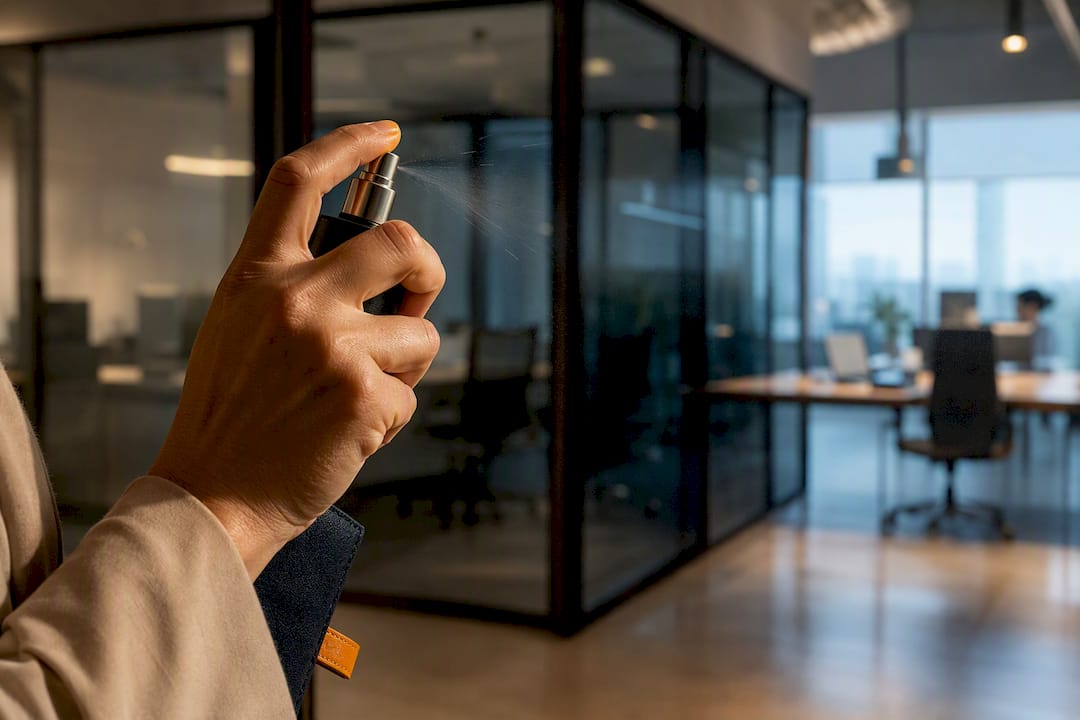
One to Two Sprays: Office Perfume Etiquette for Employees and HR
Wear one light application, on pulse points only, in the morning, and never reapply at your desk. That single habit resolves most office scent complaints before they start. Prioritize the health of colleagues nearby, since some workplaces restrict fragrance as a formal accommodation, and heavy application can trigger asthma, migraines, or contact reactions in people who never say a word about it.
TL;DR:
- Applying one light spray at pulse points in the morning is sufficient for a full workday, with one to two sprays being the ideal limit.
- Fragrance policies are primarily designed to accommodate coworkers with asthma, migraines, or sensitivities, often extending to cleaning products and diffusers.
- Exposure to heavy fragrances in the office can trigger health issues like asthma attacks and contact dermatitis, especially from VOCs linked to headaches and concentration problems.
- Lighter concentrations like eau de toilette project less and fade faster, making them more appropriate for office environments than parfum or body sprays.
- Testing scents at home and asking colleagues to assess scent projection helps ensure fragrance stays personal rather than overwhelming shared spaces.
Table of Contents
- Office Perfume Etiquette: Practical Dos and Don’ts
- How Workplace Fragrance Policies Actually Work
- Health Risks and Fragrance Sensitivity You Should Know About
- Choosing Scents That Stay Personal, Not Public
- How to Apply Perfume So It Doesn’t Take Over the Room
- What to Do When a Coworker’s Scent Is Too Much
- A Quick Checklist for Employers Building a Fragrance Policy
- Cultural Differences in Office Fragrance Norms
- How Perfume Choices Shape Your Professional Image
- Perfume vs. Cologne vs. Body Spray: What Actually Belongs at Work
- Balancing Fragrance Enjoyment With Workplace Courtesy
- Where to Find Lighter, Office-Ready Fragrances
- Sources
Office Perfume Etiquette: Practical Dos and Don’ts
Fragrance is personal, but a shared office is not. The gap between those two facts is where most etiquette breakdowns happen, and it’s almost always solvable with a few habits rather than giving up perfume altogether.
Do:
- Apply once, in the morning, before leaving home or right when you arrive.
- Stick to pulse points: wrists, inner elbows, base of the throat.
- Choose lighter concentrations like eau de toilette over parfum for daily office wear.
- Test a new scent privately and ask a trusted coworker for an honest read before wearing it around the whole floor.
Don’t:
- Spray directly onto clothing or hair in a shared bathroom or at your desk.
- Reapply midday just because you can’t smell it anymore (your nose adjusts long before anyone else’s does).
- Layer a scented lotion, scented deodorant, and perfume in the same routine.
- Assume a product labeled “unscented” is automatically safe. It often just means the scent is masked, not removed.
A good numeric heuristic: one to two short sprays, applied at arm’s length, is plenty for a full workday. If someone can smell you from across a conference table, that’s already too much.
How Workplace Fragrance Policies Actually Work
Fragrance policies aren’t about banning self-expression. They’re almost always written as accommodations for coworkers with asthma, migraines, or chemical sensitivities, and a well-built policy applies just as much to scented cleaning products, candles, and diffusers as it does to what you put on your skin. The Job Accommodation Network frames this clearly: limiting fragranced products in shared spaces is often a practical first step employers can take, rather than a promise of a completely scent-free building, which is nearly impossible to enforce.
A typical policy includes:
- A defined scope: which areas (lobbies, meeting rooms, elevators) are covered.
- Visible signage and visitor notices at entrances.
- A list of prohibited items, often including scented candles, plug-in diffusers, and air fresheners.
- A clear, confidential process for reporting violations or requesting accommodation.
If your office posts one of these notices, treat it the way you’d treat a dress code. It’s not a judgment on your taste. If your manager asks you directly to tone it down, that’s usually a sign someone already complained through proper channels, and it’s worth taking seriously the first time.
Health Risks and Fragrance Sensitivity You Should Know About
Fragrance sensitivity isn’t a minor inconvenience for the people who deal with it. Occupational surveillance data collected from 1993 to 2012 found perfume and cologne to be the ninth most common exposure tied to work-related asthma cases, accounting for most fragrance-linked incidents. That’s not a fringe statistic. It’s evidence that heavy application in a closed office can genuinely trigger a medical event for someone at the next desk.
Fragrance is also a well-documented cause of contact dermatitis, and avoidance is harder than it sounds. A review of fragrance hazards in consumer products points out that cosmetic labels only require disclosure of 26 specific allergenic substances, and many products rely on masking agents that hide scent without eliminating the chemicals causing reactions. On top of that, fragranced products release volatile organic compounds, and the EPA links VOCs directly to indoor air quality problems that show up as headaches, brain fog, and trouble concentrating in enclosed office spaces.
Choosing Scents That Stay Personal, Not Public
The safest office fragrances are the ones that project close to your skin rather than filling a room. Heavy, resinous notes like oud, patchouli, and thick amber tend to travel farther and linger longer than citrus, light florals, or clean musks, which fade into a “personal bubble” instead of following you down the hallway.
Format matters as much as the scent family:
- Eau de toilette concentrations project less than eau de parfum or parfum.
- Body mists and solid perfumes, like the low-projection formats from INGRID’s eco-friendly solid perfume line, are built for exactly this kind of restraint.
- Discovery decants let you sample a scent’s actual office behavior before committing to a full bottle.
Before wearing anything new to work, test it at home first, run a basic skin check for irritation, and ask someone you trust to tell you honestly how far it carries. Our guide on testing perfume for sensitive skin walks through that process in more detail.
Pro Tip: Ask a coworker to stand at arm’s length and tell you if they can smell you. Your own nose adjusts to your scent within minutes, so it’s a terrible judge of how far it’s actually traveling.

How to Apply Perfume So It Doesn’t Take Over the Room
Getting application right is less about the scent and more about the routine around it.
- Apply once, right after your shower or before you leave for work, to pulse points only.
- Let it dry fully before dressing. Spraying directly onto fabric or hair traps the scent and intensifies it over the day.
- Store the bottle away from direct sunlight and heat, which degrade the formula and can make it smell sharper than intended.
- If you feel like your scent has faded by afternoon, that’s usually olfactory fatigue, not reality. Reapplying compounds the smell for everyone else even though you can’t detect it anymore.
- If you genuinely want a midday refresh, reach for an unscented hand cream or plain water instead of more perfume.
Memorize the simple version: once in the morning, one to two sprays, no touch-ups at your desk.
What to Do When a Coworker’s Scent Is Too Much
Start with a private, low-key conversation rather than a group complaint or a passive-aggressive note. Something like, “Hey, I get headaches from strong fragrance, would you mind going lighter around me?” works far better than avoiding the topic and letting resentment build.
- Keep it about your own reaction, not a critique of their taste.
- If the conversation doesn’t change anything, start noting dates, symptoms, and specific incidents.
- Bring documented patterns to HR and frame it as an accommodation request, not a complaint about a person.
- If you manage a team, mediate privately, offer education about masking agents and low-projection formats, and point to your written fragrance policy if one exists.
A Quick Checklist for Employers Building a Fragrance Policy
HR teams don’t need a complicated rollout to make this work.
- Consult employees who’ve requested accommodations before drafting scope.
- Define which spaces and products are covered, including cleaning supplies and air fresheners.
- Train facilities and janitorial staff to choose fragrance-free products.
- Post visitor signage and send a short explanatory email rather than a vague memo.
- Set up a confidential channel for reporting, and revisit the policy annually.
The ASEQ-EHAQ guide to designing scent-free policies is a solid template if you’re starting from scratch.
Cultural Differences in Office Fragrance Norms
What counts as “too much” perfume shifts noticeably depending on where you work. Offices in parts of the Middle East and Latin America often carry a stronger cultural tolerance, even expectation, for noticeable fragrance as a marker of professionalism and personal care. Walk into a corporate office in much of North America or Northern Europe, though, and the norm swings the other way, favoring scent so light it’s barely detectable beyond your own personal space.
Some of this traces back to building design. Open-plan offices with centralized HVAC systems, common across much of the United States and the United Kingdom, circulate air (and scent) across a much wider footprint than older buildings with individual offices and better airflow separation. Scandinavian countries in particular have pushed scent-free workplace norms further than most, driven by higher reported rates of fragrance sensitivity and a cultural comfort with formal accommodation requests.
If you work for a multinational company or travel between offices, the safest approach is to default to the more conservative local norm rather than assuming your home office’s standard travels with you. A scent that reads as appropriately professional in one country’s office can register as overwhelming in another, and it has nothing to do with the quality of the fragrance itself. It’s entirely about context, building infrastructure, and local expectations around personal space. When in doubt, ask a local colleague or simply go lighter than you would at home. Nobody has ever been penalized at work for wearing too little perfume.
How Perfume Choices Shape Your Professional Image
Scent works as a quiet extension of how colleagues perceive your judgment, and that cuts both ways. A well-chosen, appropriately light fragrance can read as polished and put-together, part of the same impression a clean, ironed shirt makes. But a fragrance that’s too strong sends an entirely different signal: that you either haven’t noticed the effect you’re having on shared space, or you have and don’t care. Neither impression helps a career.
This matters more in certain settings than others. Client-facing roles, small conference rooms, and one-on-one meetings amplify the stakes, because there’s no room to physically distance from a scent that’s overpowering. Someone who has to mentally manage a headache through an entire client pitch is not fully focused on your argument, and that’s true whether they say anything about it or not.
There’s a relationship angle here too, separate from pure professionalism. Coworkers who feel considered, whose sensitivities get respected without them having to ask, tend to extend that same goodwill back in other areas: covering a shift, giving benefit of the doubt on a missed deadline, speaking up for you in a meeting you’re not in. Fragrance restraint is a small, low-effort way to bank some of that goodwill. It costs you nothing to apply one spray instead of four, and the upside, being seen as easy to work near, compounds over the long run of daily proximity that defines most office relationships.
Perfume vs. Cologne vs. Body Spray: What Actually Belongs at Work
These three terms get used interchangeably, but the differences matter for office wear specifically, because they map directly onto projection and longevity, the two variables that determine whether you’re being considerate or not.
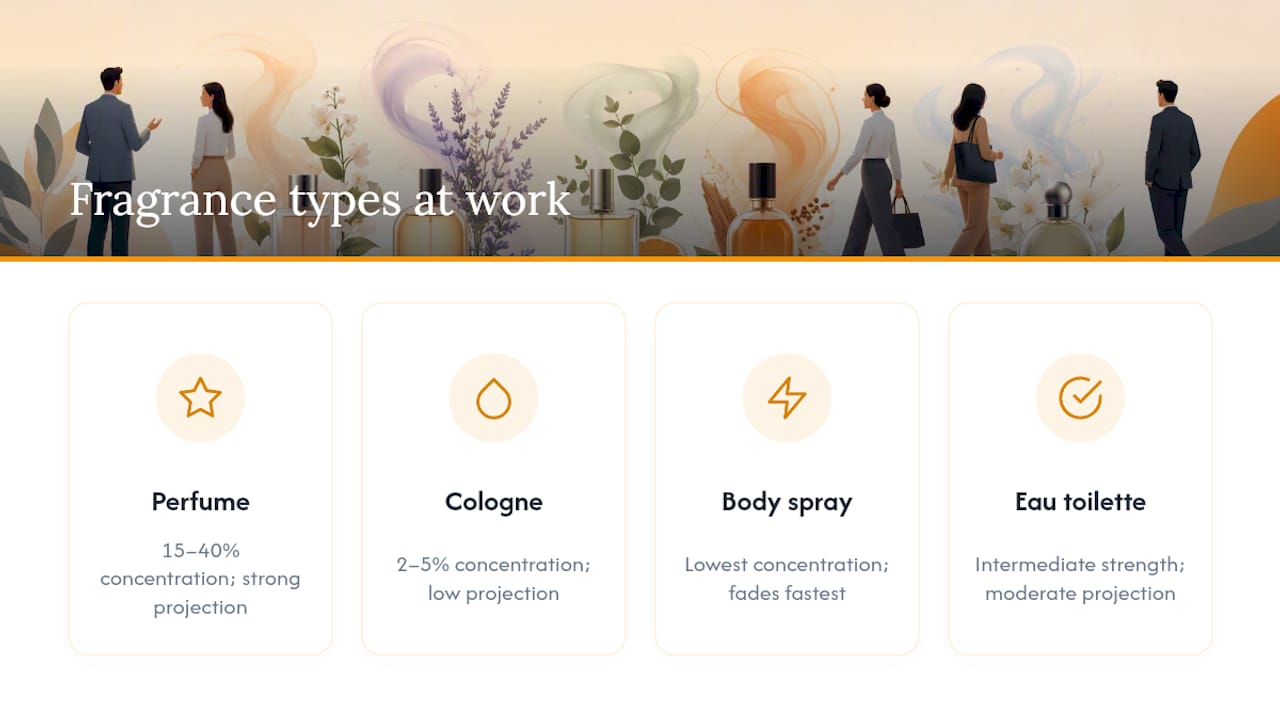
Perfume (eau de parfum or true parfum concentration) carries the highest concentration of aromatic compounds, typically landing between 15% and 40% depending on the formula. That concentration is exactly why parfum strength, while excellent for an evening out, is often the wrong call for an eight-hour shared office day. It’s built to last and to project, which is the opposite of what a considerate office scent needs to do.
Cologne, technically eau de cologne, sits at the lighter end of the concentration spectrum, generally in the 2% to 5% range. That makes it one of the more office-appropriate formats by default, since it fades faster and projects less, though “cologne” gets used loosely as a general term for men’s fragrance regardless of actual concentration, so check the label rather than the marketing name.
Body sprays contain the lowest concentration of fragrance oil and the highest proportion of alcohol and water, which is why they fade the fastest of the three. They’re a reasonable low-commitment option for the office, though many mass-market versions rely on a small number of strong, cheap aromatic compounds that can smell sharp or synthetic up close, even at low concentration. A well-made eau de toilette, sitting between cologne and full perfume strength, often hits the sweet spot for office wear: enough presence to feel finished, not enough to fill a conference room. Our guide to office-appropriate cologne picks breaks down specific options worth trying.
Balancing Fragrance Enjoyment With Workplace Courtesy
Fragrance is one of the more personal parts of getting dressed, and no policy should ask people to give that up entirely. Some fragrance retailers lean toward lighter-format options and discovery sets for exactly this reason: they let readers enjoy a great scent without dominating a shared room. The goal is simple. Wear what makes you feel good, apply it with restraint, and let a coworker’s health outweigh your habit of reapplying at 3 p.m.
— Rodney
Where to Find Lighter, Office-Ready Fragrances
Once you’ve settled on a lower-projection approach, the challenge becomes finding formats built for it rather than fighting a heavy parfum into submission with fewer sprays. Aromatick’s designer fragrance collection is organized around exactly that kind of shopping, with authentic bottles priced 30% to 60% below department store rates, so testing a lighter eau de toilette version of a favorite scent doesn’t mean paying full price twice.

If you’re drawn to sharper, more restrained profiles for daily wear, the Hugo Boss collection leans into clean, office-friendly territory by design. Readers who want something less common than what’s already on every desk in the building might look at the niche fragrance collection, which includes lower-projection and discovery-size options well suited to testing before committing. Many fragrance retailers offer satisfaction guarantees and free shipping over a certain threshold, so trying a new lighter format for the office carries minimal risk. Browse the collections and pick a decant size to test your next office scent before buying a full bottle.
Sources
- Fragrance-related work asthma surveillance data (PubMed entry)
- Ubiquity, hazardous effects, and risk assessment of fragrances in consumer products (PMC review)
- Implementing a Workplace Fragrance Policy as an Accommodation (Job Accommodation Network)
- Volatile Organic Compounds’ impact on indoor air quality (EPA)

Leave a comment
This site is protected by hCaptcha and the hCaptcha Privacy Policy and Terms of Service apply.