
Perfume Application Process: Get All-Day Scent
TL;DR:
- Proper perfume application requires skin preparation, targeted pulse points, and correct spray techniques to maximize scent longevity and projection. Moisturizing dry skin, spraying 6 to 8 inches from pulse points, and applying 15 to 30 minutes before leaving ensure optimal fragrance performance. Layering with matching products and avoiding rubbing or over-application further enhance the scent’s depth and durability.
The perfume application process is the method of applying fragrance to your skin in a way that maximizes longevity, projection, and scent development. Most people spray and walk away without realizing that technique, timing, and skin condition determine whether a fragrance lasts two hours or eight. Brands like Chanel, Dior, and Initio Parfums Privés engineer their formulas for optimal skin interaction, but even the finest eau de parfum underperforms when applied incorrectly. This guide covers every stage of the process, from skin preparation to layering strategies, so you get the full performance your fragrance was designed to deliver.
What skin preparation is essential before perfume application?
Moisturized skin is the single most important factor in fragrance longevity. Dry skin lacks the lipid barrier that traps scent molecules, causing them to evaporate quickly. Moisturizing with unscented lotion before applying perfume can extend wear time from 2 to 3 hours all the way to 6 to 8 hours or more. That difference is not marginal. It is the gap between a fragrance that disappears by lunch and one that carries you through the evening.
Apply your moisturizer about five minutes before spraying. This gives the lotion time to absorb without creating a wet barrier that dilutes the perfume. The ideal moment to apply fragrance is right after a shower, when your pores are open and your skin is clean. Warmth from the shower also activates the top notes faster, giving you a more immediate and accurate read on how the scent will develop.
Here are the key skin preparation steps to follow every time:
- Shower with a gentle, fragrance-neutral body wash to remove competing scents
- Pat skin dry rather than rubbing, which preserves skin moisture
- Apply an unscented body lotion or oil to pulse points and let it absorb for five minutes
- Avoid applying perfume over sunscreen or heavily scented products, which distort the fragrance
Pro Tip: If your fragrance brand offers a matching body lotion, use it instead of an unscented alternative. Products from the same fragrance line, such as the Chanel No. 5 body lotion or Dior J’adore moisturizing milk, are formulated to complement the perfume’s notes, creating a layered scent effect that noticeably deepens the overall impression.
How to apply perfume effectively: techniques, spray distance, and timing
Proper fragrance application follows a clear sequence that most people skip entirely. The optimal spray distance is 6 to 8 inches from the skin, which allows the mist to disperse evenly before landing. Spraying too close concentrates the fragrance in one spot, causes uneven scent development, and can irritate sensitive skin. Spraying too far wastes the fragrance before it reaches you.
Follow these steps for consistent, effective application every time:
- Shower and moisturize as described above, giving lotion five minutes to absorb.
- Hold the bottle 6 to 8 inches from your skin and spray directly onto pulse points, not into the air.
- Target your primary pulse points first: the inner wrists, the base of the throat, and the chest. These areas emit heat that continuously activates the fragrance throughout the day.
- Add secondary points for stronger projection: behind the ears, the inner elbows, and behind the knees. Behind the knees is especially effective for creating a scent trail as you move.
- Apply 2 to 4 sprays total for a balanced result. Eau de parfum concentrations like those from Hugo Boss or Tom Ford typically need two to three sprays. Lighter eau de toilette formulas may need three to four.
- Do not rub your wrists together. Rubbing wrists after application breaks down fragrance molecules and accelerates fading. Let the perfume dry naturally.
- Apply 15 to 30 minutes before leaving. This allows the alcohol carrier to evaporate fully, so the scent you present to the world reflects the fragrance’s true character rather than a sharp alcohol note.
Applying perfume 15 to 30 minutes early is one of the most overlooked steps in the entire process. The alcohol in most perfumes is a delivery vehicle, not part of the scent. Letting it dissipate before you walk out the door means your first impression is the fragrance itself, not the solvent carrying it.
Pro Tip: If you need to spread fragrance across a larger area, pat gently with a fingertip rather than rubbing. Patting distributes the scent without the friction that degrades the molecular structure.

Perfume application methods compared: what works and what doesn’t
Not all fragrance application methods deliver equal results. Understanding the difference between effective and ineffective techniques saves both money and scent.
| Method | Effectiveness | Key issue |
|---|---|---|
| Direct spray on pulse points | High | Best for longevity and projection |
| Walking through a perfume cloud | Low | Most particles miss skin entirely |
| Rubbing wrists together | Low | Breaks fragrance molecules, speeds fading |
| Spraying on clothing | Medium | Lasts longer on fabric but risks staining |
| Applying on moisturized skin | High | Significantly extends wear time |
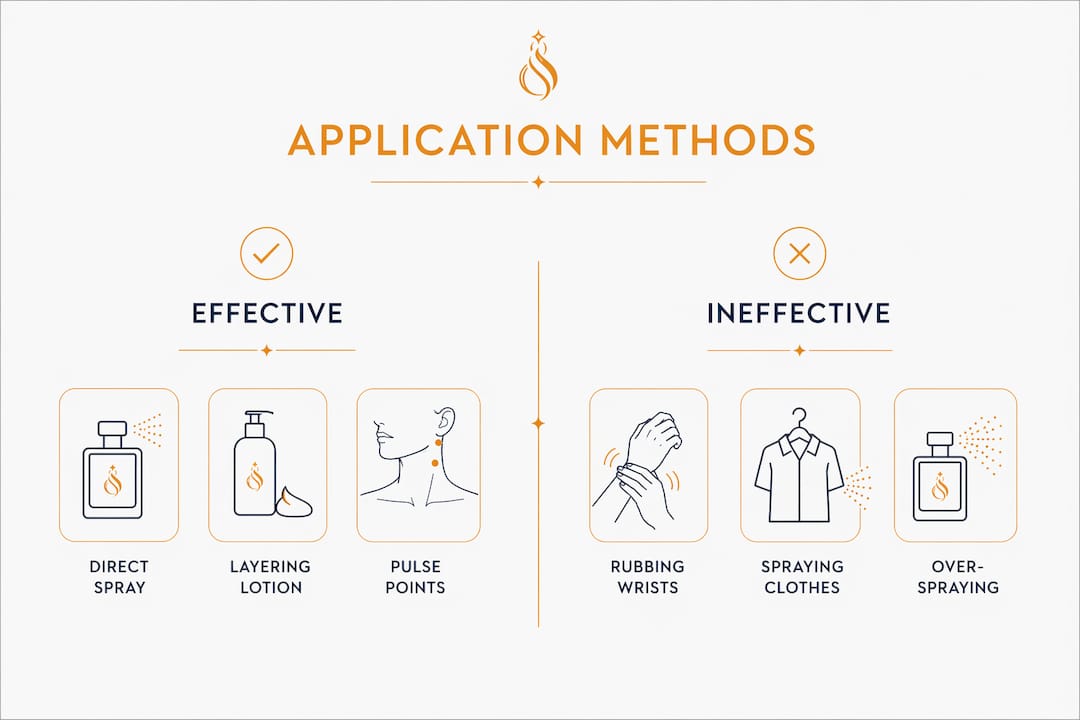
Spraying perfume into the air and walking through it wastes the majority of the fragrance. Most of the mist never contacts skin at all, settling on the floor or evaporating mid-air. This method became popular as a way to achieve light, even coverage, but it is fundamentally inefficient.
Several other common mistakes undermine even a well-chosen fragrance:
- Over-application is the most frequent error. More sprays do not mean longer wear. They mean an overwhelming opening that alienates everyone nearby.
- Spraying on sensitive areas such as near the eyes or on intimate skin can cause irritation. Stick to the standard pulse points.
- Applying directly to clothing without testing first risks permanent staining, particularly with dark or oil-heavy formulas. Fabrics do hold scent longer than skin, but the trade-off is not always worth it.
- Storing perfume in the bathroom is a habit that degrades fragrance quality faster than almost anything else. Humid bathrooms cause temperature and humidity fluctuations that break down the chemical structure of the fragrance.
Pro Tip: Olfactory fatigue causes you to stop perceiving your own scent after about 15 minutes of wear. This tricks many people into thinking their fragrance has faded and prompts unnecessary reapplication. Before adding more sprays, ask someone nearby for an honest assessment.
How to use layering and strategic placement for longer-lasting fragrance
Perfume layering techniques extend scent life by building fragrance depth across multiple product layers. Layering with matching or complementary scented products significantly enhances both longevity and the complexity of the final scent. The principle is simple: the more fragrance molecules present on the skin from different sources, the longer the overall scent lasts.
A practical layering sequence looks like this:
- Start with a scented body wash from the same fragrance line or a neutral, clean-smelling formula that won’t compete with your perfume
- Follow with a matching body lotion or scent oil applied to pulse points. Scent oils are particularly effective because they lack alcohol and create a stable, slow-release base
- Apply your perfume as the final layer, directly onto the moisturized pulse points
- Consider a hair mist as an optional finishing step. Hair perfumes are formulated to nourish the hair while delivering fragrance, avoiding the drying effects of regular perfume’s alcohol content. Hair holds scent exceptionally well and creates a noticeable trail as you move
Strategic placement also matters beyond the standard wrist-and-neck routine. For social events where you want strong projection, focus on the chest and throat. For office environments where subtlety is appropriate, the inner elbows and wrists are sufficient. For evening wear, adding a light spray behind the knees creates a scent trail that rises naturally with body heat throughout the night.
Fabric application deserves a separate note. Clothing fibers trap fragrance molecules more effectively than skin, which is why a sprayed shirt often smells of perfume days later. Spray lightly on the inner collar or cuffs of natural fabrics like cotton or wool. Avoid spraying directly on silk, delicate synthetics, or light-colored garments, as oil-based or heavily pigmented formulas can leave permanent marks.
How to troubleshoot and adjust your perfume application process
Even with good technique, issues arise. Knowing how to diagnose and fix them keeps your fragrance performing at its best.
- Scent fades within two hours: The most likely cause is dry skin. Return to the moisturizing step and use an unscented lotion or matching body oil before your next application.
- Fragrance smells harsh or chemical on opening: You are likely applying too close to departure time. Give the alcohol 15 to 30 minutes to dissipate before going out.
- You cannot smell your own perfume: This is olfactory fatigue, not fragrance failure. Trust your initial application and resist the urge to add more sprays.
- Scent is too intense: Wipe the applied area gently with a warm, damp cloth. This reduces intensity without completely removing the fragrance and avoids the skin irritation that scrubbing causes.
- Fragrance smells different than expected: Skin chemistry, diet, and even medication affect how a fragrance develops. What smells one way on a tester strip will smell different on your skin after 30 minutes. Always test on skin before committing to a full bottle.
Concentration also determines how you apply. Extrait de parfum, the most concentrated form, requires just one or two targeted sprays. Eau de parfum works well with two to three. Eau de toilette, which is lighter, benefits from three to four sprays across a slightly wider area. Applying an extrait like those from Initio Parfums Privés with the same volume as an EDT will result in an overwhelming scent that is difficult to correct.
Proper fragrance storage is as important as application technique. Keep perfumes in a cool, dark drawer or cabinet away from direct sunlight and humidity. A degraded fragrance will never perform well regardless of how carefully you apply it.
Pro Tip: Seasonal adjustments matter. In summer heat, skin projects scent more aggressively, so reduce your spray count by one. In winter, skin is drier and cold air suppresses projection, so add an extra spray and focus on warmer areas like the chest and inner elbows.
Key takeaways
The perfume application process delivers its best results when moisturized skin, targeted pulse points, correct spray distance, and proper timing work together as a system.
| Point | Details |
|---|---|
| Moisturize before applying | Unscented lotion extends wear time from 2 to 3 hours up to 6 to 8 hours or more. |
| Target pulse points directly | Wrists, throat, chest, and behind the knees maximize heat-driven projection. |
| Never rub wrists together | Friction breaks fragrance molecules and accelerates fading significantly. |
| Apply 15 to 30 minutes early | Alcohol dissipates fully, revealing the fragrance’s true character before you leave. |
| Layer for depth and longevity | Matching body wash, lotion, and scent oil build a multi-layer fragrance base. |
Why I think most people are applying perfume wrong from the start
After years of working with fragrances and speaking with perfumers, the mistake I see most consistently is not over-application or wrong placement. It is the complete absence of skin preparation. People invest in a beautiful bottle of Dior Sauvage or Chanel Chance and then spray it onto dry, unprepped skin and wonder why it disappears within an hour. The fragrance is not the problem.
Body chemistry is the other factor that rarely gets discussed honestly. Your skin’s pH, natural oils, and even what you ate that day all influence how a fragrance develops. I have worn the same bottle of Tom Ford Oud Wood on different days and noticed genuinely different dry-down results depending on hydration and diet. This is not a flaw in the fragrance. It is the reason perfume feels personal. It is also why you should always test a new fragrance on your skin for a full day before deciding whether it works for you, not just at the counter.
The most satisfying part of mastering fragrance application is the confidence it creates. When you know your scent is performing correctly, you stop second-guessing it. You stop over-spraying. You stop reaching for the bottle mid-afternoon out of anxiety. You can explore perfume longevity secrets and cologne-lasting tricks to refine your approach further. The goal is a scent that works with your skin, not against it.
— Rodney
Find your signature scent at Aromatick

Applying perfume correctly starts with having a fragrance worth applying. Aromatick offers authentic designer and niche perfumes at 30 to 60% below standard retail prices, with no compromise on quality or authenticity. Whether you are building a layering wardrobe or searching for a single signature scent, the designer fragrance collection covers everything from everyday classics to rare niche releases. For women seeking a standout scent, the women’s perfume collection features top-tier brands at prices that make exploring new fragrances genuinely accessible. Free shipping, secure payments, and a satisfaction guarantee make the experience as confident as the scent itself.
FAQ
What are the best pulse points for applying perfume?
The most effective pulse points are the inner wrists, base of the throat, chest, behind the ears, inner elbows, and behind the knees. These areas emit consistent body heat that activates and projects fragrance throughout the day.
Why does my perfume fade so quickly?
Dry skin is the primary cause of rapid fragrance fading. Moisturizing before application with an unscented lotion can extend wear time from 2 to 3 hours to 6 to 8 hours or more.
Should I rub my wrists together after spraying perfume?
No. Rubbing wrists together disrupts fragrance molecules and causes the scent to fade faster. Let the perfume dry naturally on the skin.
When is the best time to apply perfume?
Apply fragrance 15 to 30 minutes before leaving the house. This allows the alcohol to evaporate fully so the fragrance presents its true character rather than a sharp chemical opening.
How many sprays of perfume should I use?
Two to four sprays is the standard range for most fragrances. Eau de parfum concentrations typically need two to three sprays, while lighter eau de toilette formulas work best with three to four applied across multiple pulse points.

Leave a comment
This site is protected by hCaptcha and the hCaptcha Privacy Policy and Terms of Service apply.