
When to Choose Oil or Spray: Office, Travel, and Date Rules
Perfume oil generally outlasts spray on skin, often running longer than typical eau de parfum durations, but spray wins on projection because alcohol lifts volatile notes into the air the moment it hits skin. Aromatick’s Rodney breaks down the trade-off below: pick oil for closeness and staying power, spray for reach and a memorable entrance.
TL;DR:
- Perfume oils tend to last longer on skin but have lower projection, making them ideal for close, personal scent experiences.
- Alcohol in spray perfumes accelerates top note release and projection but causes faster fragrance fade than oils.
- Oils interact more with skin chemistry, leading to greater individual variability, while sprays deliver a more uniform scent profile.
- Oil formulas are generally safer for sensitive skin because they lack drying alcohol, but both formats require patch testing for allergies.
- The choice between oil and spray should depend on the setting, travel needs, and desired projection, not just personal preference.
Table of Contents
- Perfume Oil vs Spray: A Quick Comparison
- How Do Perfume Oil and Spray Actually Work?
- How Long Does Each Format Actually Last?
- How Should You Apply Perfume Oil vs Spray?
- Is Perfume Oil or Spray the Better Value?
- Which Format Is Safer for Sensitive Skin?
- When Should You Choose Oil vs Spray?
- Can You Layer Perfume Oil and Spray Together?
- Do Perfume Oil and Spray Have Different Shelf Lives?
- Which Format Is More Sustainable?
- Does the Carrier Change How a Scent Actually Smells?
- What’s the Real Trade-Off Between Oil and Spray?
- Try Both Formats Before You Commit to a Full Bottle
- Sources
Perfume Oil vs Spray: A Quick Comparison
Before getting into the chemistry, here’s how the two formats stack up on the things that actually change your daily experience.
- Carrier: Oil uses jojoba or fractionated coconut oil; spray uses alcohol (or an alcohol/water blend).
- Application: Oil is dabbed with a rollerball or wand; spray is misted from a distance.
- Longevity: Oil tends to run longer on skin; spray fades faster but announces itself immediately.
- Projection: Spray throws scent several feet; oil stays close, almost private.
- Skin feel: Oil feels moisturizing and gentle; spray can feel cool or slightly drying on contact.
- Price per wear: Oil often costs less per use despite a higher price per milliliter, since you need far less product.
If you want a scent that’s yours and yours alone, oil is usually the better fit. If you want people to notice when you walk into a room, spray does that job.
How Do Perfume Oil and Spray Actually Work?
The difference starts with the carrier, not the fragrance itself. Spray perfumes suspend aromatic compounds in alcohol, which evaporates quickly and lifts volatile top notes straight off the skin. That’s why a spritz of an eau de parfum gives you a sharp, immediate opening. This mechanism dates back centuries. Alcohol-based formats became the industry standard partly because alcohol carries scent efficiently and produces the sillage wearers associate with “real” perfume.
Perfume oil skips the alcohol entirely. The fragrance sits suspended in a carrier oil and releases gradually as your body heat warms it. There’s little to no dramatic opening, and projection stays modest, but the trade is a scent that lingers close to your skin for hours. This also means perfume oil interacts more directly with your individual skin chemistry, which is part of why the same oil can smell different from one person to the next.
How Long Does Each Format Actually Last?
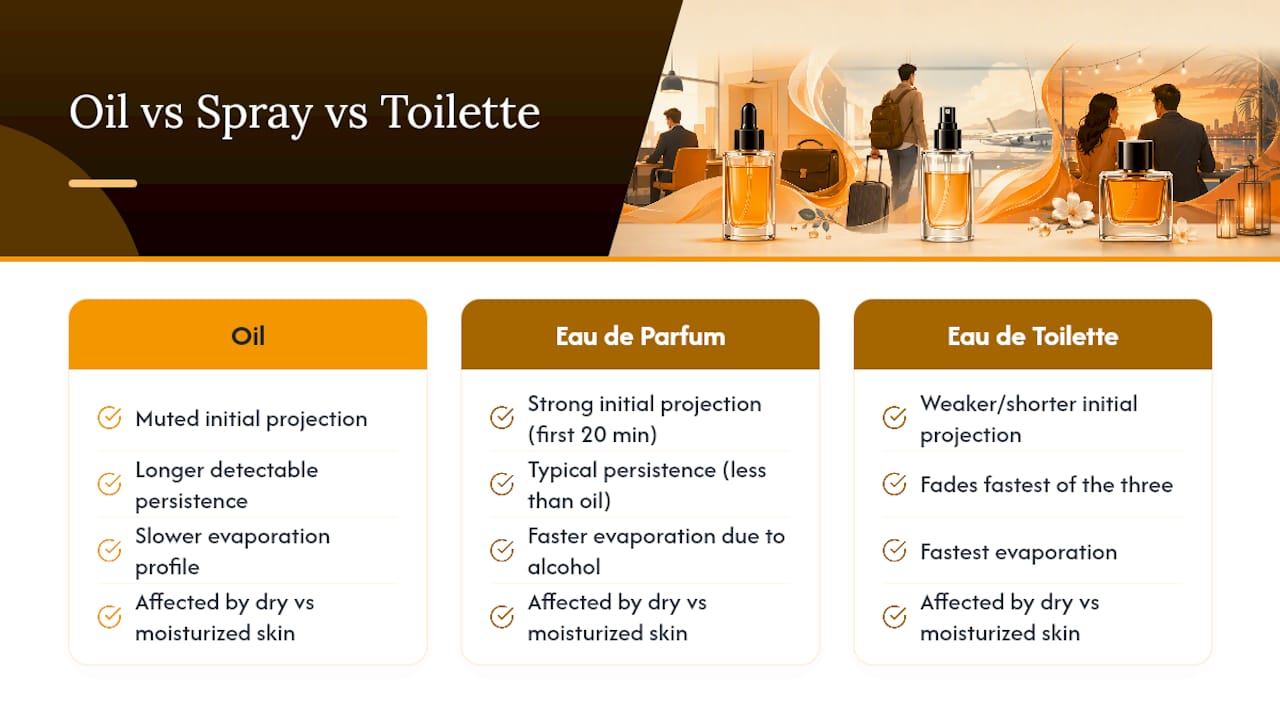
Perfume oil commonly lasts longer on skin than typical eau de parfum durations, according to side-by-side longevity comparisons. Eau de toilette formulas, with even less alcohol-suspended concentration, tend to fade faster still.
That gap creates a perception problem. Spray feels stronger in the first twenty minutes because alcohol pushes molecules into the air right away, but that intensity burns off as the alcohol evaporates. Oil never announces itself the same way, yet it’s often still detectable up close well after the spray has faded into nothing.
Wear time isn’t fixed, though. Dry skin holds fragrance poorly compared to well-moisturized skin, hot and humid climates accelerate evaporation, and pulse points (wrists, neck, inner elbows) hold scent longer than drier areas like forearms. Layering unscented lotion under either format extends wear noticeably.
How Should You Apply Perfume Oil vs Spray?
Getting the technique right matters as much as picking the format.
- Perfume oil: Apply one to three drops directly to pulse points, warm skin like the inner wrist or base of the throat works best, and press it in gently rather than rubbing, which can break down the scent molecules.
- Spray: Hold the bottle six to eight inches from skin or clothing and use one to three mists, aiming for pulse points or the chest of a shirt rather than hair or fine fabric.
- Test before committing: Apply a small amount and wait fifteen minutes before judging the scent, since top notes shift as a fragrance dries down.
Pro Tip: Never rub perfume oil into your skin to “spread” it. The friction generates heat and breaks down the top notes faster, which shortens overall wear instead of extending it.
Is Perfume Oil or Spray the Better Value?
Price per milliliter almost always favors spray, since a $90 eau de parfum bottle looks cheaper by volume than a small vial of oil. That comparison is misleading, though, because it ignores how much product each format actually uses per wear.
- A small amount of perfume oil per application can deliver many wears.
- An eau de parfum requires more volume per use, resulting in fewer wears per bottle.
- Do the math per wear, not per milliliter, before deciding which format actually saves money.
Travel adds another wrinkle: oil vials sidestep the pressurized-can restrictions and breakage risk that spray bottles carry in checked or carry-on luggage.
Which Format Is Safer for Sensitive Skin?
Alcohol in spray perfume can dry out or sting sensitive skin, especially on freshly shaved areas. Oil formulas avoid that irritation since there’s no alcohol to evaporate against the skin. That doesn’t make oil automatically hypoallergenic, though. The aromatic compounds themselves can still trigger reactions regardless of carrier, so anyone with known fragrance sensitivities should patch-test on the inner arm first. Oil can also stain lighter fabrics, so keep it off silk or delicate materials, similar to how sensitive skin dictates jewelry choices in other parts of a daily routine.
When Should You Choose Oil vs Spray?
The right format depends less on personal taste and more on the room you’re walking into.
- Office or close-contact settings: Choose oil. Low projection means you won’t compete with lunch smells or overwhelm a shared cubicle.
- Outdoor events, weddings, or large venues: Choose spray. You need projection to register in open air or across a crowded room.
- Flights and travel days: Choose oil. No pressurized can, no leak risk, and TSA-friendly sizing in most cases.
- Date nights or intimate settings: Oil creates a “lean in to notice” effect that many find more personal than a room-filling spray.
- Mixed needs: Layer both, starting with oil as a base and adding spray only where you want extra reach.
Can You Layer Perfume Oil and Spray Together?
Yes, and it’s one of the more effective tricks in fragrance wearing. Apply oil to pulse points first, wait one to two minutes for it to warm against your skin, then add a light spray over your chest or clothing.
- Oil goes down first, on pulse points only.
- Wait one to two minutes before adding spray.
- Mist lightly over clothing rather than skin to avoid overwhelming the base layer.
The oil acts as an anchor that slows the spray’s fade, extending overall wear without adding extra volume of either product. Test any combination at home before wearing it to an event, since not every oil and spray pairing blends cleanly.
Do Perfume Oil and Spray Have Different Shelf Lives?
Alcohol acts as a natural preservative, which is part of why spray perfumes tend to hold up well for three to five years when stored properly, and sometimes longer. The alcohol content resists bacterial growth and slows oxidation of the fragrance compounds inside. Keep the bottle away from direct sunlight and heat, and a spray formula will usually stay stable through its expected shelf life without much change in scent.
Perfume oil ages differently. Without alcohol’s preservative effect, oils are more exposed to oxidation over time, particularly if the carrier oil itself is prone to going rancid. Jojoba oil resists oxidation fairly well and can keep a fragrance oil stable for a couple of years under good conditions, while more delicate carrier oils shorten that window. Heat is the bigger enemy for oils specifically, since warm storage accelerates both carrier breakdown and evaporation of top notes.
Practical storage rules apply to both formats: keep bottles capped tightly, store them somewhere cool and dark (a drawer or cabinet beats a sunlit windowsill), and avoid bathroom storage where humidity swings are constant. Rollerball oil applicators are prone to air exposure every time you use them, which can shorten shelf life slightly compared to a sealed dropper bottle. If a fragrance, oil or spray, starts smelling sour, flat, or noticeably different from when you bought it, that’s oxidation setting in, and it’s time to replace it rather than keep wearing a scent that’s degraded.
Which Format Is More Sustainable?
Neither format has a clean sustainability edge, but the environmental trade-offs differ in specific ways worth knowing before you buy.
Spray perfumes rely on alcohol production, which has its own agricultural and processing footprint, plus the packaging overhead of pumps, sprayers, and often heavier glass built to handle pressure. Aerosol-propelled sprays add another layer of environmental cost through propellant gases, though most fine fragrance today uses pump sprays rather than aerosols. Glass spray bottles are recyclable in most municipal systems, but the plastic pump mechanism usually isn’t, which means a spray bottle often ends up split between recycling and landfill streams.
Perfume oil packaging tends to be smaller and lighter, since a little oil goes a long way and bottles rarely exceed 10 to 15ml. Less glass, less shipping weight, and less packaging material overall translate to a smaller transportation footprint per unit sold. The carrier oils themselves, jojoba and fractionated coconut oil especially, come from renewable agricultural sources rather than petrochemical processes, though large-scale farming of either crop carries its own land and water considerations.
The most sustainable move available to any fragrance shopper isn’t picking oil over spray. It’s buying only what you’ll actually finish, choosing discovery-sized formats before committing to a full bottle, and avoiding the abandoned half-used bottles that end up tossed once a scent falls out of favor. Waste from unused product, in either format, dwarfs the packaging differences between the two.
Does the Carrier Change How a Scent Actually Smells?
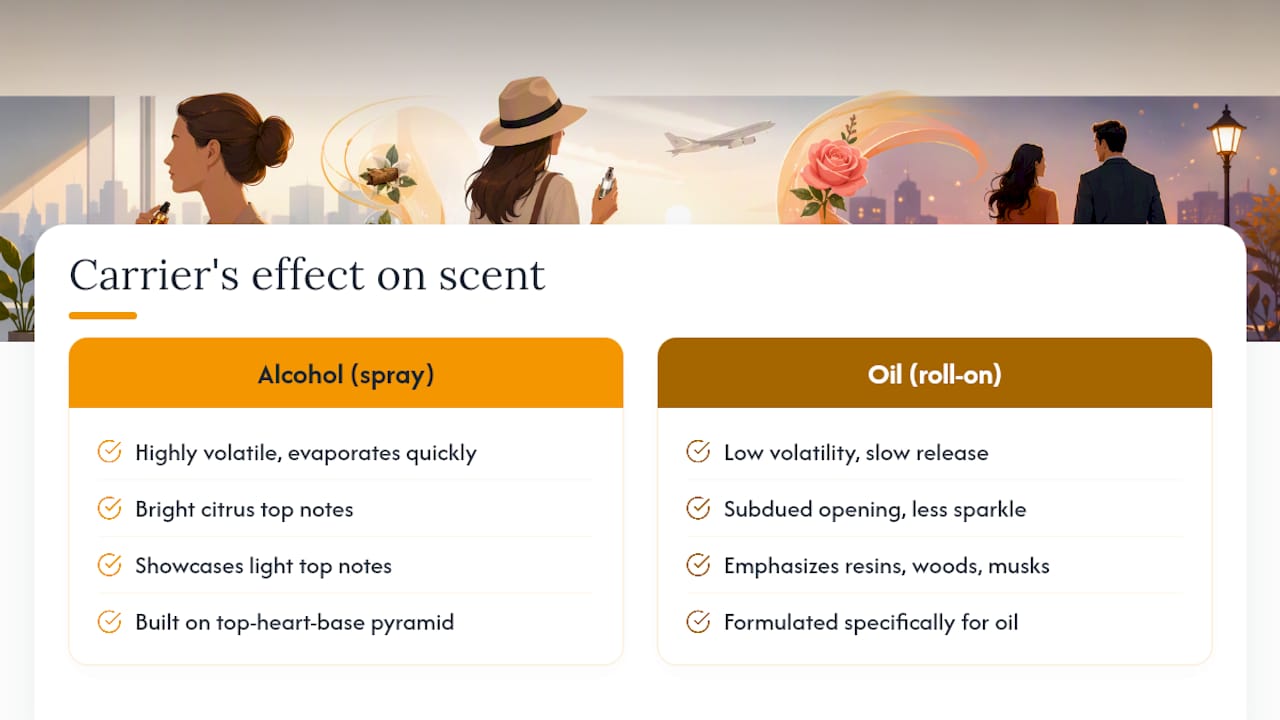
The formulation medium changes more than just how long a fragrance lasts. It changes how the scent itself unfolds. Alcohol is highly volatile, so it evaporates fast and carries the lightest, most delicate top notes (citrus, aldehydes, light florals) into the air almost instantly. That’s the “opening” you smell in the first few minutes after a spray, and it’s a large part of why eau de parfum and eau de toilette formulas are built around a top note, heart note, base note structure designed to shift over time.
Oil doesn’t evaporate the same way, so it doesn’t showcase that opening burst nearly as dramatically. Instead, oil formulas tend to emphasize the heavier, more tenacious notes from the start, things like resins, woods, and musks, because those are the compounds that survive being suspended in a slow-release oil base. Perfumers who formulate specifically for oil often adjust the note pyramid entirely rather than simply pouring an existing eau de parfum formula into oil. A fragrance designed from scratch as an oil will typically smell warmer, denser, and less “sparkly” up top compared to the same brand’s alcohol-based version, even when they share a name.
This is also why oils read so differently from person to person. Without alcohol’s evaporation forcing every wearer to smell roughly the same top notes at roughly the same time, oil interacts more directly and for longer with individual skin chemistry, body temperature, and even diet. Two people wearing the identical oil can end up with a noticeably different scent signature, which is part of the appeal for anyone chasing a true “skin scent” rather than a fragrance that smells identical on everyone who wears it.
What’s the Real Trade-Off Between Oil and Spray?
Most fragrance guides treat this as a simple preference question, oil versus spray, pick your favorite. That undersells what’s actually happening chemically. The alcohol in spray formulas isn’t just a delivery method; it’s actively shaping which notes you smell and when, front-loading the volatile top notes and then stepping back. Oil does the opposite: it holds the whole composition closer to the body and lets it unfold slower, which is why so many oil wearers describe their fragrance as feeling more “them” than any spray they’ve tried.
The mistake I see most often is people assuming one format is objectively superior. It isn’t. A perfume built for spray, layered with citrus and aldehydes up top, will often smell thin or unbalanced reformulated into oil. And a rich, resinous oil fragrance sprayed from an atomizer can lose exactly the slow-release quality that made it interesting in the first place. The format isn’t a delivery detail. It’s part of the fragrance’s design.
If you’re not sure which suits you, don’t guess from a single spritz at a counter. Sample both formats of a few scent families you already like, wear each for a full day, and pay attention to how your own skin chemistry changes them. That’s the only test that actually tells you anything.
— Rodney
Try Both Formats Before You Commit to a Full Bottle
Aromatick sells authentic designer and niche fragrances at discounts of up to 60% off department store pricing, which makes testing both oil and spray formats far less risky than paying full retail to find out which one suits you. Every order ships free above the site’s threshold and is backed by a satisfaction guarantee, so trying something new doesn’t mean gambling on a bottle you’ll never finish.
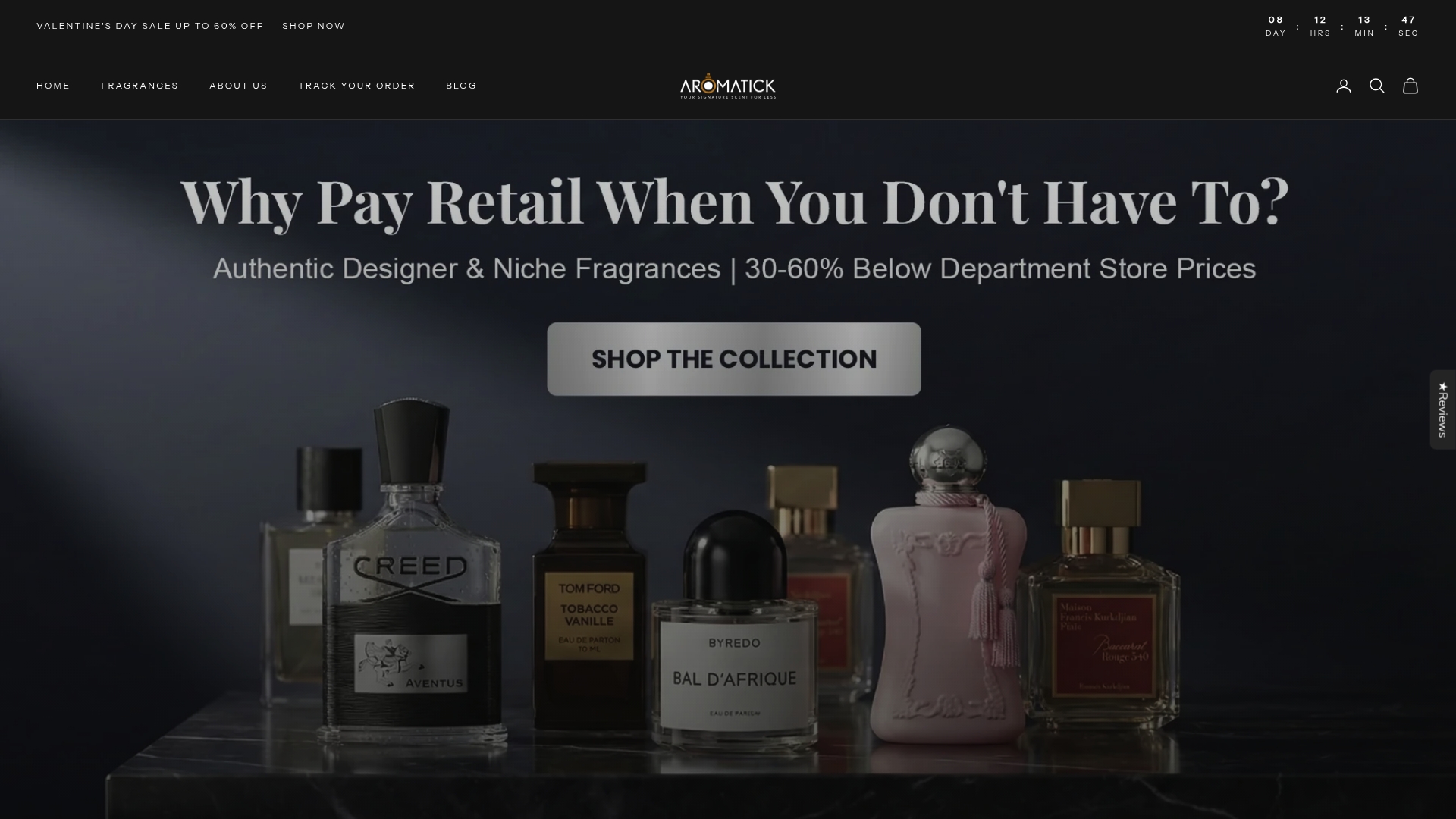
Start with a discovery set or decant if you’re torn between formats, then browse the designer fragrance collection for full-size bottles once you’ve found your match. Prefer something with more character? The niche fragrance collection leans into denser, more expressive compositions that tend to shine in oil form. Either way, the smartest next step is sampling before committing, and Aromatick’s pricing makes that an easy call.
Sources
- Perfume oil vs spray: What Is the Difference? | Onekind
- Perfume Oil vs Spray: Which Lasts Longer | WhatScent
- Perfume Oil vs Eau de Parfum: Which Is Better? – LuLu & Oliver

Leave a comment
This site is protected by hCaptcha and the hCaptcha Privacy Policy and Terms of Service apply.