
Perfume Concentration Explained: Your Buying Guide
TL;DR:
- Perfume concentration measures the percentage of aromatic oils in a fragrance, directly affecting scent strength and longevity. Different concentrations like EDC, EDT, EDP, and Parfum vary in oil content, wear time, and price, with higher oil percentages lasting longer and costing more. Selecting the appropriate concentration depends on the occasion, climate, and personal preference, as deeper formulations are reformulated for specific scent profiles rather than just increased potency.
Perfume concentration is defined as the percentage of aromatic compounds mixed with alcohol and water in a fragrance formula, and it directly determines how strong, long-lasting, and projecting a scent will be. The industry term for this measurement is “fragrance concentration,” and understanding it is the single most useful skill you can develop as a fragrance buyer. The four main categories are Eau de Cologne (EDC), Eau de Toilette (EDT), Eau de Parfum (EDP), and Parfum. Each carries a different oil percentage, a different wear time, and a different price point. Once you know what those differences mean, you stop guessing at the counter and start buying with confidence.
What is perfume concentration and how does it work?
Fragrance concentration refers to the percent of aromatic compounds dissolved in a base of alcohol and water. Higher aromatic oil concentration equals stronger scent strength and longer longevity. That relationship is direct and consistent across every fragrance house, from Chanel to Maison Margiela to Creed.
The alcohol in a fragrance is not just a filler. It carries the scent molecules off your skin and into the air around you, which is why a freshly sprayed EDT can fill a room before it settles. Water softens the blend and helps the formula sit smoothly on skin. The aromatic oils are the actual scent. More oil means more scent, more staying power, and typically a higher price.
Think of it like brewing coffee. A light roast brewed quickly gives you a bright, fast cup. A slow-brewed concentrate gives you something richer, longer-lasting, and more intense. Neither is wrong. They serve different moments.
How do concentration levels compare in strength and price?
The four main concentration types each occupy a distinct range of aromatic oil content. Here is how they break down in practical terms:
| Concentration | Oil Percentage | Typical Longevity | Best Use | Relative Price |
|---|---|---|---|---|
| Eau de Cologne (EDC) | 2–4% | 1–2 hours | Casual, warm weather | $ |
| Eau de Toilette (EDT) | 5–15% | 3–5 hours | Daytime, office | $$ |
| Eau de Parfum (EDP) | 15–20% | 5–8 hours | Day-to-night, versatile | $$$ |
| Parfum / Extrait | 20–40% | 8–12+ hours | Special occasions, intimate wear | $$$$ |
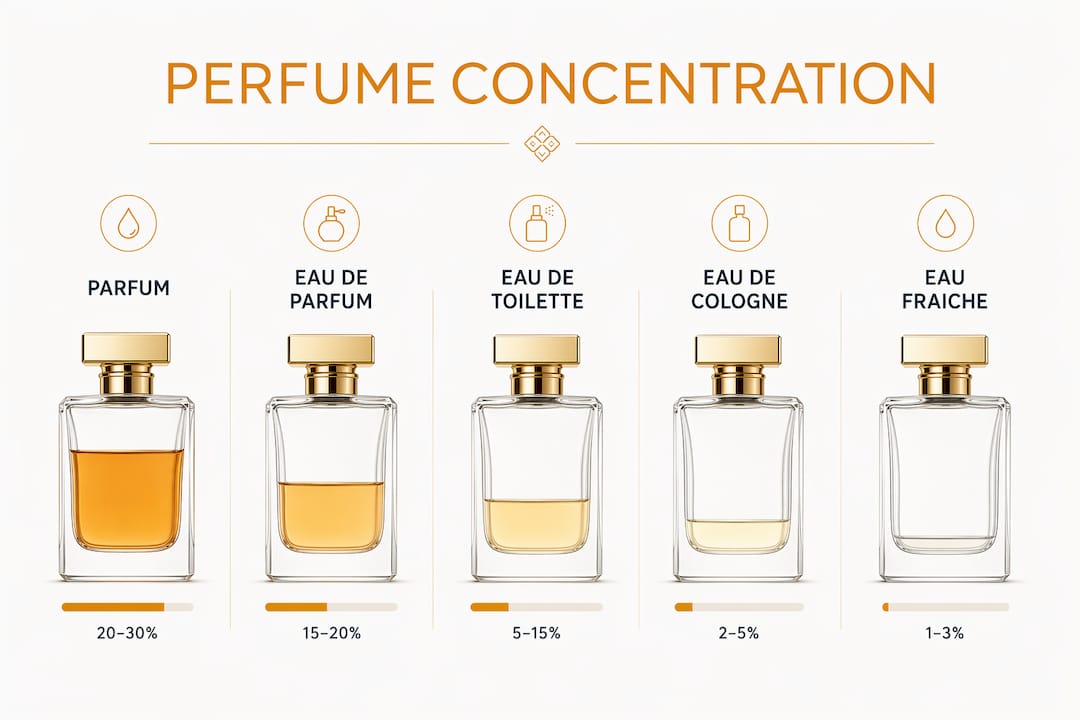
Longevity scales directly with oil percentage. An Eau Fraiche, which sits below EDC at roughly 1–3% oil, lasts only 1–2 hours. A Parfum can carry through a full day and into the next morning on clothing.
Price scales the same way. Parfum can cost 2–3 times more than an equivalent EDT from the same fragrance house. That gap reflects the raw cost of aromatic oils, which are often the most expensive ingredient in any formula.
EDP has become the most popular concentration in the market for a reason. It sits at the sweet spot between wearability and longevity, offering 5–8 hours of wear without the upfront cost of a Parfum. For most buyers, EDP is the practical default.
Pro Tip: If you wear a fragrance daily, calculate cost-per-wear before dismissing a Parfum as too expensive. Because Parfums last longer per spray, requiring fewer applications, the total cost over time can actually be lower than buying multiple bottles of EDT.
Does higher concentration always mean a stronger scent?
This is where fragrance concentration gets genuinely interesting, and where most buyers get it wrong. Concentration is not just a dilution dial. Perfumers actively change the composition between EDT and EDP versions of the same fragrance to suit the intended usage, not simply add more oil to the same formula.
An EDT version of a fragrance is typically built to be airier and lighter, with more volatile top notes like bergamot, lemon, or pink pepper leading the experience. Those top notes burn off quickly, which is why an EDT can smell bold for the first 30 minutes and then fade. An EDP version of the same scent often leans into the heart and base notes, using richer ingredients like amber, oud, or sandalwood that cling to skin for hours.
Here is what that means in practice:
- Top notes (citrus, herbs, light florals) are highly volatile. They project strongly but evaporate within 15–30 minutes regardless of concentration.
- Heart notes (rose, jasmine, spice) are the body of the fragrance. They last 2–4 hours and define the character of the scent.
- Base notes (amber, musk, woods, vanilla) are the anchor. They are the least volatile and carry the longest, often 6–12+ hours on skin.
A Parfum built around amber and musk will outlast an EDT built around bergamot and neroli, even if both are applied in the same amount. The composition matters as much as the concentration percentage.
Parfum scents often project less than EDTs but stay closer to the skin, creating what perfumers call an intimate sillage. EDTs, with their higher alcohol content, push scent outward more aggressively in the first hour. This is why a Parfum can feel quieter in a room but more personal to the wearer and anyone standing close.
Pro Tip: When testing a new fragrance, spray it on your wrist and check back at 30 minutes, 2 hours, and 4 hours. The dry-down at 4 hours tells you what the base notes actually smell like on your skin chemistry, which is the most honest version of the scent.
How to choose the right perfume concentration for your life
Choosing the right fragrance strength is less about personal preference and more about matching the scent to the context. Each concentration type suits different usage scenarios, and buying the wrong one for your lifestyle is the most common fragrance mistake.
Here is a practical framework for making that decision:
-
For warm weather and casual wear, choose an EDC or a light EDT. Heat amplifies fragrance projection significantly. A Parfum applied in summer can become overwhelming within minutes. Citrus-forward EDTs like Acqua di Gio by Giorgio Armani or Light Blue by Dolce & Gabbana are built for exactly this context.
-
For office and daytime wear, an EDT is the standard choice. It projects enough to be noticed without crossing into intrusive territory. Aim for clean, fresh, or lightly woody scents in EDT form for professional environments.
-
For day-to-night versatility, an EDP is the right call. You can apply it in the morning and still have meaningful sillage by evening. Fragrances like Yves Saint Laurent’s Black Opium EDP or Dior’s Sauvage EDP are designed for this kind of extended wear.
-
For special occasions or intimate settings, Parfum is the appropriate concentration. The close-to-skin projection creates a personal scent cloud rather than a broadcast. Parfum from houses like Tom Ford, Maison Francis Kurkdjian, or Initio Parfums Privés is built for moments where intensity and longevity matter most.
-
For gifting, consider the recipient’s lifestyle before choosing a concentration. A Parfum is a generous gift, but an EDT is often more practical for someone who wears fragrance casually. When in doubt, EDP is the safest choice because it works across most occasions.
On layering: applying an unscented moisturizer before spraying fragrance extends wear time across all concentration types. Dry skin absorbs scent faster and holds it less. This is especially useful if you love EDTs but want them to last longer without stepping up to an EDP.
Common misconceptions about fragrance concentration terms
Several widely repeated beliefs about fragrance concentration are simply incorrect. Knowing the truth protects you from bad purchases.
-
“Parfum is always louder than EDT.” This is false. Parfum projects less but lasts longer, staying close to the skin rather than broadcasting into a room. If you want projection, a well-formulated EDT often outperforms a Parfum in the first two hours.
-
“The percentage on the bottle tells you the oil concentration.” Not always. Perfume labels listing percentages sometimes indicate alcohol content by volume, not fragrance oil concentration. A bottle labeled “80% vol” means 80% of the liquid is alcohol, leaving 20% for oils and water combined.
-
“Eau Fraiche is just a weaker Eau de Cologne.” They are different products. Eau Fraiche uses water as its primary carrier rather than alcohol, giving it a different texture and feel on skin. EDC uses alcohol as the base. Both are light, but they wear differently.
-
“Your skin chemistry doesn’t matter much.” It matters enormously. The same EDP can smell warm and woody on one person and sharp and medicinal on another. Personal skin pH, diet, and hydration all influence how aromatic compounds develop. Always test on your own skin before buying.
Treating concentration levels as distinct scent iterations with different compositions, rather than just strength variations, is the mindset shift that separates informed buyers from frustrated ones.
Key takeaways
Perfume concentration is the single most important specification to understand before buying any fragrance, because it determines strength, longevity, projection, and price simultaneously.
| Point | Details |
|---|---|
| Concentration defines the formula | Fragrance concentration is the percentage of aromatic oils in the blend, directly setting scent strength and wear time. |
| Longevity scales with oil content | EDC lasts 1–2 hours, EDT 3–5 hours, EDP 5–8 hours, and Parfum 8–12+ hours per application. |
| Composition changes between types | Perfumers reformulate between EDT and EDP versions, not just dilute, so the scent character can differ meaningfully. |
| Parfum projects less, not more | Higher concentration creates intimate, close-to-skin wear rather than stronger room projection. |
| Match concentration to context | Choose EDT for daytime and warm weather, EDP for versatility, and Parfum for special occasions or intimate settings. |
Why concentration is the first thing i check on any bottle
I’ve worn fragrances for over a decade, and the single biggest shift in how I shop came when I stopped reading concentration labels as a quality signal and started reading them as a usage signal. For a long time, I assumed Parfum meant better. It doesn’t. It means different.
The most memorable fragrance experience I’ve had was wearing a well-chosen EDT on a warm afternoon. The projection was immediate, the citrus top notes were vivid, and the whole thing felt alive in a way that a heavier Parfum simply wouldn’t have in that context. Conversely, I’ve worn Parfum on cold evenings where that close-to-skin warmth felt exactly right.
My honest advice for first-time buyers: start with an EDP. It gives you enough longevity to evaluate how a scent wears across a full day, and it’s forgiving enough for most occasions. Once you understand how a fragrance behaves on your skin at EDP strength, you’ll have a much clearer sense of whether you want the lighter, airier EDT version or the richer Parfum. Explore perfume longevity before committing to a full bottle.
One more thing on gifting: if you’re buying for someone else, EDP is almost always the right call. It’s versatile, it reads as generous, and it works across seasons. Avoid gifting Parfum unless you know the person’s skin chemistry and preferences well.
— Rodney
Shop authentic fragrances across every concentration at Aromatick
Understanding fragrance concentration is only half the equation. The other half is finding authentic products at prices that make sense.
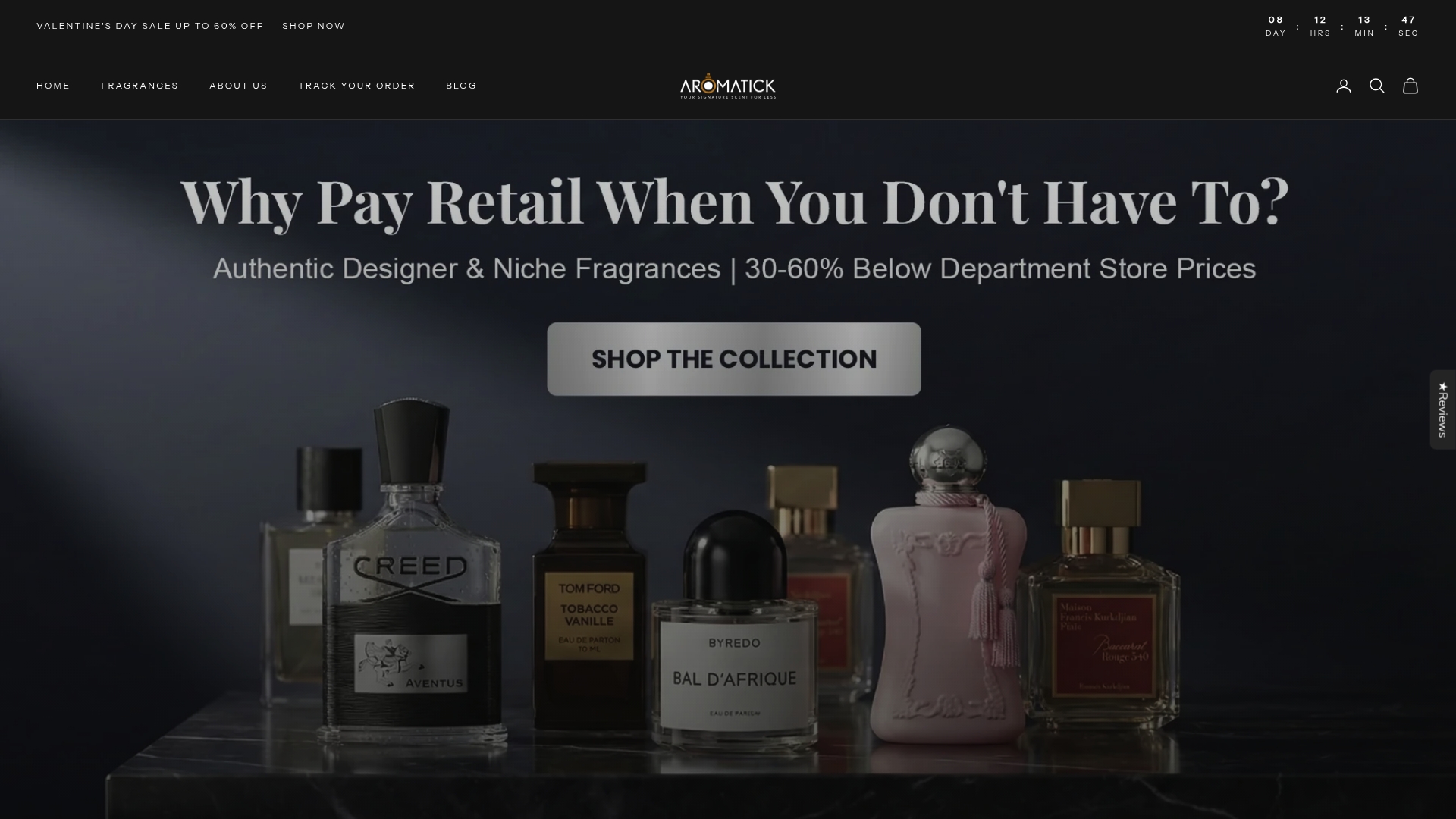
Aromatick carries a full range of designer fragrances spanning EDC, EDT, EDP, and Parfum from verified authentic sources, at up to 60% off standard retail pricing. Whether you’re testing a new concentration type for the first time or restocking a favorite EDP, the catalog covers both designer names and niche houses. Every purchase is backed by Aromatick’s authenticity guarantee, with free shipping and secure payment options. Browse by brand, concentration type, or occasion to find exactly what fits your lifestyle and budget.
FAQ
What does perfume concentration mean?
Perfume concentration is the percentage of aromatic oils in a fragrance formula. Higher concentration means a stronger scent and longer wear time on skin.
What is the difference between EDT and EDP?
Eau de Toilette contains roughly 5–15% aromatic oils and lasts 3–5 hours. Eau de Parfum contains 15–20% and lasts 5–8 hours, with a richer, more developed scent profile.
Is parfum always stronger than eau de parfum?
Parfum lasts longer and sits closer to the skin, but it does not always project more strongly. EDTs and EDPs often have greater initial projection due to higher alcohol content.
Why does the same perfume smell different on different people?
Skin chemistry, including pH levels, hydration, and body temperature, affects how aromatic compounds develop after application. The same EDP can smell noticeably different on two people wearing it side by side.
Does higher concentration mean better value?
Not automatically, but Parfums can be more economical over time because they require fewer sprays per wear. Calculate cost-per-wear rather than comparing upfront bottle prices alone.

Leave a comment
This site is protected by hCaptcha and the hCaptcha Privacy Policy and Terms of Service apply.