


How Gender Shapes Fragrance Marketing Strategies in 2026
TL;DR:
- Gender in fragrance marketing is shifting from binary codes to personal expression, driven by changing consumer preferences. Younger buyers increasingly favor fluid, unisex scents and reject traditional gender labels, prompting brands to rethink their strategies. Authentic gender-neutral marketing now requires consistent packaging, naming, and advertising to succeed.
Gender has always been one of the most powerful organizing forces in fragrance marketing, shaping which scent notes brands choose, how they design packaging, and what stories they tell in advertising. Today, that organizing force is under real pressure. As of early 2026, 70% of consumers prefer gender-neutral fragrance compositions over traditional gender-coded ones, reflecting a marked shift in buyer attitudes. Gen Z treats scent as a fluid expression of identity rather than a category assigned at the point of sale. The result is an industry at a genuine inflection point: binary segmentation still drives significant revenue, but the brands gaining ground are the ones rethinking what gender actually does for their marketing.
Here is what gender currently drives in fragrance marketing:
- Scent composition: Woody, smoky, and leathery notes are coded masculine; floral, fruity, and powdery notes are coded feminine. These associations are learned, not biological.
- Packaging and color: Dark bottles, angular shapes, and navy or black palettes signal men’s products. Soft curves, pinks, and golds signal women’s.
- Advertising narratives: Men’s campaigns emphasize strength, confidence, and seduction. Women’s campaigns lean on beauty, romance, and aspiration.
- Retail placement: Department store counters physically separate men’s and women’s fragrances, reinforcing the binary at the point of purchase.
- Pricing: Products marketed to women often carry a premium over comparable men’s products, a pattern sometimes called the “pink tax.”
- Emerging alternatives: Gender-neutral and unisex lines now occupy a fast-growing segment, with brands repositioning around mood, occasion, and personal expression rather than gender identity.
How gender in fragrance marketing became the industry standard
The strict gender divide in fragrance is younger than most people assume. Before the 20th century, scent use was primarily a marker of social class and wealth, not gender. Royalty and aristocracy of both sexes wore the same heavy florals and musks. The idea that certain smells belong to men and others to women is, as historical research confirms, a deliberate cultural invention designed to double market reach.
A brief chronology of how that invention unfolded:
- Pre-1900s: Fragrance signals status. Both men and women in European courts wear heavy florals, musks, and ambergris. No meaningful gender divide exists in scent composition.
- 1889: Guerlain releases Jicky, widely considered the first modern perfume built on synthetic molecules. It is marketed to both sexes.
- Victorian era: Social conservatism begins associating heavy perfume use with femininity and moral looseness in men, nudging male fragrance toward subtler applications.
- 1920s: French perfume houses enter the American market aggressively. Helen Marie Caldwell’s dissertation on the American perfume market documents how these brands targeted affluent women specifically, cementing perfume as a feminine luxury category.
- 1930s–1950s: American cosmetics companies respond to French dominance by marketing fragrance as an everyday necessity for women, dramatically expanding the consumer base. Men’s cologne is positioned as a separate, functional category.
- 1960s–1970s: Advertising agencies codify the gender binary visually and narratively. Women’s ads feature romance and beauty; men’s ads feature rugged independence. The two categories become visually and olfactorily distinct.
- 1994: Calvin Klein releases CK One as a deliberate challenge to binary marketing. It sells well but faces cultural resistance, and the brand eventually returns to gendered lines.
- 2010s: Niche and luxury houses begin experimenting with unisex positioning. The category grows but remains largely a premium phenomenon.
- 2020s–2026: Gender-neutral fragrances move from niche experiment to mainstream expectation, with genderless fragrance maturing into a standard market category rather than a novelty.
How gender shapes fragrance marketing strategies today
Gender still touches nearly every strategic decision a fragrance brand makes, from the perfumer’s brief to the retail floor plan.
Scent composition is the most literal expression of gender coding. Masculine archetypes draw on woody base notes like cedarwood and vetiver, smoky accords, and sharp citrus openings. Feminine archetypes lean on rose, jasmine, peony, and soft musks. These are conventions, not chemistry. There is no molecule that smells inherently masculine or feminine; the associations are built through decades of repeated marketing exposure.
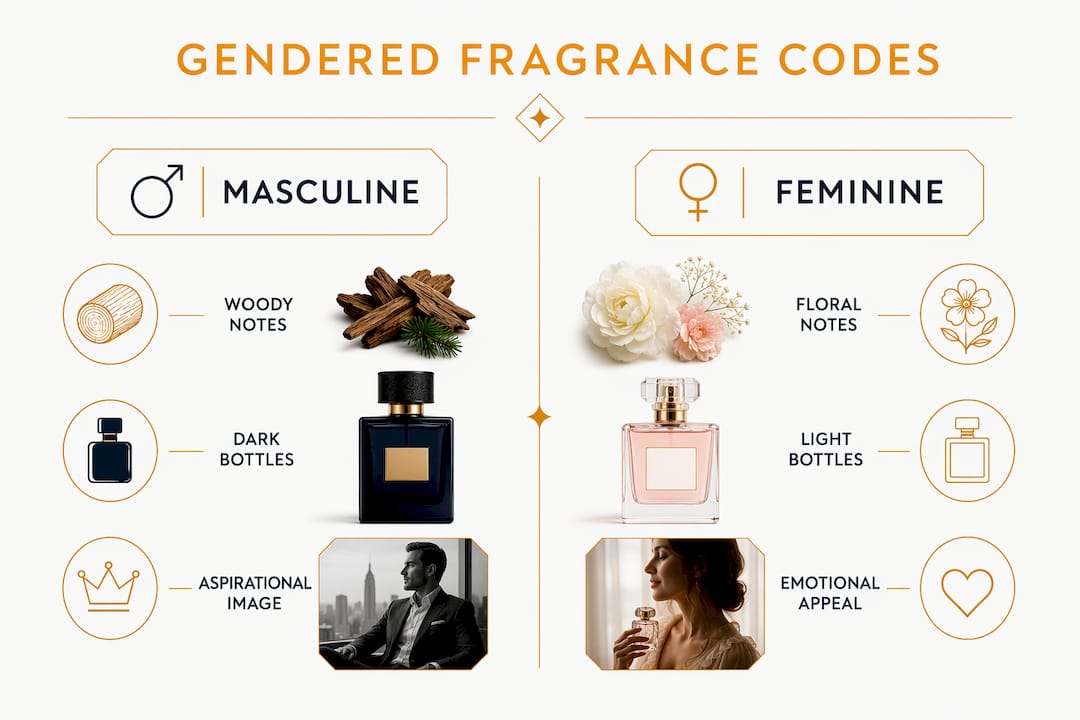
Packaging and visual identity reinforce the scent message. A square-shouldered black bottle with a metal cap reads as a men’s product before anyone smells it. A curved, frosted glass flacon with a soft pink label reads as women’s. Brands spend heavily on this visual grammar because it works at the shelf level, where most purchase decisions happen.

| Strategic touchpoint | Masculine coding | Feminine coding |
|---|---|---|
| Scent notes | Woody, smoky, leathery, citrus | Floral, fruity, powdery, musky |
| Bottle shape | Angular, heavy, geometric | Curved, delicate, ornate |
| Color palette | Black, navy, dark green, silver | Pink, gold, white, pastels |
| Ad narrative | Strength, conquest, independence | Romance, beauty, sensuality |
| Celebrity choice | Athletes, action stars | Models, actresses |
| Price positioning | Moderate to premium | Premium to luxury |
Successful gender-specific campaigns in the U.S. have consistently used aspirational identity rather than product features as the core message. A men’s fragrance ad rarely describes what the fragrance smells like. It shows who you become when you wear it.
Pro Tip: When briefing a fragrance campaign, test your visual assets with the scent removed. If the gender signal disappears without the bottle, your packaging is not doing its job.
The shift toward gender-neutral fragrance marketing
The fragrance industry’s move away from binary segmentation is not a trend driven by ideology alone. It is driven by purchasing behavior. Gen Z consumers favor fluid fragrance preferences, often ignoring traditional gender labels entirely when choosing a scent, with luxury fragrance functioning as a key component of personal identity for a significant portion of this cohort. For this generation, fragrance is closer to a mood accessory than a gender signal.
Several specific behaviors are reshaping how brands think about their portfolios:
- Scent wardrobing: Consumers build collections of multiple fragrances for different occasions and moods, rather than wearing one signature scent. Gender becomes irrelevant when the selection logic is situational.
- Layering: Mixing two or more fragrances to create a personal blend is increasingly common, especially among younger consumers. Layering inherently crosses gender lines.
- Mood-based selection: Brands now focus on mood-based scent roles, travel-friendly formats, and layering routines rather than gendered identity to meet consumer demand.
- Cross-category shopping: Women buying men’s fragrances is a documented and growing behavior, driven by a preference for drier, woodier compositions that women’s lines have historically underserved.
| Consumer behavior | Traditional gender model | Emerging gender-neutral model |
|---|---|---|
| Purchase driver | Gender identity | Mood, occasion, personal expression |
| Scent selection | Category-assigned | Self-directed, cross-category |
| Fragrance quantity | One signature scent | Multiple scents, layered |
| Brand loyalty | Brand and gender line | Scent profile, regardless of line |
The challenge for brands is that genuine gender-neutral marketing requires more than slapping a “unisex” label on an existing product. Packaging, naming conventions, retail placement, and advertising all need to align. A fragrance with a gender-neutral name sold in a pink bottle on the women’s counter sends contradictory signals. Consumers notice, and they push back. You can explore how this plays out in practice in Aromatick’s guide to gender-neutral fragrance.
What research says about consumer behavior and gender in fragrance
The consumer research on gender-neutral fragrances points in a clear direction. A study published in Procedia of Multidisciplinary Research found that epistemic value, meaning the appeal of novelty and new experiences, has the strongest effect on willingness to pay a premium for gender-neutral fragrances, with a beta coefficient of 0.294. Social value follows closely at 0.292. Functional and emotional value matter, but less so. The implication for marketers is direct: position gender-neutral fragrances around discovery and self-expression, not just quality.
Gen Z’s relationship with fragrance goes deeper than preference. Luxury fragrance functions as a key component of personal identity for a significant portion of this cohort, which explains why they resist being told what their scent should say about their gender. For this group, a fragrance that carries a rigid gender label feels like a constraint, not a feature. Aromatick’s analysis of why unisex fragrances matter covers this shift in detail.
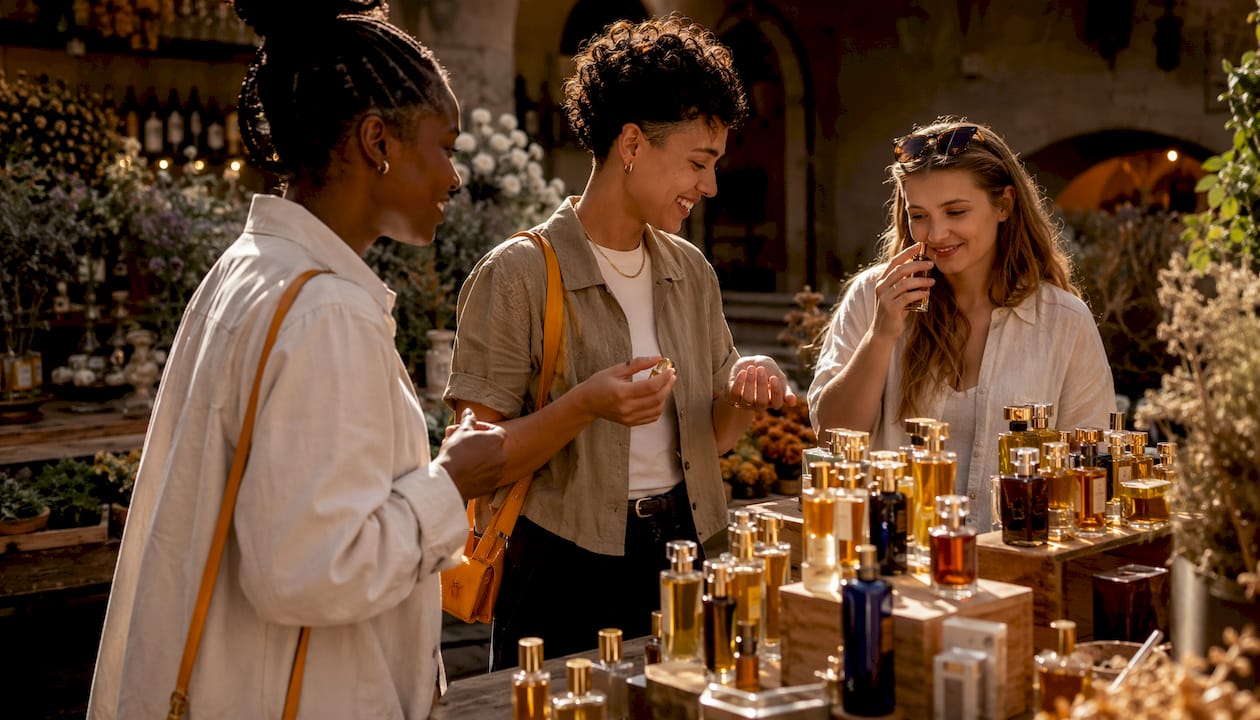
Industry analysts describe the genderless fragrance category as maturing beyond its early “statement” phase. The conversation has moved from “is this acceptable?” to “which format and scent role works best?” That is a meaningful shift in how the category is discussed internally at major fragrance houses.
How cultural and social factors shape gendered fragrance marketing
Fragrance marketing does not operate in a vacuum. The gender codes embedded in a perfume campaign reflect the broader social norms of the market where it runs. In the United States, those norms have shifted considerably over the past two decades, and fragrance marketing has followed, sometimes reluctantly.
The “pink tax” dynamic, where products marketed to women carry higher prices than comparable products for men, is one of the more visible cultural tensions in the category. It reflects an assumption about women’s willingness to pay for beauty products, and it has attracted growing consumer criticism. Brands that price gender-neutral lines at a premium above their women’s lines face a credibility problem with exactly the consumers they are trying to reach.
Cultural identity fragmentation also plays a role. As cultural identity becomes more fragmented, consumers increasingly resist the idea that a single demographic label, including gender, should define their preferences. Fragrance brands operating in the U.S. are navigating a market where identity is genuinely more complex than the binary model assumes.
Luxury brands have an advantage here. Their core consumers, wealthy young people with progressive social attitudes, are both more likely to experiment with gender-crossing scent choices and more insulated from social judgment when they do. This is partly why gender-neutral fragrance has gained its strongest foothold at the premium end of the market.
Challenges and controversies in gender-coded fragrance advertising
The fragrance industry’s advertising history is full of campaigns that pushed gender stereotypes to their limits, and the backlash has grown louder. Several recurring tensions define the current debate.
Cosmetic inclusivity versus structural change. Launching a “unisex” fragrance while keeping the rest of the portfolio rigidly gendered reads as a marketing gesture rather than a genuine shift. Consumers, particularly younger ones, are quick to identify this inconsistency. Research confirms that brands risk consumer confusion when they adopt genderless naming without redesigning packaging and visual identity to match.
The Overton Window problem. Academic analysis of the fragrance industry describes a structural constraint: society can absorb only so much change at once before rejecting it. CK One’s 1994 launch is the clearest example. It was genuinely ahead of its time, sold well among early adopters, but could not sustain a market-wide shift. The brand returned to gendered marketing because the broader consumer base was not ready.
Class and accessibility. Gender-neutral fragrances remain disproportionately concentrated at the luxury and niche end of the market. If the only way to opt out of gendered fragrance is to spend $200 or more on a bottle, the movement’s reach is inherently limited. Affordable fragrance brands have largely not adopted gender-neutral positioning, which means the binary model persists for most consumers by default.
Advertising imagery. Even when a fragrance is positioned as gender-neutral in name, its advertising often defaults to conventional gender imagery. A campaign featuring a conventionally attractive woman in soft lighting undermines a “for everyone” positioning. The effect of gender-neutral marketing on consumer behavior is real, but only when the entire brand expression is consistent.
Key Takeaways
Gender remains the single most influential segmentation variable in fragrance marketing, but its dominance is eroding as consumer preferences shift toward personal expression over prescribed identity.
| Point | Details |
|---|---|
| Historical construct | Gendered fragrance marketing was invented in the 20th century to expand markets, not because scent has inherent gender. |
| Epistemic value, meaning the appeal of novelty and new experiences, has the strongest effect on consumers’ willingness to pay a premium for gender-neutral fragrances, with a beta coefficient of 0.294, followed closely by social value at 0.292. | |
| Gen Z rejects binary labels | Younger consumers treat fragrance as identity expression, favoring fluid, mood-based choices over gender-assigned categories. |
| Integrated execution required | Genuine gender-neutral positioning demands aligned packaging, naming, retail placement, and advertising, not just a label change. |
| Genderless is now mainstream | The genderless fragrance category has matured from a niche experiment into a recognized market segment in recent years. |
Explore fragrances beyond the binary at Aromatick
Whether you are drawn to classic gender-coded compositions or the growing world of niche and unisex fragrances, Aromatick carries authentic designer and niche scents at up to 60% off retail prices. Every bottle is guaranteed authentic, with free shipping and secure checkout. Browse the full collection and find a fragrance that fits your identity, not a marketing category.

Leave a comment
This site is protected by hCaptcha and the hCaptcha Privacy Policy and Terms of Service apply.