
The Role of Perfumer in Fragrance Creation Explained
TL;DR:
- Perfumers create stable and compliant fragrance formulas that accurately reflect a brand’s creative vision. They blend ingredients, ensure safety, and manage costs, influencing scent quality and longevity. Recognizing their process helps shoppers verify authenticity and make informed perfume choices online.
A perfumer translates a brand’s creative brief into a legally compliant, stable fragrance formula that smells the intended way on skin and performs in its chosen product matrix. That single sentence covers a lot of ground, so here is what it means for you as a shopper:
- Creative + technical: Perfumers blend hundreds of natural extracts and synthetic aroma molecules to shape how a scent opens, evolves, and lingers across top, heart, and base notes.
- Safety and compliance: Every formula is designed within IFRA limits, informed by RIFM research, and aligned with FDA cosmetic rules before it reaches U.S. shelves.
- Commercial impact: A perfumer’s ingredient choices directly affect a fragrance’s longevity, authenticity, and retail price — all details worth understanding when you’re comparing listings on a discounted fragrance retailer like Aromatick.
Knowing what a perfumer actually does helps you read product pages more critically, spot authenticity signals, and choose sampling options wisely before committing to a full bottle.
Table of Contents
- The perfumer’s role: artist, chemist, and businessperson
- How perfumers turn a brief into a finished fragrance
- Materials, fragrance architecture, and what they mean on your skin
- Quality control, IFRA limits, RIFM research, and U.S. regulatory context
- How brand briefs, budgets, and raw materials reshape the final formula
- Practical tips for buying authentic designer and niche fragrances online
- Key Takeaways
- Why authenticity signals are the real story here
- Authentic fragrances at prices that make sense
- Authoritative sources and further reading
The perfumer’s role: artist, chemist, and businessperson
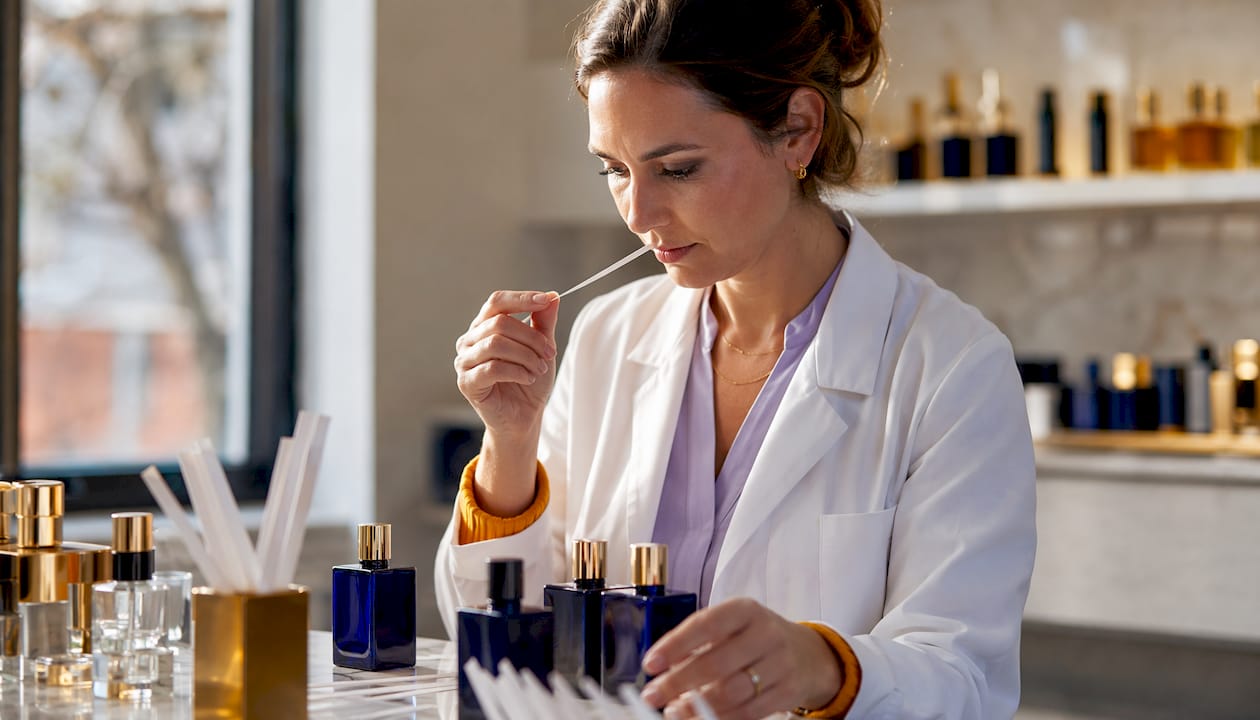
A perfumer is an expert who composes scent accords from a palette of ingredients to meet a creative brief, then engineers the formula so it is stable, compliant, and manufacturable at scale. The American Society of Perfumers describes the role as requiring in-depth knowledge of the physical, chemical, and aesthetic properties of hundreds of raw materials — knowledge built through years of training, not just a sharp sense of smell.
As an artist, a perfumer interprets mood, memory, and brand identity into notes and accords. Fine fragrance perfumers, in particular, are storytellers: they construct an emotional narrative that unfolds on skin over hours. As a chemist, they select molecules by volatility, reactivity, and compatibility, then balance evaporation rates to shape the scent’s evolution from the first spritz to the dry-down. As a businessperson, they work within cost-in-use targets, raw-material sourcing timelines, and marketing constraints — collaborating with marketing, product development, and supply chain teams throughout the process.

The term “nose” is a useful shorthand, but it undersells the skill set. IFF, one of the world’s largest fragrance houses, notes that what enables composition is the perfumer’s creative mind, structural knowledge, and chemistry literacy — not acute smell alone. Training paths include formal programs such as those recognized by the Institute for Art and Olfaction, a U.S.-based nonprofit that supports perfumery education and awards independent creators.
How perfumers turn a brief into a finished fragrance
The fragrance development process follows a structured workflow, even when the creative vision feels spontaneous.
- Brief intake: The perfumer receives a document describing the target market, persona, price-per-liter ceiling, and intended application (fine fragrance, personal care, etc.).
- Palette strategy: They select a hybrid of naturals and synthetics suited to the brief’s mood, budget, and stability requirements.
- Early modifications and accords: Initial blends are built and refined, often producing three to five distinct interpretations for client review.
- Sensory screening and panel feedback: Trained evaluators assess each modification for emotional resonance, projection, and skin performance.
- Base-side testing: The concentrate is tested in its actual delivery matrix — alcohol, lotion, wax, or surfactant — because performance varies significantly across bases.
- Compliance checks: IFRA category limits and allergen totals are calculated and verified.
- Stability testing: Samples are exposed to heat, light, and varying pH to confirm shelf life.
- Pilot scale-up and documentation: The formula is documented by weight percentage per batch, with a Safety Data Sheet (SDS), Certificate of Analysis (COA), and IFRA conformity certificate prepared.
- Maturation and maceration: The concentrate rests for weeks to months so volatile components harmonize into a coherent whole.
Pro Tip: Maceration is where a fragrance finds its voice. Perfumers allow concentrates to rest because skipping this step is one of the most common causes of sharp, discordant, or off-smelling imitations. When you see production or batch notes on a product page, that documentation is a quiet signal that this step was taken seriously.
Shoppers can spot evidence of this process in batch codes, concentration labels (EDT, EDP, parfum), and ingredient or allergen disclosures on product pages.
Materials, fragrance architecture, and what they mean on your skin
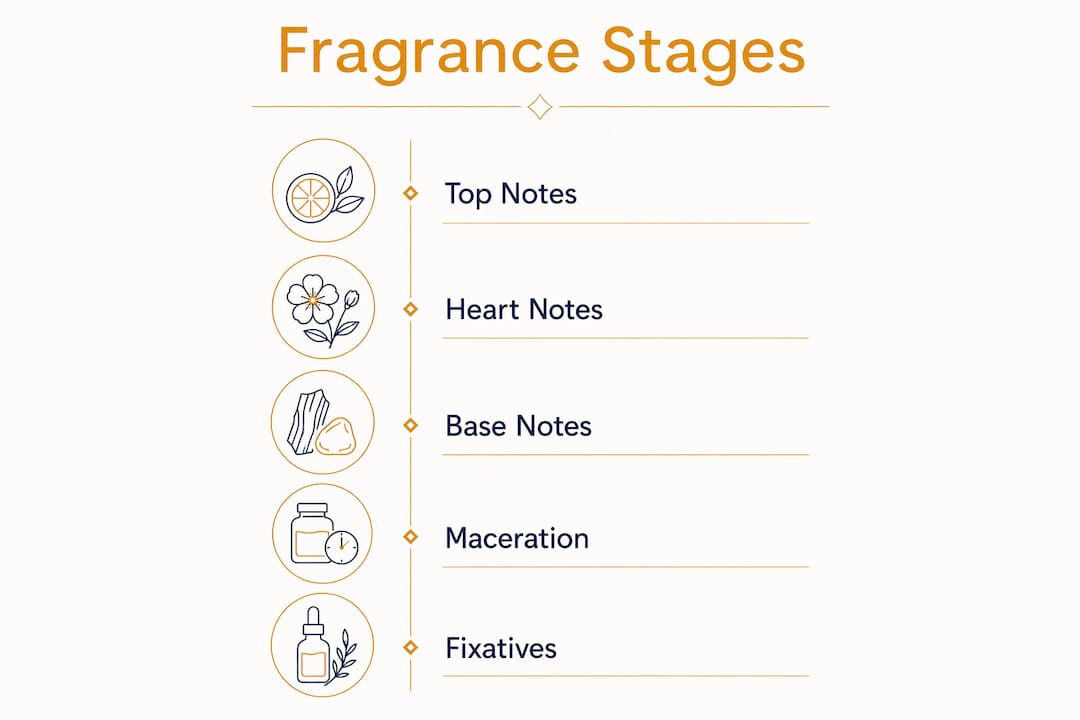
Fragrance architecture describes how a scent evolves in three stages. Top notes — citrus, aromatics, light herbs — are the most volatile and fade within 15–30 minutes. Heart notes — florals, spices, fruits — form the character of the scent and last one to four hours. Base notes — woods, musks, resins, amber — are the structural backbone, anchoring volatile top notes and persisting for hours after application.
| Material Type | Supply & Cost | Stability | Batch Consistency | Storytelling Value |
|---|---|---|---|---|
| Natural extracts | Variable; often costly | Can degrade with heat/light | Varies by harvest | High; evokes origin and craft |
| Synthetic aroma molecules | Stable supply; scalable cost | Highly stable | Consistent batch to batch | Moderate; enables novel accords |
| Hybrid formulas | Balanced cost | Good overall stability | High when well-engineered | High; combines authenticity with performance |
Fixatives extend longevity by slowing evaporation. Musks, resins, and molecules like ambroxide (often marketed as Ambroxan) are common choices. Some modern perfumers also use microencapsulation, a delivery technology that releases fragrance gradually with friction or body heat, improving performance in lotions and hair products.
For shoppers: a higher proportion of long-lasting base materials and engineered fixatives generally signals better longevity. Look for concentration (EDP tends to outperform EDT in sillage and staying power), and note any mention of encapsulation or delivery technology on the product page.
Quality control, IFRA limits, RIFM research, and U.S. regulatory context
Three bodies shape what a fragrance formula can legally and safely contain in the U.S. market:
- IFRA (International Fragrance Association): Sets usage limits for fragrance ingredients by product category. Formulas must conform to the current IFRA standard before market release.
- RIFM (Research Institute for Fragrance Materials): Conducts and publishes the safety research that informs IFRA limits. Their database is the scientific backbone of the industry’s self-regulatory system.
- FDA (U.S. Food and Drug Administration): Regulates fragrances as cosmetic ingredients under the Federal Food, Drug, and Cosmetic Act. Manufacturers are responsible for safety before marketing; the FDA does not pre-approve cosmetic formulas but enforces labeling and safety requirements.
Common quality-control documents and tests include:
- Stability testing results (heat and light exposure over defined periods)
- GC-MS fingerprint analysis to verify ingredient identity and batch consistency
- Sensory panel evaluation records
- IFRA conformity certificate
- Safety Data Sheet (SDS) and Certificate of Analysis (COA)
- Allergen totals and labeling where EU or U.S. disclosure thresholds apply
On product pages, look for explicit IFRA compliance statements, complete or partial ingredient lists, and any available batch or stability notes. Absence of basic compliance information is a genuine red flag — either for authenticity or for proper formulation.
How brand briefs, budgets, and raw materials reshape the final formula
Commercial constraints are not a compromise of artistry; they are part of the perfumer’s job description. Cost-in-use targets, supplier lead times, seasonal variation in naturals, and shifting IFRA windows all push a perfumer to make trade-offs that can subtly change a scent from one production run to the next.
A typical scenario: a brand must hit a price target while also meeting a new IFRA limit on a key base ingredient. The perfumer swaps an expensive natural base accord for a synthetic analog and adjusts fixation strategies to preserve the fragrance’s emotional core. The result is close but not identical to the previous version. That is what “reformulated” means on a product listing.
When you see terms like reformulated, new concentration, or vintage bottle online, they reflect real perfumer decisions made under real constraints. A vintage bottle may carry a discontinued natural ingredient no longer permitted under current IFRA limits. A current EDP may use an engineered synthetic that improves supply stability and lowers allergen risk while delivering a similar sensory impression.
Practical tips for buying authentic designer and niche fragrances online
Understanding the fragrance development process gives you a concrete checklist for evaluating any online listing:
- Check concentration: EDT, EDP, and parfum differ in oil percentage and longevity. Confirm the concentration matches what you expect.
- Look for ingredient or allergen disclosure: Transparent product pages list major components or at least flag common allergens. This signals a properly formulated product.
- Verify batch codes: Authentic products carry traceable batch codes. No code is a warning sign.
- Prefer discovery sets or decants first: Sampling before a full-bottle purchase is the single best way to confirm a scent works on your skin chemistry.
- Confirm return and authenticity policies: A retailer that guarantees authenticity and offers a clear return path is putting real accountability behind its listings.
- Look for IFRA mention: Even a brief compliance note on a product page indicates the seller understands what they’re carrying.
Pro Tip: Well-documented products, those with batch codes, concentration details, and at least partial ingredient disclosure, are statistically likelier to be authentic and properly matured. When a listing is vague on all three, treat it with caution. Aromatick’s product pages are built around this kind of transparency, making it easier to shop discounted designer and niche fragrances with confidence.
For niche selections specifically, choosing niche fragrances with documented provenance and clear concentration labeling reduces the risk of receiving a reformulated or mislabeled bottle.
Key Takeaways
A perfumer’s creative, technical, and commercial decisions determine everything about a fragrance — from how it smells on your skin to whether it is safe, stable, and worth the price on the label.
| Point | Details |
|---|---|
| Perfumer as artist and engineer | Ingredient and process choices determine scent identity, longevity, and skin performance. |
| Compliance signals matter | IFRA conformity, RIFM-informed safety data, and FDA cosmetic rules are non-optional; look for them on product pages. |
| Reformulation is real | Commercial constraints and updated IFRA limits cause genuine formula changes; “vintage” and “reformulated” labels carry meaning. |
| Sampling reduces risk | Discovery sets and decants let you verify skin chemistry and maturation quality before committing to a full bottle. |
| Aromatick’s transparency | Aromatick offers authentic designer and niche fragrances with clear product details, discovery options, and an authenticity guarantee. |
Why authenticity signals are the real story here
Most fragrance content focuses on notes and accords. What gets less attention is the chain of decisions, from brief to batch code, that determines whether the bottle you receive is the real thing. A perfumer’s work does not end at the formula; it extends through every stability test, compliance check, and maturation period that separates a properly made fragrance from a rushed imitation.
Shoppers who understand this have a real advantage. They know what documentation to look for, why a discovery set is worth the small upfront cost, and why a retailer’s authenticity guarantee is more than marketing language. The perfumer’s craft is the foundation; your ability to read its signals is what protects your purchase.
Authentic fragrances at prices that make sense
Aromatick carries authentic designer and niche fragrances at 30–60% below typical retail prices, without the overhead of a department store counter. Every listing is sourced for genuine authenticity, with clear concentration details and product information so you can shop with confidence rather than guesswork.
Browse the niche fragrance collection for independent and artisan releases, or explore women’s designer perfumes and men’s designer fragrances for discounted authentic options from recognized houses. Discovery sets and decants are available for shoppers who want to sample before committing to a full bottle. Free shipping applies over the qualifying threshold, and a satisfaction guarantee backs every order. Check current availability and start with a sample.
Authoritative sources and further reading
- American Society of Perfumers — Perfumery: Overview of perfumer training, specializations, and the professional standards behind the craft.
- Perfumer — Wikipedia: Definition of the perfumer’s role, the brief process, and the creative/technical dual function.
- FY Chem Group — Perfumers: The Art and Science Behind Every Scent: Primary source for the step-by-step development process, maceration guidance, base-side testing, and QC documentation.
- The Artisan Insider — The Fragrance Creation Process: Covers olfactive fatigue management and the trained sensory discipline behind professional perfumery.
- IFF — How Perfume Is Made: Industry-level perspective on sustainability, green chemistry, and the evolving perfumer’s palette.
- Ecole Parfum — What Is a Perfumer: Covers the business and collaborative dimensions of the perfumer’s role.
- Aromatick: Brand proof points for authenticity, product transparency, and consumer-facing trust signals referenced throughout.

Leave a comment
This site is protected by hCaptcha and the hCaptcha Privacy Policy and Terms of Service apply.