


How Fragrance Notes Work: Decode Perfume Layers
TL;DR:
- Fragrance notes evolve over time due to molecular volatility, changing the scent experience.
- Note pyramids used in marketing may not accurately reflect a fragrance’s true development.
- Understanding notes and their progression helps consumers choose better, more authentic perfumes.
Most people spray a perfume and expect to smell everything at once. That assumption is completely understandable, but it misses one of the most fascinating aspects of fine fragrance: the scent you smell in the first thirty seconds is not the scent you’ll be wearing an hour later. Perfume is not a single static smell. It’s a sequence of evolving layers called fragrance notes, and understanding how those layers work will permanently change how you shop for, test, and enjoy perfume. This guide walks you through the science, the storytelling, and the practical skills you need to choose fragrances with real confidence.
Table of Contents
- What are fragrance notes? Basic definitions and structure
- How do fragrance notes work? The science behind the layers
- How brands use fragrance notes: Storytelling and marketing versus reality
- How to use fragrance notes for smarter perfume shopping
- Why understanding fragrance notes isn’t enough: What real-world experience teaches
- Find your signature scent with confidence
- Frequently asked questions
Key Takeaways
| Point | Details |
|---|---|
| Fragrance notes evolve | Perfumes unfold in stages—top, middle, and base notes appear over time, not all at once. |
| Science supports the pyramid | Volatility and chemistry, not just marketing, explain why certain notes emerge and fade in a set order. |
| Watch for red flags | Too many top notes or vague ‘fantasy’ notes can signal poor quality or over-marketing. |
| Critical shopping skill | Understanding notes helps you predict performance and choose scents that fit your style. |
| Experience trumps labels | Personal testing is always more reliable than note lists when shopping for fragrances. |
What are fragrance notes? Basic definitions and structure
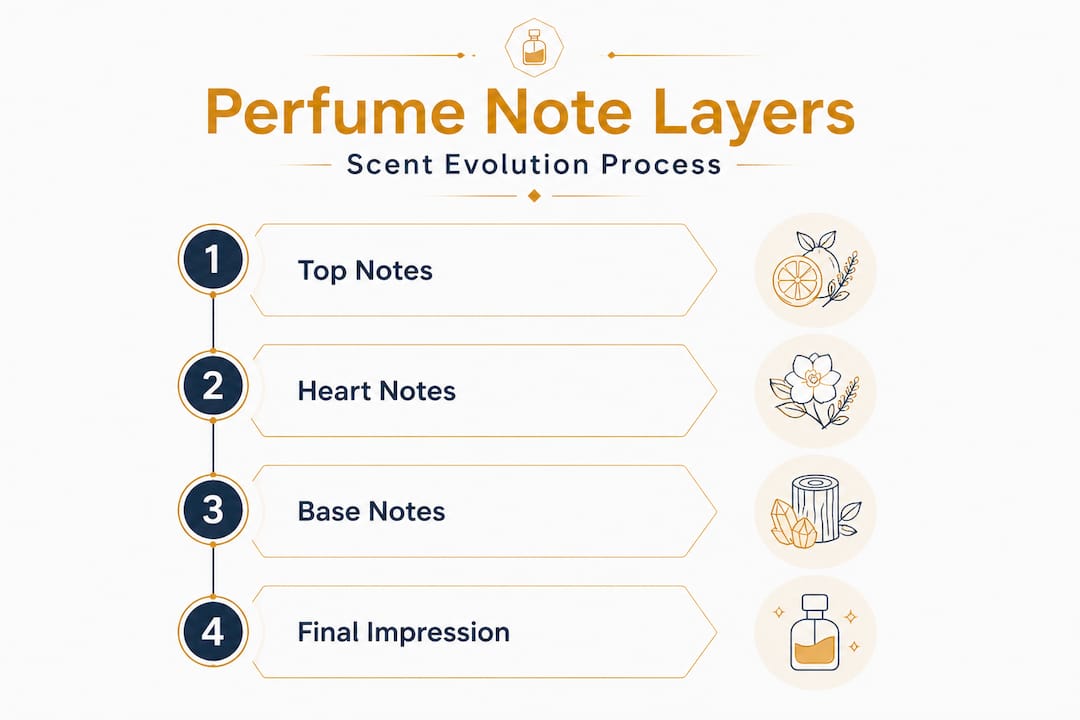
Fragrance notes explained in their simplest form are the distinct scents released in stages after a perfume is applied to skin. Because different aromatic ingredients evaporate at different speeds, the scent you smell changes over time. Perfumers and brands organize these stages into what is commonly called the note pyramid, with three distinct levels: top notes, middle notes (also called heart notes), and base notes.
Top notes are the first impression. They’re the bright, sharp, or fresh scents you detect immediately after spraying, typically citrus, light herbs, or green accords. They tend to fade within fifteen to thirty minutes because their molecules are small and evaporate quickly.
Middle notes (or heart notes) form the emotional core of a fragrance. Florals, spices, and soft fruits are common here. They take over as the top notes fade, typically lasting anywhere from thirty minutes to two hours. This is often the most important part of a perfume’s identity.

Base notes are the foundation. They’re the deep, rich, long-lasting elements like woods, musks, vanilla, and resins that anchor the entire composition. Base notes can last four to eight hours or longer depending on the formula.
Here is a quick overview of each level:
- Top notes: Citrus, bergamot, green herbs, aldehydes. Duration: 15 to 30 minutes.
- Middle notes: Rose, jasmine, cinnamon, cardamom, iris. Duration: 30 minutes to 2 hours.
- Base notes: Cedarwood, sandalwood, vetiver, musk, amber, benzoin. Duration: 4 hours or more.
As the fragrance note guide points out, brands use note pyramids to map a fragrance’s evolution for consumers, but those pyramids can be imperfect or even marketing-driven. The visual diagram may not reflect the true, nuanced way a scent unfolds on your skin.
Pro Tip: Never judge a perfume on the first sniff at the counter. Spray it on your wrist, walk around for at least twenty minutes, and revisit before making any decision. The fragrance you test in the bottle is not the fragrance you’ll wear.
How do fragrance notes work? The science behind the layers
The reason top, middle, and base notes appear in sequence comes down to basic chemistry: volatility. Every aromatic ingredient in a perfume formula is made of molecules, and lighter, smaller molecules evaporate faster. When you spray a perfume, the most volatile compounds escape into the air first, creating that initial burst of scent. As time passes, heavier, less volatile molecules take longer to evaporate, which is why they linger on the skin long after the top notes have disappeared.
This isn’t just a poetic idea. Research into odorant partitioning and evaporation uses physical chemistry concepts like vapor pressure, odor thresholds, and surrogate volatility models to predict how a fragrance will actually behave over time. The Perfumery Ternary Diagram is one such analytical framework, allowing formulators to map how different ingredients distribute, evaporate, and interact throughout the life of a fragrance on skin. It’s a rigorous scientific approach, not just guesswork.
Understanding how fragrance notes influence scent helps you predict your wearing experience before you even open a bottle.
Here’s a straightforward comparison of how each note tier behaves:
| Note tier | Typical duration | Volatility | Common ingredients | Role in the fragrance |
|---|---|---|---|---|
| Top | 15–30 minutes | High | Citrus, green, light herbs | First impression, initial attraction |
| Middle | 30 min to 2 hours | Medium | Florals, spices, soft fruits | Core identity, emotional signature |
| Base | 4–8+ hours | Low | Woods, musks, resins, vanilla | Lasting impression, skin scent |
Learning to detect note transitions takes some practice, but it is an incredibly useful skill. If you blind test a fragrance by smelling it without knowing the brand or note list, you can actually trace when the heart notes begin to emerge and when the base settles. That awareness makes you a far more informed buyer.
How brands use fragrance notes: Storytelling and marketing versus reality
Here is something every fragrance enthusiast should know: the note pyramid you see on a brand’s website or on the back of a box is not a neutral, scientific document. It is also a marketing tool. Brands understand that certain notes carry emotional associations. “Bulgarian rose,” “Madagascan vanilla,” and “Haitian vetiver” all sound far more compelling than their more generic alternatives, even when the actual ingredient used is a synthetic accord designed to mimic those raw materials.
Common issues with fragrance authenticity concerns aside, note lists can be misleading in more subtle ways too. A brand might list six or seven top notes to create the impression of complexity, while the base notes section contains only one or two vague entries. That imbalance is a structural signal worth paying attention to.
As noted by fragrance note guides, consumers can look for structural red flags like too many top notes, missing base notes, and vague “fantasy” notes as potential signs of weak, short-lived, or overly synthetic fragrances. Understanding these signals gives you real power as a shopper.
Here’s a comparison of what a trustworthy note pyramid looks like versus a marketing-heavy one:
| Feature | Balanced, informative pyramid | Marketing-heavy pyramid |
|---|---|---|
| Top notes | 2 to 3 clearly named ingredients | 5 or more, sometimes vague |
| Middle notes | 2 to 4 distinct heart accords | Listed loosely or missing |
| Base notes | 2 to 4 grounding elements | Only 1 or absent entirely |
| Ingredient names | Specific and recognizable | “Fantasy,” “oceanic,” “mystery” |
| Overall feel | Structured and plausible | Padded and exaggerated |
What to look for in a trustworthy note list:
- Clear, specific ingredient names at every level of the pyramid
- A logical balance of top, middle, and base entries
- No more than three or four top notes in most cases
- Base notes that include at least one lasting, anchoring material
- No vague or invented descriptors that mean nothing in chemistry
The 3-layer perfume note guide breaks this structure down further and is worth reading before any significant purchase.
Pro Tip: Before trusting a brand’s note list, look for independent reviews on fragrance community sites. Real-world wearers will tell you what the fragrance actually smells like in each stage, which is far more reliable than polished marketing copy.
How to use fragrance notes for smarter perfume shopping
Now that you understand what fragrance notes are and how brands communicate them, here’s how to put that knowledge to practical use. Whether you’re shopping in a store or browsing online, this process will help you evaluate any fragrance with more confidence.
-
Read the full note list carefully. Start at the top and look for balance. Does the pyramid have entries for all three tiers? Are the names specific or vague? A well-constructed note list should read like a believable recipe, not a wish list.
-
Check for balance across the pyramid. A note list dominated entirely by top notes is a warning sign. As fragrance structure analysis makes clear, more than three or four top notes can be a sign of weak or short-lived performance. Look for a pyramid with strong middle and base sections.
-
Test on your skin, not the strip. Blotter strips are useful for a first impression, but skin chemistry changes everything. Your body temperature, skin type, and natural pH alter how ingredients interact and evaporate. Always wear a fragrance for at least thirty minutes before deciding.
-
Watch for marketing tricks. Exaggerated ingredient sourcing, overly romantic descriptions, and extremely long note lists without specific chemistry grounding are all reasons to investigate further before buying. Cross-reference with trusted community sources.
-
Consider the occasion before choosing. Top-heavy fragrances with fleeting citrus and green accords work beautifully for daytime, casual, or warm-weather wear. But if you want something that lasts through a dinner or an evening event, prioritize fragrances with strong middle and base notes. Knowing verifying fragrance authenticity practices also helps ensure what you buy matches what was described.
Pro Tip: Use your note knowledge to build an intentional fragrance wardrobe. A light, citrus-forward scent for the office. A rich, woody or amber base for evenings. A floral heart for spring. You’re not just buying bottles, you’re building a personal scent library.
Applying this process consistently will make you a much more discerning buyer, whether you’re choosing a well-known designer name or something from the niche fragrance world.
Why understanding fragrance notes isn’t enough: What real-world experience teaches
Here’s a perspective that most fragrance guides won’t give you. Note pyramids, however well-constructed, are a simplified map of a complex, living experience. The map is not the territory.
You can read every ingredient on a note list and still be genuinely surprised by what arrives on your skin. Why? Because personal chemistry is real and significant. Two people wearing the same fragrance can produce noticeably different results. Dry skin tends to absorb base notes faster and reduce overall projection. Oily skin tends to amplify and prolong. Body heat, diet, and even stress can shift how a fragrance performs throughout the day. None of that is captured in a note pyramid.
Textbook note structures are a starting point, not a verdict. Real connoisseurship lives in the space between what a label promises and what your nose actually receives.
Skepticism is a valuable tool when reading note lists. Even a perfectly balanced, beautifully written pyramid can underdeliver if the raw materials used are low quality, the concentration is too dilute, or the formula wasn’t tested across a range of skin types. The fragrance world rewards those who test before committing and who trust their own sensory experience over any piece of marketing.
This doesn’t mean note pyramids are useless. They remain the clearest way to get a preliminary sense of a fragrance’s character and potential longevity. But treat them as an invitation to explore, not a guarantee of experience. Learning to spot authentic scents is one of the most practical skills you can develop as a fragrance buyer.
The most experienced collectors will tell you the same thing: the fragrance that surprises you, the one that smells better on hour three than hour one, is often the one you’ll reach for most often. That’s the kind of discovery that no note pyramid can predict. It takes time, curiosity, and a willingness to smell beyond the label.
Find your signature scent with confidence
Armed with real knowledge about fragrance notes, you’re ready to shop in a way that feels intentional rather than overwhelming. At Aromatick, every bottle in our catalog is 100% authentic, sourced directly to eliminate the overhead that inflates department store prices by as much as 60%.

Whether you’re searching for a structured floral heart, a rich woody base, or a bright citrus opening, our designer fragrance collection offers the iconic names you already trust. And if you’re ready to go deeper, our niche fragrance collection showcases compositions built for enthusiasts who appreciate exactly the kind of layered complexity you’ve just learned about. Free shipping, secure payments, and a satisfaction guarantee make it easy to explore with confidence.
Frequently asked questions
Do more fragrance notes always mean a better perfume?
No. An excess of notes, especially top notes, often signals marketing over substance rather than quality. A well-crafted perfume can be built on just a handful of precisely chosen ingredients.
Why does my perfume smell different after an hour?
As lighter top notes evaporate, middle and base notes emerge, changing the scent profile entirely. This progression is driven by molecular volatility and odor thresholds, not a flaw in the formula.
What are “fantasy” notes and should I trust them?
Fantasy notes are invented or vague descriptors like “oceanic breeze” or “morning dew” that don’t correspond to a specific ingredient. They often indicate synthetic accords or marketing padding rather than real complexity.
Are note pyramids reliable for blind buying fragrance online?
Note pyramids are a useful starting point, but as fragrance marketing shows, they can be imprecise or brand-driven. Sampling, community reviews, and testing on skin remain more reliable than descriptions alone.
How can I tell if a fragrance note list is honest or inflated?
Look for a balanced distribution across all three tiers and specific, recognizable ingredient names. A structurally sound pyramid with no more than three to four top notes and clearly named base materials is a strong sign of a well-built fragrance.
Recommended
- Perfume notes explained: 3 layers, smarter choices
- Fragrance Notes Explained: Unlocking Perfume’s Secrets
- Fragrance Layering: Elevate Your Scent Game with Expert Techniques
- How to Layer Fragrances Like a Pro: Secrets to Building Your Perfect
- Types of perfume notes: Unlock fragrance layers and lasting power – ThePerfumeSampler

Leave a comment
This site is protected by hCaptcha and the hCaptcha Privacy Policy and Terms of Service apply.