


Olfactory Families in Perfume: A Beginner's Guide
An olfactory family is a category that groups perfumes sharing similar dominant scent characteristics, giving shoppers and perfumers a shared language for describing what a fragrance smells like at its core. According to Wikipedia’s overview of perfume classification, these groupings are industry-developed heuristics, meaning a single fragrance can belong to more than one family or carry a hybrid label like “floral-woody-musk.”
The main families you’ll encounter across most classification systems include:
- Fresh (clean, aquatic, green)
- Citrus (bright, zesty, sparkling)
- Floral (rose, jasmine, lily)
- Woody (sandalwood, cedar, vetiver)
- Amber/Oriental (warm, resinous, spiced)
- Chypre (oakmoss, labdanum, bergamot)
- Fougère (lavender, coumarin, oakmoss)
Some guides consolidate these into four broad families (Fresh, Floral, Woody, Amber), while others expand to seven or more. Both approaches are valid, and you’ll see both in stores and online.
Key Takeaways
Olfactory families are practical scent categories that help you recognize, compare, and choose fragrances, but skin chemistry and wear time always have the final word.
| Point | Details |
|---|---|
| Definition | An olfactory family groups perfumes by dominant scent character, giving shoppers a shared vocabulary. |
| Main families | Fresh, Citrus, Floral, Woody, Amber/Oriental, Chypre, and Fougère cover most fragrances you will encounter. |
| Test on skin | Blotter strips only show top notes; wear each sample for several hours to judge the full family character. |
| Families are heuristics | Odor perception is partly learned and subjective; a hybrid fragrance can belong to more than one family simultaneously. |
| Aromatick | Aromatick’s discovery sets and decants let you sample across families affordably, with an authenticity guarantee on every order. |
Table of Contents
- What is an olfactory family, and where did the idea come from?
- The main olfactory families: what each one smells like
- How the fragrance wheel helps you find scents you’ll love
- How to use olfactory families when picking and testing perfumes
- Why olfactory families are helpful but not the whole story
- Smart strategies for exploring olfactory families
- The case for treating families as a starting point, not a destination
- Affordable ways to explore fragrance families with Aromatick
- Sources
What is an olfactory family, and where did the idea come from?
The concept of grouping fragrances by scent type predates modern perfumery, but the system most retailers use today traces back to perfume consultant Michael Edwards. In 1983, Edwards introduced his fragrance wheel, a circular diagram that arranged broad families and their subfamilies around a visual map. The wheel was built as a practical retail and communication tool, not a scientific taxonomy. Department store buyers needed a way to shelve fragrances logically; perfumers needed a shared vocabulary for briefing clients.
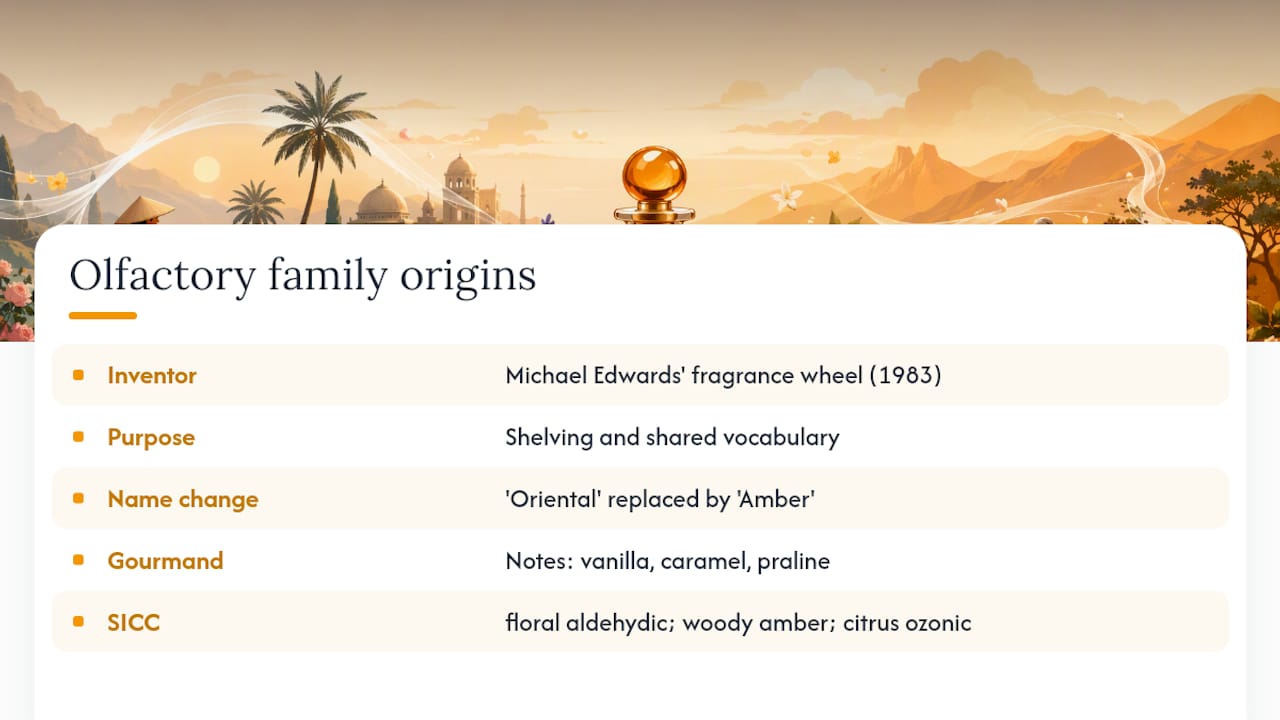
The Perfume Society notes that Edwards’ wheel has been updated repeatedly over the decades, and the industry has followed suit. The term “Oriental,” for example, is now widely replaced by “Amber” among professionals, reflecting both cultural sensitivity and a more accurate description of the warm, resinous character those fragrances share. The Gourmand family, built around edible notes like vanilla, caramel, and praline, rose to prominence in the 1990s and now appears in most modern classification guides.
Multiple family lists exist because no single authority governs perfume classification. The SICC proceedings on fragrance classification show that French technical committees and industry bodies use detailed subfamilies and qualifiers (“floral aldehydic,” “woody amber,” “citrus ozonic”) for precision in perfumer-to-perfumer communication. Consumer guides simplify this into the seven-family model most shoppers recognize.
The main olfactory families: what each one smells like
Consumer guides commonly present seven families as the practical standard for organizing and choosing scents. Here is what each one delivers on skin, along with its signature notes and a representative example available in the U.S. market.
- Fresh: Light, clean, and often aquatic or green. Signature notes include sea spray, cut grass, cucumber, and white musk. Acqua di Giò by Giorgio Armani is a textbook example. Subfamilies include aquatic, green, and ozonic.
- Citrus: Bright and sparkling, built on bergamot, lemon, grapefruit, and neroli. These tend to be the most volatile family, fading fastest on skin. Eau de Cologne formats have belonged here for centuries.
- Floral: The largest family, ranging from single-flower soliflores (a perfume centered on one bloom) to lush bouquets. Rose, jasmine, peony, and tuberose are the anchors. Chanel No. 5 is a classic aldehydic floral, where synthetic aldehydes amplify the bouquet into something powdery and abstract.
- Woody: Grounded and warm, with sandalwood, cedar, vetiver, and patchouli as the structural backbone. Woody fragrances tend to last well on skin because these materials are fixatives. Terre d’Hermès sits firmly in this family.
- Amber/Oriental: Rich, warm, and often sweet or spiced, built on labdanum, benzoin, vanilla, and resins. Shalimar by Guerlain is the landmark reference. Modern Gourmand fragrances (think vanilla-forward or caramel-laced scents) are typically classified as a subfamily here.
- Chypre: Named after the French word for Cyprus, this family is built on a classic accord of bergamot, oakmoss, and labdanum. Miss Dior (original formulation) is a well-known example. Chypre fragrances feel sophisticated and slightly earthy.
- Fougère: French for “fern,” though ferns have no real scent. The family is defined by lavender, coumarin, and oakmoss, creating a clean, herbal, slightly powdery character. Most classic men’s barbershop-style colognes belong here.
Fragrances often straddle families. A floral-woody scent opens with rose but dries down to cedar and musk. That shift is normal, and it’s why the family label on a bottle describes the dominant impression rather than every note.
| Family | Signature Notes | Typical Mood / Occasion |
|---|---|---|
| Fresh | Sea spray, green, white musk | Daytime, spring/summer, office |
| Citrus | Bergamot, lemon, grapefruit | Morning, warm weather, casual |
| Floral | Rose, jasmine, peony | Everyday, romantic, spring |
| Woody | Sandalwood, cedar, vetiver | Evening, fall/winter, formal |
| Amber/Oriental | Vanilla, labdanum, resins | Evening, cold weather, date night |
| Chypre | Oakmoss, bergamot, labdanum | Sophisticated, daytime, office |
| Fougère | Lavender, coumarin, oakmoss | Casual, everyday, fresh air |
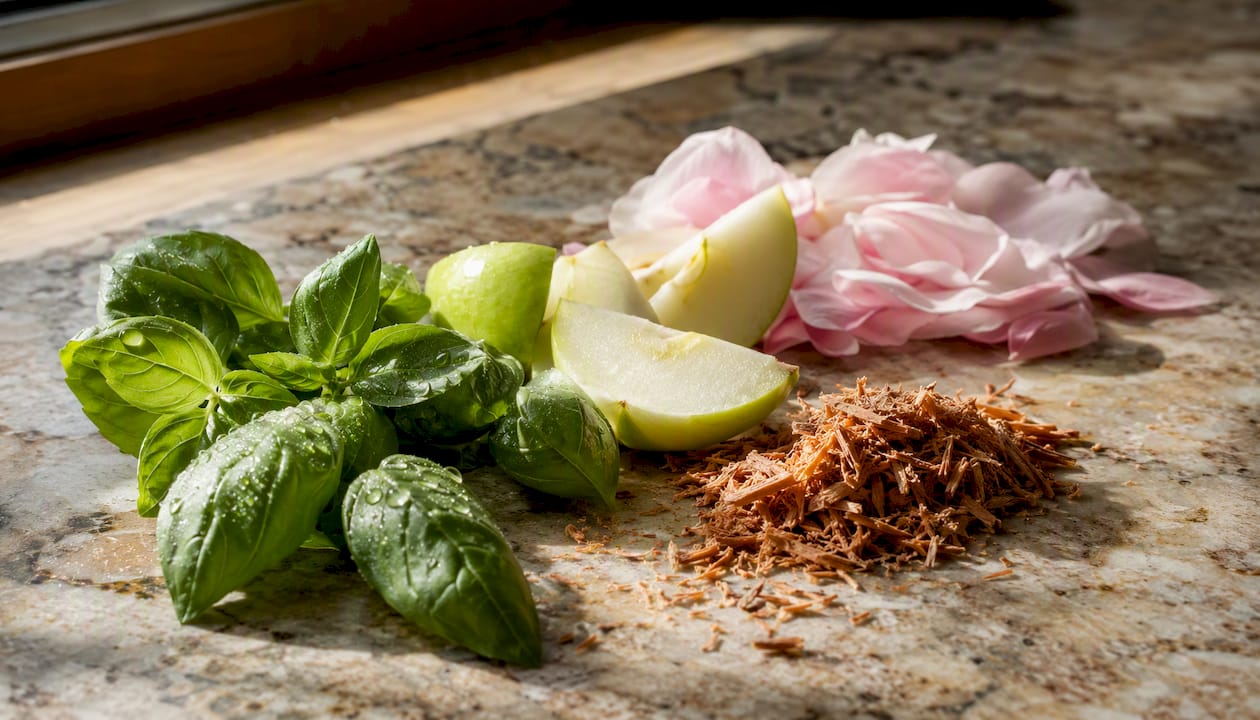
Pro Tip: When testing a new family, sniff the base notes last. Spray on your wrist, wait 20 minutes for the top notes to fade, then smell again at the 2-hour mark. The base is where the family character lives longest.
How the fragrance wheel helps you find scents you’ll love
The fragrance wheel is a circular diagram that places families next to the ones they most resemble. Families bordering each other share characteristics, which makes adjacency the simplest navigation tool for discovery.
Here is how that works in practice:
- If you love Citrus, the wheel places Fresh and Aromatic/Fougère right beside it. Both feel clean and light, so either is a natural next step.
- If you enjoy Floral, moving toward Chypre introduces earthiness while keeping the brightness; moving toward Woody adds depth and longevity.
- If Amber/Oriental is your comfort zone, the adjacent Woody family offers warmth without the sweetness, which suits those who find Amber too heavy.
Different versions of the wheel exist, and some reposition subfamilies or add newer categories like Gourmand. Treat the wheel as a map, not a rulebook. It tells you where to look next, not what you will definitely like.
How to use olfactory families when picking and testing perfumes
Knowing the families is only useful if you apply that knowledge when you actually test. Follow these steps to avoid the most common sampling mistakes.
- Prepare your nose. Avoid strong food smells or other fragrances for at least 30 minutes before testing. Coffee beans as a palate cleanser are a popular retail trick, though plain air works just as well.
- Spray on skin, not paper. Blotter strips show top notes only. Your skin chemistry, warmth, and pH all change how a fragrance develops. Retail and editorial guides consistently recommend skin testing as the only reliable method.
- Wait for each phase. Top notes (the first impression) fade within 15–30 minutes. Heart notes define the family character and last 1–4 hours. Base notes anchor the scent and can linger for hours beyond that.
- Limit your session. Test no more than 3–4 fragrances per session to avoid olfactory fatigue, where your nose stops distinguishing differences.
- Wear it for a full day. A fragrance that smells perfect at the counter can shift dramatically by afternoon. Wear a sample for at least 4–6 hours before deciding.
- Use season and occasion as filters. Light Fresh and Citrus families suit warm weather and daytime wear. Amber, Woody, and Chypre families carry better in cool weather and evening settings.
- Filter online by family. When shopping online, use family labels in product descriptions and filters to narrow your options before ordering a discovery set or decant.
Why olfactory families are helpful but not the whole story
Olfactory family labels are practical tools, not scientific certainties. A Chemical Senses review on odor classification makes clear that odor perception is complex, partly learned, and context-dependent. Classification systems are cognitive constructs, not universal maps of chemical structure. Two people smelling the same Chypre fragrance may describe it as “earthy and sophisticated” or “musty and old-fashioned,” and both responses are valid.
Several common mistakes trip up beginners:
- Judging from a blotter only. Paper strips capture top notes. The family character usually lives in the heart and base, which only emerge on skin over time.
- Sampling too many at once. After four or five fragrances, the nose fatigues and everything starts to blur together.
- Relying on a single review. Skin chemistry varies enough that one person’s “warm vanilla” is another person’s “sharp and medicinal.”
- Treating the family label as a guarantee. A fragrance marketed as “woody” may open with citrus and only reveal its cedar base after an hour. The label describes the dominant impression, not every phase.
Hybrid fragrances add another layer of complexity. A scent built on rose, patchouli, and musk sits at the intersection of Floral, Woody, and Amber simultaneously. Classifying it as strictly one family misses the point. The better question is: which phase do you spend the most time in, and does that phase suit you?
Smart strategies for exploring olfactory families
Active exploration beats passive reading every time. Here is a practical approach to building your family knowledge quickly.
- Start with one family per week. Pick Fresh one week, Floral the next. Focused exposure builds recognition faster than sampling across all families at once.
- Use discovery sets and decants. Small-format samples let you wear a fragrance for a full day without committing to a full bottle. The Perfumed Court and similar decant retailers make this accessible.
- Keep a scent journal. Note the family, the top/heart/base impressions, how long it lasted, and the occasion it suited. After a month, patterns emerge that tell you exactly which families work on your skin.
- Rotate samples across different days. Skin hydration, diet, and even stress levels affect how a fragrance develops. Testing the same sample twice, on different days, gives a more accurate read.
- Verify authenticity before you buy. Counterfeit fragrances often smell “off” because the formula is wrong, which makes family identification unreliable. Check batch codes, packaging quality, and retailer credentials before purchasing. Aromatick’s fragrance authenticity guide walks through exactly what to look for on a product page.
Pro Tip: Record your impressions in three stages: immediately after spraying (top), 30 minutes later (heart), and 2 hours in (base). That three-point log is the fastest way to map your preferences to specific families.
Scent families also translate beyond personal fragrance. If you enjoy a particular family in perfume, you’ll likely find the same character appealing in home fragrance products like scented candles, where Woody and Amber families are especially popular for evening ambiance.
The case for treating families as a starting point, not a destination
There is a tendency among beginners to over-rely on family labels, treating them as a reliable shortcut to finding the right perfume. The label is useful for narrowing a search from hundreds of options to a manageable shortlist. But the moment you start dismissing a fragrance because it is classified as Chypre when you thought you only liked Florals, you are letting a heuristic make decisions that only your nose can make.
The most interesting fragrances often resist clean classification. Some of the most beloved modern scents sit at the edge of two families, borrowing warmth from Amber and structure from Woody, or pairing Citrus brightness with a Fougère herbal base. Wearing those hybrids is how preferences evolve. The family system is a map, and maps are most useful when you are willing to wander off the marked path.
Affordable ways to explore fragrance families with Aromatick
Aromatick publishes this guide as a resource for fragrance learners, and the retailer’s designer fragrance collection offers a direct way to put family knowledge into practice.

Every product ships with Aromatick’s authenticity guarantee, which matters when you are testing family characteristics: a counterfeit formula will not represent the family accurately. U.S. customers benefit from free shipping over the threshold and a satisfaction guarantee. Browse the niche fragrance collection to find trend-forward families including Gourmand and modern Woody hybrids, or check the authenticity guarantee page for full details on verification and returns before you order.
Sources
- Perfume
- Fragrance families: what are they? How can you recognise them? - The Perfume Society
- Review on odor classification and perception (Chemical Senses review)
- Fragrance Families: The 7 Families of Fragrance Explained - ScentAir
- Fragrance family guide (Cosmopolitan)

Leave a comment
This site is protected by hCaptcha and the hCaptcha Privacy Policy and Terms of Service apply.