

What Is Perfume Sillage? A Fragrance Lover's Guide
TL;DR:
- Perfume sillage is the scent trail a fragrance leaves as the wearer moves, influenced by skin and environment.
- It is distinct from projection and longevity, which describe scent dispersion when stationary and duration, respectively.
Perfume sillage is defined as the scented trail a fragrance leaves in the air as the wearer moves through a space. The word comes from the French term for a ship’s wake, and the parallel is exact: just as a vessel leaves a disturbance in the water behind it, a well-composed fragrance leaves an olfactory impression in the air. Sillage is not the same as projection or longevity, though all three shape how a fragrance performs on your skin. Ingredients like Hedione and Iso-E Super are specifically engineered to enhance this trailing effect, and fragrances like Giorgio Armani’s Stronger With You are often cited as textbook examples of strong, elegant sillage. Understanding this concept changes how you shop, test, and wear perfume.
What is perfume sillage vs. projection and longevity?
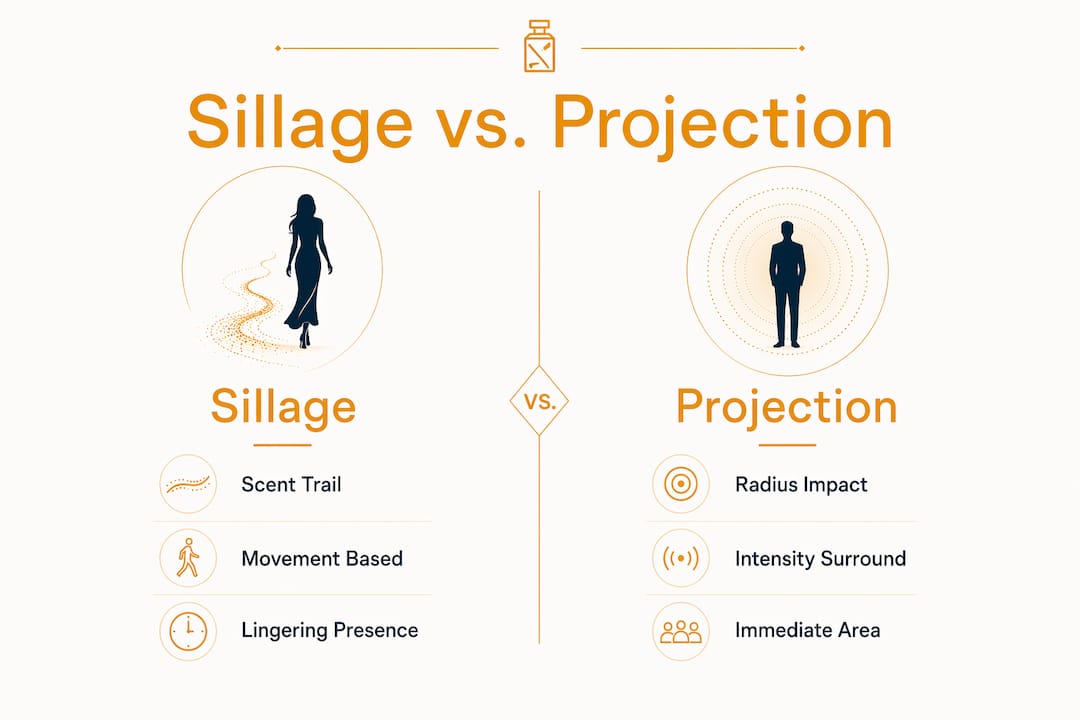
Sillage is the scent trail) left in the air as you move, while projection is the radius of scent that radiates from your skin when you are standing still. Longevity is a third, separate measure: how long the fragrance remains detectable on your skin over time. Many shoppers treat these three terms as interchangeable, and that confusion leads to poor fragrance choices.
Think of it this way. A fragrance with high projection but low sillage smells powerful when you are in a room but leaves little trace when you walk out of it. A fragrance with high sillage but moderate longevity creates a dramatic entrance and exit but fades within a few hours. The most prized fragrances in collector circles tend to score well across all three dimensions, but that combination is rare and usually comes at a price.
The table below clarifies each term at a glance.
| Term | Definition | Effect on Wearer Experience |
|---|---|---|
| Sillage | Scent trail left in the air as wearer moves | Others notice your fragrance after you leave a room |
| Projection | Scent radiating from skin while stationary | Others detect your fragrance when standing near you |
| Longevity | Duration the scent remains detectable on skin | Determines how often you need to reapply |
Pro Tip: Spray a fragrance on your wrist, walk briskly down a hallway, and ask someone standing at the far end what they smell. That feedback tells you far more about sillage than sniffing your own wrist ever will.
Many shoppers conflate projection with sillage, and that misunderstanding leads them to buy the wrong fragrance for their intended use. A boardroom fragrance needs controlled projection and moderate sillage. A date-night fragrance benefits from a lingering trail. Knowing the difference lets you match the fragrance to the occasion.
What factors influence perfume sillage on an individual?
Sillage is not inherent to the bottle) but shaped dynamically by the wearer’s biology and surrounding environment. The same fragrance can leave a powerful trail on one person and almost nothing on another. This is not a flaw in the perfume. It is the nature of how fragrance molecules interact with living skin.
The primary personal factors that shape sillage include:
- Skin temperature. Warmer skin accelerates evaporation, which pushes fragrance molecules into the air more aggressively. People who run warm naturally tend to project and trail more.
- Skin oiliness. Oily skin holds fragrance molecules longer and releases them more gradually, which can sustain sillage over time. Dry skin absorbs fragrance quickly and may reduce the trail.
- Hydration. Well-moisturized skin creates a better surface for fragrance to sit on. Applying an unscented lotion before spraying is one of the most reliable ways to extend sillage.
- Microbiome. The unique bacterial environment on your skin interacts with fragrance compounds, subtly altering how they smell and how far they travel. This is why skin chemistry affects diffusion) so significantly.
Beyond biology, the fragrance formula itself matters. Ingredients like Hedione and Iso-E Super enhance diffusion) by increasing the volatility of the scent molecules, helping them travel farther from the skin. Perfumers at houses like Firmenich and Givaudan use these molecules deliberately to engineer sillage into a composition.
Environmental conditions add another layer. Warm, humid climates increase evaporation rates, which amplifies sillage intensity. A fragrance that performs modestly in a dry, air-conditioned office may leave a bold trail on a warm summer evening outdoors. Airflow also matters: a gentle breeze carries scent molecules farther, while a still room concentrates them close to the body.

Pro Tip: If you want an honest read on how a fragrance trails, spray it on a fabric scarf and wear it for an hour. Fabric holds scent differently than skin, and the trail it leaves in a room is often more pronounced and longer-lasting.
How can you measure and evaluate perfume sillage accurately?
Measuring sillage accurately is harder than it sounds, because wearers become nose-blind quickly after applying a fragrance. Your brain filters out familiar smells within minutes. This means self-assessment is almost always unreliable, and most beginners dramatically underestimate or overestimate their fragrance’s trail as a result.
Here is a practical method for evaluating sillage with more accuracy:
- Apply the fragrance as you normally would. Use two to three sprays on pulse points: the neck, inner wrists, and chest. Do not rub the skin after spraying, as this breaks down the top notes faster.
- Wait 15–20 minutes. The opening blast of a fragrance is dominated by volatile top notes, which evaporate quickly. Judging sillage in the first five minutes gives you a misleading picture of how the fragrance actually performs.
- Walk through a neutral room. Move at a normal pace through a space where no other fragrances are present. Then step out and ask a trusted observer to walk through the room and describe what they detect.
- Repeat the test at the two-hour mark. This tells you whether the heart and base notes carry the sillage forward after the top notes fade. A fragrance with strong base notes like sandalwood, musk, or ambergris tends to maintain its trail longer.
- Test on fabric. Spray a small amount on a cotton scarf or shirt cuff and check the trail it leaves in a room after an hour. Applying to hair and clothing can enhance sillage significantly, though always test fabric for staining first.
Testing sillage over time after the initial spray gives a far more accurate picture of how the fragrance performs throughout the day. This is the single most common mistake beginners make: they judge a fragrance in the first few minutes at a counter and miss how it actually wears.
Does higher sillage mean better quality or longer-lasting perfume?
Higher sillage does not equal higher quality, and the two are not reliably linked. This is one of the most persistent misconceptions in fragrance culture, and it costs shoppers real money.
The key facts to understand:
- Volatile top notes create strong early sillage. Citrus, aldehydes, and light florals evaporate fast and project powerfully at first. That opening trail can be dramatic, but it often disappears within 30–60 minutes.
- High concentration may not mean stronger sillage. Sillage relates more to molecular diffusion and formulation than to whether a fragrance is labeled Eau de Parfum or Eau de Toilette. Some EDTs trail more aggressively than EDPs from the same house.
- Longevity depends on molecular weight. Heavier molecules like musks, resins, and woods evaporate slowly and stay close to the skin. They extend longevity but often reduce sillage because they do not travel far from the body.
- Fragrances engineered with volatile top notes create impressive early sillage but diminish rapidly. This is not a sign of permanence or quality. It is a design choice.
- Consumer preferences vary widely. Some wearers want a fragrance that announces their presence across a room. Others prefer a scent that stays intimate and close to the skin. Neither preference is wrong, but they require completely different fragrance profiles.
A fragrance like Maison Margiela’s Replica line is deliberately designed for low sillage and high intimacy. Initio Parfums Privés fragrances, by contrast, are known for bold, long-lasting trails. Both are high-quality products. The difference is intent, not craftsmanship.
How can you optimize perfume application for better sillage?
Application technique has a direct and measurable effect on how a fragrance trails. Most people apply fragrance the same way every time without considering how small adjustments can change the result significantly.
Pulse points are the standard starting point for good reason. The neck, inner wrists, the crook of the elbow, and behind the knees are all areas where blood vessels sit close to the skin surface, generating warmth that drives evaporation and lifts the scent into the air. Applying to two or three of these points simultaneously creates overlapping scent clouds that merge into a more consistent trail.
Hair is one of the most underused application sites for sillage. Hair fibers hold fragrance molecules exceptionally well and release them gradually as you move. Spraying fragrance into the air and walking through the mist is a gentler method that avoids alcohol contact with the scalp. Clothing also holds scent longer than skin, and a light spray on a scarf or collar can extend the trail for hours. Always test a small hidden area of the fabric first to rule out staining.
Seasonal adjustment matters too. Climate-adapted application is a real practice among experienced fragrance wearers. In summer heat, one or two sprays may be enough since warmth amplifies diffusion. In cold, dry winter air, three to four sprays on layered clothing points can compensate for the reduced evaporation rate.
Pro Tip: Moisturize with an unscented body lotion before applying your fragrance. Hydrated skin holds fragrance molecules longer and releases them more evenly, which produces a steadier, more consistent trail throughout the day.
Key takeaways
Sillage is the dynamic scent trail a fragrance leaves in the air as the wearer moves, shaped by skin chemistry, formula design, and environment in equal measure.
| Point | Details |
|---|---|
| Sillage vs. projection | Sillage is the moving trail; projection is the stationary scent radius around the wearer. |
| Skin chemistry matters | Temperature, oiliness, and microbiome all change how a fragrance diffuses and trails. |
| Self-assessment is unreliable | Ask an observer or test on fabric for an accurate read on how a fragrance trails. |
| High sillage is not high quality | Strong early trails often come from volatile top notes that fade within the hour. |
| Application technique changes results | Pulse points, hair, and moisturized skin all extend and shape the scent trail. |
Sillage taught me to stop buying fragrances at the counter
I spent years buying fragrances based on how they smelled on a paper strip under fluorescent department store lighting. The results were consistently disappointing. A fragrance that smelled bold and rich in the store would trail almost nothing by the time I got home. It took a while to understand why.
The first time I asked a friend to walk through a room I had just left and describe what they smelled, I was genuinely surprised. The fragrance I thought was barely registering on my skin was leaving a clear, warm trail of sandalwood and amber behind me. My nose had simply stopped noticing it. That single test changed how I evaluate every fragrance I consider buying.
What I have observed across different skin types is that people with naturally warmer, oilier skin consistently get more sillage from the same fragrance than those with dry, cool skin. This is not a disadvantage for either type. It just means the application strategy needs to be different. For drier skin, layering with a matching body lotion and applying to hair or clothing makes a real difference. For warmer skin, one or two sprays is often enough, and going heavier can become overwhelming in enclosed spaces.
My personal benchmark for elegant sillage is Dior Homme Parfum. It trails with a quiet authority: iris, leather, and vetiver that announce your presence without demanding attention. That balance between presence and restraint is what I look for now, and understanding sillage is what made me capable of recognizing it.
— Rodney
Find fragrances with the sillage profile you want at Aromatick
If you know what kind of scent trail you are looking for, the next step is finding a fragrance that actually delivers it. Aromatick carries an extensive selection of authentic designer and niche fragrances at discounts of up to 60% off retail prices, including options known for bold sillage, intimate close-to-skin wear, and everything between.

Whether you are drawn to the commanding trails of niche fragrance houses or the refined sillage of classic designer collections, Aromatick offers genuine products with free shipping and a satisfaction guarantee. You can also explore the Dior Homme Parfum directly, a fragrance that consistently earns praise for its measured, elegant trail. Browse the full collection and use what you have learned here to choose with confidence.
FAQ
What is sillage in perfume, simply defined?
Sillage is the scented trail a fragrance leaves in the air as the wearer moves through a space. It is distinct from projection, which describes how far a scent radiates from the skin while the wearer is stationary.
How do i measure sillage at home?
Apply your fragrance, wait 15–20 minutes, then walk through a room and ask a trusted observer to describe what they detect. Observer feedback is far more reliable than self-assessment because wearers become nose-blind quickly.
Does a higher concentration like EDP always mean more sillage?
No. Sillage depends on molecular diffusion and formulation design, not concentration label alone. Some Eau de Toilette formulas trail more aggressively than Eau de Parfum versions from the same brand.
What ingredients increase perfume sillage?
Hedione and Iso-E Super are two synthetic aroma molecules known to enhance diffusion and sillage. They increase the volatility of scent molecules, helping them travel farther from the skin into the surrounding air.
Why does the same perfume smell different on different people?
Skin chemistry, including temperature, oiliness, and microbiome composition), causes the same fragrance to diffuse differently on different individuals. These biological variables shape both the scent character and the strength of the trail.

Leave a comment
This site is protected by hCaptcha and the hCaptcha Privacy Policy and Terms of Service apply.