
Why Is Eau de Toilette Cheaper Than Parfum?
TL;DR:
- Parfum costs more than eau de toilette because it contains higher concentrations of fragrance oils and natural ingredients. The increased raw material volume, formula complexity, and rigorous stability tests all contribute to its higher price. Packaging and smaller production runs further elevate parfum’s retail cost, making it a luxury choice tailored for special occasions.
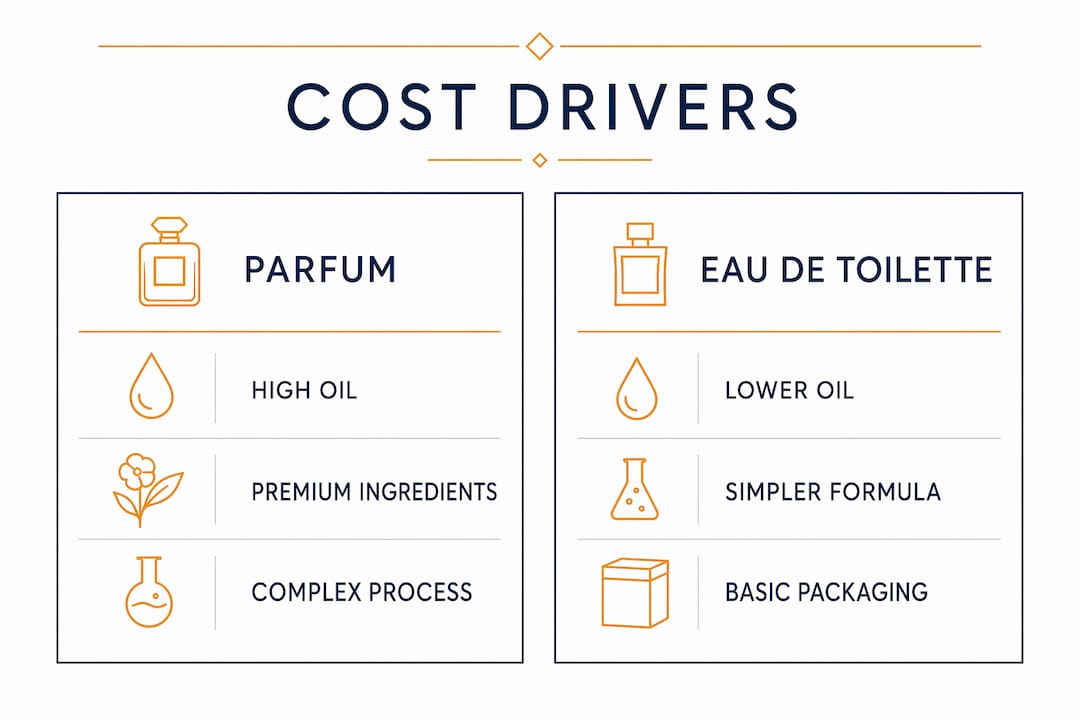
Eau de toilette is less expensive than parfum primarily because it contains a lower concentration of fragrance oils, which directly reduces raw material costs. The industry defines eau de toilette (EDT) as containing 5–15% fragrance oil, while parfum sits at 20–40%. That concentration gap creates a 25–60% raw material cost difference per unit before a single bottle is filled. Beyond concentration, ingredient sourcing, formula complexity, stability testing, and packaging all push parfum’s retail price higher. Understanding why eau de toilette is cheaper than parfum helps you spend your money on the right fragrance for the right occasion.
Why does fragrance oil concentration make EDT cheaper?
Fragrance oil concentration is the single biggest driver of the price gap between eau de toilette and parfum. The math is direct: more oil means more raw material, and raw materials are the most expensive input in any fragrance formula.
Parfum’s 20–40% fragrance oil load means a 100ml bottle may contain 20–40ml of pure aromatic concentrate. An EDT at 5–15% uses a fraction of that same concentrate. When those concentrates include costly naturals like Bulgarian rose absolute, Haitian vetiver, or Indian sandalwood, the cost difference compounds quickly.
The table below shows how concentration ranges translate into cost impact at the raw material level.
| Fragrance type | Fragrance oil concentration | Relative raw material cost |
|---|---|---|
| Eau de Cologne (EDC) | 2–4% | Lowest |
| Eau de Toilette (EDT) | 5–15% | Moderate |
| Eau de Parfum (EDP) | 15–20% | High |
| Parfum (Extrait) | 20–40% | Highest |
The gap between EDT and parfum is not a small step. It is a structural cost difference baked into every batch produced. A parfum formula can require two to four times the volume of aromatic concentrate compared to an EDT of the same size.
Pro Tip: If you want to understand how concentration affects your specific fragrance purchase, Aromatick’s perfume concentration guide breaks down each category with clear examples.
How do ingredient quality and formula complexity raise parfum costs?
Raw material volume explains part of the price gap. Ingredient quality explains the rest. Parfum formulas rely heavily on natural aromatic ingredients, which cost significantly more than their synthetic counterparts.
The price gap between EDP and EDT is driven by raw material quality and the technical expertise required to stabilize demanding ingredients like oud, ambergris, and natural musks. Synthetic aroma molecules are consistent, affordable, and easy to work with. Natural extracts vary by harvest, require careful handling, and cost multiples more per kilogram.
Formula complexity adds another layer of cost. A parfum typically features a richer, more layered fragrance pyramid, with distinct top, heart, and base notes designed to evolve over hours on skin. Building that pyramid requires more ingredients, more iterations, and more senior perfumer time.
The key cost drivers beyond concentration include:
- Natural vs. synthetic ingredients: Natural rose absolute can cost hundreds of dollars per kilogram. A synthetic rose molecule costs a fraction of that.
- Number of ingredients: Complex parfum formulas may use 50 or more distinct aromatic materials. Each adds cost and reformulation risk.
- Perfumer expertise: Senior perfumers command higher fees. Parfum briefs require more development rounds.
- Ingredient sourcing risk: Naturals are subject to crop failures, geopolitical disruptions, and seasonal price swings.
- Regulatory compliance: IFRA (International Fragrance Association) guidelines limit certain naturals, requiring costly reformulation when limits change.
Fragrance composition complexity affects labor costs, reformulation risk, and overall pricing unpredictability for parfum versus EDT. That unpredictability gets priced into the retail margin.
Pro Tip: When comparing a parfum to an EDT from the same brand, check whether the parfum uses a different formula entirely, not just a higher dilution. Many houses reformulate the fragrance pyramid for each concentration tier.
What production and stability testing costs go into parfum pricing?
Production costs for parfum extend well beyond raw materials. Higher aromatic loads create technical challenges that require additional quality control steps, and those steps cost money.
Higher concentration variants require more rigorous stability testing to avoid discoloration, precipitation, and pH drift. These are not cosmetic issues. A parfum that turns cloudy or changes color on the shelf is unsellable. Preventing that requires extensive testing before a formula goes to production.
The production quality control process for a parfum typically includes:
- Stability testing at multiple temperatures: Formulas are tested at accelerated aging conditions (typically 40°C and 50°C) to predict shelf life.
- Discoloration checks: High concentrations of certain naturals, especially citruses and phenolics, can cause yellowing or browning over time.
- Precipitation testing: Some aromatic materials crystallize or separate at high concentrations, requiring formula adjustment.
- pH monitoring: Aromatic compounds can shift a formula’s pH, affecting both scent and skin safety.
- Batch-to-batch consistency checks: Higher aromatic loads amplify variation between batches, requiring tighter tolerances.
High concentration parfums require more extensive safety and stability testing, which adds hidden costs embedded in higher retail prices beyond raw ingredient cost. These costs are invisible to the buyer but real to the manufacturer.
Minimum order quantities also affect unit cost. Parfum is often produced in smaller batches than EDT, which means fixed production costs are spread across fewer units. That raises the cost per bottle even before packaging is considered.
How does packaging affect the price of parfum vs. eau de toilette?
Packaging is where many buyers underestimate parfum’s cost structure. The bottle, pump, cap, decoration, and carton together can exceed the cost of the fragrance itself at the mass market level.
Custom bottles cost $4.50–$9.00 each, while standard bottles cost $0.80–$1.20, and parfum bottles are almost always custom. Parfum is a luxury product, and the packaging signals that. Heavier glass, intricate caps, gold-tone hardware, and embossed cartons are standard for parfum presentations. EDT bottles tend toward lighter glass and simpler closures.
| Packaging component | Typical EDT cost | Typical parfum cost |
|---|---|---|
| Bottle | $0.80–$1.20 (standard) | $4.50–$9.00 (custom) |
| Pump and collar | $0.30–$0.60 | $0.80–$1.50 |
| Cap | $0.20–$0.40 | $0.60–$1.20 |
| Decoration (printing, labeling) | $0.10–$0.30 | $0.50–$1.50 |
| Carton | $0.20–$0.50 | $0.80–$2.00 |
Small batch premiums amplify these costs further. A parfum produced in a run of 500 units pays a much higher per-unit packaging cost than an EDT produced in a run of 10,000. That premium flows directly into the retail price.
Price variance in fragrant formulas includes upstream and downstream costs: raw materials, compliance, formula complexity, packaging, and minimum order quantities. Packaging alone can account for 20–40% of a parfum’s total production cost. For buyers comparing eau de toilette pricing to parfum pricing, the bottle in your hand is part of what you are paying for.
You can read more about what drives fragrance prices across designer and niche categories on the Aromatick blog.
Key Takeaways
Parfum costs more than eau de toilette because it contains more fragrance oil, uses higher-quality ingredients, requires stricter production testing, and demands premium packaging at every stage.
| Point | Details |
|---|---|
| Concentration drives base cost | Parfum’s 20–40% oil load uses two to four times more raw material than EDT’s 5–15%. |
| Ingredient quality multiplies the gap | Natural aromatics in parfum cost far more per kilogram than the synthetics common in EDT formulas. |
| Stability testing adds hidden costs | Higher aromatic loads require rigorous QC testing for discoloration, precipitation, and pH drift. |
| Packaging is a major cost factor | Custom parfum bottles cost up to $9.00 each versus $1.20 for standard EDT bottles. |
| Batch size raises unit cost | Parfum’s smaller production runs spread fixed costs across fewer bottles, raising the price per unit. |
Rodney’s take: price is a signal, not the whole story
People often frame the eau de toilette vs parfum question as a budget decision. I think that framing misses the point almost entirely.
Consumers benefit from choosing fragrance formats based on occasion, climate, and desired projection rather than price alone. An EDT is not a cheaper parfum. It is a different tool. EDT formulas often emphasize freshness and projection, making them genuinely better suited for warm weather, office environments, or daily casual wear. A parfum in those same contexts can feel heavy and intrusive.
Where I see buyers go wrong is treating parfum as the “correct” version of a fragrance. The truth is that a well-chosen EDT worn daily delivers more pleasure per dollar than a parfum worn twice a year because the price felt too high to use freely. Cost per wear matters more than sticker price.
Authenticity and ingredient transparency matter too. A genuine EDT from a reputable house, purchased from a source you trust, will outperform a counterfeit parfum every time. The key differences between parfum and EDT are worth understanding before you buy, not after.
My honest advice: buy the concentration that fits your life, not the one that sounds most impressive.
— Rodney
Aromatick’s collection: authentic fragrances at every concentration
Knowing why parfum costs more is useful. Finding the right fragrance at a fair price is the actual goal.
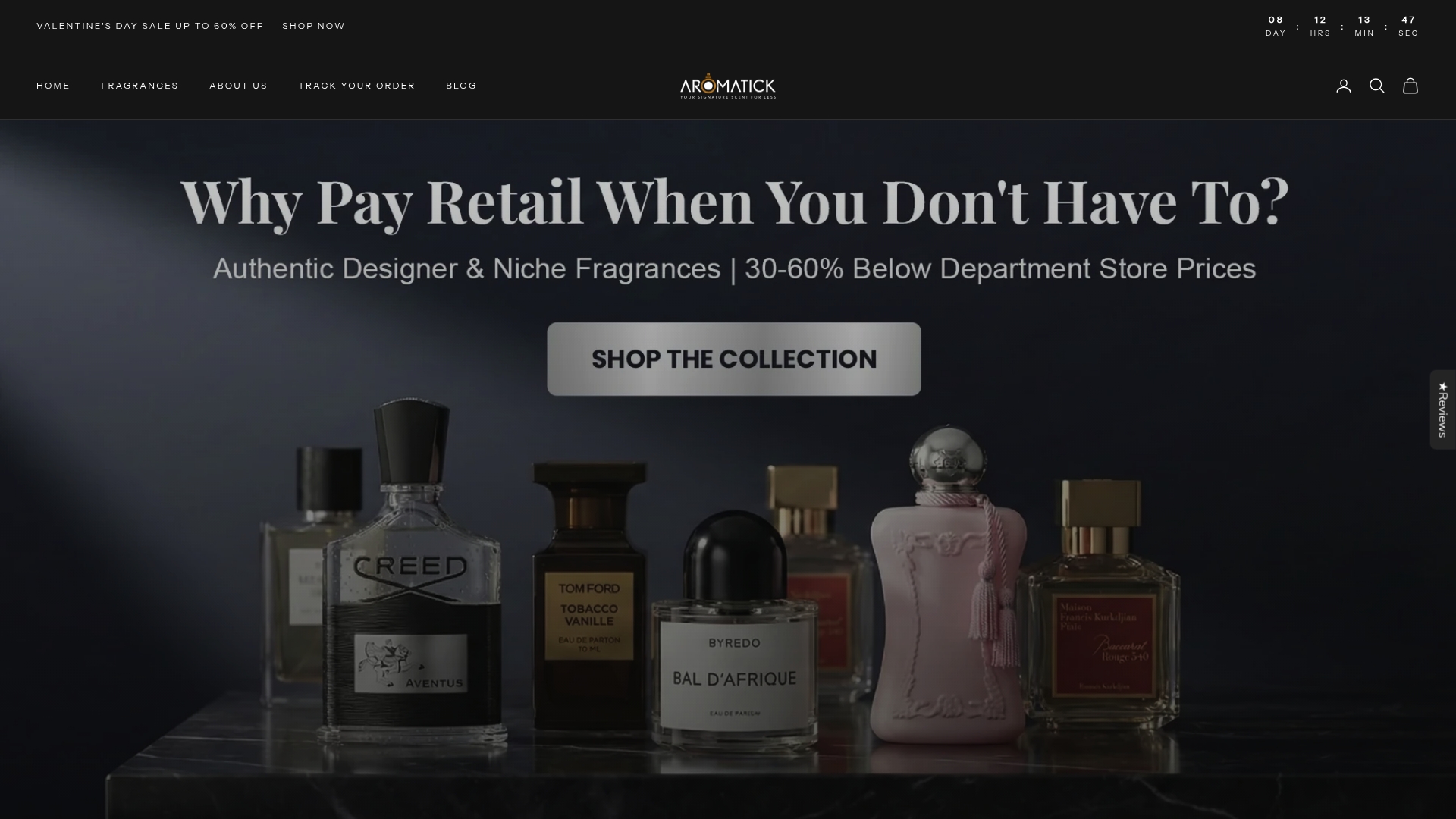
Aromatick carries authentic designer and niche fragrances across every concentration tier, from everyday EDTs to luxury parfums, at discounts of up to 60% off retail. Every product is genuine, sourced directly to cut out department store overhead. Whether you want a fresh EDT for daily wear or a rich parfum for special occasions, the designer fragrance collection covers both ends of the spectrum. Buyers looking for niche options can also browse the niche fragrance collection for higher-concentration exclusives. Free shipping, secure payments, and a satisfaction guarantee come standard on every order.
FAQ
Why is eau de toilette cheaper than parfum?
Eau de toilette contains 5–15% fragrance oil versus parfum’s 20–40%, creating a 25–60% raw material cost difference per unit. Lower ingredient volume, simpler formulas, and less intensive stability testing all reduce production costs.
Does a higher concentration always mean a better fragrance?
No. Consumers should not equate concentration solely with strength or quality. EDTs project brighter up front and suit casual or warm-weather wear, while parfums offer richness and longevity at skin level.
What makes parfum more expensive to produce than EDT?
Parfum requires more raw aromatic material, higher-quality ingredients, rigorous stability testing, and premium custom packaging. Each factor adds cost independently, and together they account for a significant price premium over EDT.
Is the price difference between EDT and parfum always justified?
The price difference reflects real production costs, not marketing alone. Whether it is justified depends on how you plan to use the fragrance. Frequent daily wear often favors EDT on a cost-per-wear basis.
How can I find authentic parfum and EDT at lower prices?
Buying directly from an authorized online retailer like Aromatick, which sources authentic fragrances and eliminates brick-and-mortar overhead, is one reliable way to access genuine products at significantly reduced prices. You can also explore fragrance options at Jeffi Inc for additional reference on available formats and pricing.

Leave a comment
This site is protected by hCaptcha and the hCaptcha Privacy Policy and Terms of Service apply.