
Fragrance layering guide: Build lasting, personal scents
TL;DR:
- Fragrance layering combines scents to improve longevity, complexity, and personalization.
- Applying heavy notes first and lighter notes last optimizes scent development.
- Testing with decants and samples helps craft unique, lasting scent combinations affordably.
If your signature scent fades by noon or smells identical to the person next to you, you already know the limitation of wearing a single fragrance straight from the bottle. Fragrance layering, the practice of combining two or more scents on your skin in a deliberate sequence, transforms your daily routine into something genuinely creative. It extends longevity, builds complexity, and gives you a scent that belongs to no one else. Whether you own a handful of drugstore finds or a growing collection of niche bottles, this guide walks you through every step.
Table of Contents
- What you need: Layering essentials and budget-smart picks
- How fragrance layering works: The science and art
- Step-by-step: Layering your fragrances for unique results
- Testing, tweaking, and wearing: How to get maximum impact
- Why the best scent is the one you build yourself
- Discover your next layering favorite at Aromatick
- Frequently asked questions
Key Takeaways
| Point | Details |
|---|---|
| Get creative with budget picks | Unscented lotions and samples let you layer scents without overspending. |
| Follow the heavy-to-light rule | Apply heavier perfumes first so light notes stay fresh and noticeable. |
| Test, tweak, and log results | Keep notes on combinations and adjust until you find your perfect blend. |
| Experiment to stand out | Unique scent combinations are easier and more personal with layering. |
What you need: Layering essentials and budget-smart picks
Now that you see why layering can elevate your scent game, let’s start with what you need and how to do it on any budget.
Successful layering does not require an expensive collection. The foundation is simpler than most people expect. You need at least two fragrances with complementary notes, a moisturizing base layer, and a willingness to test before committing. The good news is that this practice rewards experimentation and thrift in equal measure.
Core materials at a glance
| Item | Purpose | Budget option |
|---|---|---|
| Base scent (EDP or EDP intense) | Anchor and longevity | Decant or sample vial |
| Accent scent (EDT or body mist) | Freshness and character on top | Affordable body spray |
| Unscented body lotion | Binds scent molecules to skin | Any fragrance-free drugstore lotion |
| Sample or decant vials | Testing before full purchase | Available at many fragrance retailers |
| Cotton test strips | Pre-skin testing | Cheap and reusable |
The single smartest move you can make as a beginner is to avoid buying full bottles before testing. As a budget-friendly perfume tip, using decants and samples as your base lets you experiment with pricey designer or niche EDPs without the full-bottle financial risk.
Here are some practical budget hacks that experienced layers rely on:
- Buy decants first. Many online fragrance communities and specialty retailers sell 2ml to 10ml vials of authentic designer perfumes at a fraction of the full price.
- Use fragrance-free products as your canvas. An unscented body lotion from any pharmacy creates the moisturized skin surface that holds fragrance molecules longer.
- Shop discovery sets. Several niche houses offer curated sample kits, giving you five to eight scents to test together without committing to a single bottle.
- Repurpose body mists. Affordable scented body mists from mass-market brands often carry clean, simple notes like vanilla or white musk that layer beautifully under richer EDPs.
- Label your test strips. When you test a combination, write the pairing and the date on the strip. Your nose gets confused after a few trials, and notes help you track what worked.
Learning how perfume notes interact is also essential before you spend money, because buying complementary scents without understanding notes is guesswork.
Pro Tip: Store your sample vials upright in a cool, dark drawer away from humidity. Heat and light degrade fragrance oil quickly, especially in small volumes. A properly stored 2ml decant can stay accurate for six to twelve months, giving you plenty of time to experiment.
How fragrance layering works: The science and art
With your materials in hand, you’ll need to understand both the method and the logic behind successful layering.
Fragrance layering is not random. When two scents combine on warm skin, their aroma molecules interact with each other and with your individual skin chemistry. The result can be harmonious and surprising, or it can be muddy and unpleasant. Understanding the underlying principles helps you predict outcomes instead of stumbling across them.
Emerging receptor science in 2026 suggests that complementary olfactory receptor activation is the key to balanced scent evolution. When two fragrance profiles activate overlapping but non-competing receptor groups in your nose, the brain processes them as a unified and pleasing whole rather than two separate signals fighting for attention. This is why woodsy notes layer beautifully with vanilla or amber but clash with sharp citrus when not balanced carefully.
“The future of personalized fragrance lies not just in choosing individual perfumes, but in understanding how their molecular profiles interact at the receptor level. Layering done right is essentially composing your own olfactory chord.” — Emerging consensus in olfactory research, 2026
The most important structural rule is layering from heaviest to lightest. Heavy scents, typically those with dense base notes like oud, patchouli, sandalwood, or musk, have low volatility. They cling to skin and evaporate slowly. Lighter top notes like citrus, green tea, and aquatic accords evaporate quickly. Applying the lightest scent last preserves its volatility and ensures it leads the initial impression before fading gracefully into the heavier base.
Here is how that progression typically plays out during a day of wear:
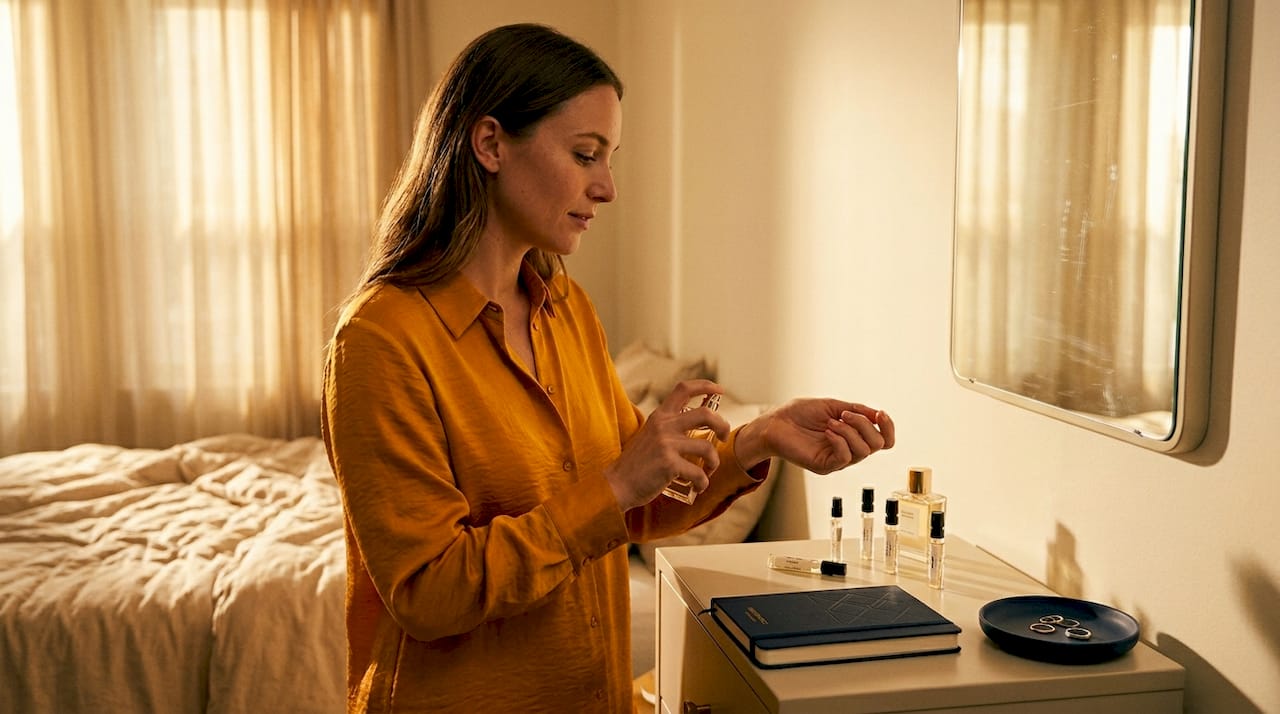
- Apply your unscented moisturizer to slightly damp skin after a shower. This creates a hydrated surface that traps fragrance molecules.
- Spray or dab your heaviest base scent on pulse points. Think oud-based EDPs, dark ambers, or earthy musks.
- Add your mid-layer scent once the base has settled for about 30 seconds. Warm florals, spiced orientals, and woody notes work well here.
- Finish with your lightest accent scent. A fresh citrus body mist, a light aquatic EDT, or a green floral spray adds the top note character.
You can explore more advanced techniques through expert fragrance layering or through the art and science of layering if you want to go deeper into note pairing theory.
Layering order and expected scent evolution
| Layering sequence | Morning impression | Afternoon dry-down | Evening finish |
|---|---|---|---|
| Oud base + rose mid + bergamot top | Bright citrus opening | Soft floral transition | Rich, warm oud |
| Sandalwood base + vanilla mid + green tea top | Clean and fresh | Creamy and warm | Deep, woody sweetness |
| Musk base + amber mid + white florals top | Powdery floral | Warm, honeyed musk | Skin-close, intimate musk |
| Patchouli base + iris mid + lemon top | Zesty and earthy | Rooty floral | Dark, grounding patchouli |
These progressions show exactly why the heavy-to-light rule matters. Each combination tells a story across time, and that story depends entirely on the sequence you use.
Step-by-step: Layering your fragrances for unique results
With science and artistry on your side, it is time for you to begin layering and experimenting at home.
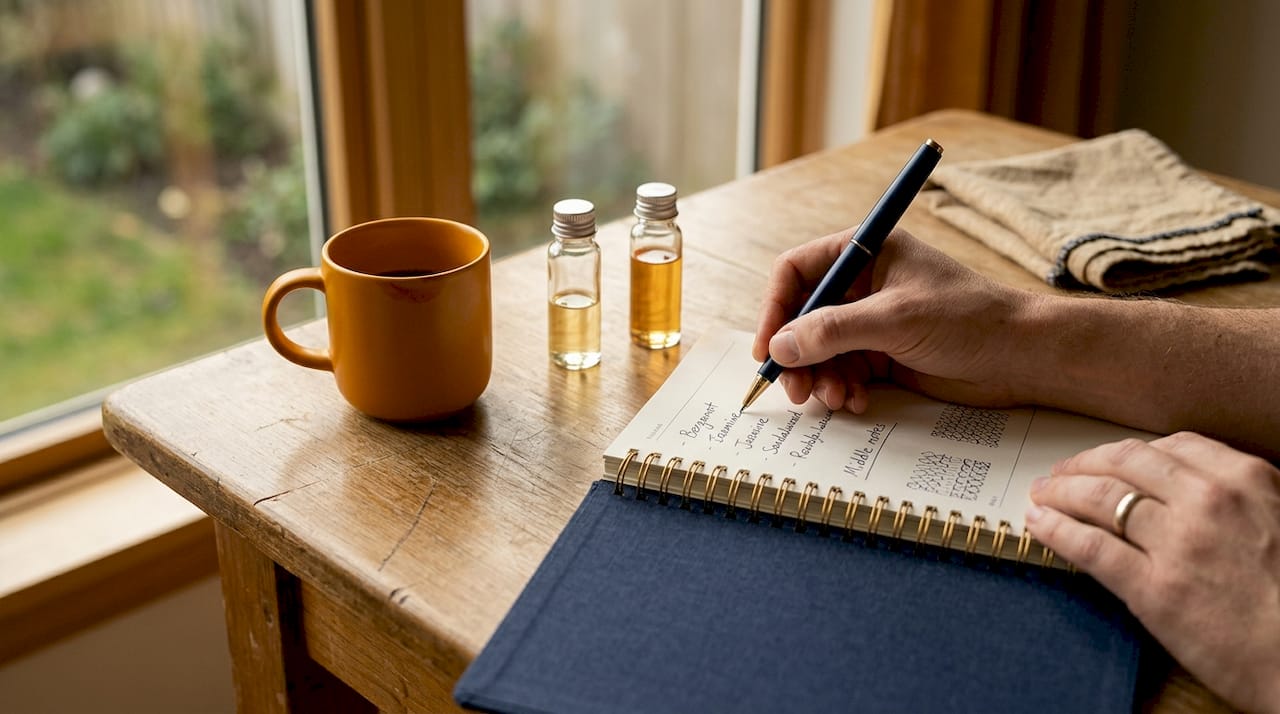
The process is straightforward, but the details matter. Skipping steps like skin prep or testing leads to most of the disappointments beginners experience. Follow this sequence carefully, and you will avoid the most common pitfalls.
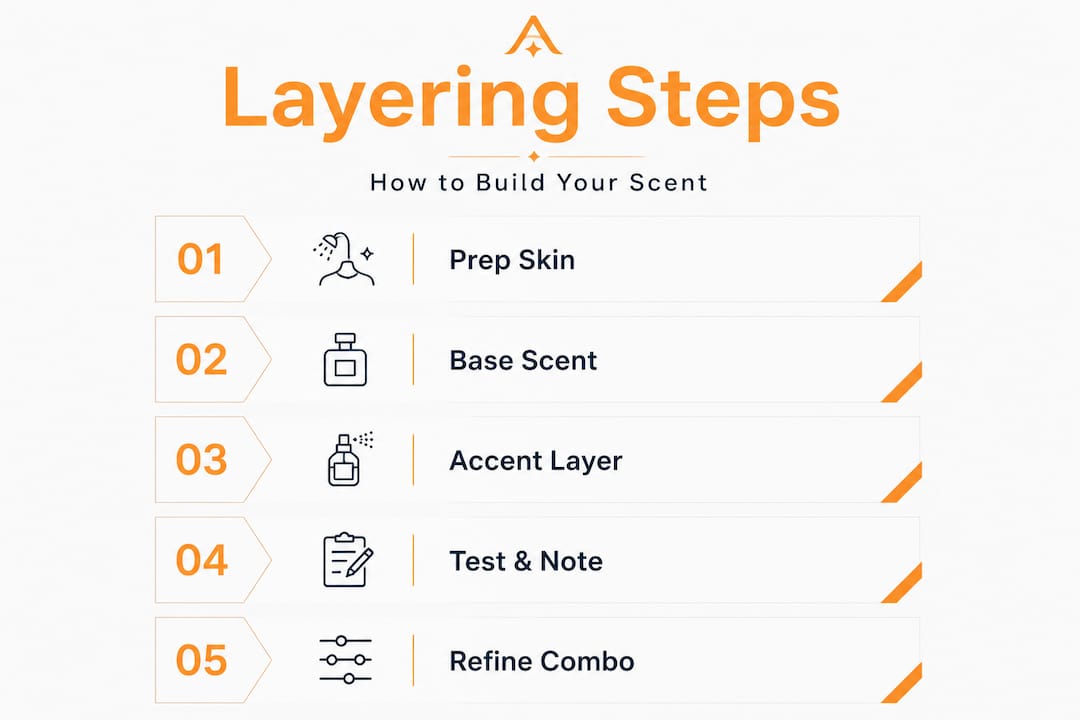
The layering process, step by step
- Shower and pat dry. Clean, lightly moisturized skin is the best canvas. Residual soap fragrance can interfere with your blend.
- Apply unscented body lotion. Use a fragrance-free moisturizer on pulse points: inner wrists, base of neck, inner elbow, behind knees. Allow it to absorb for one to two minutes.
- Apply your base scent. Spray or dab two to three times on moistened pulse points. This is your heaviest, longest-lasting fragrance.
- Wait 30 seconds. Let the base scent settle and begin to warm on your skin before adding the next layer.
- Apply your accent or top scent. One to two sprays are usually enough. More is rarely better. This lighter layer should complement, not compete with, the base.
- Test and wait. Do not judge the combination for at least 20 minutes. The initial alcohol blast fades, and the true character of the blend emerges only after the dry-down begins.
- Adjust if needed. If one scent dominates too strongly, reduce its application next time. If the blend feels flat, try swapping the accent layer for something with more contrast.
As a smart fragrance shopper, starting with a step-by-step selection process before you begin layering ensures you already own scents with good layering potential.
Common layering mistakes to avoid
- Overapplying every layer. More product does not equal more impact. It usually creates a suffocating wall of scent with no definition.
- Mismatching note families. Pairing a sharp synthetic citrus with a heavy, medicinal oud without a bridging mid note often creates dissonance rather than depth.
- Skipping skin testing. What smells great on paper or in the bottle can smell very different on your specific skin chemistry.
- Switching too quickly. Layering takes time to develop. Judging a combination after two minutes gives you no useful information.
- Ignoring concentration. Layering two EDPs of equal intensity can overwhelm. Pair an EDP with a lighter EDT or body mist for balance.
Pro Tip: The inner elbow and base of the throat are two of the best application zones for layered scents. They stay warm throughout the day, which activates fragrance molecules steadily without the abrupt heat spikes you get from wrists, which you wash frequently.
Testing, tweaking, and wearing: How to get maximum impact
After layering your fragrances, assessing and refining your creation is key to making it truly personal and effective.
Testing is not optional. It is the entire point. A layered combination that works brilliantly on one person can smell completely different on another because individual skin pH, moisture levels, and diet all affect how scent molecules behave. This is why using decants and samples to test layered combinations before investing in full bottles is one of the most practical habits you can build.
Research consistently shows that overapplication reduces perceived longevity for roughly 80% of users, because saturated skin cannot continue to project scent dynamically. The molecule release slows when there is no gradient from skin to air. Less application, more strategically placed, nearly always outperforms more product sprayed randomly.
Adjusting your blend for longevity, sillage, and season
- For longer longevity: Add one extra pump of your base scent rather than reapplying the top layer. The base anchors everything.
- For stronger sillage (projection): Choose an accent scent with good projection molecules like ISO E Super or Hedione, both of which are common in designer fragrances.
- For summer: Shift toward lighter base layers. A clean musk or soft sandalwood carries better in heat than a heavy oud, which can become overwhelming.
- For winter: Lean into richer, denser base notes. Spiced amber, dark vanilla, and beeswax bases perform exceptionally well in cold weather, where scent molecules need warmth to project.
- For formal occasions: Reduce overall application and focus on pulse points near the collar. You want intrigue, not announcement.
You can deepen your understanding of seasonal fragrance choices and use a practical fragrance selection guide to pick scents that work well across your wardrobe.
Personal testing log template
| Date | Base scent | Accent scent | Morning impression | 4-hour dry-down | Rating (1-5) |
|---|---|---|---|---|---|
| — | — | — | — | — | — |
| — | — | — | — | — | — |
Keeping a simple log like this removes guesswork. After a few weeks of consistent testing, patterns emerge: you will notice which base scents anchor your skin best, which accent layers you consistently prefer, and which combinations fade fastest.
Why the best scent is the one you build yourself
Perfume marketing is very good at selling the idea of a perfect, singular scent. Every campaign suggests that one bottle will define you. The reality is that no single fragrance smells the same across different bodies, climates, or seasons. The “signature scent” concept is a useful marketing frame, but it often sets people up for a faint disappointment when their expensive bottle smells less magical three hours into a Tuesday than it did in the department store.
Layering disrupts that model entirely. It shifts control from the brand to you. Instead of accepting a fixed formula, you become the final formulator. You decide how much oud anchors the composition, how loud the rose sings, how much citrus opens the story. That creative authority is genuinely satisfying in a way that buying the most expensive bottle rarely is.
There is also a financial argument that often goes unspoken. Layering lets you mix accessible and niche fragrances strategically, so a well-chosen $15 body mist can amplify a decant of a $300 niche perfume into something that lasts twice as long and smells twice as complex. The most expensive element in your blend does not have to do all the work, and a thoughtful base layer does more for longevity than doubling the application of any single fragrance.
The combinations that feel most surprising and personal rarely come from following a formula. They come from curiosity. From the afternoon you decide to layer your weekend oud with the clean sport fragrance you thought you had outgrown. Patience and genuine curiosity matter here as much as knowledge.
Pro Tip: Some of the most distinctive layering combinations come from pairing a niche fragrance with an unexpected, affordable counterpart. Try a heavy niche oriental over a light synthetic clean musk body spray. The contrast creates a scent that no brand is selling yet.
Discover your next layering favorite at Aromatick
Ready to bring these layering ideas to life? Here is where to find your next signature combination.
At Aromatick, we carry authentic designer and niche fragrances at up to 60% off retail, which means building a layering wardrobe does not have to cost a fortune. Whether you are starting with a single entry-level bottle or building out a full collection of complementary scents, the options are all in one place.

Browse our affordable perfume collection for accessible base layers and accent scents that work beautifully as part of a layered routine. For those who want richer, more complex options, our designer fragrance collection includes iconic names at prices that make experimentation realistic. And if you are ready to push your layering practice into truly unique territory, our niche fragrance collection features bold, distinctive bottles that were made to stand out, and layer even better.
Frequently asked questions
How can I start fragrance layering if I’m on a tight budget?
Begin with an unscented body lotion and a small decant or sample of a designer EDP. Using samples to test combinations before buying full bottles is the single most effective budget strategy in fragrance layering.
Does the order I apply fragrances really matter?
Yes, significantly. Applying heavy to light preserves the natural volatility gradient of each scent, so each layer has the room it needs to develop fully without being overwhelmed by a lighter layer underneath.
What are the most common fragrance layering mistakes?
Overapplying, mismatching note families, and skipping skin testing account for the majority of failed combinations. Decants reduce the risk by letting you test honestly before investing in a full bottle.
How do I make my layered scent last all day?
Start with moisturized skin, apply your base layer first, and use a fragrance-free moisturizer as your foundation. An unscented lotion as base dramatically extends how long scent molecules cling to your skin throughout the day.
Recommended
- How to Layer Fragrances Like a Pro: Secrets to Building Your Perfect
- Fragrance Layering: Elevate Your Scent Game with Expert Techniques
- Perfume notes explained: 3 layers, smarter choices
- How to choose fragrances: a step-by-step guide
- How to layer fragrances for a unique signature scent – ThePerfumeSampler

Leave a comment
This site is protected by hCaptcha and the hCaptcha Privacy Policy and Terms of Service apply.