

Cruelty-Free Fragrance: What It Means and How to Verify It
TL;DR:
- A cruelty-free fragrance has not been tested on animals at any stage and requires independent certification verification.
- The terms cruelty-free and vegan are different, with cruelty-free relating to testing and vegan to ingredient sourcing.
A cruelty-free fragrance is one that has not been tested on animals at any stage of development, including by ingredient suppliers, contract testing labs, or any third party acting on the brand’s behalf. That definition sounds straightforward, but the term “cruelty-free” is not legally defined in the United States, which means any brand can print it on a bottle without meeting a single external standard.
That gap is exactly why verification matters. Before you trust a cruelty-free claim on a perfume, check for:
- An audit-based certification logo such as Leaping Bunny or Cruelty Free International
- A dated, supplier-inclusive animal-testing policy on the brand’s own website
- The brand’s presence in a searchable third-party database (Leaping Bunny, PETA’s Beauty Without Bunnies, or V-Cert)
Table of Contents
- What does “cruelty-free” actually cover for a perfume?
- How does cruelty-free differ from vegan in fragrance?
- How does animal testing happen in fragrance development?
- Which certifications can you actually trust?
- How can you verify a fragrance is truly cruelty-free?
- What U.S. shoppers should know about market-driven animal testing
- Common misunderstandings and red flags to spot quickly
- How Aromatick approaches cruelty-free fragrance listings
- Key Takeaways
- The verification gap most shoppers skip
- Shop cruelty-aware fragrances at Aromatick
- Useful sources for verifying cruelty-free claims
What does “cruelty-free” actually cover for a perfume?
The phrase can mean very different things depending on how a brand applies it. At its narrowest, a company might claim the finished bottle of perfume was never tested on animals, while its ingredient suppliers quietly commissioned animal safety studies on individual raw materials. That narrower interpretation is common and, in the U.S., perfectly legal.
A genuinely comprehensive cruelty-free claim covers three distinct points in the supply chain: the finished product, every ingredient used in that product, and the suppliers who provide those ingredients. Leaping Bunny’s Corporate Standard requires brands to commit that neither the finished product nor any ingredient supplier has conducted animal testing after a fixed cut-off date, and to submit to independent audits and annual renewals. That cut-off date matters because it prevents a brand from grandfathering in old supplier data while calling itself cruelty-free today.
There is a further complication specific to fragrance: the ingredient list. Perfume formulas are routinely protected as trade secrets, so the full ingredient deck often collapses into the single word “fragrance” on a label. That single word can represent dozens of synthetic or natural aroma compounds, some of which may have animal-derived origins or have been tested on animals at the supplier level. Ingredient-level verification is therefore harder for perfume than for most other beauty categories.
How does cruelty-free differ from vegan in fragrance?
These two claims address completely separate questions, and confusing them is one of the most common mistakes shoppers make.
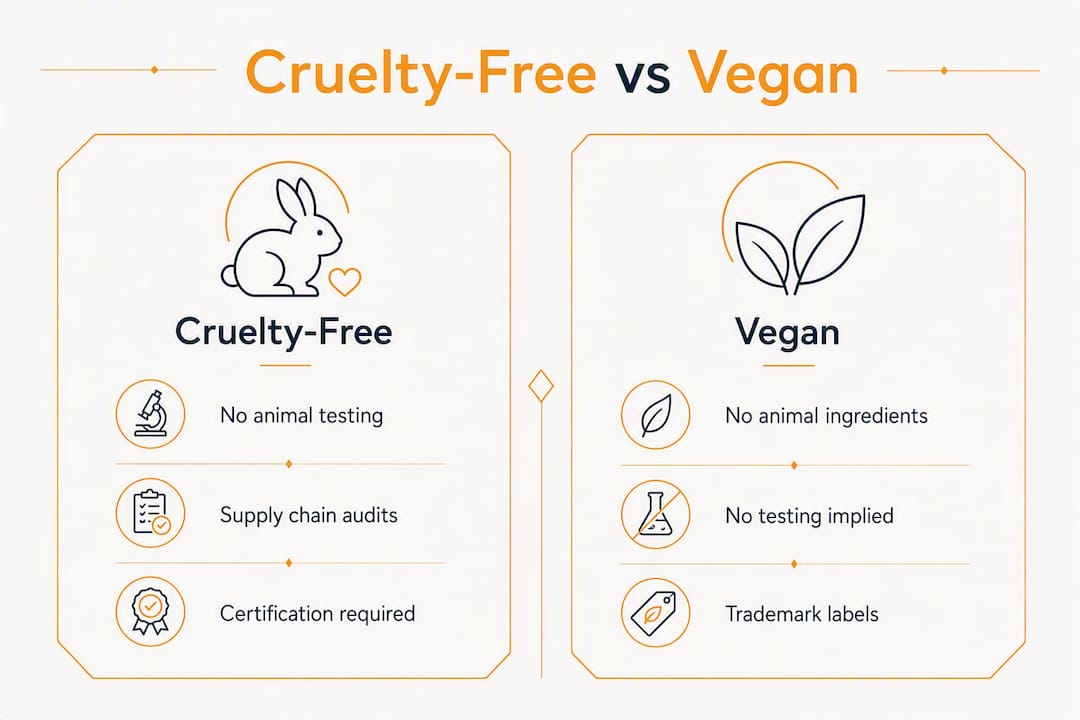
Cruelty-free means no animal testing at any stage. It says nothing about what the product is made from.
Vegan means no animal-derived ingredients. It says nothing about whether those ingredients or the finished product were tested on animals.
A perfume can be cruelty-free and still contain animal-derived materials. Classic examples include:
- Musk (historically from musk deer glands, though most modern musk is synthetic)
- Ambergris (a waxy substance from sperm whales, still used in some luxury formulas)
- Castoreum (a secretion from beavers, used as a leathery or vanilla-like note)
- Beeswax and honey (common in oriental and floral compositions)
- Civet (a secretion from civet cats, largely replaced by synthetics but still present in some heritage formulas)
Conversely, a perfume can be vegan and still have been tested on animals somewhere in its development. Cruelty-free and vegan are genuinely distinct claims: one addresses testing practices, the other addresses ingredient sourcing.
The Vegan Society’s Vegan Trademark is one of the few labels that covers both, requiring the absence of animal-derived ingredients and confirmation that no animal testing occurred. For shoppers who care about both dimensions, that combined standard is the most efficient single label to look for.
Pro Tip: If both claims matter to you, look for a product carrying both an audit-based cruelty-free certification (Leaping Bunny or Cruelty Free International) and a vegan trademark (The Vegan Society or Vegan Action/Vegan.org). One label alone rarely covers everything.
How does animal testing happen in fragrance development?
Animal testing in fragrance is rarely a single event. It tends to occur at specific trigger points in the development process.

The most common trigger is a new raw material. When a perfumer introduces a novel aroma compound that lacks a long safety history, a toxicology study may be required before it can be used commercially. Historically, some of those studies involved animal models. Today, alternatives including in vitro cell-based assays, read-across analysis (using existing safety data from structurally similar chemicals), historical exposure data, and computational (Q)SAR modeling have replaced many animal tests for ingredient safety. The EU’s REACH regulation and the International Fragrance Association’s (IFRA) safety standards have both accelerated the shift toward these non-animal methods.
A second trigger is regulatory registration in certain markets. Some countries have historically required animal safety data as part of the cosmetic registration process, which meant a brand selling in those markets could inadvertently trigger animal testing even if its domestic practices were clean. That market-driven risk is covered in more detail below.
Contract toxicology is a third, less visible trigger. A brand may outsource safety testing to a third-party lab without specifying non-animal methods, and the lab defaults to animal protocols. Audit-based certifications close this gap by requiring supplier and contractor declarations, not just brand-level promises.
Which certifications can you actually trust?
Not all cruelty-free logos carry the same weight. The key distinction is between audit-based programs and attestation-based programs.
| Certifier | Program type | What it requires | Searchable database |
|---|---|---|---|
| Leaping Bunny / Cruelty Free International | Audit-based | Independent supplier audits, annual renewal, fixed cut-off date | Yes |
| Cruelty Free International | Audit-based | Independent monitoring, supplier-level declarations, global standard | Yes |
| V-Cert | Audit-based | Supplier documentation, independent verification, on-site audit for high-risk categories | Yes |
| PETA Beauty Without Bunnies | Attestation-based | CEO-signed questionnaire; no independent supplier audit | Yes |
| The Vegan Society Vegan Trademark | Audit-based (combined) | No animal ingredients + no animal testing; covers both claims | Yes |
| Vegan Action / Vegan.org | Attestation-based | Self-reported vegan ingredients; no animal testing claim required | Yes |
Audit-based certifications require supplier-level documentation, independent verification of the full supply chain, and on-site review for high-risk product categories. That is a meaningfully higher bar than a signed CEO questionnaire. PETA’s Beauty Without Bunnies list is useful as a starting point, but it relies on brand self-declaration rather than independent supplier audits, so it works best as a first filter rather than a final answer.
A credible cruelty-free policy on a brand’s own website should include a specific cut-off date, explicit supplier assurance language, and a statement about whether the brand or its parent company sells in markets that may require animal testing.
How can you verify a fragrance is truly cruelty-free?
Use this checklist before purchasing any perfume you want to confirm as cruelty-free.
- Check certifier databases. Search the brand in the Leaping Bunny certified brand list, the Cruelty Free International approved brand directory, V-Cert’s database, and PETA’s Beauty Without Bunnies list. Presence in an audit-based list carries more weight.
- Read the brand’s animal-testing policy. Look for a specific cut-off date, explicit coverage of ingredient suppliers, and language about third-party testing labs. A policy that says only “we do not test on animals” without supplier coverage is incomplete.
- Check the parent company. A brand can hold a cruelty-free certification while being owned by a parent company that tests on animals or sells in markets requiring testing. Look up the parent company name and check whether it appears in the same certifier databases.
- Confirm retail markets. If the brand sells in markets that have historically required animal testing for imported cosmetics, look for a specific disclosure explaining how the brand navigates that requirement (such as a Leaping Bunny China Qualification Program note).
Red flags to watch for:
- “Not tested on animals” with no mention of suppliers or ingredients
- No cut-off date on the animal-testing policy
- No third-party database listing
- Parent company sells in testing-required markets without a qualification disclosure
- The word “fragrance” on the label with no further ingredient transparency
For a deeper look at how product authenticity and ingredient claims are verified at the retail level, Aromatick’s fragrance authenticity guide walks through the practical checks that matter most.
What U.S. shoppers should know about market-driven animal testing
For years, China’s regulations for imported cosmetics required animal safety testing as part of the registration process, which meant any brand selling through general retail channels in mainland China was effectively triggering animal tests, regardless of its domestic policies. That requirement created a direct conflict for brands holding cruelty-free certifications.
The regulatory picture has shifted. China has introduced pathways that allow certain cosmetic categories to register without mandatory animal testing, particularly for products manufactured under Good Manufacturing Practice (GMP) standards and for some “ordinary” cosmetics categories. Leaping Bunny runs a China Qualification Program specifically to help certified brands enter the Chinese market through these alternative routes without breaching their cruelty-free commitments.
For U.S. shoppers, the practical check is simple: if a brand you are considering states it sells in China, look for a specific disclosure about which registration pathway it uses. A brand that simply says “we sell in China” without any qualification note is a yellow flag. A brand that references the Leaping Bunny China Qualification Program or a GMP-based exemption pathway has done the work.

Consumer guides from organizations like Humane World for Animals consistently recommend using third-party certified brand lists precisely because self-declared claims cannot account for these market-level complexities.
Common misunderstandings and red flags to spot quickly
Greenwashing in the cruelty-free space is widespread, and the language brands use can be genuinely misleading without being technically false.
Watch for these specific patterns:
- “We oppose animal testing” without any policy, supplier commitment, or certification to back it up. Opposition is not the same as abstention.
- “Not tested on animals” applied only to the finished product. This leaves ingredient suppliers entirely uncovered and is one of the most common narrow interpretations.
- “Cruelty-free” on a product from a brand whose parent company tests on animals or sells in markets requiring testing. The subsidiary certification does not override the parent’s practices in the supply chain.
- No cut-off date on the policy. Without a date, there is no way to know whether the commitment applies to current suppliers or only to historical practices.
- The word “fragrance” as the only ingredient disclosure. As noted earlier, this trade-secret label can conceal animal-derived materials and makes ingredient-level verification nearly impossible without contacting the brand directly.
- No appearance in any third-party database. A brand that is genuinely certified will always appear in at least one searchable certifier list.
For readers who want to go deeper on ingredient sourcing and what fragrance labels actually reveal, the perfume ingredient guide at Alexandria UK’s Fragrance Academy is a useful reference.
How Aromatick approaches cruelty-free fragrance listings
Aromatick is an e-commerce retailer of authentic designer and niche fragrances. It is not an independent certifying organization and does not conduct supplier audits on behalf of the brands it carries.
What Aromatick does before listing a product: the team reviews publicly available brand policies, checks for presence in recognized certifier databases (Leaping Bunny, Cruelty Free International, PETA’s Beauty Without Bunnies), and verifies product authenticity through batch code checks and authorized supply chain sourcing. Where a brand carries an audit-based certification, that information is noted on the product page.
Shoppers using Aromatick’s site can check individual product pages for available cruelty-free notes and certification logos. For brands where that information is not publicly listed by the manufacturer, Aromatick recommends using the certifier databases linked in the section above before purchasing. The niche fragrance collection includes a number of brands with published ethical sourcing policies, and product pages are updated as new certification information becomes available.
Key Takeaways
A cruelty-free fragrance requires no animal testing at any stage, verified through audit-based certification, a dated supplier policy, and a confirmed parent-company record.
| Point | Details |
|---|---|
| Audit-based certification is the strongest signal | Leaping Bunny, Cruelty Free International, and V-Cert require independent supplier audits and annual renewal. |
| Cruelty-free and vegan are separate claims | A perfume can be cruelty-free yet contain musk, ambergris, or beeswax; check both labels when both matter. |
| Parent company and market checks are required | A brand’s own certification can be undermined by a parent company that tests or sells in markets requiring animal testing. |
| “Fragrance” on a label hides ingredients | Trade-secret protections mean a single word can conceal dozens of compounds; contact the brand or check certifier databases for clarity. |
| Aromatick lists available cruelty-free info | Aromatick verifies product authenticity and notes certification data on product pages, but is not an independent certifier. |
The verification gap most shoppers skip
The cruelty-free conversation in fragrance tends to stop at the brand level, and that is where most shoppers get misled. The harder question is not whether the brand has a policy, but whether that policy reaches the ingredient suppliers and contract labs that actually do the testing. A CEO signing a questionnaire is not the same as an auditor reviewing supplier declarations on-site. Those two things look identical on a product label, and only one of them closes the gap.
The other underappreciated issue is the parent company check. A beloved indie fragrance brand can be acquired by a conglomerate that operates in markets requiring animal testing, and the subsidiary’s certification may remain technically valid while the broader supply chain tells a different story. Running a quick parent company search through the Leaping Bunny database takes about two minutes and catches this scenario reliably.
Verification is not a one-time act either. Certifications lapse, brand ownership changes, and market regulations shift. Checking a brand’s status annually, especially after any news of acquisition or market expansion, is the habit that separates informed shoppers from those relying on a logo they saw three years ago.
Shop cruelty-aware fragrances at Aromatick
Knowing what to look for is only half the work. Finding authentic fragrances at a price that does not require a compromise is the other half.
Aromatick carries authentic designer and niche fragrances at discounted retail pricing, sourced through verified supply channels with full authenticity guarantees. Product pages include available cruelty-free certification notes, so you can cross-reference what you have learned here before adding anything to your cart. Aromatick is not a certifying body, but it does the sourcing and authenticity work so you are starting from a verified product, not a counterfeit. Browse the designer fragrance collection to find options with published ethical sourcing policies, or visit the authenticity guarantee page to understand exactly what every purchase is backed by.
Useful sources for verifying cruelty-free claims
Use these resources directly when checking any brand before purchase. Prefer the audit-based listings when possible.
- Leaping Bunny — Searchable database of brands certified under the Corporate Standard of Compassion for Animals; audit-based with annual renewal. The strongest single resource for U.S. shoppers.
- Cruelty Free International — Global audit-based approval program; its certified brand list overlaps with Leaping Bunny but includes additional international brands.
- V-Cert — Audit-based certification requiring supplier documentation and independent verification; useful for confirming supply-chain depth.
- PETA’s Beauty Without Bunnies — Attestation-based list; useful as a first filter but does not substitute for an independent supplier audit.
- The Vegan Society Vegan Trademark — Covers both no animal-derived ingredients and no animal testing; the most efficient combined label for shoppers who care about both claims.
- Humane World for Animals consumer guide — Practical U.S.-focused guide explaining why third-party certified lists matter and how to use them.
This article is general consumer information, not legal or regulatory advice. Certification requirements and market regulations change; always confirm current status directly with the certifying body or the brand.

Leave a comment
This site is protected by hCaptcha and the hCaptcha Privacy Policy and Terms of Service apply.