

What Is an Independent Perfume Brand? A Buyer's Guide
TL;DR:
- An independent perfume brand is owned and creatively controlled by the founder without a conglomerate or licensing deal. Verifying ownership and control is essential for authentic indie scents, especially when shopping at a discount.
An independent perfume brand is a fragrance house that retains full ownership and creative control without being subordinate to a fashion conglomerate, licensing deal, or outside investor. According to the Institute For Art and Olfaction, that independence is defined by who controls the creative direction, not by whether the brand blends its own formulas in-house. For discount-minded shoppers, that distinction is the first thing worth checking before buying a bottle at a reduced price.
Before you add anything to your cart, do two things:
- Look for an ownership disclosure or “about” page that names a founder or owner with creative credit.
- Confirm the seller offers a clear return policy and batch-code verification, as Aromatick does across its niche and designer collections.
Table of Contents
- What actually defines an independent perfume brand?
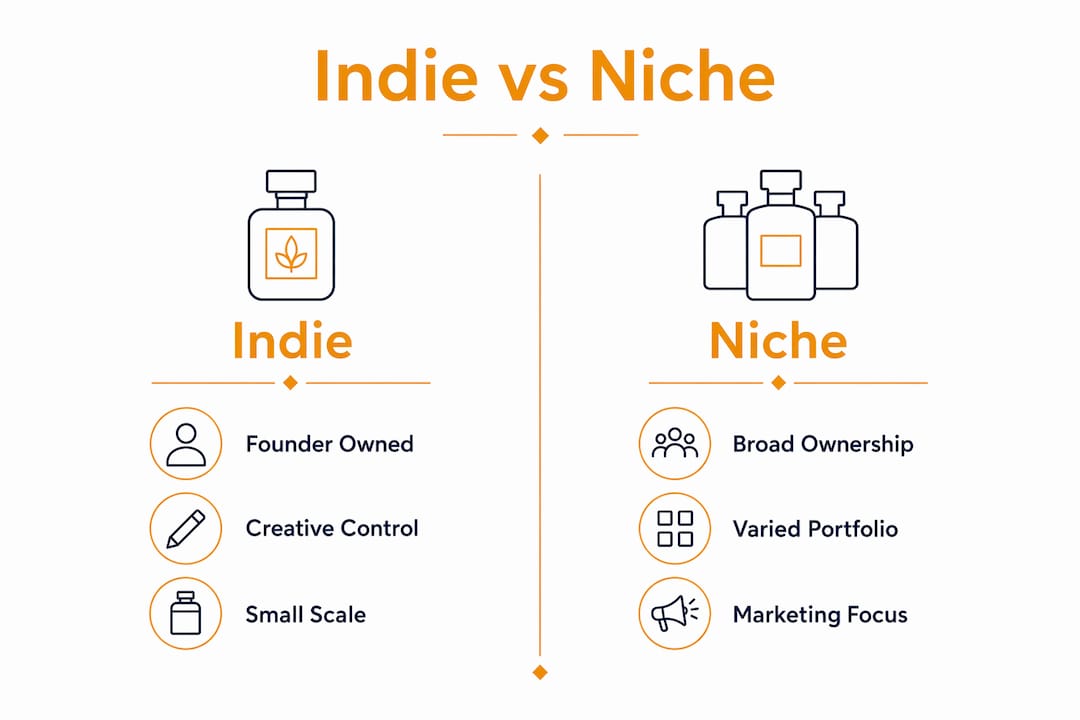
- How do indie, niche, and designer labels actually differ?
- How do indie brands actually create their fragrances?
- Why choose an independent fragrance over a mainstream one?
- How can you verify authenticity before buying discounted indie perfume?
- Where can you safely buy indie fragrances in the U.S.?
- How should you sample an indie scent before buying a full bottle?
- What should you expect to pay for an independent perfume?
- How did independent perfume brands develop over time?
- What ethical and environmental standards do indie brands follow?
- Key Takeaways
- Why indie perfumes matter more than the labels suggest
- Authentic niche fragrances at a real discount
- Useful sources
What actually defines an independent perfume brand?
Independence in perfumery is a business classification, not a production method. A brand qualifies as indie when it is privately owned by a founder or small group, with no conglomerate parent, no outside equity controlling creative decisions, and no licensing arrangement that subordinates the scent brief to a fashion house’s commercial calendar.
Three concrete criteria separate a genuine indie from a marketing claim:
- Ownership: The brand is founder-owned or held by a small private group. No conglomerate stake, no private-equity buyout that hands creative sign-off to a board.
- Creative control: The founder or a named perfumer approves formulations, marketing, and product direction. If a parent company can override a formula, the brand is not indie.
- Licensing independence: The brand does not exist as a licensed extension of a fashion or celebrity name. Licensing deals typically require the licensor’s approval on scent direction and packaging.
On a brand’s website, look for a named perfumer or founder bio, batch or pour details, and a transparent ownership statement. Those signals are harder to fake than a “niche” label.
How do indie, niche, and designer labels actually differ?
These three terms get used interchangeably online, and that confusion costs shoppers money. Here is the practical taxonomy:
- Designer: A fragrance line attached to a fashion or lifestyle house. The scent is typically a licensed revenue stream, not the core business. Production runs can exceed 100,000 units per SKU.
- Niche: A house whose primary business is perfumery rather than fashion. Niche brands may be independently owned or acquired by a conglomerate. Creed is owned by Kering; Kilian Paris is owned by Estée Lauder. Both are niche, neither is indie.
- Indie: A subset of niche. Independently owned, no corporate parent, no outside investors. Brands like D.S. & Durga and Zoologist fit here. Production runs typically fall in small to moderate batch sizes.
- Artisanal: A subset of indie. The perfumer personally compounds each batch, often by hand, usually under 500 units.
The hierarchy runs one direction: every artisanal brand is indie, every indie brand is niche, but not every niche fragrance brand is indie.
The word “niche” is not legally protected, so any brand can use it. Ownership and portfolio size are the only reliable verification tools.
Pro Tip: When a brand’s website lists multiple sub-brands or references a “group” or “house portfolio,” search that group name before assuming the brand is indie. A single conglomerate can own dozens of “niche” labels.
How do indie brands actually create their fragrances?
The creation process varies widely, but a common workflow looks like this:
- Concept and brief: The founder or in-house perfumer develops the creative concept, mood, and target scent profile. This is where indie brands diverge most sharply from designer houses — no committee approval required.
- Formula development: Many indie brands work with a contract perfumer or a business-to-business supplier like Givaudan or IFF for technical manufacturing, while retaining creative direction over the final formula.
- Materials sourcing: Indie brands often specify natural absolutes, unusual aroma molecules, or region-specific raw materials. Small purchase volumes mean higher per-unit ingredient costs.
- Small-batch production: Runs of a few hundred to a few thousand units are common. Smaller batches mean tighter quality control but also higher per-bottle costs and occasional reformulations when a raw material becomes unavailable.
- Packaging and bottling: Bespoke bottles and hand-applied labels are frequent. These add cost and are often the clearest visual signal of a genuine small operation.
Founder-led indie brands often have the same person sourcing ingredients, testing batches, and answering customer emails — a level of involvement that rarely survives a conglomerate acquisition.
Pro Tip: In a product listing, look for language like “batch number,” “hand-poured,” or “perfumer: [name].” Generic phrases like “crafted with care” with no named perfumer are marketing copy, not production transparency.

Why choose an independent fragrance over a mainstream one?
The clearest advantage is creative range. Because indie perfumers do not need committee approval, they produce more atmospheric, unconventional, and sometimes polarizing scents — the kind that a mass-market brand would never greenlight for fear of alienating a broad audience.
Advantages:
- Unique, often genre-defying scent profiles not available in department stores
- Direct connection to the perfumer’s or founder’s creative vision
- Limited production runs that reduce the chance of smelling like everyone else
- Transparent ingredient sourcing is more common than in large houses
Trade-offs to weigh:
- Higher per-bottle prices due to small-batch economics and bespoke packaging
- Patchy U.S. distribution — many indie brands sell direct or through a handful of specialist retailers
- Return policies vary; some small brands cannot accept opened bottles
- Reformulations happen more often when a key raw material becomes scarce
For discount shoppers, the calculus shifts when a reputable retailer offers an indie bottle at a meaningful reduction. Discounts on indie fragrances can make them more affordable than comparable designer bottles, increasing accessibility. Explore niche fragrance comparisons to sharpen that value judgment before buying.
How can you verify authenticity before buying discounted indie perfume?
Counterfeits and grey-market bottles are real risks in the discounted fragrance space. A practical checklist before purchasing:
- Inspect packaging: Fonts, cellophane wrap, and box construction on authentic bottles are consistent and precise. Blurry printing or uneven seams are red flags.
- Check batch codes: Every legitimate bottle carries a batch code on the box and the bottle base. Cross-reference it with CheckFresh or the brand’s own verification page.
- Request a receipt or invoice: A reputable seller provides proof of purchase that ties the bottle to an authorized source.
- Evaluate seller transparency: Clear contact information, a documented return policy, and stated shipping origins are strong predictors of a safe purchase.
- Assess the discount: Discounts of 30–60% from an established retailer with a return policy are plausible. An 80% discount from a seller with no history and no returns is a warning sign.
Red flags specific to indie brands include unverifiable ownership claims, product photos that look stock rather than actual, and listings that describe a brand as “niche” without naming a founder or perfumer. Aromatick’s guide on discount fragrance authenticity walks through these checks in detail.
Where can you safely buy indie fragrances in the U.S.?
- Brand direct: The safest channel. You get the full story, batch transparency, and a clear return policy. The trade-off is full retail price.
- Specialist boutiques: Brick-and-mortar niche retailers carry curated selections and can often let you test before buying. Stock is limited and prices are typically full retail.
- Vetted e-tailers: Online retailers that publish return policies, list shipping origins, and provide receipts. Aromatick operates this way, offering discounts up to 60% with a satisfaction guarantee.
- Decant and discovery services: Platforms and sellers that portion full bottles into smaller vials. Useful for sampling before committing. Verify the decant seller’s sourcing — reputable ones name their bottle sources. Jeffi Inc’s fragrance section is one option worth checking for variety.
- Third-party marketplaces: Proceed carefully. Large discounts from sellers with no review history, no stated return policy, and no batch-code documentation are high-risk.
How should you sample an indie scent before buying a full bottle?
Decants and discovery sets are the standard low-cost path for testing indie fragrances. A reliable test routine:
- Apply a small amount to the inside of your wrist. Avoid rubbing — it breaks down top notes.
- Wait 15–20 minutes for the dry-down. Top notes fade; the heart and base are what you will actually wear.
- Test on skin and a fabric strip. Some fragrances perform very differently on cloth versus skin chemistry.
- Compare against an unscented control (clean skin on the other wrist) to isolate the fragrance’s character.
- Wear it for a full day before deciding. Projection and longevity only reveal themselves over hours.
Pairing a decant purchase with a discounted full bottle from a vetted retailer is the lowest-risk path to building an indie collection.
What should you expect to pay for an independent perfume?
Indie fragrances typically run $80–$300 for a full-size bottle, with extrait concentrations and limited editions pushing higher. Several cost drivers explain why prices stay elevated even when ingredient costs are not proportionally higher:
- Small-batch economics: Producing 500 bottles costs far more per unit than producing 50,000. That gap shows up directly in the retail price.
- Bespoke packaging: Custom bottles, hand-applied labels, and specialty closures add per-unit cost that mass-market brands spread across enormous runs.
- Curated distribution: Selling through a handful of specialist retailers rather than mass-market chains means less volume and higher margin requirements per sale.
When evaluating a discount, ask whether the seller has a return policy, provides a receipt, and lists the bottle’s batch code. A genuine discount from a transparent retailer reflects lower overhead, not a compromised product. A suspiciously deep cut from an anonymous seller usually reflects the opposite.
How did independent perfume brands develop over time?
The modern independent perfume movement traces back to the 1980s, when a handful of perfume-focused houses began positioning themselves explicitly against the licensed designer model. The term “niche” emerged to describe these houses whose sole business was fragrance, not fashion. Brands like Serge Lutens and Guerlain (in its pre-acquisition era) established the template: perfume as the primary creative and commercial output, not a brand extension.
The internet changed the economics dramatically. Direct-to-consumer sales removed the need for department store shelf space, which had historically been controlled by a small number of large distributors. A founder with a compelling scent and a functional website could reach fragrance enthusiasts across the country without a retail partner. That shift opened the category to a much wider range of voices and aesthetics through the 2000s and 2010s, producing the current landscape where indie brands range from solo kitchen-table operations to sophisticated small houses with global followings.
What ethical and environmental standards do indie brands follow?
Independent brands vary considerably in their sustainability commitments, but the category as a whole tends to lead on transparency. Several patterns are common:
- Cruelty-free formulation: Many indie brands explicitly avoid animal-derived ingredients or testing, and some carry PETA or Leaping Bunny certification.
- Sustainable sourcing: Smaller purchase volumes make it easier to trace ingredient origins. Some indie houses specify fair-trade or sustainably harvested naturals, such as vetiver from Haiti or sandalwood from Australia.
- Eco-conscious packaging: Refillable bottles, recycled cardboard, and minimal plastic are more common in indie lines than in mass-market fragrance.
- Transparency: Because the founder is often the face of the brand, there is stronger incentive to be honest about ingredients, sourcing, and production methods.
That said, “indie” does not automatically mean ethical. Verify claims by looking for third-party certifications or named sourcing partners on the brand’s website, not just marketing language.
Key Takeaways
An independent perfume brand is defined by ownership and creative control, not production method — and verifying those two factors is the most reliable way to shop authentically at a discount.
| Point | Details |
|---|---|
| Independence = ownership + control | A brand is indie only when it is founder-owned with no conglomerate parent overseeing creative decisions. |
| “Niche” is not a protected term | Verify ownership and distribution before trusting a “niche” label; many acquired brands still use it. |
| Authenticity checklist | Inspect batch codes, packaging, receipts, and seller return policies before purchasing any discounted bottle. |
| Sample before committing | Use decants or discovery sets to test dry-down and longevity before buying a full-size indie bottle. |
| Aromatick for discounted authentics | Aromatick offers verified niche and designer fragrances at meaningful discounts, with a satisfaction guarantee and transparent return policy. |
Why indie perfumes matter more than the labels suggest
The fragrance industry has a labeling problem, and shoppers pay for it. “Niche,” “artisanal,” and “indie” are used so loosely that they have become marketing shorthand rather than meaningful descriptors. The only way to cut through that noise is to go back to the structural question: who owns this brand, and who controls what goes in the bottle?
What strikes me most about the indie perfume space is how much creative risk it absorbs that the mainstream market simply cannot. A large house with quarterly targets cannot afford to release a fragrance that smells like rain on hot asphalt or fermented wood — but an indie founder with 500 bottles and a direct-to-consumer channel can, and often does. That creative latitude is the real value proposition, not the “indie” badge itself.
For discount shoppers, the practical takeaway is this: the label matters less than the ownership structure, and the ownership structure matters less than the seller’s transparency. A well-documented discount from a retailer with a clear return policy and batch-code verification is safer than a full-price purchase from a brand whose ownership is opaque. Focus on those signals, and the label becomes secondary.
Authentic niche fragrances at a real discount
Aromatick carries a curated selection of authentic niche and designer fragrances at 30–60% below standard retail pricing, with free shipping above the order threshold and a satisfaction guarantee on every purchase.
For shoppers ready to explore independent and niche bottles without paying boutique prices, the niche fragrance collection is the clearest starting point. If you are specifically looking for Initio Parfums Privés, one of the most respected names in contemporary niche perfumery, Aromatick’s Initio collection offers authenticated bottles with full batch documentation. Every order comes with a receipt, and the return policy is stated upfront — the same transparency signals this guide recommends you look for in any indie or niche purchase.
Useful sources
- Institute For Art and Olfaction / The Artisan Insider — Defining Niche, Indie, and Artisan: Grounds the ownership-and-creative-control definition used throughout this article.
- Premiere Peau — What Is Niche Perfume?: Source of the taxonomy table (designer / niche / indie / artisanal) and the structural independence definition.
- Exuma Fragrance Co. — What Is Indie Perfume?: Supports claims about founder involvement in sourcing, blending, and customer communication.
- Fragrance.link — What Niche Really Means in Perfume: Explains why “niche” is a loosely used marketing term and how to verify true indie status.
- Parfumerie Nasreen — Designer vs. Niche vs. Indie: Explains small-batch economics and why indie prices remain elevated even at a discount.
- Aromatick Fragrance School — Are Discount Fragrances Authentic?: Practical authenticity checklist for batch codes, packaging, and seller transparency.
- Rcaliph — Niche vs. Indie Perfume: Supports decant and discovery-set guidance in the sampling section.

Leave a comment
This site is protected by hCaptcha and the hCaptcha Privacy Policy and Terms of Service apply.