
What Is Scent Longevity? A Fragrance Guide
TL;DR:
- Scent longevity refers to how long a fragrance remains perceptible on the skin or clothing after application. It depends on factors like concentration, skin chemistry, environment, and application technique. Understanding these variables helps in choosing fragrances that match personal needs for lasting power.
Scent longevity is defined as the length of time a fragrance remains detectable on your skin or clothing after application. In perfumery, the industry term for this concept is longevity, and it sits alongside projection and sillage as one of three core measures of fragrance performance. Understanding what is scent longevity matters because it directly shapes how you shop, how you apply perfume, and how much value you get from every bottle. Brands like Creed, Maison Margiela, and Initio Parfums Privés are frequently evaluated on this metric by fragrance communities on Fragrantica and Basenotes.
What is scent longevity vs. projection and sillage?
Scent longevity is the duration a fragrance is perceptible, but it is not the same as how far it travels or how much of a trail it leaves. These three terms are related but measure different things.
- Longevity: How many hours a scent remains detectable on your skin.
- Projection: How far the scent radiates outward from your body into the surrounding air.
- Sillage: The trail a fragrance leaves behind as you move through a room.
A perfume can score high on longevity while scoring low on projection. This is a common source of confusion for buyers. Extrait de Parfum formulas, for example, often last 8 or more hours but project softly because they contain less alcohol to carry the scent outward. The result is an intimate, skin-close experience that wears for a long time without announcing itself across the room.
“Long-lasting does not mean strong projection; intimate fragrances can last longer but project less, showing complexity in performance aspects.” — Perfumes.news
The practical takeaway: if you want a fragrance that fills a room, prioritize projection. If you want one that stays with you through a full workday, prioritize longevity. Knowing the difference helps you choose lasting scents that match your actual needs rather than chasing the strongest opening spray.
What factors affect scent longevity?
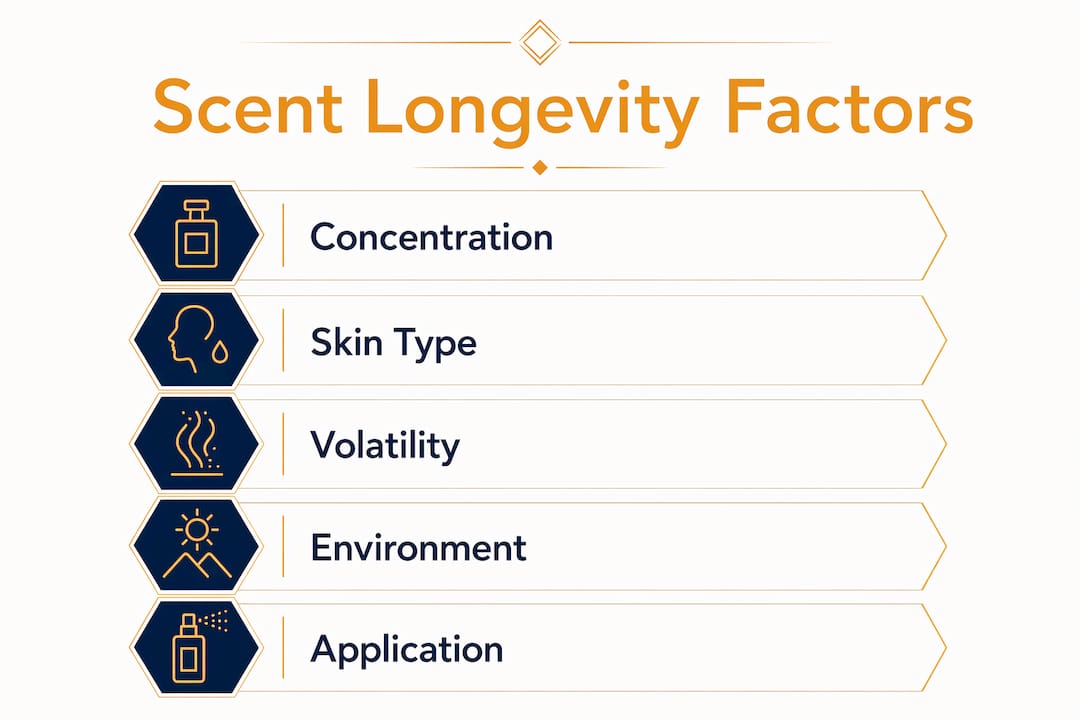
Perfume lasting power results from a combination of concentration, molecular volatility, skin biology, environment, and application technique. No single factor controls the outcome alone.
1. fragrance concentration
Concentration is the ratio of fragrance oil to alcohol and water in a formula. Higher concentration generally means longer wear time.
- Parfum (Extrait): 20–40% fragrance oil. Typically lasts 8+ hours. Projects softly.
- Eau de Parfum (EDP): 15–20% fragrance oil. Typically lasts 4–8 hours. Balanced projection.
- Eau de Toilette (EDT): 5–15% fragrance oil. Typically lasts 2–4 hours. Stronger initial projection.
- Eau de Cologne (EDC): 2–4% fragrance oil. Typically lasts 1–2 hours. Light and fresh.
Parfum lasts the longest due to more fragrance material and less alcohol to evaporate. That said, concentration is not the only variable at play.
2. skin chemistry and hydration
Your skin is not a neutral surface. Oily skin holds scent longer because the natural lipids trap fragrance molecules, while dry skin absorbs and loses scent faster. Body temperature, pH levels, and even your diet can shift how a fragrance performs on you specifically.
3. fragrance composition and volatility
Fragrance molecules evaporate at different rates. Citrus and green top notes disappear within 15–30 minutes. Floral heart notes last 1–3 hours. Base notes like sandalwood, vetiver, oud, and musk anchor the fragrance and define its overall wear time. Perfumers use fixatives, including ingredients like Ambroxan and ISO E Super, to slow evaporation and extend the base note phase.
4. environmental conditions
Heat accelerates evaporation, which can shorten wear time in summer. Humidity, by contrast, can help fragrance molecules cling to the skin. Wind disperses a scent faster. Cold, dry air tends to suppress projection but can preserve longevity at a skin level.
5. application technique
Where and how you apply perfume matters. Pulse points, including the wrists, neck, and inner elbows, generate heat that activates and diffuses the fragrance. Rubbing the wrists together after spraying breaks down fragrance molecules and shortens wear time.
Pro Tip: Apply perfume right after a shower on slightly damp skin and layer it over an unscented moisturizer. Moisturized skin traps fragrance molecules more effectively, extending wear time noticeably.
Why do two people experience different scent longevity?
Fragrance longevity is a silent dialogue between perfume and biology. No two people experience the same scent duration from an identical bottle. This is one of the most misunderstood aspects of perfume performance.
Several personal variables shape your individual experience:
- Skin pH: A more acidic skin pH can break down certain fragrance molecules faster.
- Hormonal fluctuations: Hormones affect skin chemistry and can shift how a scent develops and fades.
- Medications: Some medications alter skin secretions, which changes how fragrance interacts with the skin.
- Diet and hydration: Spicy foods and dehydration can affect how your skin carries a scent.
- Body hair: Hair holds fragrance molecules longer than bare skin, which is why applying to the hair or beard extends wear time.
One of the most counterintuitive factors is olfactory fatigue, also called nose blindness. Your nose filters out repeated smells after 1–2 hours of continuous exposure, but the fragrance remains fully detectable to everyone around you. This means you may think your perfume has faded when it has not. Nose blindness causes many wearers to over-apply, which can overwhelm others nearby.
Pro Tip: Before buying a fragrance, wear it on your skin for a full 6-hour day rather than judging it from a paper strip. Paper strips cannot replicate how your skin chemistry transforms a scent over time.
Understanding these variables also explains why reading online reviews for longevity is useful but imperfect. A reviewer with oily skin in a humid climate will report very different wear times than someone with dry skin in a dry desert environment. Use reviews as a starting point, not a definitive verdict.
How to choose and wear fragrances for better lasting power
Selecting a fragrance for optimal scent duration requires thinking beyond the opening spray. The first 30 seconds of a fragrance on a test strip tell you almost nothing about its staying power.
Choose the right concentration and base notes
Fragrances built on heavy base notes last longer by design. Woods like cedarwood and sandalwood, resins like benzoin and labdanum, and musks like Ambroxan and Iso E Super all have low volatility. They evaporate slowly and form the structural backbone of a long-lasting fragrance. When browsing, look for EDPs or Extraits with prominent woody, amber, or musky bases.
For expert guidance on selecting luxury options, tips for luxury fragrances from experienced reviewers can help you narrow down candidates before you commit.
Application and storage best practices
| Practice | Why It Works |
|---|---|
| Apply to pulse points | Body heat activates and diffuses fragrance molecules |
| Moisturize before applying | Hydrated skin retains fragrance molecules longer |
| Layer with matching body lotion | Creates a scent foundation that extends the top and heart notes |
| Avoid rubbing wrists together | Rubbing breaks fragrance molecular bonds and shortens wear |
| Store away from heat and light | Heat and UV light degrade fragrance compounds over time |
| Apply to hair or clothing | Both surfaces hold fragrance longer than bare skin |
Match your fragrance to the season
Warm weather amplifies projection but shortens wear time because heat speeds up evaporation. Light, fresh EDTs work well in summer because their natural volatility suits the season. In winter, heavier EDPs and Extraits with dense base notes perform better because cold air slows evaporation and keeps the fragrance close to the skin. Matching concentration and composition to climate is one of the simplest ways to improve your daily fragrance experience. You can explore long-lasting perfume choices by season to find options that suit your environment.
Key takeaways
Scent longevity is multi-factorial, shaped by concentration, skin biology, fragrance composition, environment, and application technique working together.
| Point | Details |
|---|---|
| Longevity differs from projection | A fragrance can last all day on skin while projecting softly into the room. |
| Concentration is a starting point | Parfum lasts 8+ hours, but skin chemistry and application also determine final wear time. |
| Base notes define staying power | Woody, musky, and resinous base notes evaporate slowly and anchor long wear. |
| Nose blindness distorts perception | You may stop smelling your fragrance after 1–2 hours, but others can still detect it. |
| Application technique matters | Moisturized skin and pulse point application extend how long any fragrance lasts. |
The part most fragrance buyers get wrong
I have spoken with hundreds of fragrance buyers over the years, and the same misconception comes up repeatedly. People assume that a perfume that hits hard in the first five minutes will last all day. The opposite is often true. Fragrances with explosive openings, typically those loaded with citrus and aldehydic top notes, burn off fast. The ones that seem quiet at first, built on woods, musks, and resins, are the ones still whispering on your skin eight hours later.
The second thing most buyers overlook is their own skin care routine. If you apply a fragrance over dry, unhydrated skin after a long day, you are setting it up to fail. The same bottle on freshly moisturized skin after a morning shower will perform noticeably better. Fragrance does not exist in isolation. It interacts with everything on your skin.
My honest advice: stop chasing the strongest fragrance and start thinking about the most compatible one. Test on your skin, not on paper. Wear it for a full day before deciding. Pay attention to what your skin does to the dry-down, because that is where the real character of a fragrance lives. Longevity is not just a spec on a review site. It is a relationship between the formula and you.
— Rodney
Explore authentic fragrances built to last at Aromatick
If you are ready to find a fragrance that genuinely performs on your skin, Aromatick offers a carefully curated selection of authentic designer and niche perfumes across every concentration, from light Eau de Toilettes to rich Extraits.
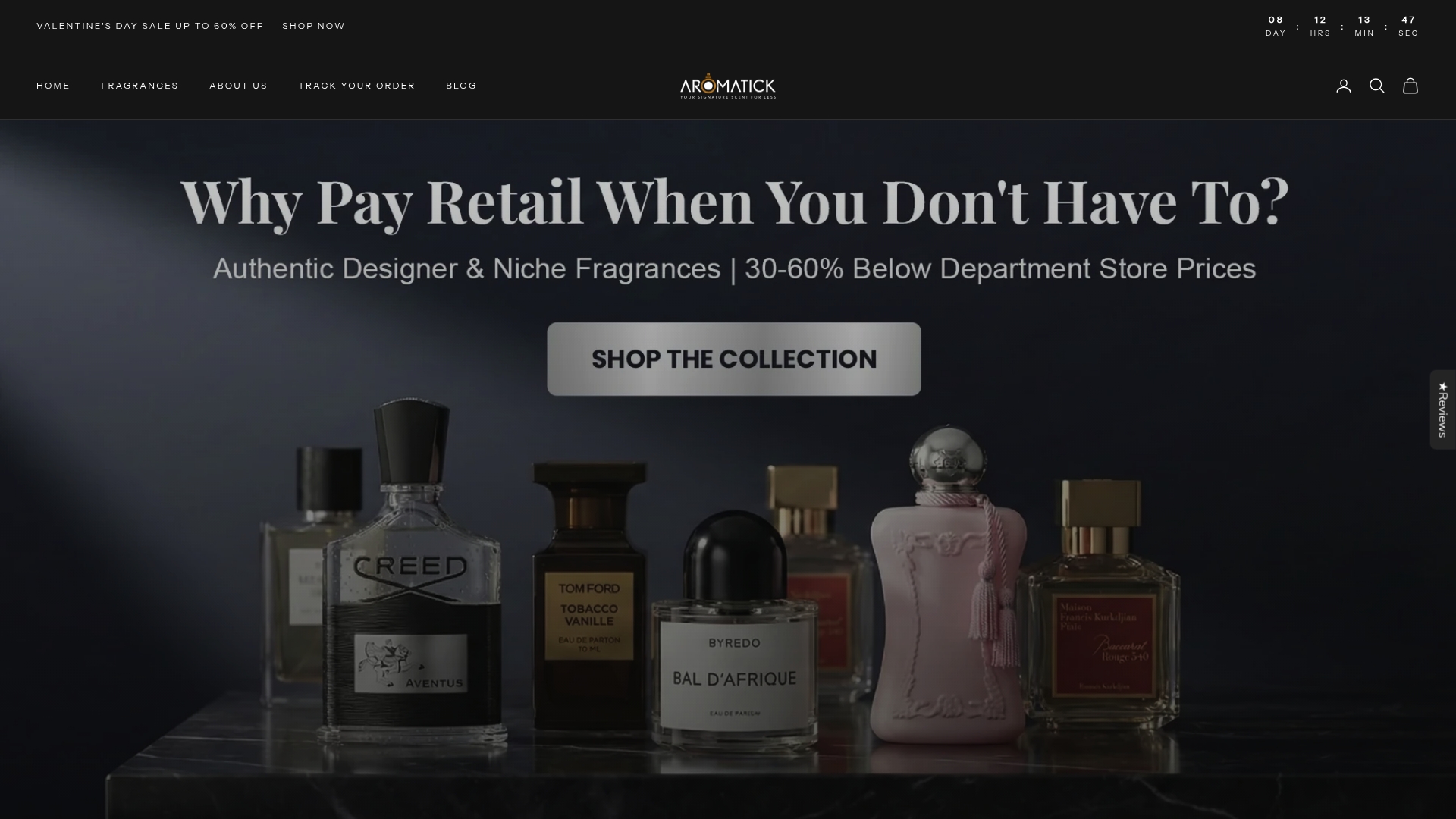
Aromatick sources directly from authorized channels, which means you get genuine formulas at up to 60% off department store prices. Whether you prefer a skin-close Parfum that wears quietly all day or a bold EDP with strong projection, the designer fragrance collection covers the full range. For something more distinctive, the niche fragrance collection features houses known for complex, long-wearing compositions. Free shipping and a satisfaction guarantee make it easy to explore without risk.
FAQ
What is scent longevity in simple terms?
Scent longevity is how long a fragrance remains detectable on your skin after you apply it. It is influenced by the perfume’s concentration, its ingredient composition, your skin type, and the environment around you.
How long does a typical perfume last on skin?
Wear time varies by concentration. Parfum typically lasts 8 or more hours, Eau de Parfum lasts 4–8 hours, Eau de Toilette lasts 2–4 hours, and Eau de Cologne lasts around 1–2 hours.
Does expensive perfume last longer?
Not automatically. Price reflects ingredients, brand positioning, and bottle design. What determines lasting power is the concentration of fragrance oil and the volatility of the ingredients used, not the retail price.
Why does my perfume fade so quickly on me?
Dry skin absorbs fragrance faster than oily skin, shortening wear time. Applying to unhydrated skin, skipping pulse points, or rubbing the wrists together after application all reduce how long a scent lasts.
Can nose blindness make me think my perfume has faded?
Yes. Olfactory fatigue causes your nose to stop registering a familiar scent after 1–2 hours of continuous exposure. The fragrance is still present and detectable to others around you.

Leave a comment
This site is protected by hCaptcha and the hCaptcha Privacy Policy and Terms of Service apply.