
Fragrance layering guide: Build your perfect signature scent
TL;DR:
- Fragrance layering allows you to create long-lasting, personalized scents by combining multiple perfumes intentionally. Proper skin preparation, understanding fragrance families, and careful application techniques are essential for effective layering. This practice fosters creative self-expression and offers an affordable alternative to purchasing multiple standalone perfumes.
You finally found a perfume you love, but it fades by noon. Or you have a small collection of great scents that each feel too specific to wear every day. Fragrance layering solves both problems at once. By combining two or more scents in a deliberate sequence, you create something longer-lasting, more personal, and genuinely your own. This guide walks you through every step of the process, from skin prep to final spritz, so you can start building a signature scent without wasting a single drop or dollar.
Table of Contents
- What you need to start: Skin prep and layering essentials
- Choosing compatible scents: Notes and families that blend well
- Layering methods: Step-by-step application for lasting impact
- Troubleshooting, budget strategies, and verifying your blend
- Why scent layering matters now: Beyond trends and budgets
- Explore niche and designer fragrances for layering mastery
- Frequently asked questions
Key Takeaways
| Point | Details |
|---|---|
| Prep for best results | Hydrated and moisturized skin with neutral products helps fragrances last and prevents scent clashes. |
| Choose compatible notes | Pair simple and complex scents from similar families to avoid olfactory confusion and maximize harmony. |
| Layering extends your collection | Mixing and matching scents lets you achieve signature blends without needing dozens of full bottles. |
| Evaluate after settling | Always wait 20–30 minutes before judging your layered scent for the true finished effect. |
| Budget-friendly experimentation | Samples, miniatures, and discovery sets enable safe and affordable layering experimentation. |
What you need to start: Skin prep and layering essentials
Now that you know why layering matters, let’s cover what you’ll need to get started for best results.
The single most important factor in fragrance longevity is your skin condition before you apply anything. Moisturized skin holds fragrance significantly better than dry skin, because the oils and water content in hydrated skin help trap scent molecules and slow their evaporation. Dry skin, by contrast, absorbs fragrance quickly and lets it disappear within an hour or two. This is why two people wearing the same perfume can have completely different experiences.
The ritual of layering goes well beyond stacking two perfumes. A bath to lotion to perfume progression builds a continuous scent foundation that dramatically improves wear time and consistency throughout the day. Each layer reinforces the next, creating a kind of scent scaffolding that holds everything in place.
Here is what you need to set up your layering practice, whether you are just starting out or ready to go deeper:
Basic layering setup:
- Unscented body lotion or shea butter
- One or two fragrances (can be samples or minis)
- Clean, freshly washed skin
Advanced layering setup:
- Unscented shower gel, lotion, and hair mist
- Three or more coordinated fragrances across different families
- Body oil as a primer layer
- Fragrance wardrobe organized by note families
| Feature | Basic setup | Advanced setup |
|---|---|---|
| Number of scents | 1 to 2 | 3 or more |
| Skin prep products | Unscented lotion | Body oil, lotion, hair mist |
| Cost range | Low (samples/minis) | Moderate (curated collection) |
| Best for | Beginners | Experienced enthusiasts |
| Customization level | Moderate | High |
Samples and mini bottles are genuinely underrated tools for layering. They let you test combinations without committing to full bottles, which means you can experiment freely and find what works on your specific skin chemistry before spending more.
Pro Tip: Always use unscented body products as your base unless you have confirmed that your scented lotion or shower gel coordinates with your intended fragrance combo. A mismatch here can undermine even the best perfume pairing before you even begin. If you want to go deeper on technique, reading about layering fragrances like a pro is a great next step.
Choosing compatible scents: Notes and families that blend well
Next, let’s make sense of which scents will layer beautifully, and which combinations to approach with caution.
Fragrance families are broad categories that describe the dominant character of a perfume. The four most common families you will work with are:
- Woody: Sandalwood, cedar, vetiver, oud. Warm, grounding, and long-lasting.
- Fresh: Citrus, aquatic, green. Light, clean, and energizing, but shorter-lived.
- Floral: Rose, jasmine, iris, peony. Soft, romantic, and versatile.
- Spicy/Oriental: Amber, vanilla, pepper, cardamom. Rich, warm, and complex.
Understanding these families is the foundation of smart layering. When you understand fragrance families and how they interact, you stop guessing and start making intentional choices.
The core rule is this: compatible families reduce clashing, and using restraint rather than stacking too many complex scents keeps your blend coherent. A perfume that already has 15 distinct notes layered on top of another equally complex fragrance creates what perfumers call olfactory confusion. The result is a muddy, indistinct smell that reads as “too much” rather than sophisticated.
Beginner-friendly combinations to try first:
- Fresh citrus over a warm woody base (classic and crowd-pleasing)
- Light floral over a soft musk (feminine and elegant)
- Spicy oriental base with a clean aquatic accent (unexpected but balanced)
- Vanilla base with a green or herbal top (cozy with a fresh lift)
- Sandalwood base with a rose or jasmine accent (timeless and rich)
| Base scent family | Accent scent family | Mood/occasion | Difficulty |
|---|---|---|---|
| Woody (cedar, sandalwood) | Fresh citrus | Casual/daytime | Easy |
| Musk/amber | Light floral | Evening/romantic | Easy |
| Vanilla/oriental | Aquatic/green | Office/neutral | Moderate |
| Oud/resin | Spicy (pepper, cardamom) | Formal/statement | Advanced |
| Vetiver | Herbal (lavender, sage) | Relaxed/weekend | Easy |
Understanding perfume notes at a deeper level, specifically top, heart, and base notes, helps you predict how a layered combination will evolve over time. A fresh citrus top note will fade within 30 minutes, leaving the woody or musky base to carry the blend through the rest of the day.
Pro Tip: When you are unsure where to start, pick one simple, linear fragrance as your base and add a more complex accent on top. The simple scent gives the blend stability, while the complex one adds character without overwhelming. This approach is also a great way to choose fragrances step by step when building your collection.
Layering methods: Step-by-step application for lasting impact
With your chosen perfumes and products ready, here are the exact steps to create your layered scent.
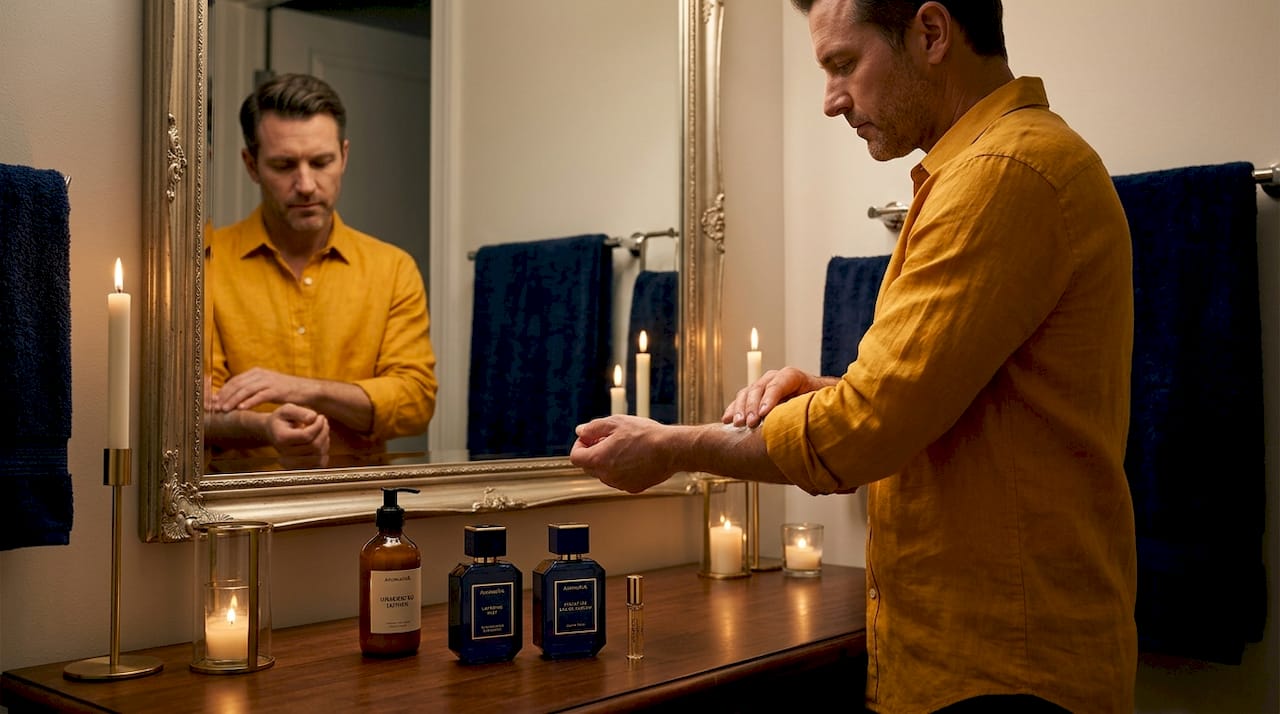
There are two main methods of fragrance layering, and understanding both gives you more creative control. Note-based layering means selecting scents whose notes complement each other so that the combination reads as one unified fragrance. Spatial layering means applying different scents to different areas of the body so they interact subtly in the air around you rather than blending directly on skin.
Most people use a combination of both. Here is the full step-by-step process:
- Shower with unscented products. Start with a clean, neutral canvas. Scented shower gels can interfere with your intended combination before you even begin.
- Apply an unscented body lotion or oil. Focus on pulse points: wrists, inner elbows, neck, and behind the knees. Let it absorb for two to three minutes.
- Apply your base fragrance first. This is typically the heavier, longer-lasting scent, often woody, musky, or oriental. Spray or dab it on pulse points and let it settle for 30 to 60 seconds.
- Apply your accent fragrance second. This is usually lighter, fresher, or more volatile. Apply it to the same or adjacent areas, but use a lighter hand than you did with the base.
- Consider spatial layering for contrast. If you want two distinct scents to interact rather than fully merge, apply the base on your wrists and the accent on your neck or chest.
- Apply a hair mist if desired. Hair holds fragrance beautifully and diffuses it gently as you move. A bath to lotion to perfume progression that ends with a hair mist creates the most complete and long-lasting scent experience.
- Wait before judging. Give the blend 20 to 30 minutes to settle before evaluating whether it works.
The difference between note-based and spatial layering matters more than most beginners realize. Note-based layering creates a single unified scent that evolves on your skin. Spatial layering creates a dynamic, shifting cloud of fragrance that changes as you move and as the day progresses. Both are valid. Your choice depends on whether you want cohesion or complexity.
A word of caution: Avoid applying two strong, complex fragrances directly on top of each other in the same spot. This is the fastest route to olfactory confusion, where the brain stops being able to distinguish individual notes and the whole thing reads as “loud.” Use restraint, especially when you are still learning your combinations.
Pro Tip: Layer lighter, more volatile scents closer to the skin and heavier, more persistent ones on top or in the air around you. This creates a natural diffusion effect where the lighter notes lift off first and the heavier ones anchor the blend throughout the day. For more advanced application strategies, explore these expert layering techniques that go even further.
Troubleshooting, budget strategies, and verifying your blend
Even well-planned layering can go awry. Here is how to troubleshoot, stretch your budget, and judge your blend for best results.
One of the most common mistakes is judging a layered blend too quickly. The opening of a fragrance, the first five to ten minutes after application, is often the most chaotic and misleading phase. Top notes are volatile and loud at first, then fade rapidly. Evaluate your blend after settling rather than immediately, because what you smell in the first few minutes is not what the blend will become.
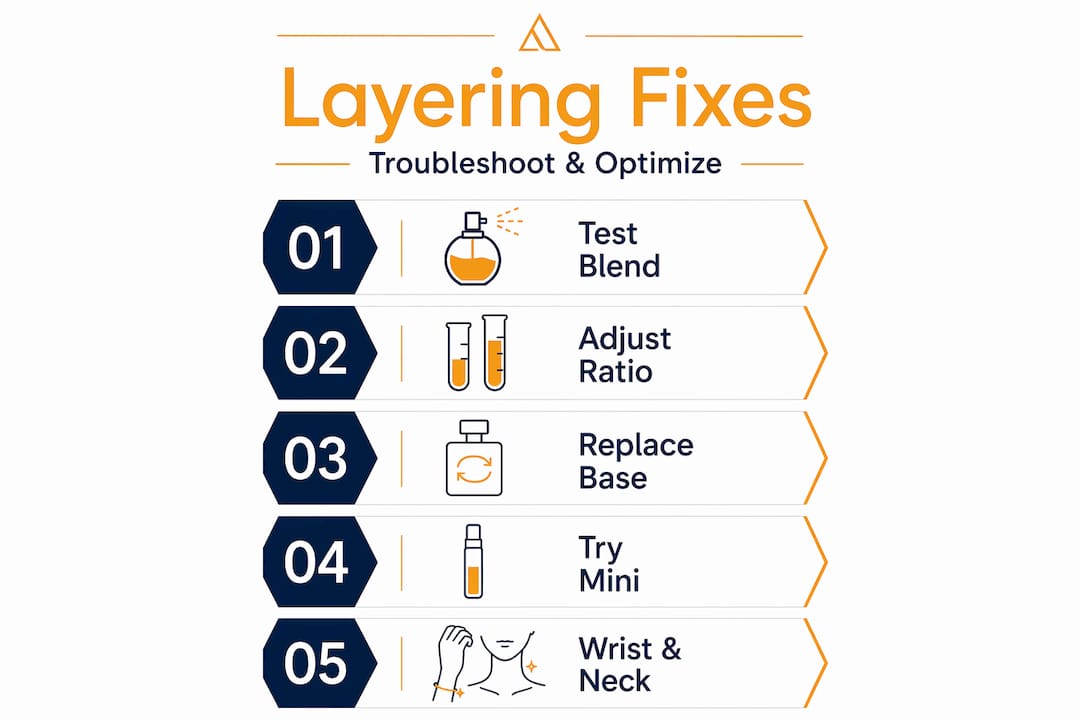
Common layering mistakes and how to fix them:
- Too much of both scents: Reduce to one spray of each. Layering amplifies projection, so you need less than you think.
- Scents that clash immediately: They are likely in incompatible families. Try swapping one for something from a more neutral family like musk or sandalwood.
- The blend fades too fast: Your skin may be dry, or you skipped the moisturizer step. Rehydrate and try again.
- One scent completely dominates: The dominant fragrance has higher concentration (EDP vs EDT) or stronger projection. Use less of it or apply it to a less prominent area.
- The blend smells generic or flat: You may have chosen two scents that are too similar. Add a contrasting accent from a different family to create dimension.
Budget strategy is where layering really shines. Scent stacking is increasingly mainstream, especially among younger consumers, which has driven a surge in mini bottles, samples, and discovery sets. These formats let you build a layering wardrobe at a fraction of the cost of buying full bottles of every scent you want to try.
The smartest approach is to invest in one or two quality base fragrances in full size, then rotate accent fragrances using minis and samples. This way, your base stays consistent and familiar, while your accent keeps things fresh and seasonally appropriate. Exploring mini perfume discovery sets is one of the best ways to build out your accent collection without overspending.
Pro Tip: Test your layered combinations on your wrist and your neck separately before committing to a full application. Skin temperature and texture vary across the body, which means the same combination can smell noticeably different depending on where it lands. Test both, then decide which application zone gives you the result you prefer.
Why scent layering matters now: Beyond trends and budgets
Now, let’s step back and see why layering is more than just a technique or trend.
There is a tendency to frame fragrance layering as a clever budget hack or a social media trend. And while it is both of those things, reducing it to either misses the point. Layering is fundamentally a creative act. It is the difference between wearing a scent and composing one.
The shift from signature scents to flexible scent wardrobes reflects something real about how people want to present themselves now. A single signature fragrance implies a fixed identity. A layered wardrobe implies fluidity, the ability to be warm and woody on a cold morning, clean and fresh for a long workday, and rich and spicy for an evening out, all from the same small collection of bottles.
Gen Z and younger millennial consumers are driving this shift, and the industry has noticed. Discovery sets, layering guides, and mini formats are no longer niche offerings. They are front and center in how fragrance is marketed and sold. This is good news for anyone who wants access to luxury scent experiences without paying luxury prices for every bottle.
“The era of the single signature scent is giving way to a more fluid, expressive approach, where fragrance becomes a daily creative choice rather than a fixed identity marker.”
What makes layering genuinely democratizing is that it levels the playing field between a $30 body mist and a $300 niche perfume. A well-chosen, affordable base fragrance layered with a small amount of something more complex can produce a result that neither could achieve alone. The art and science of layering fragrances is not about spending more. It is about thinking more carefully about what you already have.
The most interesting layering combinations often come from unexpected pairings. A simple drugstore musk under a niche oud can ground and humanize what might otherwise feel austere. A fresh aquatic over a rich vanilla can keep a heavy scent from feeling suffocating in warm weather. The skill is not in the price of the bottles. It is in the understanding of how notes interact.
Explore niche and designer fragrances for layering mastery
If you’re ready to explore more scents and architect your own unique blends, here’s where to start.
Building a layering wardrobe is easier when you have access to authentic fragrances at prices that make experimentation feel low-risk. At Aromatick, you will find a curated niche fragrance collection alongside extensive men’s and women’s designer collections, all backed by an authenticity guarantee so you never have to second-guess what you are buying.

Whether you are looking for a bold base from the Initio Parfums Prives collection, an accessible accent from the Fragrance World collection, or something from the broader designer fragrance collection, Aromatick offers up to 60% off retail prices with free shipping. That kind of savings makes building a real layering wardrobe genuinely achievable.
Frequently asked questions
What is fragrance layering and why should I try it?
Fragrance layering combines multiple scents applied in sequence to create a unique, longer-lasting signature, and scent stacking is increasingly mainstream as a way to stretch your collection and express personality more flexibly.
Can I layer fragrances if I use scented shower gel or lotion?
You can, but experts recommend a neutral base before layering because scented shower gels, lotions, or shampoos with active fragrance notes can conflict with your intended perfume combination.
How long should I wait before judging a layered fragrance?
Wait 20 to 30 minutes after application, because scent openings can be misleading and the true character of a layered blend only emerges once the volatile top notes have settled.
Is fragrance layering only for expensive designer or niche perfumes?
Not at all. Sampling and miniatures support layering by letting you test multiple base and accent combinations without committing to full bottles, making it accessible at any budget level.
What mistakes should beginners avoid when layering?
Avoid stacking too many complex scents at once, and always start with moisturized, neutral skin, because using restraint and staying in compatible families is the most reliable way to avoid olfactory confusion and clashing.

Leave a comment
This site is protected by hCaptcha and the hCaptcha Privacy Policy and Terms of Service apply.