

How to Read Fragrance Notes: A Clear Guide
TL;DR:
- Fragrance notes are scent impressions organized into top, heart, and base layers that reveal a perfume’s evolving character. Understanding the fragrance pyramid helps shoppers evaluate scent longevity and personality, with notes representing moods rather than ingredients. Testing on skin and interpreting descriptive language provides the most accurate guide for selecting perfumes suited to personal chemistry.
Fragrance notes are defined as the individual scent impressions that make up a perfume’s full olfactory profile, organized into top, heart, and base layers. Learning how to read fragrance notes gives you a real advantage when shopping for perfume, whether you’re browsing online or standing at a counter. The industry standard for describing this structure is the fragrance pyramid, a three-tier model that maps how a scent evolves from first spray to final dry-down. Note lists on product pages are not ingredient disclosures. They are curated scent impressions designed to communicate character, mood, and evolution.
How to read fragrance notes: the pyramid structure
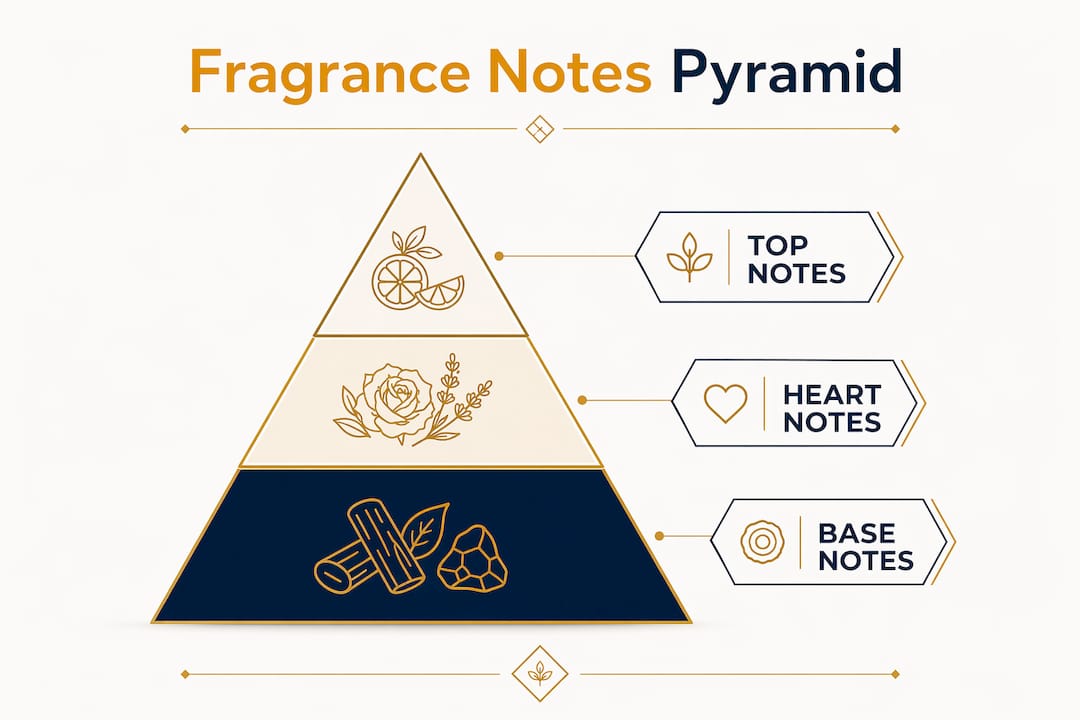
The fragrance pyramid organizes every perfume into three layers ranked by volatility. Top, heart, and base notes each play a distinct role in how a scent unfolds over time.
Top notes: the opening act
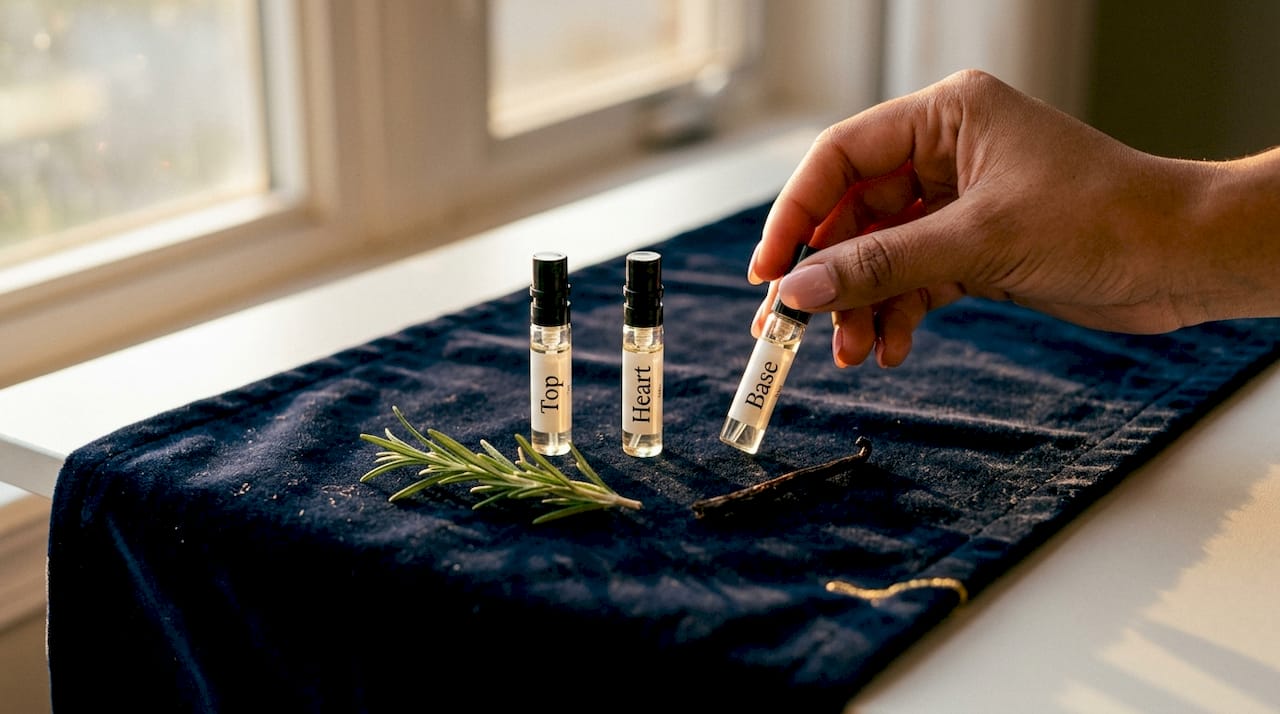
Top notes are the most volatile molecules in a formula. They hit your nose within seconds of spraying and last roughly 10–30 minutes before fading. Common top notes include citrus fruits like bergamot and lemon, light herbs like basil and mint, and green or aquatic accords. They create the critical first impression, but they do not represent the lasting character of the fragrance. Think of them as the handshake, not the conversation.
Heart notes: the core identity
Heart notes emerge as the top notes fade, typically appearing 20–30 minutes after application. They form the core identity of the fragrance and can last anywhere from 30 minutes to 3 hours. Florals like rose, jasmine, and ylang-ylang dominate this tier, alongside spices such as cardamom and cinnamon. Heart notes carry the personality of the fragrance. They are what most people mean when they say a perfume “smells like” something specific.
Base notes: the foundation
Base notes are the slowest to evaporate and the longest to last, often persisting for 4–12+ hours on skin. Woods like sandalwood and cedarwood, resins like benzoin and labdanum, and musks anchor the entire composition. They also amplify and extend the heart notes above them. Base notes are the most important layer for evaluating longevity and depth before a purchase.
Fragrance pyramid proportions at a glance
| Note tier | Typical duration | Formula proportion |
|---|---|---|
| Top notes | 10–30 minutes | 15–20% |
| Heart notes | 30 min – 3 hours | 40–50% |
| Base notes | 4–12+ hours | 30–40% |
These proportions explain why a fragrance can smell completely different an hour after you spray it. The top notes burn off, and the heavier molecules take center stage.
What do fragrance note names actually mean?
Note names on a product page are olfactory impressions, not ingredient lists. A perfumer builds what is called an accord, which is a blend of aroma molecules that together communicate a single scent idea. “Rose” in a note list does not mean the formula contains rose petals. It means the accord smells rosy.
This distinction matters because it changes how you read a note list. You are decoding a mood board, not a recipe. Poetic names like “cashmere woods” or “skin musk” are blends of musks and woods engineered to feel soft, warm, and intimate. They are real scent experiences, just not literal materials.
Decoding common texture and vibe words
Perfume descriptions use texture and vibe language to communicate scent character quickly. Here is how to translate the most common terms:
- “Sparkling” or “zesty” points to citrus top notes like lemon, grapefruit, or bergamot.
- “Creamy” or “lactonic” suggests vanilla, sandalwood, or tonka bean in the base.
- “Powdery” typically indicates iris, violet, or soft musks.
- “Smoky” or “leathery” signals birch tar, oud, or labdanum in the base or heart.
- “Green” or “dewy” describes violet leaf, galbanum, or fresh herbal accords.
- “Warm” or “spicy” usually means cardamom, cinnamon, or amber-type base materials.
Pro Tip: When a note list feels confusing, ignore the individual names and read the texture words instead. “Warm, creamy, and woody” tells you far more about how a fragrance will feel on skin than a list of exotic botanical names.
Understanding this language lets you select fragrances with confidence, even when you have never smelled the actual product.
How to evaluate fragrance notes for personal use or shopping
Reading a note list critically is a skill. These steps give you a repeatable process for evaluating any fragrance, whether you are testing in person or shopping online.
-
Start with the base notes. Base notes determine longevity and the scent you will live with for hours. Prioritize base notes when assessing whether a fragrance suits your lifestyle. If the base is heavy with oud or animalic musks and you prefer clean scents, that fragrance is likely not for you, regardless of how appealing the top notes sound.
-
Scan the heart notes for character. Heart notes tell you what the fragrance “is.” A floral heart with rose and peony reads very differently from a spicy heart with pepper and saffron. Match the heart notes to the mood or occasion you are shopping for.
-
Treat top notes as context, not criteria. Top notes create the opening impression, but they fade within 30 minutes. Do not let a beautiful citrus opening drive a purchase decision. The top notes will be gone before you finish your morning commute.
-
Test on skin and wait. Spray the fragrance on your wrist and wait at least 30 minutes before evaluating. Skin testing is essential because body temperature, hydration, and personal chemistry all change how notes develop. A fragrance that smells sharp on a paper strip may bloom into something rich and complex on your skin.
-
Check for red flags in the note list. A list with 15 or more notes is often a marketing exercise rather than a meaningful guide. Genuine complexity in perfumery comes from well-chosen accords, not from stacking every appealing ingredient name into a description.
Pro Tip: Spray one fragrance per wrist and nothing else. Testing more than two fragrances at once creates olfactory fatigue, and your nose stops registering differences accurately after about 20–30 minutes.
How skin chemistry changes the experience
Individual skin chemistry is one of the most underappreciated factors in fragrance note development. Alkaline skin tends to amplify woody and musky base notes, making fragrances smell richer and deeper. Acidic skin brightens citrus top notes but can sour floral heart notes over time. This means the same fragrance can smell noticeably different on two people wearing it side by side. Note lists are guides, not guarantees. Your skin is the final variable.
Common mistakes when reading fragrance notes
Even experienced fragrance enthusiasts fall into predictable traps. Avoiding these errors will save you from purchasing regrets and give you a more accurate read on any scent.
-
Rubbing your wrists together after spraying. This is the most common mistake. Rubbing damages the evaporation pattern and crushes the delicate top note molecules, causing the fragrance to skip stages and smell flat. Spray and let it sit.
-
Judging a fragrance in the first five minutes. The opening spray is dominated by alcohol and the most volatile top notes. Neither represents the true character of the fragrance. Give it at least 20–30 minutes before forming an opinion.
-
Taking note names literally. “Oud” in a mass-market fragrance is almost never real oud resin. It is a synthetic accord designed to evoke the idea of oud. Understanding this prevents disappointment when the listed note does not match your expectation of the real material.
-
Ignoring your own skin chemistry. Comparing your experience of a fragrance to someone else’s review without accounting for skin differences leads to confusion. Reviews are useful for identifying scent families and character, not for predicting exactly how a fragrance will smell on you.
-
Letting environment distort your perception. Heat amplifies projection and can make base notes emerge faster. Cold weather slows evaporation and keeps top notes present longer. Testing a fragrance in summer versus winter can produce genuinely different results.
“The fragrance pyramid is a simplified representation, not a literal chemical layering. All materials evaporate simultaneously. What changes over time is the concentration of each molecule reaching your nose, which creates the illusion of distinct stages.”
This is why understanding the pyramid as a consumer tool, rather than a scientific formula, gives you a more realistic and satisfying experience with every fragrance you try.
Key Takeaways
Reading fragrance notes accurately requires understanding the pyramid structure, decoding descriptive language, testing on skin, and accounting for personal skin chemistry.
| Point | Details |
|---|---|
| Base notes drive longevity | Prioritize base notes when evaluating lasting scent character and suitability for daily wear. |
| Note names describe impressions | Fragrance notes represent olfactory accords, not literal ingredients, so read them as mood descriptors. |
| Skin testing is non-negotiable | Body chemistry, pH, and temperature change how notes develop, making personal testing the only reliable method. |
| Avoid rubbing after spraying | Rubbing disrupts the natural evaporation sequence and distorts how top, heart, and base notes unfold. |
| Texture words decode faster | Terms like “creamy,” “powdery,” or “smoky” communicate scent character more reliably than exotic ingredient names. |
What years of smelling perfume actually taught me
Reading fragrance notes is a skill, and like any skill, it gets sharper with repetition. When I first started paying serious attention to note lists, I treated them like a shopping checklist. If I liked rose and sandalwood individually, I assumed I would love any fragrance that listed both. That logic fails more often than it succeeds.
The real lesson is patience. A fragrance reveals itself in stages, and the most interesting part is almost always the dry-down. I have written off fragrances in the first ten minutes that became genuinely beautiful an hour later. I have also been seduced by stunning openings that faded into something forgettable. The base is where a fragrance earns its keep.
What I find most fascinating is how much individual perception varies. I have smelled the same fragrance on three different people and gotten three distinct experiences. Skin chemistry is not a minor footnote. It is a central variable. This is why I always encourage people to test before committing, and to trust their own skin over any review, including mine.
The other thing worth saying: marketing language in perfumery is creative, not scientific. “Cashmere,” “skin,” and “solar” are not materials. They are feelings. Once you accept that, note lists stop being confusing and start being genuinely useful. They tell you what the perfumer wanted you to feel, which is actually more valuable than a raw ingredient list would be.
— Rodney
Put your note-reading skills to work with Aromatick
Knowing how to interpret a fragrance note list changes the way you shop for perfume. You stop guessing and start choosing with intention.

Aromatick carries a curated selection of authentic niche fragrances for men and women at up to 60% off retail pricing, including complex compositions where note-reading skills pay off immediately. If you want to practice on some of the most layered and rewarding scents available, the Initio Parfums Privés collection is an excellent place to start. Every product listing includes detailed note breakdowns so you can apply everything covered here before you buy. Free shipping, secure payments, and a satisfaction guarantee mean you can shop with confidence.
FAQ
What are fragrance notes in perfume?
Fragrance notes are the individual scent impressions that make up a perfume, organized into top, heart, and base layers based on how quickly each evaporates. They describe olfactory character, not literal ingredients.
How long do top, heart, and base notes last?
Top notes last roughly 10–30 minutes, heart notes persist for 30 minutes to 3 hours, and base notes can remain detectable for 4–12+ hours depending on the formula and skin chemistry.
Why does a perfume smell different on my skin than in the bottle?
Body temperature, skin pH, and hydration all influence how fragrance molecules evaporate and interact with your chemistry. Alkaline skin amplifies woody and musky notes, while acidic skin can brighten citrus but may alter florals.
Are fragrance note lists accurate ingredient disclosures?
No. Fragrance notes represent scent impressions and accords crafted by perfumers, not a transparent list of raw materials. A note labeled “cashmere” is typically a blend of musks and woods engineered to feel soft and warm.
How do I use a fragrance note chart when shopping online?
Focus on the base notes for longevity, the heart notes for character, and use texture words like “creamy,” “smoky,” or “powdery” to predict how the fragrance will feel. Then test on skin before committing to a full bottle.

Leave a comment
This site is protected by hCaptcha and the hCaptcha Privacy Policy and Terms of Service apply.