


What Is a Fragrance Pyramid? Scent Layers Explained
TL;DR:
- A fragrance pyramid organizes a perfume’s scent notes by evaporation rate, showing its evolution from spray to dry-down. It includes top, heart, and base notes, each contributing to the scent’s personality, projection, and longevity. Understanding this model helps consumers make better perfume choices by focusing on the core and base notes for lasting impressions.
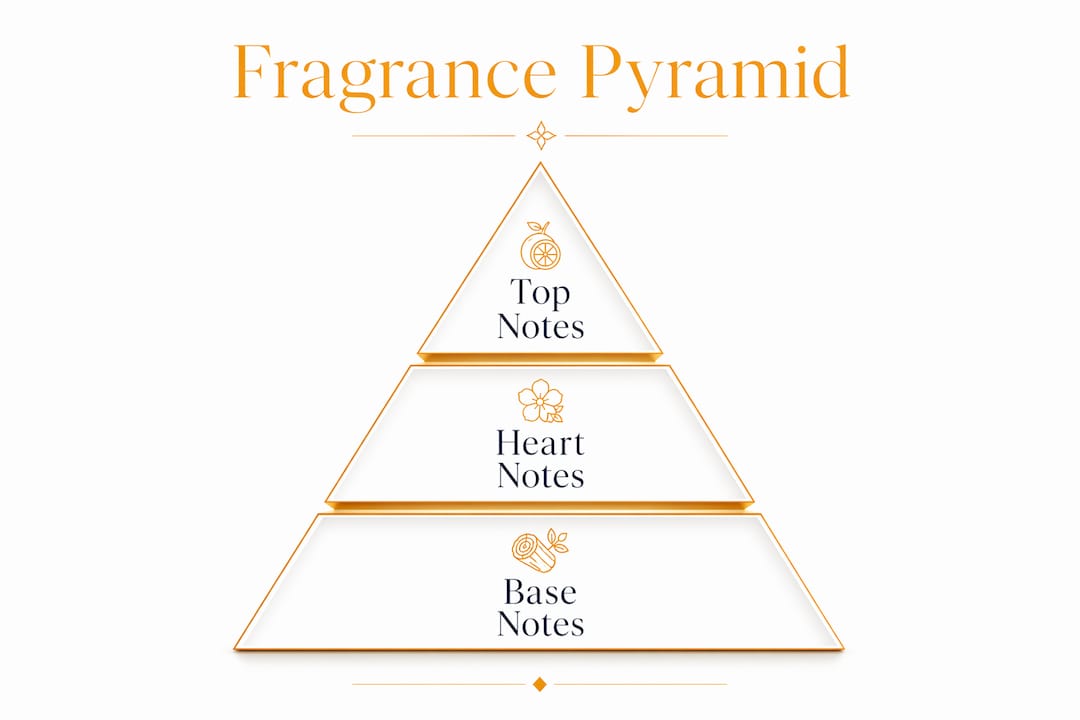
A fragrance pyramid is a three-tier model that organizes a perfume’s scent notes by how fast they evaporate, revealing how a fragrance changes from the first spray to the final dry-down. Known formally in perfumery as the olfactory pyramid, this structure divides every fragrance into top, heart, and base notes, each layer contributing a distinct role in the scent’s lifecycle. Understanding what is a fragrance pyramid gives you a real framework for evaluating perfumes beyond the first impression at a department store counter. It is the single most useful concept in fragrance education.
What is a fragrance pyramid and how does it work?
The fragrance pyramid is defined as a visual and conceptual model that maps a perfume’s ingredients across three layers, ordered from the most volatile at the top to the heaviest and longest-lasting at the base. Perfumers design each layer intentionally, balancing evaporation rates to create a smooth, evolving scent experience. According to Memo Paris, the pyramid functions like a musical symphony, where volatility is balanced to create a layered olfactory journey from first impact to lingering finish. That artistry is what separates a well-constructed perfume from a flat, one-dimensional scent.

The three layers do not operate in isolation. They overlap and interact continuously on your skin, which is why a great fragrance feels alive rather than static. The pyramid gives you a map for that evolution, so you know what to expect and when.
What are the top, heart, and base notes in a fragrance pyramid?
Each layer of the fragrance pyramid has a specific character, duration, and set of typical ingredients. Here is a breakdown of all three:
Top notes: the opening act
Top notes evaporate within the first 15–30 minutes and deliver the first impression of a fragrance. They are typically bright, light, and attention-grabbing. Common top note ingredients include citrus fruits like bergamot, lemon, and grapefruit, as well as fresh herbs like basil and mint. These materials have small, light molecules that lift off the skin quickly. They are designed to attract you, but they are not the full story of the perfume.
Heart notes: the core identity
Heart notes define the fragrance family and core personality, lasting from roughly 30 minutes to several hours after application. Florals like rose, jasmine, and ylang-ylang are classic heart note ingredients, alongside spices like cardamom and cinnamon, and richer fruits like peach or plum. The heart is where a perfume reveals what it truly is. If you want to find a signature scent, the heart notes are the layer that should resonate most with you.
Base notes: the lasting foundation
Base notes last from roughly the second hour through the full dry-down at the end of the day. They are built from heavy molecules that evaporate slowly, anchoring the entire fragrance. Common base note materials include woods like sandalwood and cedarwood, musks, vanilla, amber, resins, and patchouli. These ingredients give a perfume its depth, warmth, and staying power. They are also the layer most influenced by your personal skin chemistry.
Pro Tip: When testing a new fragrance, spray it on your wrist and check back after 45 minutes. What you smell then is far closer to what you will actually wear all day.
Note stages overlap considerably in practice. Vanilla, for example, is listed as a base note in many fragrances, yet some people perceive its warmth much earlier due to their skin’s natural heat and pH. The pyramid is a guide, not a rigid clock.
How does the fragrance pyramid influence scent longevity?
The relationship between molecular weight and evaporation rate is the science behind how fragrance pyramids work. Lighter molecules in top notes have low molecular weight, so they lift off the skin fast. Heavier molecules in base notes cling to the skin and fabric for hours. This is why the pyramid structure directly determines how long a fragrance lasts and how far it projects.
Here is how each layer contributes to overall wear time and sillage (the scent trail a fragrance leaves):
- Top notes create immediate appeal. They are the marketing hook of a fragrance. Bright citrus or herbal openings draw you in at the counter, but they fade within half an hour. Judging a perfume only by its top notes is like judging a film by its opening credits.
- Heart notes define projection and personality. During the heart phase, a fragrance reaches its fullest expression. This is when sillage is typically strongest. The heart notes tell you which fragrance family the scent belongs to, whether floral, oriental, woody, or fresh.
- Base notes determine longevity. Fragrances built on heavy base materials like woods, ambers, musks, vanilla, and resins last significantly longer than fresh, citrus-heavy scents. Base notes are the structural backbone of the entire composition.
- Note overlap creates smooth transitions. A well-designed pyramid ensures that as top notes fade, heart notes are already rising. As heart notes soften, base notes deepen. This overlap prevents the fragrance from smelling disjointed or abrupt.
“The olfactory pyramid is more than a list of ingredients. It is a balancing act with artistic intent, designed to create a smooth and evolving scent experience.” — Memo Paris
Understanding fragrance longevity means looking past the opening spray and evaluating the full arc of a scent on your skin.
What common misconceptions exist about the fragrance pyramid?
The biggest misconception about the fragrance pyramid is that it operates on a strict, predictable timeline. Many people expect top notes to vanish at exactly 30 minutes and base notes to appear on schedule. That is not how it works in practice.
Here are the most common misunderstandings, clarified:
- The pyramid is not a rigid clock. Note stages overlap considerably, and personal skin chemistry can alter the timing and perception of each stage. Oily skin tends to hold fragrance longer. Dry skin can cause notes to evaporate faster.
- Not all fragrances follow the pyramid. Modern perfumery sometimes uses linear compositions that smell almost identical from first spray to dry-down. Fragrances like many aquatic or clean musks are intentionally designed this way. The pyramid is a useful framework, not a universal rule.
- Top notes are not the fragrance’s true character. Many buyers judge a perfume at the counter based solely on the opening spray. The true character of a fragrance reveals itself after 30–60 minutes on skin, once the heart and base notes emerge.
- Nose-blindness can mislead you. You may stop noticing a fragrance after wearing it for a few hours. That does not mean it has faded. Others around you can still detect it clearly. Ask someone nearby for honest feedback before concluding a scent has no longevity.
Pro Tip: Never buy a fragrance based on a paper strip test. Paper cannot replicate how your skin chemistry interacts with the base notes. Always test on skin and give it time.
How to use fragrance pyramid knowledge when choosing perfumes
Knowing how the fragrance pyramid works changes how you shop for and wear perfume. Here is a practical framework for applying that knowledge:
| Step | What to do | Why it matters |
|---|---|---|
| Wait before deciding | Let a fragrance develop for at least 30–60 minutes on skin | Top notes disappear quickly; base notes reveal true character |
| Focus on heart notes | Identify the floral, spice, or woody core of the scent | Heart notes define fragrance family and long-term wearability |
| Evaluate base notes for longevity | Check for woods, musks, amber, or resins in the base | Heavy base materials extend wear time significantly |
| Test on skin, not paper | Apply to your wrist or inner elbow | Skin chemistry alters how notes develop and project |
| Use fragrance families as a guide | Match heart notes to your preferred scent category | Fragrance families help narrow choices before testing |
Beyond the table above, consider layering fragrances intentionally. Applying an unscented moisturizer before your perfume extends the base notes by giving the heavier molecules something to cling to. You can also layer a lighter, citrus-forward fragrance over a woody base scent to create a custom top note effect that fades into a richer dry-down.
Nose-blindness is a real factor in evaluating your own fragrance. Spray the scent in the morning, then ask someone you trust how it smells on you in the afternoon. Their perception of your base notes is often more accurate than your own. Learning to read fragrance notes with this kind of patience leads to far better purchase decisions.
Key takeaways
The fragrance pyramid is the most practical tool in perfume education because it reveals how a scent evolves, which layer defines its identity, and why longevity depends on base note composition.
| Point | Details |
|---|---|
| Three-layer structure | Top, heart, and base notes each evaporate at different rates, creating scent evolution over time. |
| Heart notes define identity | The heart layer reveals a fragrance’s true personality and should guide signature scent choices. |
| Base notes drive longevity | Heavy materials like woods, musks, and amber anchor a fragrance and extend its wear time. |
| Pyramid is a guide, not a rule | Note stages overlap, and skin chemistry alters timing; linear fragrances may skip the progression entirely. |
| Test with patience | Waiting 30–60 minutes on skin before judging a fragrance reveals its true character and longevity. |
Why most people shop for perfume the wrong way
I have spent years watching people make the same mistake at fragrance counters. They spray, sniff immediately, and decide within 60 seconds. That is the top note talking, and the top note is the most deceptive part of any fragrance.
The perfumes I have come to love most are ones that surprised me. I almost passed on a rich, woody oriental once because the opening smelled sharply medicinal. Forty-five minutes later, it had settled into one of the warmest, most complex base notes I had encountered. That experience changed how I evaluate every fragrance I test.
My honest observation is that the fragrance industry inadvertently encourages the wrong behavior. Bright, punchy top notes are designed to sell at the counter. They are not designed to represent what you will actually smell like at 3 p.m. The brands that invest in exceptional heart and base note construction are the ones worth seeking out, and they are often the niche houses rather than mass-market releases.
If you take one thing from understanding the olfactory pyramid, let it be this: patience is the most underrated skill in fragrance shopping. Give a scent time to breathe on your skin before you commit. The base notes will tell you everything you need to know.
— Rodney
Put your pyramid knowledge to work with Aromatick

Understanding the fragrance pyramid makes every purchase decision sharper. You know what to look for, what to wait for, and which layer actually matters for long-term wear. Aromatick’s designer fragrance collection brings together authentic perfumes from top houses, all at up to 60% off retail prices. Every fragrance in the catalog is genuine, so the note pyramids you read on the listing are exactly what you will experience on your skin. If you prefer something more complex and artisanal, the niche fragrance collection features scents built around intricate heart and base note compositions that reward the patience you now know to bring to testing.
FAQ
What is the fragrance pyramid in simple terms?
The fragrance pyramid is a three-layer model that organizes a perfume’s scent notes by how fast they evaporate: top notes (0–30 minutes), heart notes (30 minutes to several hours), and base notes (2 hours through the full dry-down).
Why do top notes smell different from the rest of the fragrance?
Top notes are made from light, volatile molecules that evaporate quickly, giving a bright first impression that fades within 15–30 minutes. The heart and base notes that follow represent the fragrance’s true character.
How long do base notes last on skin?
Base notes typically last from the second hour of wear through the end of the day, with heavy materials like woods, musks, vanilla, and amber providing the longest staying power.
Do all perfumes follow the fragrance pyramid structure?
Not all perfumes follow the traditional pyramid. Linear fragrance compositions are designed to smell nearly the same from first spray to dry-down, with minimal note evolution. The pyramid is a guide, not a universal formula.
Which fragrance layer should I focus on when buying a perfume?
Focus on the heart notes, as they define the fragrance family and long-term personality of the scent. Heart notes are the most reliable indicator of whether a fragrance will suit your preferences over a full day of wear.

Leave a comment
This site is protected by hCaptcha and the hCaptcha Privacy Policy and Terms of Service apply.