
How to Test Fragrances at Home Like a Pro
TL;DR:
- Proper fragrance testing at home ensures you experience the full evolution of a scent by waiting for mid and base notes to develop. Using blotter strips for initial screening and applying fragrances to pulse points without rubbing provides accurate insights into longevity and projection specific to your skin. Limiting to 2-3 scents per session and recording impressions at multiple intervals help avoid olfactory fatigue and lead to confident purchase decisions.
You buy a perfume that smells incredible at the store, wear it home, and wonder where that gorgeous scent went by noon. It happens more than it should, and it almost always traces back to skipping proper fragrance testing before purchasing. Knowing how to test fragrances at home changes everything. It turns guesswork into a reliable process, saves money on regrettable bottles, and leads you to scents that genuinely suit your skin, lifestyle, and preferences. This guide walks you through exactly how to do it right.
Table of Contents
- Key takeaways
- How to test fragrances at home: tools and preparation
- Step-by-step guide to testing perfumes at home
- Common mistakes when evaluating scents at home
- How to interpret your fragrance test results
- My honest take on testing fragrances at home
- Explore authentic fragrances worth testing at home
- FAQ
Key takeaways
| Point | Details |
|---|---|
| Blotters are just a starting point | Use blotter strips for quick screening only, then narrow to 2–3 favorites for skin testing. |
| Never rub your wrists | Rubbing distorts scent evaporation and flattens the opening notes you’re trying to evaluate. |
| Patience is part of the process | Waiting 30 to 60 minutes reveals the true heart and base notes that define a fragrance’s character. |
| Skin chemistry matters | Oily skin holds fragrance longer; dry skin reduces projection. Always test on your actual skin. |
| Record observations over time | Note your impressions at 15 minutes, 1 hour, and 3 to 6 hours for a complete, reliable picture. |
How to test fragrances at home: tools and preparation
Before you spray a single drop, your environment and skin condition directly affect what you perceive. Getting both right is what separates an accurate evaluation from a misleading first impression.
What you need to get started
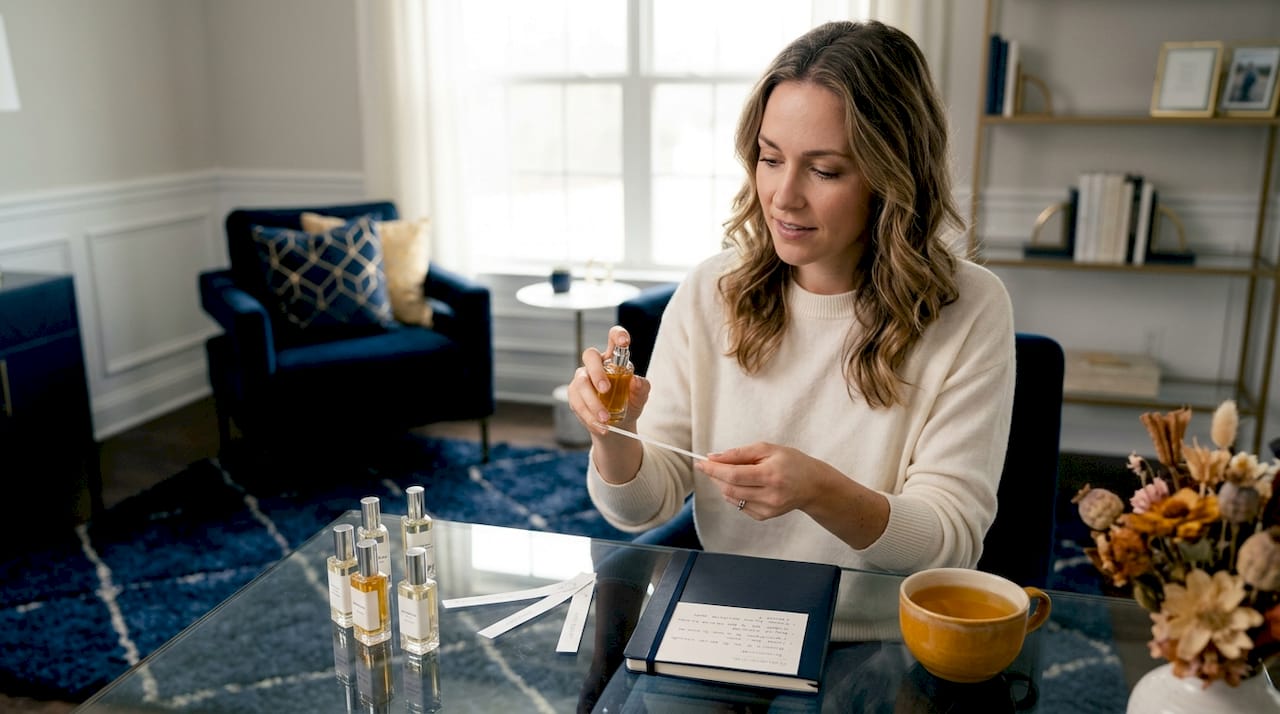
The most accessible tool for home perfume sampling is a set of blotter strips. You can find these online inexpensively, or in a pinch, cut thin strips from unscented cardstock. Blotters let you do a quick first pass without committing fragrance to skin. That said, blotter strips only show top notes and won’t reflect how a fragrance evolves once it meets your skin chemistry. Treat them as filters, not final verdicts.
Here’s what to have on hand before you begin:
- Blotter strips (or unscented cardstock)
- Unscented hand lotion or body oil for moisturizing skin before testing
- A small notebook or phone for recording observations
- Clean water and unscented soap for between-test skin cleansing
- Coffee beans (optional, as a scent reset between blotter tests)
- A timer or phone alarm to track note progression
Preparing your skin and space
Moisturized skin holds fragrance better and produces more stable test results than dry skin. Apply a small amount of fragrance-free lotion to your wrists and inner elbows about 20 minutes before testing. Avoid scented body wash, perfumed lotion, or heavily fragranced products on test days, since these will layer into whatever you’re evaluating and distort the picture.
Your environment matters just as much. Testing in a neutral-scent setting gives more accurate results than a kitchen that smells of garlic or a room thick with candle wax. Open a window, step outside briefly, or choose a room that gets fresh air before you start.
Pro Tip: Apply a thin layer of unscented petroleum jelly to pulse points before spraying. This trick extends wear time on dry skin and gives you a more realistic picture of how the fragrance will perform day-to-day.
| Condition | Effect on Testing |
|---|---|
| Dry, unloitioned skin | Fragrance fades faster, projection feels weaker than in real use |
| Moisturized skin | Oils hold fragrance compounds, giving stable and realistic results |
| Scented lotion or soap residue | Interferes with top notes, creates misleading blend impressions |
| Heavily scented environment | Masks mid and base notes, blurs distinct fragrance character |
Step-by-step guide to testing perfumes at home
Once your skin and space are ready, follow this four-step workflow. It draws on the same approach fragrance professionals use, adapted for home use.
-
Screen with blotters first. Spray or dip each fragrance onto a labeled blotter. Give each one a 30-second rest, then smell in sequence. You’re looking for initial impressions: does this smell appealing, off-putting, or interesting? Narrow your field to 2 or 3 candidates. Testing more than that invites olfactory fatigue, which blurs your ability to perceive differences.
-
Apply to pulse points. Take your top candidates and apply 1 to 2 sprays on pulse points: wrists, inner elbows, or the side of your neck. Pulse points warm the fragrance oils, accelerating diffusion and helping the scent open naturally. If you’re testing two fragrances simultaneously, use one per arm to keep them separated.
-
Do not rub. This is probably the single most misunderstood step in fragrance testing methods. Rubbing changes how the fragrance evaporates, breaking down molecular structures and flattening what should be a layered opening. Let the spray settle on its own.
-
Check in at timed intervals. Smell the fragrance at 10 to 20 minutes (top notes still present, heart beginning to emerge), at 45 to 60 minutes (true heart notes revealed), and again at 3 to 6 hours (base notes dominant, longevity becomes clear). Recording your impressions at each checkpoint is what makes this process reliable. Memory fades fast. Notes don’t.
Pro Tip: Smell your own skin, not just the air above your wrist. Bring the pulse point close to your nose and inhale slowly. This gives you the skin-level scent, which is what others experience standing near you, not just the projected cloud.
What you’re building across those intervals is a complete picture of the fragrance’s arc. The opening is what draws you in. The heart is the fragrance’s personality. The base is what stays with you for hours and what lingers on your clothes the next morning. Each phase carries weight in the final decision.
- Top notes: Bright, volatile, and usually the first 10 to 30 minutes. Think citrus, herbs, or light florals.
- Heart notes: The core identity. Florals, spices, woods, or green notes. Dominant from roughly 30 minutes to 2 hours.
- Base notes: The foundation. Musks, ambers, vanilla, woods, and resins. These anchor everything and last the longest.
Common mistakes when evaluating scents at home
Even with the right tools, certain habits will throw off your entire evaluation. Here are the mistakes that matter most.
-
Testing too many fragrances at once. Olfactory fatigue sets in quickly when you test more than three or four scents in a session. Your nose loses the ability to distinguish between them. Limit sessions to 2 or 3 skin tests and take breaks between blotter screenings.
-
Judging too fast. The dry-down reveals the true fragrance character, and many people make decisions during the top note phase. That bright, sharp opening might mellow into something warm and stunning, or it might fade into something flat. Give it time.
-
Over-applying. More spray does not mean better perception. It overwhelms your nose and makes projection assessment impossible. Two sprays for testing purposes is the standard.
-
Testing on already-scented skin. Wearing another perfume, heavily scented lotion, or even certain hair products interferes with accurate results. Start with a clean, neutral baseline.
-
Ignoring the environment. Humidity, heat, and ambient scents all alter how a fragrance performs. Testing in July on a hot patio gives different results than testing indoors in winter. Neither is wrong, but noting your conditions adds important context.
Fragrance allergens can cause delayed skin reactions, including contact dermatitis, so if you have sensitive skin or known fragrance sensitivities, a patch test before full skin application is a sensible precaution. Apply a small amount to the inner arm, cover, and monitor for 24 to 48 hours.
Pro Tip: If your nose feels overwhelmed mid-session, sniff the inside of your elbow or your own wrist with no fragrance on it. Your own skin scent acts as a neutral reset. Coffee beans work too, but your skin is always with you.
How to interpret your fragrance test results
Raw observations are useful. Interpreted observations are decisive. Here’s how to turn your notes into a confident purchase decision.
Understanding scent development on your skin
Skin chemistry varies significantly from person to person, especially in the mid and base note phases. Oily skin generally holds fragrance compounds longer and amplifies projection. Dry skin can cause scents to fade faster, sometimes making a fragrance feel weaker than its concentration suggests. What smells intensely woody on a friend might read as barely-there on you. This is not a flaw in the fragrance. It’s the reason personal skin testing is non-negotiable.
Your 60-minute check-in is the most telling. At this point, the opening has faded and the heart is fully expressed. Ask yourself: does this still feel appealing? Does it suit the mood or occasion you have in mind? Can you imagine wearing this for 8 hours?
Assessing longevity and projection
Longevity refers to how long a fragrance remains detectable on skin. Projection is how far it radiates from the body. Both matter differently depending on how you plan to use the fragrance. A scent meant for close personal interactions can afford low projection. A scent worn to fill a room needs strong sillage.
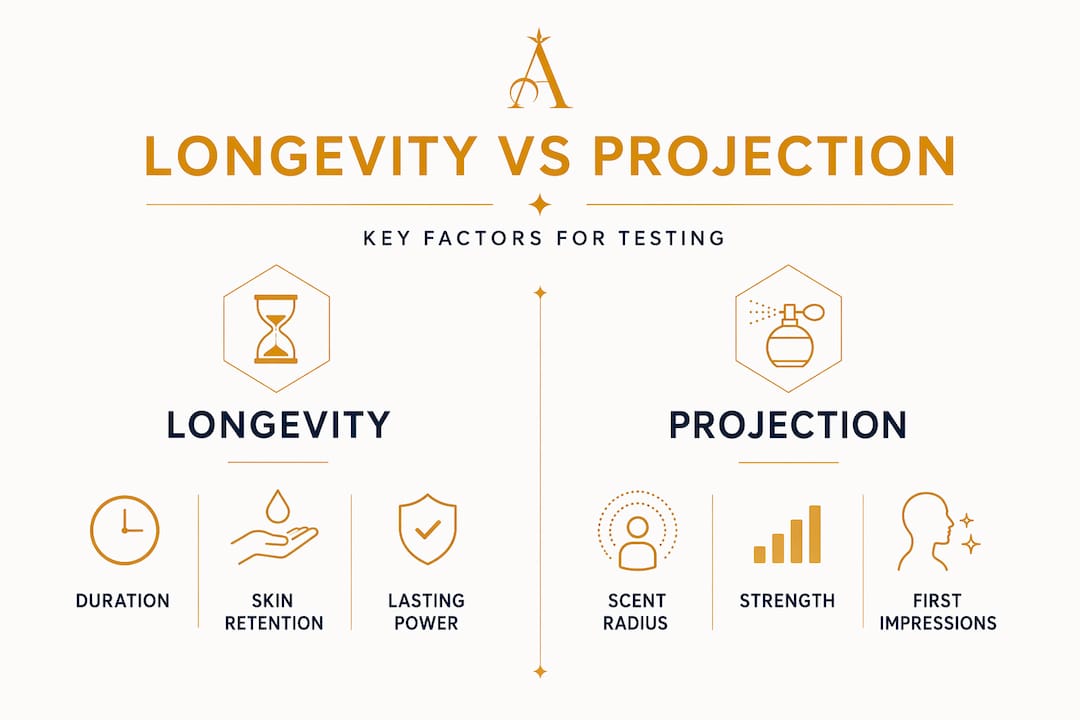
| Evaluation Factor | What to Assess |
|---|---|
| Longevity | How many hours the fragrance remains detectable on your skin |
| Projection | How far the scent radiates at the 30-minute and 2-hour marks |
| Scent evolution | Whether the fragrance shifts pleasantly or loses its appeal as it dries down |
| Skin compatibility | Whether the scent smells like “you” or feels mismatched to your chemistry |
| Seasonal fit | Does the weight and warmth suit the season you intend to wear it? |
To learn more about what drives a fragrance’s lasting power, the Aromatick guide on fragrance longevity breaks down the chemistry behind why some scents stay and others disappear. For a deeper understanding of note structure and how to read a fragrance’s composition before testing, fragrance notes explained is worth reading alongside this guide.
Pro Tip: Test a fragrance on the same day you plan to wear it for real. Your hormone levels, diet, and hydration actually shift day to day and create subtle differences in how your skin interacts with fragrance compounds.
My honest take on testing fragrances at home
I’ve heard the same story dozens of times: someone buys a bottle based on a 90-second sniff at a counter and spends the next year resenting it. The scent seemed right in the moment, and then it just… wasn’t. I’ve been there myself.
What I’ve learned is that the first impression almost never tells the full story. I’ve tested fragrances that smelled aggressively sharp for the first 20 minutes and then opened into some of the most beautiful dry-downs I’ve encountered. The reverse is true too. I’ve also watched gorgeous openings dissolve into generic musk within an hour. Patience genuinely changes purchase outcomes.
The myth I see most often is that testing at home is harder than testing in a store. It’s actually the opposite. You control the environment, you’re not distracted by a sales interaction, and you can let the fragrance run its full course over several hours. That’s something no department store counter allows.
My personal approach: I screen with blotters on Day 1, pick two candidates for skin tests on Day 2, then wear the top choice for a full day before committing. The extra day of real-world wear has saved me from regrettable purchases more times than I can count. Don’t skip that final step. It’s where the real evaluation happens.
— Rodney
Explore authentic fragrances worth testing at home

Now that you know how to evaluate scents with precision, the next step is having quality fragrances worth testing. Aromatick carries a curated selection of authentic designer and niche perfumes, all at 30 to 60% off retail prices. Whether you’re drawn to the bold complexity of Initio Parfums Privés or exploring the wider world through the niche fragrance collection, every bottle is guaranteed authentic. Aromatick’s catalog gives you real options to bring home and test properly, without the pressure of a counter and without overpaying. Browse women’s designer perfumes or men’s designer colognes and start building a testing lineup worth your time.
FAQ
What is the best way to test perfumes at home?
Apply 1 to 2 sprays on pulse points, avoid rubbing, and evaluate the fragrance at 15 minutes, 1 hour, and 3 to 6 hours. Recording your impressions at each interval gives you the most accurate picture of how the scent performs on your skin.
How many fragrances can I test in one session?
Limit skin tests to 2 or 3 fragrances per session to avoid olfactory fatigue. You can use blotter strips to pre-screen a larger group before committing any to skin.
Why does perfume smell different on my skin than in the bottle?
Your skin chemistry, pH, moisture level, and body heat all interact with fragrance compounds, particularly in the heart and base note phases. Skin chemistry changes the mid and base notes significantly, which is why skin testing is always necessary before buying.
How long should I wait before judging a fragrance?
Wait at least 30 to 60 minutes before forming a real opinion. The true personality of a fragrance only shows after the opening top notes fade and the heart and base notes take over.
Do I need special tools for home perfume sampling?
No special equipment is required. Blotter strips and an unscented moisturizer are the two most useful items, but the most important tool is simply time and a consistent testing process.

Leave a comment
This site is protected by hCaptcha and the hCaptcha Privacy Policy and Terms of Service apply.