
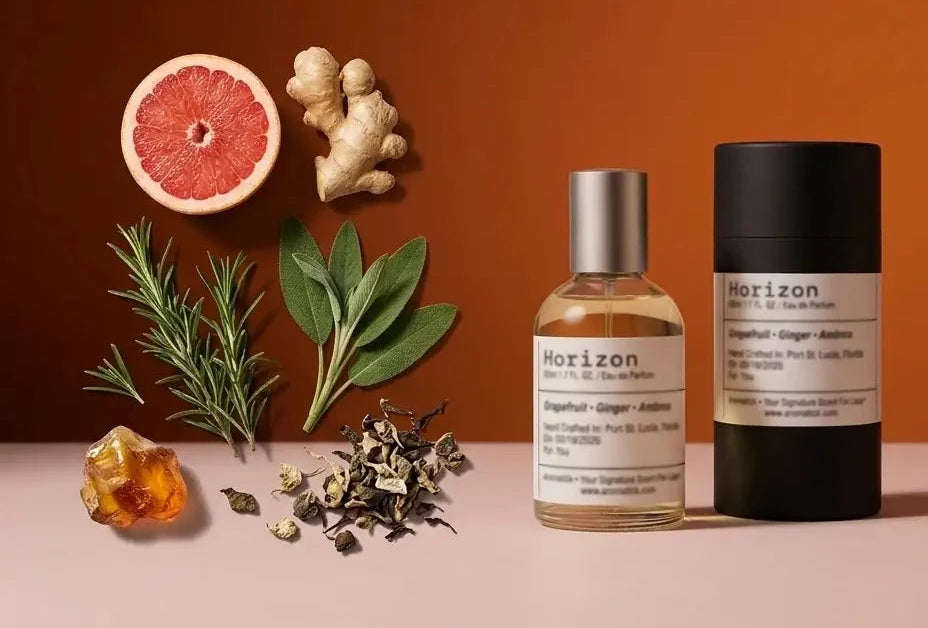

How Base Notes Shape the Lasting Personality of a Scent
Base notes are the slowest-evaporating materials in a fragrance, and they are responsible for everything you smell after the first hour of wear. They form the dry-down, the phase when lighter top and heart notes have mostly lifted and what remains is the deepest, most personal layer of a scent. Understanding the role of base notes is not an academic exercise. It directly changes how you test, select, and wear fragrance.
Three things make base notes worth your attention:
- Longevity. Base notes, which typically represent about 30–40% of a finished formula, can persist on skin for 4–12+ hours, and some musk and animalic materials remain detectable for more than 24 hours.
- Structural role. Base notes act as fixatives, slowing the evaporation of lighter materials and anchoring the entire composition so it holds together over time.
- Selection relevance. The base is what you will actually live with all day. Choosing a fragrance by its opening alone is like judging a book by its first sentence.
Later sections cover how to run a proper dry-down test and how to use that knowledge when shopping for a scent that genuinely suits you.
Key Takeaways
Base notes are the foundation of a fragrance’s longevity, depth, and lasting impression, making the dry-down the most important phase for any serious fragrance selection.
| Point | Details |
|---|---|
| Base notes define longevity | They typically persist 4–12+ hours and represent roughly 30–40% of a finished formula. |
| Fixative function is central | Base notes slow evaporation of lighter materials, anchoring the entire composition over time. |
| Test the dry-down, not the opening | Evaluate at the 3-hour and 6-hour marks; the opening is top notes, not what you will wear all day. |
| Use decants for base-forward picks | Extended wear testing before buying a full bottle prevents most fragrance disappointments. |
| Aromatick for authentic options | Aromatick offers designer and niche fragrances at up to 60% off, with a satisfaction guarantee for risk-free testing. |
Table of Contents
- How the fragrance pyramid places base notes in a scent’s timeline
- What makes a material behave as a base note
- How base notes function inside a perfume composition
- How to identify base notes when testing or wearing a scent
- Common base-note ingredients and the scent families they create
- Why base notes matter when you are choosing a fragrance
- How perfumers think about base notes as a fragrance’s memory
- Practical tips for testing, storing, and wearing base-note-forward fragrances
- The case for choosing by dry-down, not by first impression
- Try base-note-forward fragrances through Aromatick’s discovery options
- Sources
How the fragrance pyramid places base notes in a scent’s timeline
The fragrance pyramid is the model perfumers use to describe how a scent unfolds in three distinct phases: top, heart (middle), and base. Each tier contains materials with different volatility levels, and they reach your nose in sequence as the lighter molecules evaporate first.

According to perfumery convention), top notes are the first impression, typically lasting 15–30 minutes. Heart notes emerge as the top fades, dominating the mid-wear period from roughly 30 minutes to 2–3 hours. Base notes are not clearly perceptible until about 30 minutes after application, and they become the dominant character from the 2–3 hour mark onward.
The three tiers do not switch on and off like lights. They overlap and blend continuously, which is why a fragrance smells different at 10 minutes than at 3 hours. The base is always present, but it takes time for the louder, faster-evaporating materials to clear before the base can speak clearly.
| Layer | Typical onset | Typical duration | Volatility | Perceptual role |
|---|---|---|---|---|
| Top notes | Immediate | 15–30 minutes | High | First impression, brightness, freshness |
| Heart notes | 15–30 minutes | 30 min–3 hours | Medium | Core character, floral/spicy/fruity body |
| Base notes | ~30 minutes | 4–12+ hours | Low | Depth, warmth, longevity, dry-down personality |

What makes a material behave as a base note
The defining physical trait of a base-note material is low volatility. These are larger, heavier molecules that evaporate slowly at skin temperature, which is precisely why they linger. Where a citrus top note like bergamot disperses within minutes, a resin like benzoin or a wood like sandalwood holds on for hours.
Chemically, base-note materials tend to have higher molecular weights and lower vapor pressures than top or heart materials. That density translates directly into how a fragrance feels on skin: warmer, richer, and more enveloping as the dry-down progresses.
Olfactory descriptors for base notes cluster around a recognizable set of sensory qualities:
- Warm and woody: sandalwood, cedar, vetiver
- Resinous and balsamic: benzoin, labdanum, frankincense
- Sweet and creamy: vanilla, tonka bean, heliotrope
- Earthy and smoky: patchouli, oakmoss, oud
- Musky and clean: white musk, ambrette, Iso E Super
- Ambery and animalic: ambergris accords, civet, castoreum
That warmth is not accidental. Heavier molecules interact with skin heat, and the result is a scent that feels intimate and close-wearing rather than airy and projecting. Many people describe a well-composed base as what makes a fragrance smell “expensive,” because the depth and complexity it adds cannot be faked with top-note brightness alone.
How base notes function inside a perfume composition
The most practical function of a base note is fixative behavior. Base notes act as fixatives that slow the evaporation of lighter materials, effectively extending the life of the heart and top notes above them. A few drops of a potent base oil can hold an entire blend together in a way that adding more top notes never could. If a fragrance fades too quickly, the fix is almost always to increase the base proportion, not to pile on more citrus or aldehydes.
Beyond fixation, base notes shape the emotional character of a fragrance. The same floral heart note smells entirely different depending on what sits beneath it. A rose heart over a woody cedar-and-vetiver base reads as cool, sophisticated, and slightly austere. The same rose over a vanilla and benzoin base becomes warm, sensual, and gourmand-adjacent. The base does not just support the heart; it reframes it.
Consider a practical example: a fresh aquatic heart note paired with a clean musk and ambergris base produces a skin-close, modern scent suitable for office wear. Swap that base for patchouli and oud, and the same heart transforms into something far more assertive and evening-appropriate. Perfumers make these decisions deliberately, and understanding them gives you a real advantage when you are evaluating a fragrance for a specific occasion or season.
For readers interested in how these layers interact when you combine multiple fragrances, Aromatick’s guide on building a signature scent through layering covers the practical mechanics in detail.
How to identify base notes when testing or wearing a scent
Most people smell a fragrance at the counter, like it, and buy it, only to find that what they wear home is not quite what they sampled. That gap is almost always the base note revealing itself. Here is a reliable sequence for detecting base notes properly:
- Apply and wait (0–15 minutes). Smell the immediate opening. This is almost entirely top notes: bright, sharp, and often the most appealing phase. Note it, but do not decide here.
- Check at 30 minutes. The top notes have largely lifted. Heart notes are now dominant. You may catch early hints of the base, particularly if it contains a strong resin or musk.
- Evaluate at 1–3 hours. This is the heart-to-base transition. The fragrance is settling into its true character. Woody, ambery, or musky qualities become much clearer at this stage.
- Assess the dry-down at 6+ hours. What remains is almost pure base. This is what you will smell on your skin at the end of a workday or on your clothing the next morning. If you love this phase, the fragrance is a strong candidate.
Blotter vs. skin: A blotter strip shows you the structure of a fragrance, but it cannot replicate skin chemistry. Skin temperature, pH, and moisture level all alter how base notes develop. Always move from blotter to skin before making a final decision. Skin chemistry changes the perception of both heart and base notes during dry-down, which is why two people can wear the same fragrance and smell noticeably different by hour three.
Pro Tip: After applying a fragrance to your wrist, set it aside and resist smelling it for the first 10 minutes. The initial alcohol and top-note burst can overwhelm your nose. Returning after a short break gives you a cleaner read on the heart and early base without olfactory fatigue skewing the result.
Common base-note ingredients and the scent families they create
Base-note materials fall into a handful of recognizable families, each with a distinct sensory character and a different contribution to longevity and depth.
Woods. Sandalwood, cedar, and guaiac wood are among the most widely used base materials. Sandalwood is creamy and smooth; cedar is dry and pencil-shaving sharp; guaiac wood leans smoky. All three are long-lasting and blend well with almost any heart note.

Resins and balsams. Benzoin, labdanum, and frankincense bring a warm, slightly sweet, resinous quality that reads as ancient and luxurious. Labdanum in particular has a complex, slightly animalic edge that adds depth without being overtly heavy.
Musks. Natural musks are now largely restricted due to regulatory and ethical concerns, so most modern fragrances use synthetic musks such as Galaxolide, Habanolide, or Iso E Super. These range from clean and powdery to woody and skin-like, and they are among the most potent fixatives in a perfumer’s toolkit.
Ambers and ambery accords. True ambergris is rare and expensive; most “amber” in modern perfumery is a synthetic accord blending labdanum, benzoin, and vanilla. Ambroxan, derived from ambergris, has a chameleon-like quality that amplifies skin warmth and projects differently on each wearer.
Vanilla and sweets. Vanilla, tonka bean, and coumarin anchor gourmand and oriental fragrances. They are sweet without being sugary when used with restraint, and they extend the life of floral and spicy hearts considerably.
Earthy and soilic notes. Vetiver and patchouli are the workhorses of this family. Vetiver is smoky, rooty, and dry; patchouli is earthy, slightly sweet, and deeply persistent. Both can last well beyond 12 hours on skin.
Synthetic fixatives. Materials like Ambroxan, Iso E Super, and Cashmeran are engineered for longevity and skin-interaction. They are odorless or nearly odorless on their own but dramatically extend the life of the materials around them.
A brief note on animalic materials: traditional animalic bases like civet and castoreum are largely replaced by synthetics today, both for ethical reasons and because regulatory bodies such as IFRA (the International Fragrance Association) restrict many natural animalic compounds. Synthetic alternatives deliver similar olfactory effects with a cleaner production profile.
Home fragrances like candles and diffusers rely on a similar base-note logic. Candle formulations often shift ratios to favor base materials so the scent lingers in rooms and on fabrics after the flame is extinguished. The 30:50:20 guideline (roughly 30% top, 50% middle, 20% base) is a widely used blending heuristic for small-batch and essential-oil-based fragrances, though professional fine fragrance formulas often deviate significantly from it based on the specific materials used.
Why base notes matter when you are choosing a fragrance
The base is the part of a fragrance you will wear for the longest stretch of any given day. That makes it the most consequential tier for practical decisions about occasion, season, and concentration.
- Occasion. Heavy, resinous, or animalic bases (oud, patchouli, labdanum) project strongly and suit evening or formal settings. Lighter bases built on clean musks or soft woods work better in close-contact environments like offices or public transit.
- Season. Warm, sweet, and resinous bases feel natural in cooler months when skin temperature is lower and the warmth of the base complements the environment. In summer, a lighter base of white musk or aquatic ambers lets the fragrance breathe without becoming oppressive.
- Concentration. An Eau de Toilette (EDT) typically contains a lower concentration of aromatic compounds than an Eau de Parfum (EDP) or an extrait de parfum. Higher concentrations amplify base-note presence, which is why an EDP version of a fragrance often smells noticeably richer and longer-lasting than its EDT counterpart. For understanding how concentration affects longevity, the relationship between base-note proportion and concentration is one of the most reliable predictors of wear time.
- Skin chemistry. Some bases amplify on certain skin types; musks in particular tend to project more on warmer, slightly oilier skin. Testing on your own skin, not just a blotter, is the only reliable way to know how a base will behave for you specifically.
Pro Tip: If longevity is your primary concern, look for fragrances with prominent resinous, woody, or musk bases rather than relying on concentration alone. A well-formulated EDT with a strong base can outlast a poorly constructed EDP.
How perfumers think about base notes as a fragrance’s memory
The way professional perfumers talk about base notes reveals something useful for anyone who wears or buys fragrance.
That framing has a direct practical implication: the base is what other people remember about your fragrance. The opening might catch attention, but the dry-down is what lingers on a scarf, a jacket collar, or a letter. Testing the dry-down is not optional if you want to know what impression you actually leave.
It also changes how you should approach sampling. Spraying a fragrance and deciding within five minutes is a decision based almost entirely on top notes, which will be gone within the hour. The more useful test is to wear a sample through an entire day, or at minimum to check back at the 3-hour and 6-hour marks. Discovery sets and decants make this kind of extended testing practical without committing to a full bottle.
Practical tips for testing, storing, and wearing base-note-forward fragrances
Getting the most from a base-heavy fragrance requires a slightly different approach than you might take with a fresh or citrus-forward scent.
Shopping and sampling:
- Order a decant or discovery set before buying a full bottle of any base-note-forward fragrance. The dry-down is where these scents live, and you need real wear time to evaluate them.
- Test on fabric as well as skin. Spray a small amount on the inside of a shirt cuff and check it at the end of the day. Fabric often holds base notes even longer than skin and gives you a clearer read on the dry-down character.
- Avoid testing more than two or three fragrances in a single session. Base notes are dense and persistent; olfactory fatigue sets in quickly and makes accurate comparison difficult.
Storage:
- Keep fragrances away from direct light and heat. Base-note materials, particularly resins and musks, can oxidize or shift character when exposed to temperature fluctuations. A cool, dark drawer or cabinet is preferable to a bathroom shelf or a sunny windowsill.
Application:
- Apply to pulse points (wrists, neck, inner elbows) where body heat helps diffuse the base gradually. For a more skin-close dry-down, apply to the chest rather than the neck.
- For fragrances with very heavy bases like oud or patchouli, one or two sprays is usually enough. These materials project significantly and can become overwhelming with heavy application.
- If you want to extend longevity further, layering complementary fragrances with matching or compatible base notes is one of the most effective techniques available.
The case for choosing by dry-down, not by first impression
Most fragrance disappointments follow the same pattern: a scent smells perfect at the counter, and by mid-afternoon it has turned into something flat, sharp, or simply not what was expected. The culprit is almost always a mismatch between the opening and the base.
Shifting selection criteria to prioritize dry-down behavior changes the experience of wearing fragrance in a meaningful way. When you choose a scent because you love what it becomes after two or three hours, rather than what it smells like in the first five minutes, you end up wearing something that genuinely suits you for the majority of the time you have it on. Fewer bottles go unused. Fewer purchases feel like mistakes.
The practical step is simple: request a decant or sample, wear it for a full day, and make your decision based on the 3-hour and 6-hour marks. That single habit, more than any other, tends to produce a collection of fragrances that actually get worn.
Try base-note-forward fragrances through Aromatick’s discovery options
Authentic luxury fragrance at a price that makes extended testing realistic is exactly what Aromatick is built around. Rather than committing to a full bottle based on a counter spray, you can explore designer and niche fragrances at up to 60% off retail, with free shipping and a satisfaction guarantee that removes the risk from the decision.

For readers who want to explore base-note-rich niche options specifically, Aromatick’s niche fragrance collection covers a wide range of base-forward profiles, from deep oud and resinous amber to clean musk and vetiver-driven compositions. Every product is authentic, sourced directly, and priced to make the dry-down test a low-stakes experiment rather than a costly gamble. Browse the collection, pick a decant sized for a full day’s wear, and run the testing sequence described earlier. That is the most reliable path from curiosity to a fragrance you will actually reach for.
Sources
The sources below support the key claims in this article and are worth consulting for deeper reading on fragrance composition, blending principles, and expert perspective on base-note behavior.
- Perfume Notes Explained: Top, Middle, and Base Notes (And How to Use Them) · SCENT + ART
- What is the 30 50 20 rule for essential oils? - LAEYO Labs

Leave a comment
This site is protected by hCaptcha and the hCaptcha Privacy Policy and Terms of Service apply.