
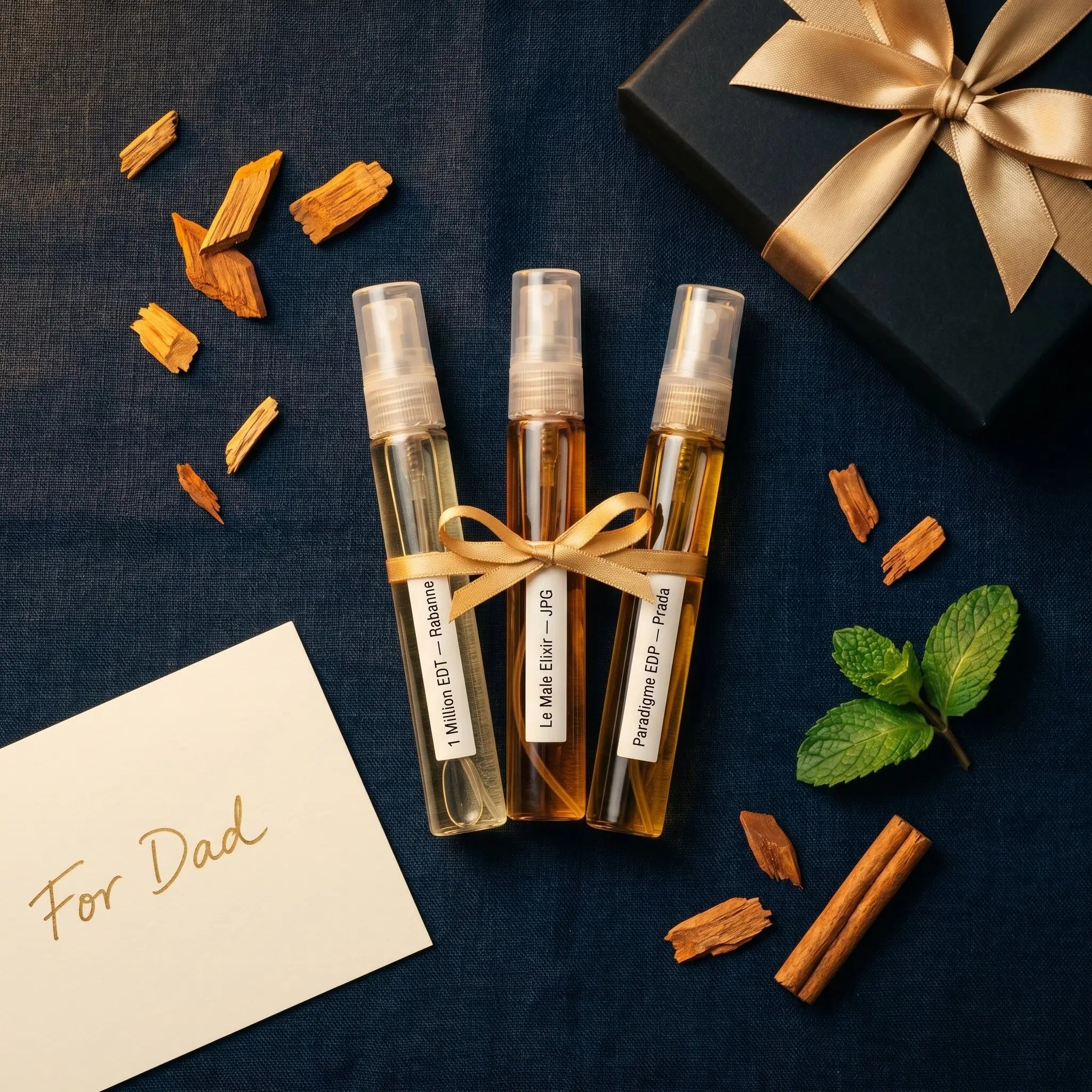

The Role of Top Notes: What Every Buyer Must Know
Top notes are the volatile opening molecules you smell the moment you spray a fragrance — they create the first impression and invite you in, but they are not the long-term identity of the perfume. Their role in a fragrance is to attract and set the mood, then gracefully step aside as the heart and base take over. Understanding this distinction is the single most useful thing you can know before buying a perfume.
Quick sampling checklist:
- Spray on skin (not paper) and take one initial sniff
- Wait 30–60 minutes before forming any opinion
- Compare how the scent feels at the opening versus the dry-down
Pro Tip: If you love a fragrance only in the first two minutes, wait. What you smell after 30 minutes is far closer to what you will actually wear all day.
Table of Contents
- How do top notes differ from heart and base notes?
- What ingredients are commonly used as top notes?
- Why do perfumers design top notes the way they do?
- How should you test a fragrance so the opening doesn’t mislead you?
- Common misconceptions about top notes — and the correct facts
- Top-note families at a glance
- How does skin chemistry change the way top notes smell?
- Key Takeaways
- Why the opening is the least reliable part of a fragrance
- Explore fragrances beyond the first impression with Aromatick
- Further reading and authoritative sources
How do top notes differ from heart and base notes?
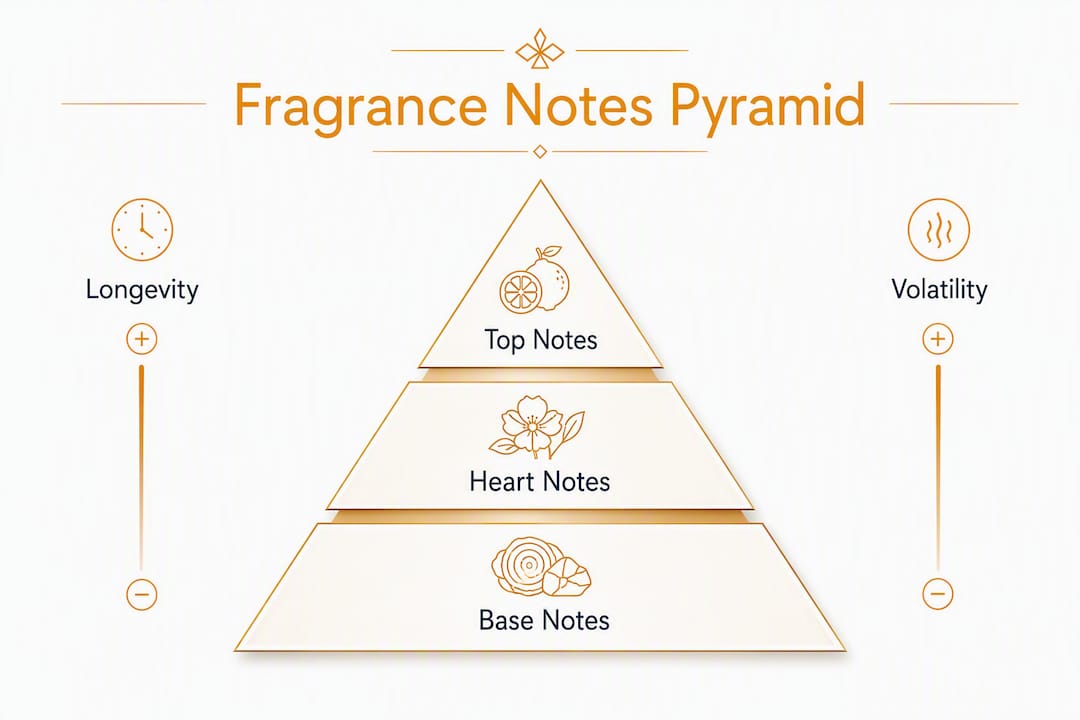
The fragrance pyramid is a useful teaching tool, but it is worth understanding what it actually represents. According to NCBI research on olfactory perception, all three layers are present simultaneously from the first spray — what changes is which layer you perceive most strongly as volatility shifts over time.
Volatility is the key variable. Top notes are composed of small, light molecules with high vapor pressure, which means they evaporate fastest. Heart notes carry moderate molecular weight and emerge as the top fades. Base notes are large, heavy molecules that linger for hours.
Here is how the timing typically breaks down:
- Top notes: typically last from about 15 minutes up to 2 hours, depending on formulation and skin chemistry
- Heart notes: emerge shortly after the top notes fade, lasting for a longer duration
- Base notes: often barely noticeable at first, then persist for hours as the lighter materials evaporate
A helpful framing for beginners is the 30:50:20 rule — roughly 30% of perceived impact from top notes, 50% from the heart, and 20% from the base. It is a conceptual heuristic, not a precise formula, but it reinforces why the opening is only part of the story.
Stat to know: Top notes typically represent 15–25% of a finished fragrance formula by composition, yet they dominate the first impression entirely.
What ingredients are commonly used as top notes?
Recognizing top-note ingredients on a fragrance description helps you predict how a perfume will open. Most top-note materials share two traits: high volatility and a bright, immediately perceptible odor profile. Common examples span several families.
- Citrus: bergamot, lemon, mandarin, neroli, grapefruit. These are the most widely used top notes because they are universally fresh, clean, and approachable.
- Aromatic herbs: basil, mint, lavender (in its lighter applications), rosemary. They add a green, slightly sharp edge that transitions well into floral or woody hearts.
- Light florals: petitgrain, violet leaf, rose absolute in small doses. These bridge the gap between the bright opening and a fuller floral heart.
- Green and ozonic notes: cut grass, sea air accords, cucumber. They create a cool, airy opening that reads as clean and modern.
- Aldehydic accords: synthetic molecules that produce a soapy, powdery, almost effervescent brightness — famously used in classics like Chanel No. 5.
Each of these families works as a top note precisely because the molecules involved evaporate quickly, delivering an immediate sensory signal without overpowering the composition beneath.

Why do perfumers design top notes the way they do?
Top notes are not just about smelling good in the first spray. Perfumers craft them to lead the wearer smoothly into the composition, managing both first impressions and the transition to the heart. As one widely cited principle in fragrance design puts it, the top should invite, not dominate.
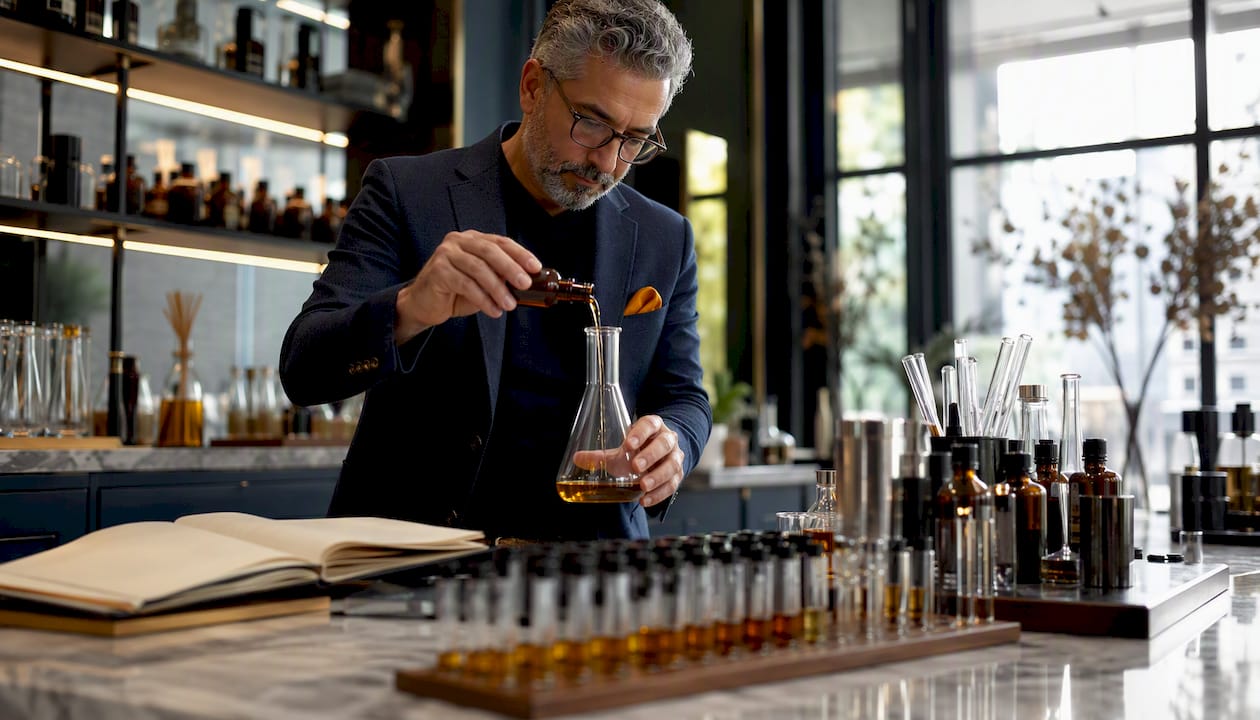
Balance is everything. Too many sharp, high-volatility materials in the opening can make a fragrance feel aggressive or disjointed — the kind of opening that clears a room rather than draws people in. Too little freshness, and the fragrance feels flat from the first spray, with no sense of lift or energy.
There is also a commercial dimension. A striking opening is a powerful sales tool at the fragrance counter, which is why some budget and mass-market lines over-invest in the top note at the expense of heart and base structure. The opening is easy to formulate and tests well in a 30-second counter spray. Depth takes longer to reveal — and longer to appreciate.
Pro Tip: When sampling at a counter, ask yourself: “Is this fragrance giving me everything in the first 10 seconds?” If yes, that can signal a shallow composition. A well-built fragrance should feel like it is still revealing itself after 20 minutes.
How should you test a fragrance so the opening doesn’t mislead you?
Experts recommend waiting 30–60 minutes before forming a judgment, because the heart and base notes reveal the perfume’s true identity only after the opening fades. Here is a practical protocol you can follow in-store or at home.
- Spray on skin, not paper. Apply one or two sprays to your wrist or inner elbow. Paper blotters show the opening but under-represent heart and base behavior on skin entirely.
- Take one initial sniff, then set it aside. Note the opening character — fresh, citrusy, herbal — but do not decide anything yet.
- Wait 15–20 minutes. The top notes will fade and the heart will begin to emerge. This is when the fragrance’s real personality starts to show.
- Wait another 20–30 minutes. By the 30–60 minute mark, you are smelling the heart in full and the base beginning to develop. This is the version you will wear most of the day.
- Test only two fragrances at a time. More than two on skin makes it impossible to evaluate either one fairly.
- For at-home testing, use a decant or discovery set. An Eau de Parfum (EDP) will show more heart and base character than an Eau de Toilette (EDT) of the same fragrance because the higher concentration amplifies the denser molecules.
Pro Tip: A blotter is useful for a quick sniff of the opening, but never buy a fragrance based on a paper strip alone. The interaction between the formula and your skin chemistry is where the real experience lives.
Common misconceptions about top notes — and the correct facts
A few persistent myths lead shoppers to make decisions they later regret. Here is each one, corrected directly.
- “The top note is the strongest part of the fragrance.” Not exactly. Top notes are the most immediately perceptible, but strength and longevity belong to the heart and base. A loud opening can mask a thin structure beneath it.
- “If I don’t like the top note, I won’t like the perfume.” This is the most costly mistake in fragrance shopping. A challenging or sharp opening can give way to a beautiful, warm heart. Always wait.
- “What I smell on the blotter is what I’ll smell on my skin.” Paper strips show the opening molecules only. Skin chemistry — temperature, oiliness, hydration — changes how every layer develops, especially the top.
- “The fragrance pyramid is a literal sequence.” The pyramid is a communication diagram. All notes are present from the first spray; you perceive them differently as volatility shifts, not as a strict before-and-after sequence.
- “A great opening means a great fragrance.” Budget lines sometimes build an explosive opening to win the counter test, then fade quickly. Depth lives in the heart and base, not the first 60 seconds.
Top-note families at a glance
| Family | Example ingredients | Typical impression | Approximate duration |
|---|---|---|---|
| Citrus | Bergamot, lemon, mandarin, neroli | Fresh, zesty, clean | 15 minutes to 2 hours |
| Aromatic herbs | Basil, mint, rosemary | Green, sharp, invigorating | 15 minutes to 2 hours |
| Light florals | Petitgrain, violet leaf | Delicate, airy, soft | 15 minutes to 2 hours |
| Green / ozonic | Cut grass, sea air accords | Cool, clean, modern | 15 minutes to 2 hours |
| Aldehydic | Synthetic aldehydes | Soapy, powdery, effervescent | 15 minutes to 2 hours |
A few things to keep in mind when using this table while shopping:
- Duration ranges vary with skin chemistry, concentration (EDP vs. EDT), and ambient temperature
- Citrus notes tend to be shorter-lived, which is why many citrus-forward fragrances rely on a strong heart to carry the wear
- Aldehydic notes are almost always synthetic; their presence signals a classic or vintage-style composition
- If a fragrance lists only top-note ingredients on its product page, treat that as a signal to dig deeper into the heart and base before buying
- Reading fragrance notes on product pages becomes much more useful once you know which ingredients belong to which tier
How does skin chemistry change the way top notes smell?
Skin temperature, oiliness, and hydration all directly affect how quickly top notes evaporate and how the scent evolves on a given person. Warmer or oilier skin shortens the opening period and accelerates the transition to heart and base notes. Cooler, drier skin tends to hold top notes slightly longer.
This is why the same fragrance can smell noticeably different on two people standing side by side. Diet and even medication can influence skin pH, which in turn affects how certain aromatic molecules interact with the surface. The practical takeaway: always test on your own skin before committing to a full bottle, because a friend’s recommendation or a counter spray on someone else’s wrist tells you very little about how a fragrance will perform for you.
Key Takeaways
Top notes create the first impression of a fragrance but fade quickly, making it critical to evaluate a perfume’s heart and base before buying.
| Point | Details |
|---|---|
| Top notes are fleeting by design | They last a short time; the heart and base define the fragrance you actually wear. |
| Always test on skin, not paper | Blotters show only the opening; skin chemistry shapes how all three layers develop. |
| Wait before deciding | Heart and base notes reveal the perfume’s true identity only after the opening fades. |
| Skin chemistry changes the experience | Temperature, oiliness, and hydration affect evaporation speed and scent evolution for every wearer. |
| Aromatick for deeper exploration | Aromatick’s detailed note listings and discovery sets let you evaluate heart and base before committing to a full bottle. |
Why the opening is the least reliable part of a fragrance
Most shoppers make their buying decision in the first 30 seconds at a counter. That is understandable — the opening is vivid, immediate, and easy to react to. But it is also the part of a fragrance that will be gone before you finish your morning coffee.
The more interesting question is what a fragrance does after the top notes clear. A well-constructed heart that feels like the natural continuation of the opening, a base that adds warmth and staying power without overwhelming — that is the architecture that determines whether you will still reach for a bottle six months from now. Bright openings are easy to engineer. Depth takes genuine craft.
There is also something worth saying about the fragrance pyramid as a concept. It is a useful shorthand, but it has trained a generation of shoppers to think of a perfume as a sequence of events rather than a unified composition. Skilled perfumers do not think in tiers — they think in balance. The top note frames the heart; the base anchors everything. When all three work together, you do not notice the transitions at all.
Explore fragrances beyond the first impression with Aromatick
Knowing how top notes work is only useful if you have the right tools to act on it. Aromatick’s designer fragrance collection includes detailed note breakdowns for every product, so you can read the full composition — top, heart, and base — before you buy.

Discovery sets and decants let you wear a fragrance through its full dry-down at home, which is the only reliable way to judge whether the heart and base suit you. Every product is authenticated and backed by a satisfaction guarantee, so you are not taking a risk on a blind buy. Aromatick also offers up to 60% off retail pricing, which means you can sample more fragrances for less and find the ones that genuinely work on your skin. Browse the full collection and read the complete note listings to shop with confidence.
Further reading and authoritative sources
- Note (perfumery) — Wikipedia: A solid reference covering the classification of top, heart, and base notes, including the chemistry of evaporation and how notes interact with one another.
- Perfume Notes Explained — The Perfumery Guide: Detailed breakdown of note timing, volatility, and the fragrance pyramid structure — useful for readers who want precise duration ranges and composition percentages.
- Perfume — Neurobiology of Sensation and Reward (NCBI): Academic source on olfactory perception and how the brain processes scent over time; supports the science behind why the pyramid is a perceptual model, not a literal sequence.
- Why Top Notes Lie — Perfume Cultures: Practical explainer on how skin chemistry, temperature, and individual biology affect the opening and dry-down of a fragrance.
- Fragrance Notes Explained — Aromatick: Consumer-focused guide to note timing and identity, with practical advice for shoppers evaluating fragrances online or in-store.

Leave a comment
This site is protected by hCaptcha and the hCaptcha Privacy Policy and Terms of Service apply.