
What Is a Top Note in Perfume? A Clear Guide
TL;DR:
- Top notes are the highly volatile, immediate scents that form a perfume’s first impression and last about 5 to 15 minutes. They mask alcohol, evoke emotional responses, and set expectations for the fragrance’s subsequent layers, primarily influencing initial perception. Understanding and prolonging top notes through skin care and proper testing enhances overall fragrance appreciation and satisfaction.
A top note in perfume is defined as the first scent you perceive immediately after application, composed of small, highly volatile molecules that evaporate within minutes. In perfumery, the industry term is top note or head note, and it represents the opening chapter of any fragrance. These notes form your first impression of a scent and are deliberately engineered to be bright, fresh, and attention-grabbing. Top notes make up approximately 20 to 40% of a fragrance formula, making them a significant but fleeting part of the overall composition. Understanding them changes how you shop for, wear, and appreciate perfume.
What is a top note in perfume, and why does it matter?
Top notes are the designed sensory prompt that captures your attention the moment a fragrance touches your skin. They function as the hook of the scent story, setting the emotional tone before the deeper, more complex layers emerge. Top notes last between 5 and 15 minutes, which means the scent you smell in the first spray is not the scent you will wear all day. That gap between first impression and lasting character is one of the most misunderstood aspects of buying perfume.

The importance of top notes extends beyond personal enjoyment. In retail settings, top notes are the primary reason a shopper picks up a bottle or walks away. They are the olfactory equivalent of a book’s opening line. A well-crafted top note creates immediate desire, even if the heart and base notes carry the fragrance’s true personality. Recognizing this distinction helps you make smarter, more satisfying purchases.
Why do top notes evaporate so quickly?
The rapid disappearance of top notes is a matter of chemistry, not coincidence. Top notes consist of the most volatile molecules) in a fragrance, classified by evaporation coefficients ranging from 1 to 14. A lower evaporation coefficient means the molecule disperses into the air faster, which is why you smell top notes so intensely at first and then lose them within minutes. Heart notes carry higher coefficients, and base notes higher still, which is why sandalwood or musk can linger on skin for hours.
Molecular size drives this behavior. Smaller molecules have less mass, require less energy to vaporize, and diffuse more readily into the surrounding air. Citrus compounds like limonene, found in lemon and bergamot, are classic examples of small, fast-evaporating molecules. Heavier aromatic compounds like cedarwood or vetiver, which anchor base notes, simply cannot move as quickly. Understanding evaporation coefficient groupings) gives you a scientific lens for why a fragrance smells different five minutes after application versus two hours later.
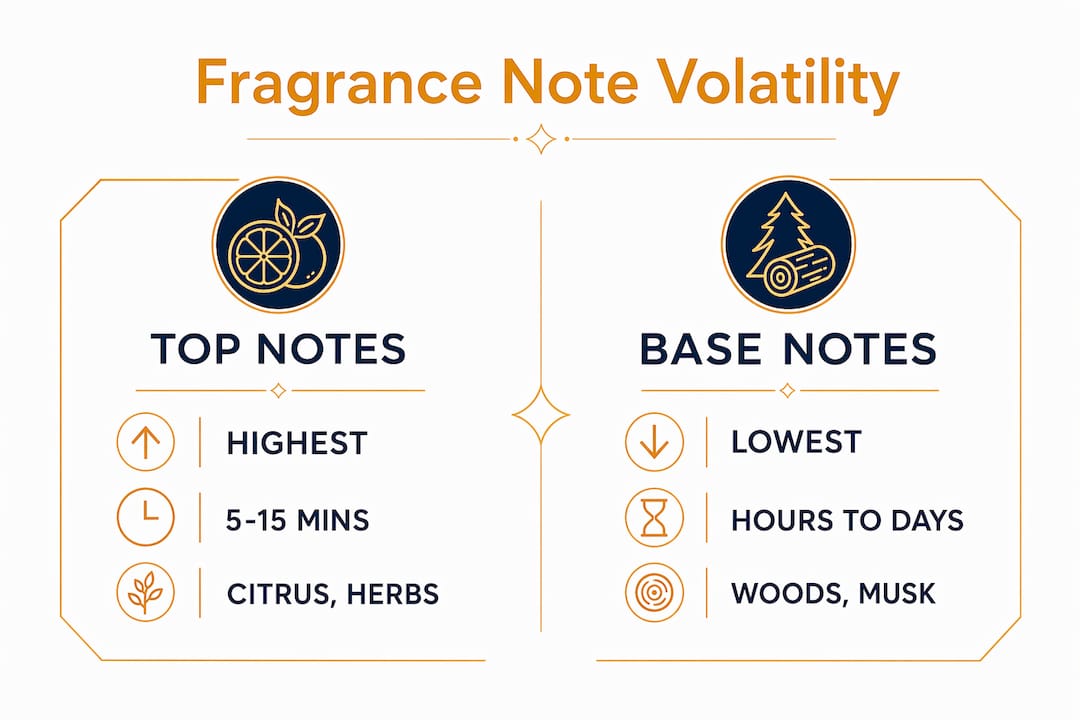
| Note Layer | Volatility | Typical Duration | Common Examples |
|---|---|---|---|
| Top notes | Highest | 5 to 15 minutes | Bergamot, lemon, grapefruit, basil |
| Heart notes | Medium | 20 to 60 minutes | Rose, jasmine, geranium, cardamom |
| Base notes | Lowest | 2 to 8 hours | Sandalwood, vetiver, musk, amber |
Pro Tip: Spray a fragrance on your wrist and smell it immediately, then again at the 10-minute mark and the 30-minute mark. You will experience three distinct scent phases, which tells you far more about a perfume than a single sniff ever could.
How do top notes influence your perception of a perfume?
Top notes do more than smell pleasant. They perform a specific functional role: masking the initial alcohol scent of the perfume carrier, which would otherwise be the first thing your nose detects. Without a well-constructed top note, the opening of a fragrance would smell sharp and medicinal. The top note transforms that raw chemical opening into something inviting and clean.
Beyond function, top notes carry emotional and situational associations that shape how you feel wearing a fragrance. Consider how citrus top notes like bergamot or grapefruit signal freshness, energy, and warmth. Lavender or basil top notes suggest calm and clarity. These associations are not accidental. Perfumers at houses like Chanel, Dior, and Maison Margiela select top notes with deliberate intent to position a fragrance emotionally before the heart notes take over.
The transition from top to heart notes is where a fragrance either succeeds or stumbles. A smooth transition feels like one continuous scent story. A jarring transition, where the top note has nothing in common with the heart, can make a fragrance feel disjointed or cheap. When you evaluate a perfume, pay attention to how the opening evolves. Here is what to watch for:
- Freshness and brightness: A clean, lively opening typically signals citrus or aromatic herb top notes.
- Spicy or herbal sharpness: Notes like basil, rosemary, or black pepper create an energetic, slightly edgy opening.
- Soft floral hints: Some fragrances open with light florals like neroli or violet leaf, bridging top and heart seamlessly.
- Green or aquatic quality: Cucumber, violet leaf, or marine accords signal a cool, modern opening.
- Smooth fade: The best top notes dissolve gradually rather than disappearing abruptly, giving the heart notes room to emerge naturally.
Common examples of top notes and how to identify them
Citrus oils and aromatic herbs dominate top note compositions, appearing in roughly 90% of commercial fragrances. Their natural volatility makes them ideal candidates for the opening layer. Here are the most recognizable examples and what they contribute:
- Bergamot: A citrus fruit with a slightly floral, tea-like quality. Found in classics like Acqua di Gio by Giorgio Armani and Chanel No. 5. Bergamot is arguably the most widely used top note in modern perfumery.
- Lemon and grapefruit: Bright, sharp, and immediately refreshing. These notes signal cleanliness and energy, common in colognes and fresh summer fragrances.
- Lavender: Technically an aromatic herb, lavender sits at the boundary between top and heart notes. It opens with a cool, slightly medicinal freshness before softening into a floral warmth.
- Basil: Delivers a green, slightly spicy brightness. Basil appears in fragrances like Hermès Un Jardin en Méditerranée, where it creates a distinctly herbal, sun-warmed opening.
- Rosemary: Sharper and more resinous than basil, rosemary adds a clean, almost medicinal quality that works well in masculine and unisex compositions.
- Mandarin and orange: Sweeter and softer than lemon, these citrus notes add warmth to an opening without the sharp edge of grapefruit.
To identify top notes accurately, smell the fragrance immediately after application on skin. Evaluating top notes requires smelling perfume right after application), because even a 60-second delay can cause the most volatile molecules to begin fading. Smelling a paper strip at a counter gives you a distorted picture. Your skin chemistry, temperature, and moisture level all interact with the fragrance in ways paper cannot replicate.
Pro Tip: To train your nose, apply a fragrance to one wrist and a different fragrance to the other. Compare the top notes side by side in the first 30 seconds, then track how each evolves. This side-by-side method accelerates your ability to recognize individual notes far faster than smelling one fragrance at a time.
How to make top notes last longer
Top notes are inherently short-lived, but a few practical techniques can extend how long you perceive them. Moisturizing skin and layering matching fragrance products are the two most effective methods. Dry skin absorbs fragrance molecules faster, accelerating evaporation. Well-hydrated skin creates a slightly oily surface that slows the process and gives volatile top notes more time to diffuse.
- Moisturize before applying: Use an unscented lotion or body oil on pulse points before spraying. The added moisture creates a barrier that slows evaporation.
- Layer with matching products: Many fragrance houses offer body washes, lotions, and hair mists in the same scent family. Layering these products builds a base that supports the top note’s presence.
- Apply to pulse points: Wrists, neck, and the inside of the elbow generate heat, which helps diffuse fragrance upward and outward, making top notes more perceptible.
- Store fragrances correctly: Heat, light, and humidity degrade volatile molecules over time. Keep perfumes in a cool, dark place, away from bathroom humidity, to preserve the integrity of top note ingredients.
- Avoid rubbing: Rubbing your wrists together after application crushes the fragrance molecules and accelerates evaporation. Spray and let the scent settle naturally.
How top notes fit into the overall fragrance pyramid
The fragrance pyramid is the structural model perfumers use to organize a scent’s lifecycle. It places top notes at the peak, heart notes in the middle, and base notes at the foundation. This model, developed and refined by perfumers at houses like Givaudan and Firmenich, reflects the order in which each layer becomes perceptible and the duration each layer persists on skin. You can explore the full structure in detail through Aromatick’s guide on fragrance notes explained.
Top notes lead the experience, but they also set expectations for what follows. A citrus-forward opening primes your nose for a fresh, clean heart note. A spicy, herbal opening signals that the heart will likely be warm and complex. When the top and heart notes share complementary molecular families, the transition feels natural. When they clash, the fragrance can feel incoherent. This is why perfumers spend considerable time engineering smooth transitions, not just selecting appealing individual notes.
Base notes anchor the entire composition. They are the slowest to evaporate and the longest to persist, often remaining on skin and fabric for six to eight hours. While top notes capture attention and heart notes define character, base notes determine how a fragrance is remembered. The interplay between all three layers is what separates a well-constructed fragrance from a one-dimensional scent. Understanding how notes follow evaporation over time) gives you a practical framework for evaluating any perfume you encounter.
| Fragrance layer | Role in composition | Persistence on skin |
|---|---|---|
| Top notes | First impression, attention capture | 5 to 15 minutes |
| Heart notes | Core character and personality | 20 to 60 minutes |
| Base notes | Depth, longevity, and memory | 2 to 8 hours |
Key takeaways
Top notes are the most volatile layer of a fragrance, lasting 5 to 15 minutes, and they define the first impression that determines whether a perfume earns a second chance.
| Point | Details |
|---|---|
| Top notes evaporate fastest | Small, volatile molecules with low evaporation coefficients disperse within 5 to 15 minutes of application. |
| They mask alcohol on application | Top notes convert the sharp alcohol opening into a fresh, inviting scent before the heart notes emerge. |
| Citrus and herbs dominate | Bergamot, lemon, lavender, and basil appear in the majority of commercial fragrance compositions. |
| Skin prep extends their presence | Moisturized skin slows evaporation, giving top notes more time to diffuse and remain perceptible. |
| They set expectations for the heart | The top note primes your nose for what follows, making the top-to-heart transition critical to overall quality. |
Why top notes deserve more attention than they get
Most people smell a perfume in the store, love the opening, and buy it. Then they wear it for a day and wonder why it smells different on their skin. That disconnect is almost always a top note problem. The opening you loved in the store was gone within 15 minutes, and what remained was the heart and base, which you never actually evaluated.
I think the fragrance industry does buyers a disservice by not explaining this more clearly. The top note is a marketing tool as much as it is a compositional element. Perfumers know that a bright, fresh citrus opening sells bottles. What matters more for long-term satisfaction is whether the heart note is equally appealing and whether the transition between the two layers is smooth.
My advice for anyone exploring fragrances: never buy based on the first spray. Wear a sample for a full day, or at minimum, wait 30 minutes before deciding. The top notes will have faded, and you will be smelling the fragrance you will actually live with. That is the version worth evaluating. For a structured approach to this process, Aromatick’s guide on how to select fragrances walks through exactly this kind of deliberate evaluation.
— Rodney
Discover designer fragrances with exceptional top notes at Aromatick
If understanding top notes has changed how you think about fragrance, the next step is finding perfumes where the opening genuinely earns your attention.

Aromatick carries an extensive designer fragrance collection featuring authentic perfumes and colognes from the world’s leading houses, all at 30 to 60% below department store prices. Whether you are drawn to bright citrus openings, herbal freshness, or something more complex, the catalog covers the full range of top note profiles. Every product is guaranteed authentic, with free shipping and secure checkout. Exploring a few samples across different top note families is one of the most effective ways to develop your fragrance vocabulary and find scents that genuinely suit you.
FAQ
How long do top notes last in perfume?
Top notes typically last between 5 and 15 minutes after application. Their small, highly volatile molecules evaporate quickly, which is why the scent you smell immediately after spraying differs from what you wear throughout the day.
What are the most common examples of top notes?
Bergamot, lemon, grapefruit, mandarin, lavender, basil, and rosemary are among the most widely used top notes. Citrus oils and aromatic herbs dominate top note compositions and appear in the majority of commercial fragrances.
What is the difference between top notes vs base notes?
Top notes are the most volatile layer, perceived first and lasting only minutes. Base notes are the least volatile, emerging after the top and heart notes fade and persisting on skin for two to eight hours. They differ in molecular size, evaporation rate, and the role each plays in the fragrance’s lifecycle.
How do I identify top notes when testing a perfume?
Smell the fragrance immediately after applying it to your skin, not on paper. The first 30 to 60 seconds reveal the top notes most clearly. Waiting longer means the most volatile molecules have already begun to fade, making accurate identification harder.
Why do top notes smell different on skin than on a paper strip?
Skin temperature, moisture, and individual chemistry all interact with fragrance molecules in ways paper cannot replicate. Your skin actively diffuses and transforms the scent, which is why a fragrance can smell sharper on a strip and softer, warmer, or more complex on your wrist.

Leave a comment
This site is protected by hCaptcha and the hCaptcha Privacy Policy and Terms of Service apply.