
Understanding Perfume Concentrations: A Buyer's Guide
TL;DR:
- Perfume concentration refers to the percentage of fragrance oil in a perfume’s base, affecting scent strength and longevity. Higher concentrations like Parfum offer longer wear and richer scents, while lighter options like EDT are suitable for daytime and casual use. Choosing the right concentration depends on personal preference, occasion, climate, and budget.
Perfume concentration is defined as the percentage of fragrance oil dissolved in a perfume’s alcohol and water base, and it directly controls scent strength, longevity, and price. The industry term for this measurement is concentration level, and understanding perfume concentrations is the single most practical skill a fragrance buyer can develop. The five main categories are Extrait de Parfum (Parfum), Eau de Parfum (EDP), Eau de Toilette (EDT), Eau de Cologne (EDC), and Eau Fraîche, each carrying a distinct oil percentage, wear time, and price point. Knowing which category fits your lifestyle prevents wasted money and scent disappointment.
What are the main types of perfume concentrations?
Fragrance strength levels are organized into five recognized categories, each defined by its fragrance oil percentage. The higher the oil percentage, the richer and more complex the scent character becomes over time.
Parfum (extrait de parfum): 20–40% oil
Parfum contains 20–40% fragrance oil and typically lasts 8–24 hours on skin. That longevity makes it the longest-wearing option in the market. Because of its density, Parfum projects as a close, intimate scent bubble rather than a wide trail. It suits evening wear, special occasions, and anyone who prefers a personal scent that stays near the skin.
Eau de parfum (EDP): 15–20% oil
EDP offers 6–10 hours of longevity with moderate projection of roughly 1–2 meters. That combination of staying power and reach makes EDP the most versatile concentration for most people. It works equally well at the office, on a date, or at a casual weekend gathering. Good Housekeeping identifies EDP as the market sweet spot for balancing longevity, projection, and value.
Eau de toilette (EDT): 5–15% oil
EDT fragrances last 3–6 hours and produce a light scent cloud that fades gracefully. This lighter profile makes EDT ideal for daytime use, warmer climates, and casual settings where a subtle presence is preferred. EDT is also the most widely available concentration at retail, which keeps prices accessible.
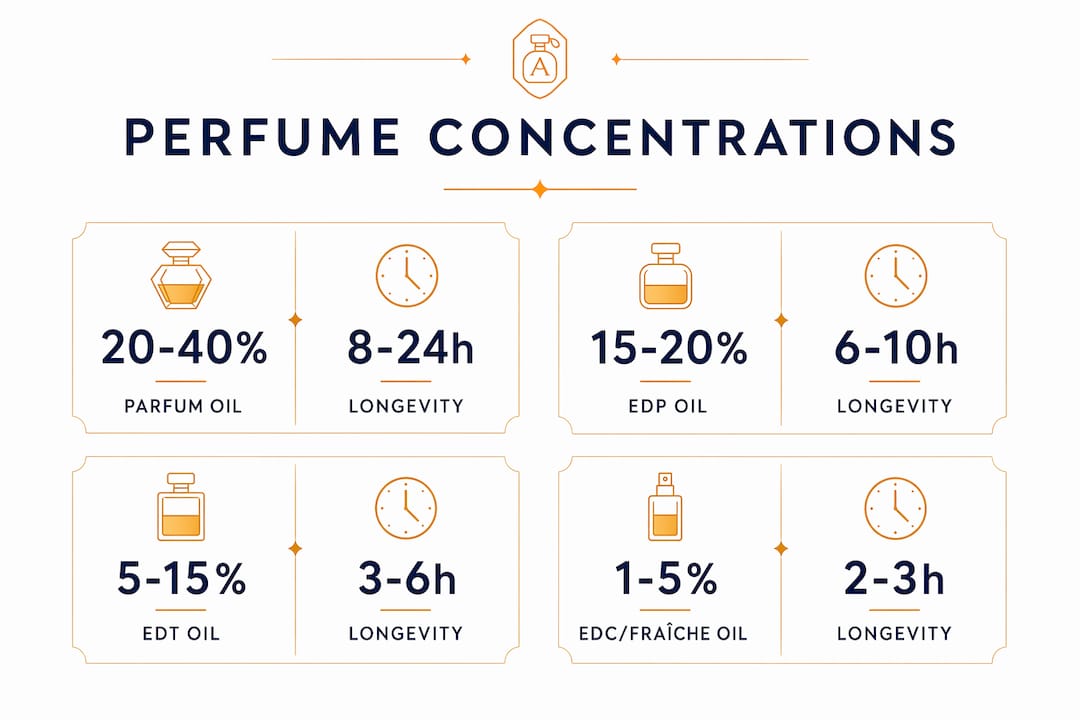
Eau de cologne (EDC) and eau fraîche: 1–5% oil
EDC carries 2–5% oil and lasts roughly 2–3 hours. Eau Fraîche sits at 1–3% and is the lightest option available. Both suit hot weather, post-gym freshening, or situations where a very brief scent impression is all that is needed.
| Concentration | Oil % | Longevity | Projection | Typical Use |
|---|---|---|---|---|
| Parfum / Extrait | 20–40% | 8–24 hrs | Intimate | Evening, special occasions |
| Eau de Parfum | 15–20% | 6–10 hrs | Moderate | Everyday, versatile |
| Eau de Toilette | 5–15% | 3–6 hrs | Light | Daytime, casual |
| Eau de Cologne | 2–5% | 2–3 hrs | Very light | Warm weather, sport |
| Eau Fraîche | 1–3% | 1–2 hrs | Minimal | Quick refresh |
Pro Tip: Test a fragrance on your skin for at least 30 minutes before buying. Concentration affects how quickly top notes fade and how soon the base notes emerge, so what you smell in the first 60 seconds is rarely what you will wear all day.
How does concentration affect longevity and scent intensity?
The relationship between oil percentage and wear time is direct but not perfectly linear. Higher fragrance oil concentration generally produces richer scent, longer longevity, and a higher cost per milliliter. That richness comes from a greater volume of aromatic molecules bonding with your skin over time.
Concentration also shapes scent development in a less obvious way. Higher concentrations reveal deeper base notes and more complex scent evolution across the wear period. An EDP version of a fragrance will often smell noticeably different from its EDT counterpart, not just stronger. The base notes in an EDP have more material to work with, so they emerge more fully and last longer.
Here is how concentration affects your experience at each stage of wear:
- Top notes (0–30 minutes): Higher concentrations slow the evaporation of top notes, giving you a longer opening phase before the heart emerges.
- Heart notes (30 minutes to 3 hours): EDP and Parfum sustain the heart longer, creating a more developed mid-stage scent.
- Base notes (3 hours onward): Only Parfum and EDP typically carry enough oil to project base notes beyond the 4-hour mark.
- Skin chemistry interaction: Your skin’s natural oils, pH, and moisture level interact with fragrance oil. Higher concentrations give your skin chemistry more material to work with, which is why the same Parfum can smell different on two people.
“Each concentration suits particular usage contexts, helping consumers set realistic expectations and avoid disappointment.” — Good Housekeeping
Pro Tip: Apply fragrance to pulse points like the wrists, neck, and inner elbows immediately after showering while skin is still slightly warm. Heat activates fragrance molecules and extends scent longevity regardless of concentration.
How to choose perfume concentration for your lifestyle
Selecting the right concentration is about matching the fragrance’s performance profile to your environment and personal goals. There is no single best concentration. There is only the best concentration for a given situation.
Consider these practical selection factors:
- Climate and season: EDT and EDC perform well in heat because their lighter oil load does not overwhelm warm air. Parfum and EDP shine in cooler months when their projection is more controlled.
- Setting and dress code: A formal evening event calls for Parfum or EDP. A gym session or outdoor lunch calls for EDT or EDC.
- Proximity to others: Office environments, airplanes, and crowded spaces favor lighter concentrations. You want your scent to be noticed by those close to you, not by the entire room.
- Reapplication preference: If you enjoy refreshing your scent mid-day, EDT is designed for that. If you prefer to apply once and forget it, EDP or Parfum is the better choice.
- Budget per wear: A 50ml Parfum costs more upfront but requires fewer applications per day. The cost per wear often balances out against a cheaper EDT applied three times daily.
The difference between perfume oils at each concentration level also affects how you layer fragrances. Layering an EDT body spray under an EDP of the same scent family extends longevity without overwhelming projection. This technique works particularly well with woody or musky fragrance families where the base notes benefit from added depth.
Pro Tip: If you are new to a fragrance house, start with the EDT version. It is typically less expensive, easier to wear in multiple settings, and gives you a reliable preview of the scent’s character before committing to a higher-concentration bottle.
Does higher concentration mean a higher price?
Price and concentration move in the same direction, but the relationship is more complex than a simple ratio. Parfum prices reflect both oil content and ingredient quality, with raw material costs and formula complexity adding significantly to the final retail price.
The table below shows typical retail price ranges for a 50ml bottle across concentration levels. These figures reflect general market positioning rather than any single brand.
| Concentration | Typical 50ml Price Range | Primary Cost Driver |
|---|---|---|
| Parfum / Extrait | $120–$400+ | High oil %, rare ingredients |
| Eau de Parfum | $70–$180 | Balanced oil %, brand prestige |
| Eau de Toilette | $45–$120 | Lower oil %, wide availability |
| Eau de Cologne | $25–$70 | Minimal oil %, mass market |
Price differences also arise from ingredient sourcing. A Parfum built around natural oud, Bulgarian rose, or Haitian vetiver costs more to produce than an EDT built around synthetic aroma molecules. That means two Parfums at the same concentration can differ dramatically in price based on what is inside the bottle. Understanding why perfume prices vary helps you evaluate whether a premium price reflects genuine ingredient quality or simply brand markup.
The practical takeaway is this: paying more for a Parfum makes sense when you want a signature scent for special occasions and you value complex, long-lasting base notes. Paying for an EDP makes sense for daily wear where versatility and moderate projection matter more than maximum longevity.
Common misconceptions about perfume concentrations
The most widespread myth in fragrance is that Parfum is always the strongest, loudest option. The most concentrated perfumes are designed for intimate wear and do not aggressively project. A well-constructed Parfum wraps close to the skin. An EDP or even a well-projected EDT can fill a room more noticeably.
Projection and longevity are separate performance qualities. Longevity measures how long a scent lasts on skin. Projection measures how far the scent radiates outward. Parfum wins on longevity. EDT often wins on initial projection because its lighter molecules diffuse more freely into the air.
“Consumers should view perfume concentrations as tools for different purposes, not ‘strong vs weak’ labels.” — Good Housekeeping
A second misconception is that applying more of a lighter concentration equals the same result as a higher concentration. Applying extra EDT does not replicate the scent development of an EDP. The base note profile simply is not there in sufficient quantity, regardless of how many sprays you use. Parfum requires only small dabs rather than multiple sprays, because its density means a little goes a long way. Overspraying a Parfum is a common and expensive mistake.
Key takeaways
Choosing the right fragrance concentration is a practical decision based on occasion, climate, and how you want your scent to perform, not a measure of quality or prestige.
| Point | Details |
|---|---|
| Concentration defines performance | Oil percentage controls longevity, projection, and scent development across the wear period. |
| EDP is the most versatile option | Eau de Parfum balances longevity and projection, making it suitable for most daily wear situations. |
| Parfum projects intimately, not loudly | Higher concentration creates a close scent bubble, not a stronger room-filling trail. |
| Price reflects more than oil content | Ingredient quality and formula complexity drive price as much as concentration percentage does. |
| Match concentration to context | Choose EDT for daytime and warm climates, EDP for versatility, and Parfum for evening or special occasions. |
Concentration is a tool, not a trophy
By Rodney
After years of working with fragrances, the single most useful shift I made was stopping to think of concentration as a ranking system. Parfum is not better than EDT. It is different. That reframing changes everything about how you shop and how you wear fragrance.
I have seen people buy Parfum because they assumed it would be the most impressive option in a room, then feel confused when no one noticed it. They expected volume. What they got was depth. That is not a flaw in the perfume. It is a mismatch between expectation and design.
My honest advice is to build a small collection across concentration levels rather than defaulting to the highest you can afford. An EDT of a citrus or aquatic fragrance for summer mornings, an EDP of a woody or floral for year-round wear, and a Parfum of something rich and personal for evenings. That three-bottle approach covers nearly every situation without overspending or under-performing.
Testing matters more than any guide, including this one. Skin chemistry is real. A fragrance that reads as warm and musky on one person can turn sharp and medicinal on another. Always test on your wrist, wait 20 minutes, and trust what you smell rather than what the bottle promises.
— Rodney
Find authentic fragrances across every concentration level
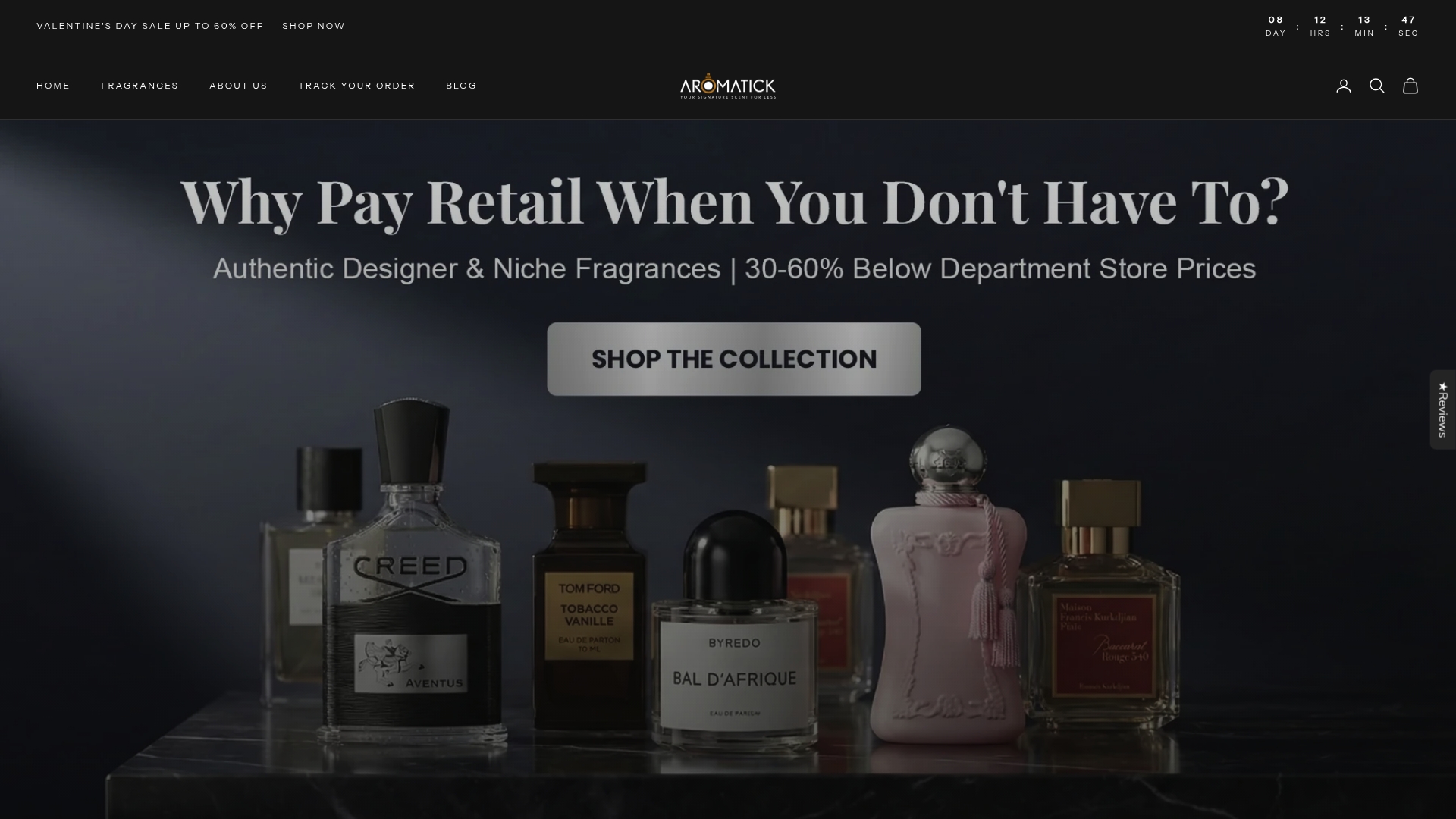
Aromatick carries authentic designer and niche fragrances across every concentration level, from light Eau de Toilette options to rich Extrait de Parfum bottles, all at up to 60% below standard retail prices. Whether you are building your first fragrance wardrobe or adding a new Parfum to an existing collection, the selection covers hundreds of brands with verified authenticity on every product.
Explore the full designer fragrance collection to compare options by concentration, brand, and price point. Free shipping, secure payments, and a satisfaction guarantee mean you can shop with confidence. Aromatick removes the department store markup so the money goes into the bottle, not the overhead.
FAQ
What is perfume concentration?
Perfume concentration is the percentage of fragrance oil in a perfume formula. It determines scent strength, longevity, and price per milliliter.
What is the difference between EDP and EDT?
Eau de Parfum contains 15–20% fragrance oil and lasts 6–10 hours, while Eau de Toilette contains 5–15% oil and lasts 3–6 hours. EDP projects more consistently and suits a wider range of occasions.
Does higher concentration always smell stronger?
No. Parfum and Extrait de Parfum project intimately rather than loudly. EDT often diffuses more freely into the air, creating a wider scent trail despite lower oil content.
How do i choose the right concentration for daily wear?
EDP is the most practical choice for daily wear because it balances longevity, projection, and versatility across work, casual, and evening settings.
Why does parfum cost more than EDT?
Parfum costs more because it contains a higher percentage of fragrance oil and often uses more expensive raw ingredients. Formula complexity and ingredient sourcing add to the price beyond the concentration percentage alone.

Leave a comment
This site is protected by hCaptcha and the hCaptcha Privacy Policy and Terms of Service apply.