

What Is a Scent Profile? A Fragrance Enthusiast's Guide
TL;DR:
- A scent profile is the unique combination of fragrance notes that determines how a perfume smells, evolves, and lingers on skin. It consists of top, heart, and base notes that develop over time, influencing the fragrance’s character and perception. Understanding these elements helps consumers select scents that suit their personality, chemistry, and lifestyle more accurately.
A scent profile is defined as the unique combination of fragrance notes and olfactory characteristics that determine how a perfume smells, evolves, and lingers on the skin. In professional perfumery, this concept is also called a fragrance profile. Understanding what is a scent profile gives you a real framework for choosing fragrances that suit your personality, body chemistry, and lifestyle. The fragrance wheel, note pyramids, and sillage are the core tools professionals use to build and analyze these profiles. Once you understand how they work together, shopping for perfume stops being guesswork.
What are the main elements of a scent profile?
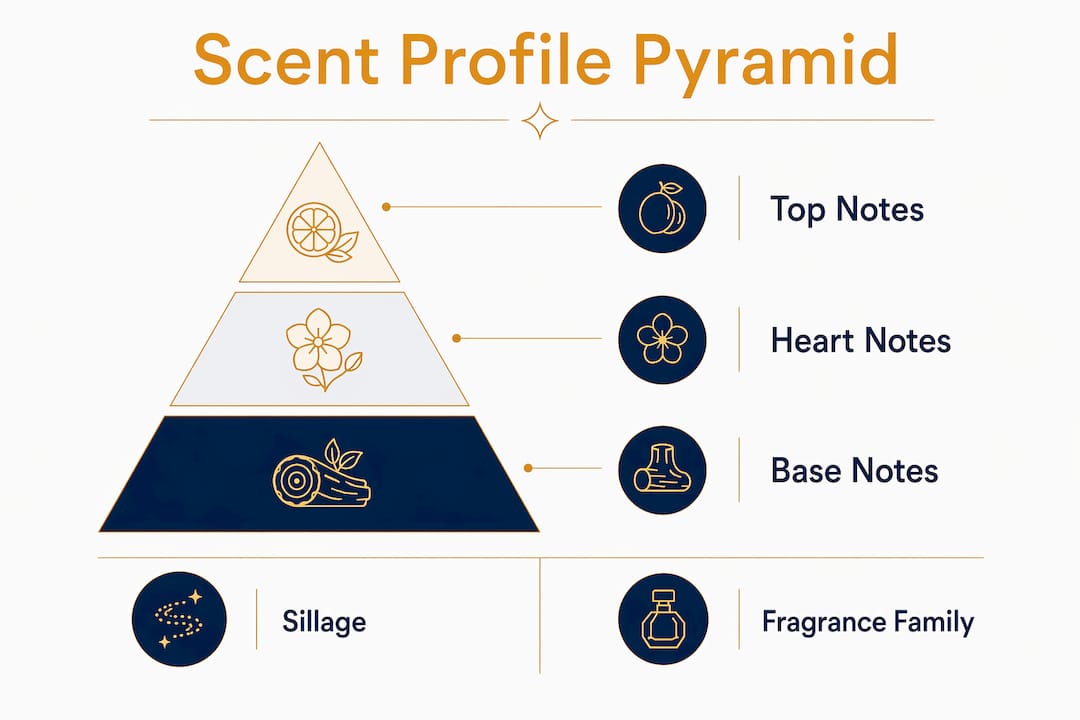
A scent profile’s structure rests on three layers of fragrance notes, each revealing itself at a different point in time. These layers are the top notes, heart notes, and base notes. Together, they create the full arc of how a fragrance smells from the first spray to hours later.
- Top notes are the lightest molecules in the formula. They evaporate within 10–15 minutes and deliver the first impression. Common top notes include bergamot, lemon, grapefruit, and pink pepper.
- Heart notes form the core identity of the fragrance. They emerge after the top notes fade and last roughly 2–3 hours. Heart notes make up 40–80% of the total scent structure, which means they dominate what most people actually smell on you. Rose, jasmine, lavender, and geranium are classic examples.
- Base notes are the heaviest molecules. They anchor the entire composition and provide lasting depth. Sandalwood, vetiver, musk, and amber are typical base notes that can linger for six hours or more.
Beyond the note pyramid, fragrance families define the broader character of a scent profile. The main families are floral, fresh, woody, amber (also called oriental), and fougère. Each family carries a recognizable emotional tone. Fresh profiles feel clean and energetic. Woody profiles feel grounded and warm. Amber profiles feel rich and sensual.
Sillage is another critical element. It describes how far a fragrance projects from your skin and how much of a trail it leaves. A high-sillage fragrance fills a room. A low-sillage fragrance stays close to the body. Sillage significantly affects how a scent is perceived as strong or subtle, making it a defining part of any scent profile.

Pro Tip: Skin temperature affects how quickly notes evaporate. Warmer skin accelerates the scent’s progression, so pulse points like the wrists and neck tend to amplify both projection and note transitions.
How do experts describe and categorize scent profiles?
The fragrance wheel is the primary tool professionals use to categorize and compare scent profiles. Developed by fragrance consultant Michael Edwards, the fragrance wheel organizes all olfactory families into a circular map showing their relationships and overlaps. It helps both perfumers and consumers understand why certain fragrances feel similar and how to move between families when exploring new options.
Professional scent description goes far beyond words like “nice” or “fresh.” Experts use concrete sensory references to communicate exactly what a fragrance does. Using food-related references like “creamy vanilla” or “sharp citrus rind” helps people understand scent nuances far better than abstract adjectives. The same principle applies to natural references: “wet forest floor,” “sun-warmed cedar,” or “cold ocean spray” all communicate specific olfactory experiences.
Here are the habits that separate precise scent description from vague marketing language:
- Replace “fresh” with a specific source: “freshly cut grass,” “cold mineral water,” or “lemon zest.”
- Replace “warm” with a texture or material: “burnished wood,” “dry amber resin,” or “toasted vanilla.”
- Describe the emotional context: does the scent feel intimate, social, or solitary?
- Note the progression: does the opening differ dramatically from the dry-down?
- Assess the sillage: does it project boldly or stay close to the skin?
Fragrance professionals assess scent profiles not only by smell but by how the scent moves and lingers, affecting both the wearer and the people nearby. This is why two fragrances with identical notes can feel completely different in practice.
Pro Tip: When testing a new fragrance, write down three concrete references immediately after spraying. Do the same at 30 minutes and again at two hours. Tracking the evolution trains your nose faster than any other method.
How does body chemistry affect your scent profile?
Body chemistry is the most underestimated variable in fragrance selection. Scent profiles are dynamic impressions shaped by evaporation rates, individual skin chemistry, and environmental conditions. The same bottle of Dior Sauvage or Chanel No. 5 can smell noticeably different on two people standing side by side.
Here is a practical process for testing fragrances with your own chemistry in mind:
- Spray on skin, not paper. Paper strips show you the formula’s raw ingredients. Skin shows you the actual scent profile you will wear. Testing fragrances on skin is the only reliable way to understand how body chemistry shifts the notes over 2–6 hours.
- Wait through the top notes. Most people judge a fragrance in the first 60 seconds. The top notes are the least representative part of the profile. Give the heart notes time to develop before deciding.
- Test one fragrance per wrist. Testing more than two at once creates olfactory confusion. Your nose needs clean reference points to evaluate each profile accurately.
- Revisit after two hours. The dry-down, when the base notes fully emerge, is where a fragrance’s true character shows. Many fragrances that smell generic at first become distinctive and personal at this stage.
- Consider your skin’s natural pH and moisture. Dry skin tends to absorb fragrance faster and project less. Oily or well-moisturized skin holds fragrance longer and amplifies sillage.
Consumers often expect floral fragrances to smell identical across different brands, but the scent profile involves nuanced layers and skin chemistry that make each experience unique. A rose-centered fragrance from Maison Margiela will smell fundamentally different from a rose-centered fragrance from Gucci, even if both list rose as the heart note.
Pro Tip: Apply an unscented moisturizer before spraying your fragrance. Hydrated skin holds scent molecules longer, which extends the life of the heart and base notes and gives you a more accurate read of the full profile.
What are common scent profile examples?
Fragrance profiles describe the overall character and mood created by combining several scent ingredients rather than focusing on any single note. Recognizing common profiles by their characteristic traits makes it much easier to narrow your choices before you ever enter a store.
| Scent Profile | Key Notes | Emotional Impression | Best For |
|---|---|---|---|
| Fresh Citrus | Bergamot, lemon, neroli, white musk | Energetic, clean, uplifting | Daytime, warm weather, office |
| Woody Musk | Cedarwood, sandalwood, vetiver, musk | Grounded, confident, understated | Casual wear, cooler seasons |
| Floral Spicy | Rose, jasmine, cardamom, pink pepper | Warm, romantic, complex | Evening, date nights, fall |
| Amber Oriental | Vanilla, benzoin, oud, patchouli | Rich, sensual, enveloping | Evening, winter, formal occasions |
| Aquatic Fresh | Sea salt, ambergris, cucumber, white woods | Cool, airy, effortless | Summer, sport, casual daytime |
Each profile connects to a specific mood and context. Fresh citrus profiles project confidence and approachability in professional settings. Amber oriental profiles communicate depth and sophistication in social environments. Knowing which profile resonates with your personal style helps you compare niche fragrances and designer options with much greater clarity.
Smell also triggers immediate emotional and memory responses due to direct neurological pathways, which is why certain profiles feel instantly familiar or comforting. A woody musk profile might remind you of a specific person or place, making it feel deeply personal even on first encounter.
Pro Tip: Before visiting a fragrance counter, identify two or three scent profiles from the table above that appeal to you. Ask the sales associate to show you options within those families. This cuts testing time in half and reduces nose fatigue.
Key takeaways
A scent profile is the structured combination of top, heart, and base notes that defines a fragrance’s full olfactory identity, and understanding it is the most reliable way to choose perfumes that work for you.
| Point | Details |
|---|---|
| Three-layer note structure | Top, heart, and base notes each reveal themselves at different times, forming the complete scent arc. |
| Heart notes dominate | Heart notes make up 40–80% of the scent structure and most define what others smell on you. |
| Body chemistry changes everything | The same fragrance smells different on different people; always test on skin for at least two hours. |
| Sillage defines presence | Sillage determines how far a fragrance projects and is a critical part of its overall profile. |
| Scent families guide selection | Knowing your preferred fragrance family (floral, woody, amber, fresh) narrows choices before testing begins. |
Why learning scent vocabulary changed how i shop for fragrance
For years, I picked fragrances the way most people do: I sprayed something, liked the first impression, and bought it. Half the time, I was disappointed within a week. The fragrance I wore home from the store was not the fragrance I wore to work the next morning.
The shift happened when I started paying attention to the dry-down. That is where the real character of a fragrance lives. Top notes are essentially a handshake. The base notes are the conversation. Once I understood that distinction, I stopped making impulsive decisions based on the opening spray.
Learning specific vocabulary made the biggest practical difference. Replacing “I like this” with “this has a dry cedar base with a spicy cardamom heart” gave me a language to search with. I could walk into a store, describe what I was looking for, and get useful recommendations instead of a random tour of the display counter.
The other thing I would tell any fragrance enthusiast: trust your nose over the marketing copy. Perfume descriptions are written to sell, not to inform. Words like “mysterious” and “seductive” tell you nothing about what is actually in the bottle. Concrete references do. If a description mentions “smoked birch,” “cold mineral,” or “sun-dried citrus,” you have something real to work with.
Discovering your personal signature scent takes time and a willingness to experiment. The nose learns through exposure. The more profiles you test and describe, the faster your instincts sharpen. Give yourself permission to get it wrong a few times. That is how you find the fragrances that genuinely feel like you.
— Rodney
Explore authentic fragrance profiles at Aromatick
Now that you understand how scent profiles work, you can shop with real purpose. Aromatick carries an extensive range of authentic designer and niche fragrances across every major scent family, from fresh citrus and aquatic profiles to rich amber orientals and complex woody musks.

Every fragrance on the site is genuine, and prices run up to 60% below standard retail. Whether you are searching for a floral signature for everyday wear or a bold oriental for evenings, the designer fragrance collection gives you the breadth to find exactly what your scent profile calls for. Browse the full men’s and women’s collections and use the knowledge from this guide to shop with confidence.
FAQ
What is a scent profile in simple terms?
A scent profile is the complete olfactory character of a fragrance, defined by its combination of top, heart, and base notes along with its sillage and fragrance family. It describes how a perfume smells, evolves, and performs on the skin over time.
How do top, heart, and base notes differ in a scent profile?
Top notes are the lightest and evaporate within 10–15 minutes, heart notes form the core identity and last 2–3 hours, and base notes provide the lasting foundation that can linger for six hours or more.
Why does the same perfume smell different on different people?
Individual skin chemistry, pH levels, and body temperature all affect how fragrance molecules evaporate and interact with the skin. These factors cause the same formula to produce noticeably different scent profiles on different wearers.
What is sillage and why does it matter for a scent profile?
Sillage is the measure of how far a fragrance projects from the skin and how much of a trail it leaves. It determines whether a fragrance feels intimate and personal or bold and room-filling, which directly shapes how others perceive your scent.
How do i identify my preferred scent profile?
Start by identifying which fragrance family appeals to you most: floral, fresh, woody, or amber. Then test fragrances within that family on your skin and evaluate them at the 30-minute and two-hour marks to understand how the full profile develops on your body chemistry.

Leave a comment
This site is protected by hCaptcha and the hCaptcha Privacy Policy and Terms of Service apply.