
Your Fragrance Selection Workflow: A Practical Guide
TL;DR:
- A structured fragrance selection process enhances confidence by considering skin chemistry, preferences, and lifestyle. Testing on skin and evaluating over hours prevents impulsive choices, leading to more satisfying long-term results. Building a diverse wardrobe and practicing patience ensures your scents remain personal and enjoyable over time.
Walking into a fragrance counter or browsing hundreds of options online can feel genuinely overwhelming. A structured fragrance selection workflow changes that experience entirely. Instead of guessing, spraying randomly, and walking away unsatisfied, you follow a deliberate process that accounts for your skin chemistry, personal preferences, and lifestyle. This guide gives you that process from start to finish, covering how to identify your scent profile, test fragrances correctly, build a versatile collection, and avoid the common mistakes that lead to bottles collecting dust on your shelf.
Table of Contents
- Key takeaways
- Your fragrance selection workflow starts with self-knowledge
- How to test and sample fragrances the right way
- Advanced steps for performance and personalization
- Common pitfalls in fragrance selection
- Verifying fragrance satisfaction over time
- My honest take on building a fragrance workflow
- Start your journey with Aromatick’s curated collections
- FAQ
Key takeaways
| Point | Details |
|---|---|
| Know your scent profile first | Identify your preferred fragrance family before testing to narrow choices and save time. |
| Test on skin, not paper | Skin chemistry transforms how a fragrance smells, making paper testers unreliable for final decisions. |
| Use primers for longer wear | A fragrance primer can roughly double longevity, especially for lighter citrus and floral scents. |
| Build a scent wardrobe | Curating 2 to 3 fragrances for different moods and seasons beats relying on a single signature scent. |
| Journal your impressions | Recording scent notes at multiple time points helps you evaluate and refine your selections over time. |
Your fragrance selection workflow starts with self-knowledge
Before you test a single bottle, you need a foundation. The fragrance selection workflow that actually works begins with understanding what you are drawn to and why. Scent is deeply personal, shaped by memory, emotion, and even genetics. Skipping this step means you will keep reaching for things that smell interesting in the store but feel wrong on your body.
The four major fragrance families
Fragrances generally fall into four broad families:
- Floral: Rose, jasmine, peony, lily. Think feminine, romantic, soft. The most widely produced category in the world.
- Fresh: Citrus, green, aquatic, ozonic. Clean, light, energetic. Often associated with warm weather and active lifestyles.
- Woody: Sandalwood, cedar, vetiver, oud. Grounded, warm, often gender-neutral. Base notes like amber, oud, and vetiver add depth and the perception of a rich, layered scent.
- Oriental (Amber): Vanilla, spice, musk, resin. Rich, warm, sensual. Best suited to cooler weather and evening wear.
Most people gravitate toward one or two of these families naturally. Think about the scents you have complimented on others or the candles you choose for your home. Those reactions are data points.
Identifying your personal scent inclinations
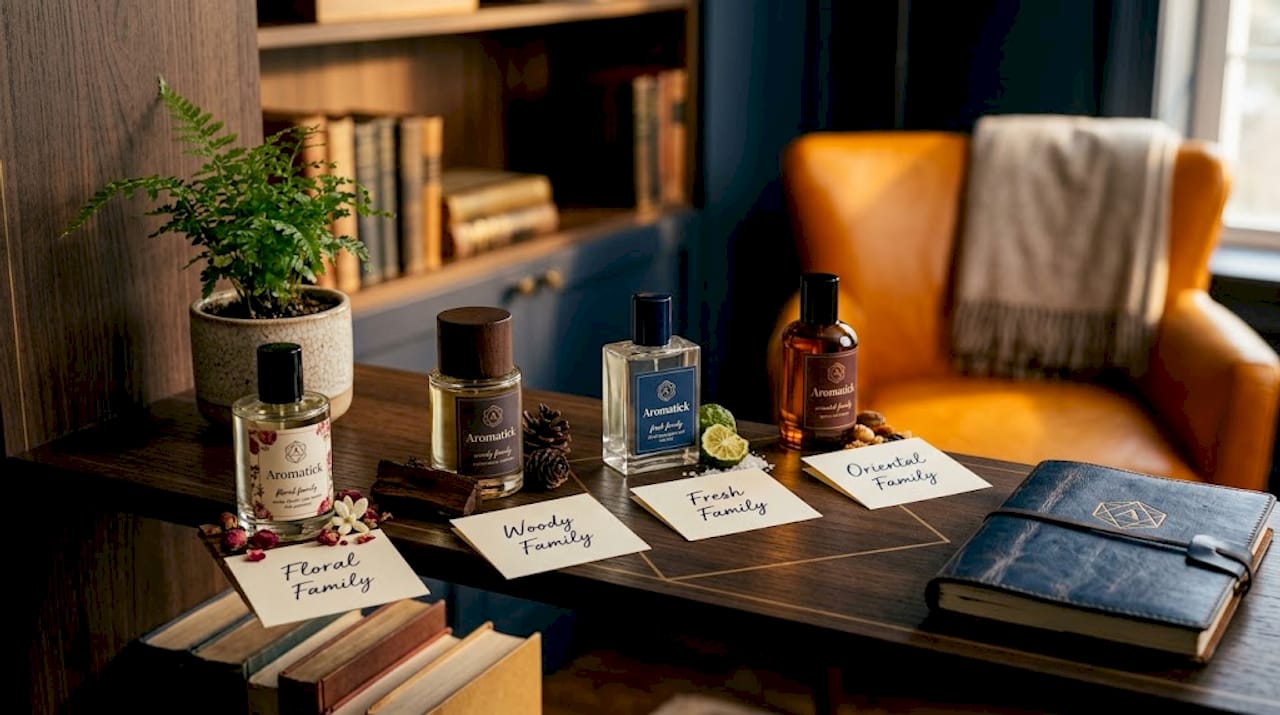
A fragrance wheel is a simple visual tool that maps how scent families relate to one another. Florals sit near fresh notes; orientals are adjacent to woody families. If you have always loved the smell of rain-soaked earth, you likely lean woody or fresh-green. If you gravitate toward vanilla-based body lotions, orientals will feel like home.
Sample sets are one of the most practical tools at this stage. Many niche and designer houses offer discovery kits with five to ten small vials, letting you test across families before committing to a full bottle. For guidance on choosing fragrances on a budget, sample sets are especially cost-effective.
Pro Tip: Write down two or three scent memories that feel positive to you, whether that is a specific place, season, or person. Share those memories with a fragrance advisor or use them to search fragrance community databases. Memory-linked scent preferences are highly consistent.
How to test and sample fragrances the right way
This is where most people’s approach breaks down. They spray something on a paper strip, sniff it twice, and decide. That process eliminates the most important variable: your skin. Skin chemistry significantly alters how a perfume smells and performs over time. Humidity, body temperature, pH, and skin oils all interact with fragrance molecules in ways unique to each person.
Here is a controlled testing process that actually reflects how a fragrance will perform for you:
- Limit simultaneous tests. Test no more than two to three fragrances per session. Your olfactory system fatigues quickly, and more than three scents at once means you will not accurately perceive any of them.
- Apply to pulse points without rubbing. The inner wrists, neck, and inside of the elbows are ideal. Rubbing your wrists together after spraying breaks down the top notes prematurely. Let the fragrance settle naturally.
- Apply one to two sprays only. Fragrance experts recommend limiting application to one or two sprays on pulse points for a scent that feels like part of you, not an announcement.
- Evaluate over at least four hours. Fragrances evolve through three phases. Top notes last 15 to 30 minutes. Heart notes emerge through hour two. Base notes define the final character and can persist for six to twelve hours. A quick sniff catches only the opening.
- Test in your intended environment. Wearing samples in their intended context avoids impulse purchases driven by how a fragrance smells in a sterile store setting rather than your actual life.
- Understand concentration differences. An Eau de Toilette (EDT) carries 5 to 15% fragrance oil, making it lighter and better suited to warm weather. An Eau de Parfum (EDP) runs 15 to 20%, offering greater depth and longevity. An extrait or parfum, at 20 to 40%, is the most intense and long-lasting. Choosing the right concentration matters as much as the scent itself.
Pro Tip: Smell coffee beans between fragrances to reset your palate. This is a standard counter technique that actually works, even though it sounds like retail mythology.
Advanced steps for performance and personalization
Once you know what works on your skin, you can move into the part of the scent selection workflow that most guides overlook entirely: making your fragrance perform better and building a collection that serves your whole life.
Fragrance primers and longevity
A fragrance primer is an unscented base layer applied to skin before your perfume. It contains moisturizing and pH-balancing ingredients that help fragrance molecules bind to skin rather than evaporate quickly. Primers can roughly double wear time for lighter scents. For citrus and fresh florals, which typically fade within two to three hours, this makes a significant difference. If a primer feels like a step too far, unscented moisturizer works similarly. Hydrated skin holds fragrance oils better than dry skin, which is why the same fragrance can smell faint on one person and bold on another. Learn more about extending fragrance longevity before you start blaming the bottle.
Fragrance layering and pairing tips
Layering is the practice of wearing two or more fragrances together to create something uniquely yours. Layering compatible fragrance families with similar base notes produces the most coherent results. A woody musk paired with a light floral, for example, creates warmth without competition.
Here is a simple comparison of layering approaches:
| Approach | Best for | Example pairing |
|---|---|---|
| Same family layering | Deepening a single note profile | Cedar body oil beneath a woody EDP |
| Complementary families | Adding contrast and complexity | Fresh citrus spray over a warm oriental base |
| Base plus accent | Adding longevity with a richer base | Sandalwood oil plus a light floral EDT |
Building your fragrance wardrobe
Modern consumers benefit from curating two to three fragrances for different moods, occasions, and seasons rather than forcing a single scent to do everything. A practical starting wardrobe might include:
- A fresh or aquatic for daytime and warm months
- A woody or oriental for evenings and cooler seasons
- A versatile floral or clean musk that works year-round
For seasonal fragrance guidance, matching the weight of your scent to the temperature is one of the most overlooked fragrance assessment criteria in everyday buying decisions. A heavy oud in summer heat can become overwhelming quickly.
A few cautions here. Over-spraying is the most common mistake people make once they find something they love. More spray does not mean more complexity. It means others cannot comfortably share a room with you. Stick to the one to two spray rule regardless of how well a fragrance wears.
Common pitfalls in fragrance selection
Even well-intentioned buyers make the same mistakes repeatedly. Recognizing them in advance is the fastest way to refine your scent selection workflow and reduce wasted spending.
- Relying on paper strips for final decisions. Paper cannot replicate skin chemistry. It shows you the opening notes of a fragrance and nothing else. Consider it a filter, not a verdict.
- Buying immediately after the first spray. The top notes in those first few minutes are deliberately designed to attract. Many fragrances smell very different at the two-hour mark. Walk away, wear the sample, and return only if you still love it the next day.
- Ignoring the season and occasion. A fragrance that smells perfect in a cool, air-conditioned store may project dramatically differently in summer heat. Your fragrance assessment criteria must include where and when you will actually wear it.
- Chasing trends over personal resonance. A scent that reflects your individuality and comfort will always serve you better than whatever is popular in a given year. Fragrance is not fashion in the same sense. Trends cycle; your chemistry does not.
- Never seeking outside feedback. You adapt to your own scent within thirty minutes (called olfactory adaptation). Asking someone you trust for honest feedback at the two-hour mark gives you information your nose can no longer provide.
Pro Tip: When testing a fragrance you are considering buying, wear it for a full workday before deciding. If you find yourself noticing it positively throughout the day, that is a reliable signal. If you forget you are wearing it or find it distracting, pass.
Verifying fragrance satisfaction over time
A fragrance selection workflow is not complete after the first purchase. Building genuine confidence with your scent choices requires a short but consistent follow-up process.
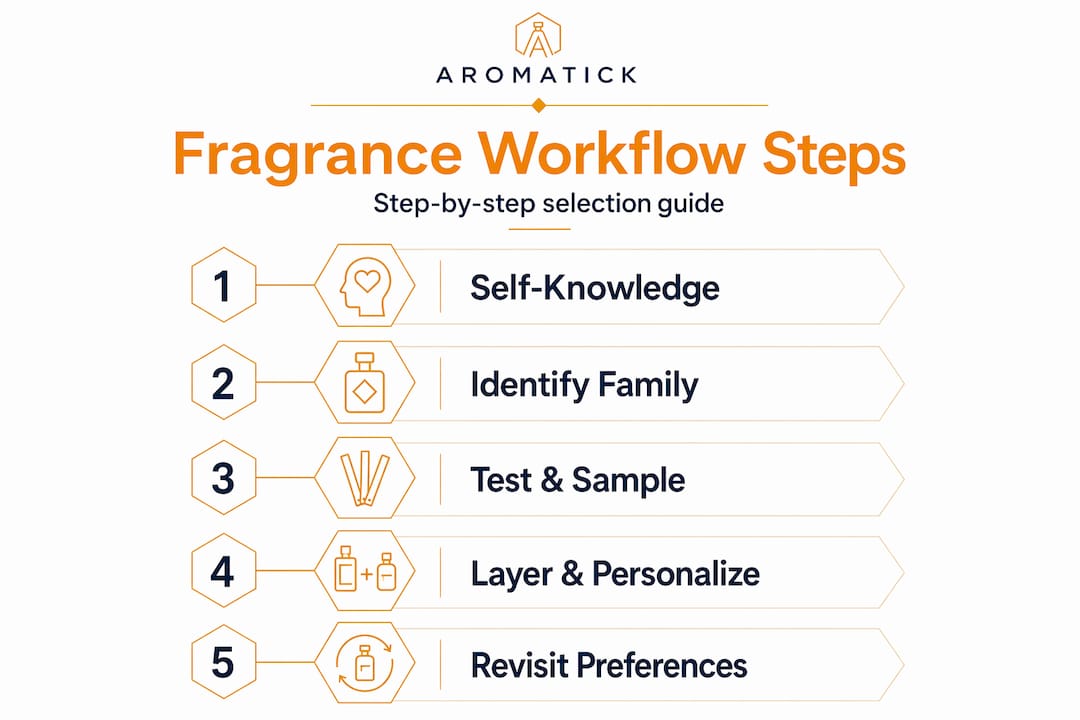
Tracking your impressions over days and across different environments reveals patterns that single-session testing cannot. A controlled testing workflow includes journaling your impressions at multiple time points, which separates genuinely satisfying purchases from novelty that fades.
Signs that a fragrance genuinely suits you long-term include:
- You receive unprompted compliments across different settings
- You reach for it consistently rather than rotating away from it
- It still feels like “you” three months after purchase
- You notice its absence on days you do not wear it
As your preferences evolve, revisit your workflow. People’s scent preferences shift with age, lifestyle changes, and even diet. What felt right at 25 may feel off at 35. Checking in on your fragrance wardrobe once or twice a year and replacing one piece when needed keeps your collection current without overcomplicating the process.
My honest take on building a fragrance workflow
I have worked in and around the fragrance space long enough to say this plainly: the single signature scent concept, while appealing in theory, sets most people up for frustration. Life asks different things of you on different days. A wardrobe approach is not indecisive. It is accurate.
The biggest lesson I have seen consumers learn the hard way is that patience in testing is not optional. Every person who has told me they bought a fragrance they regret made the same mistake. They loved the top notes, bought the bottle, and never gave the base notes time to speak. That regret is almost entirely avoidable.
My personal take is that fragrance discovery should feel enjoyable, not like homework. Start with one family, test properly, and buy one bottle you genuinely love before expanding. The people who build the most satisfying collections are the ones who gave themselves permission to go slowly. Individuality over trends, every time.
— Rodney
Start your journey with Aromatick’s curated collections

If you have followed this guide and are ready to test your workflow with real fragrances, Aromatick makes that practical. The designer fragrance collection covers the full spectrum of scent families, from fresh aquatics and bright florals to deep orientals and woody musks, with authentic bottles at up to 60% off retail pricing. If you prefer something less mainstream, the niche fragrance collection offers distinctive, harder-to-find options that reward the kind of careful, informed selection this guide has prepared you for. Every purchase includes free shipping and a satisfaction guarantee, so you are not taking a risk. You are simply executing the next step in your workflow.
FAQ
What is a fragrance selection workflow?
A fragrance selection workflow is a step-by-step process for choosing fragrances that match your skin chemistry, preferences, and lifestyle. It covers identifying your scent profile, testing samples correctly, and building a collection over time.
How many fragrances should I test at once?
Test no more than two to three fragrances per session to avoid olfactory fatigue. Evaluate each over at least four hours on your skin before making any decision.
Does skin chemistry really change how a perfume smells?
Yes. Skin pH, hydration, body temperature, and natural oils all interact with fragrance molecules in ways that make the same perfume smell noticeably different from person to person.
What is the difference between EDT and EDP?
An Eau de Toilette contains roughly 5 to 15% fragrance oil and suits lighter, warmer-weather wear. An Eau de Parfum runs 15 to 20% and offers greater depth and longevity, making it better suited for cooler seasons or evening occasions.
How do I make a fragrance last longer?
Apply an unscented moisturizer or a dedicated fragrance primer before spraying. Hydrated skin binds fragrance oils more effectively, which can roughly double wear time for lighter scents like citrus and florals.

Leave a comment
This site is protected by hCaptcha and the hCaptcha Privacy Policy and Terms of Service apply.