

5 Step Test for Shoppers: Projection vs Longevity in Perfume
Projection measures how far a fragrance radiates outward from your skin; longevity measures how long you or others can still detect it at all. The trade-off shows up constantly: a scent that fills a room in the first hour often quiets down by hour four, while a fragrance built for endurance may stay close to the skin the entire time it’s working. Neither trait predicts the other, and the testing method below explains why store spritzes rarely reveal which one you’re actually getting.
TL;DR:
- Projection depends on the volatility of top and heart notes, air movement, and concentration, and it usually peaks within the first hour.
- Longevity measures how long a fragrance remains detectable on skin or fabric, often lasting several hours beyond initial projection.
- Testing a fragrance on skin over multiple hours with checkpoints provides a more accurate assessment of true performance than a quick blotter sniff.
- Higher concentration formulas do not automatically produce louder projection; alcohol-based sprays typically project more initially than oil-based formats.
- Moisturizing skin and applying fragrance on pulse points can enhance both projection and longevity, with re-sprays helping to maintain scent presence throughout the day.
Table of Contents
- Projection vs. Longevity Perfume: Clear Definitions
- Projection, Sillage, and Skin Scent in Real Wear
- What Controls Projection and Longevity in a Fragrance
- Why a Stronger Concentration Doesn’t Guarantee Louder Projection
- How to Test a Fragrance Fairly, Beyond the First Sniff
- Application and Buying Tips for Projection or Longevity
- Rodney’s Take: Picking by Performance, Not by Hype
- Try Before You Commit: Sample and Decant Formats at Aromatick
- Sources
Projection vs. Longevity Perfume: Clear Definitions
Projection is the radius at which someone else can smell your fragrance without leaning in, and it depends heavily on the volatility of top and heart note compounds, the concentration of the formula, and how much air is moving around you. Walk into an elevator and a highly projective scent announces itself before the doors close.
Longevity is different: it’s the number of hours a fragrance stays detectable on skin or fabric, even if only to your own nose after everyone else has stopped noticing. That second qualifier matters. Your nose adapts to a smell it’s exposed to continuously, a phenomenon called olfactory fatigue, which is why you might swear a fragrance “disappeared” at hour three when a friend can still catch it clearly.
Sillage sits between the two. It’s the scent trail a fragrance leaves as you move through space, a fragrance longevity comparison in itself. Consider three stages of a scent’s life:
- Opening (0 to 30 minutes): projection peaks, sillage is widest
- Heart (30 minutes to 3 hours): trail narrows, character shifts
- Base/drydown (3+ hours): low projection, close to skin, longevity is what’s left
A deeper breakdown of sillage covers how this trail behaves across different fragrance families.
Projection, Sillage, and Skin Scent in Real Wear
These three terms get used almost interchangeably online, but they answer different questions. Sillage is the trail you leave walking past someone. Projection is the bubble of scent around you at a single moment. Skin scent is what remains once a fragrance has mostly settled into the drydown, detectable mainly if someone gets close.
Here’s how that plays out in practice:
- A fragrance can project strongly for the first hour, then drop straight into skin scent with almost no trail afterward.
- Another can stay quiet all day, barely projecting, yet remain faintly detectable at hour eight.
- Office settings usually call for skin-scent behavior; a date night or a concert crowd is where projection earns its keep.
Understanding what sillage means for your choices helps you match a bottle to the room you’ll actually be standing in.
What Controls Projection and Longevity in a Fragrance
Every aromatic molecule evaporates at its own rate, and that volatility curve across top, heart, and base notes is the single biggest driver of how a fragrance performs over time. Lighter molecules fly off fast and hit your nose hard early; heavier ones linger and anchor the drydown hours later.
Formula ratios matter as much as raw ingredients. Perfumers tune diffusion-forward aromachemicals like Hedione and Iso E Super as “diffusion engines,” boosting how far a scent radiates in air without simply dumping in more top notes.
Format changes the math too. Alcohol-based sprays lift fast because the solvent evaporates quickly, carrying volatile molecules with it. Oil-based formats release more slowly, which tends to favor longevity over immediate air impact.
Several variables sit outside the bottle entirely:
- Oily skin holds fragrance molecules longer than dry skin
- Hydrated skin (moisturized beforehand) slows evaporation
- Humid, warm climates accelerate projection but can shorten total wear
- Clothing fibers trap heavier molecules and re-release them slowly over hours
A technical look at how longevity actually works walks through how carrier systems shift this balance further.
Why a Stronger Concentration Doesn’t Guarantee Louder Projection
This is the myth that trips up more shoppers than any other: parfum concentration equals a louder fragrance. It doesn’t, not automatically. Higher oil load typically deepens and extends the drydown, but it can actually reduce initial lift compared to an EDT of the same scent, since alcohol-forward sprays evaporate faster and push volatile top notes into the air sooner.
So concentration buys you time, not necessarily volume. An EDT built with strong diffusion aromachemicals can out-project a parfum version of the same name in its opening thirty minutes, even though the parfum will still be detectable hours after the EDT fades into skin scent.
Pro Tip: If you want both loud opening and long wear, check whether the fragrance house sells the same scent in both EDT and parfum. Layering a light spray of each can give you fast lift plus extended base.
How to Test a Fragrance Fairly, Beyond the First Sniff
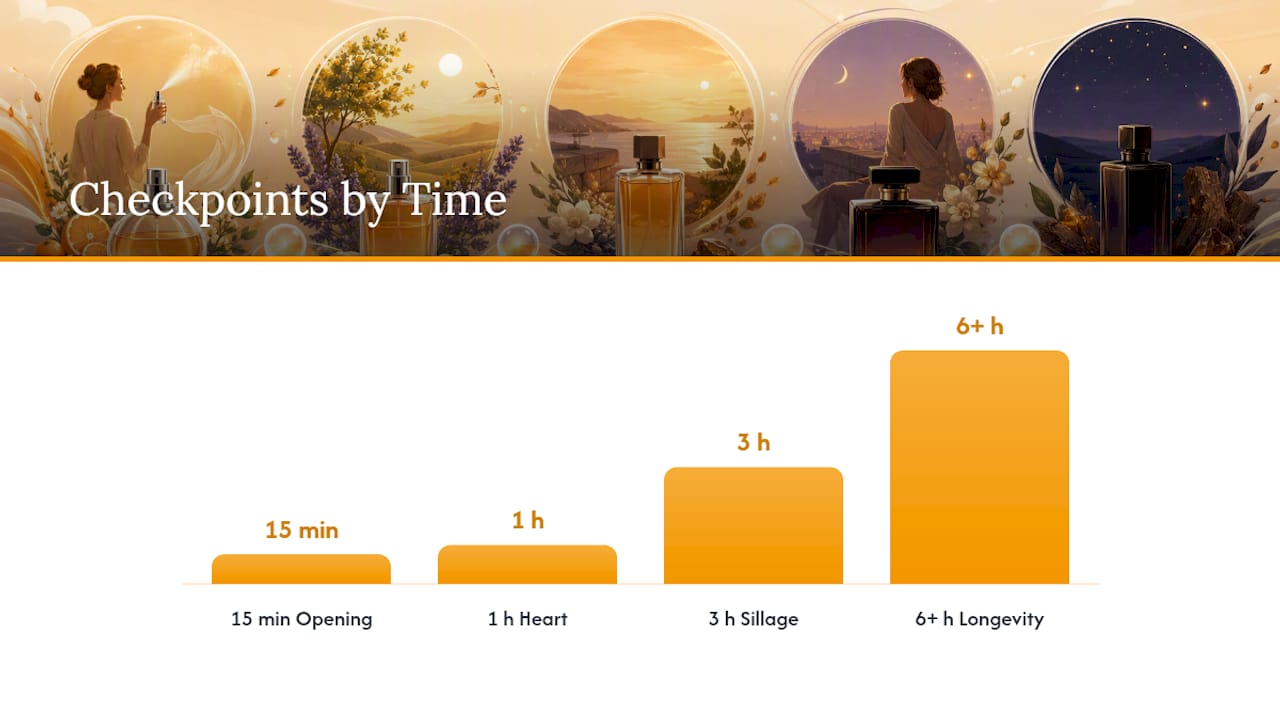
A blotter test in a store tells you almost nothing about how a fragrance will behave on you over six hours. Judging any scent this way after only the opening is the single most common mistake buyers make, since top notes evaporate within the first fifteen to thirty minutes and say little about the heart or base that follow.
A fair protocol looks like this:
- Spray on skin (pulse points) and separately on a fabric swatch or sleeve.
- Check at 15 minutes for opening projection and initial character.
- Check again at 1 hour, when top notes have mostly cleared and the heart takes over.
- Check at 3 hours for sillage: walk past a mirror or ask someone nearby if they catch it.
- Check at 6+ hours, nose close to skin, for longevity and drydown character.
| Checkpoint | What to measure | What it tells you |
|---|---|---|
| 15 minutes | Distance a friend can smell it from | Opening projection |
| 1 hour | Trail while walking | Sillage |
| 3 hours | Detectable without leaning in | Sustained projection |
| 6+ hours | Detectable up close only | Longevity |
Timed checkpoint testing like this also works better when you log the number of sprays, the room temperature, and whether your skin was moisturized, since all three swing results noticeably between wears.
Application and Buying Tips for Projection or Longevity
Moisturized skin holds fragrance longer than dry skin, so an unscented lotion before spraying is one of the cheapest longevity upgrades available. Placement matters too: pulse points (wrists, neck, chest) run warmer and push more scent into the air, which helps projection, while a light mist on clothing or hair tends to extend longevity since fabric releases trapped molecules slowly over the day.
A few buying habits pay off consistently:
- Fragrances heavy in fresh citrus or light florals usually lean toward projection over staying power.
- Amber, oud, and heavy musk bases tend to favor longevity, often reading closer to the skin.
- Re-spray once at the 4 to 6 hour mark if you need projection back, rather than assuming the bottle underperforms.
- Read a note-based breakdown of longevity before assuming EDP always outlasts EDT. It usually does, but not always.
Pro Tip: Always sample or decant a fragrance before buying full size. A guide to how fragrance materials evolve shows why the same formula can smell completely different on two people, which is exactly why a single blotter test at a counter isn’t enough to judge either trait.
Rodney’s Take: Picking by Performance, Not by Hype
If you’re choosing based on performance, start with the occasion, not the marketing copy. A fragrance marketed as “beast mode” is usually describing its opening thirty minutes, not its behavior at hour six, and treating that claim as a guarantee of all-day loudness is where most buyers end up disappointed.
Test past the opening every time. A sample or decant costs a fraction of a full bottle and tells you more about real-world longevity than any counter spritz ever will.
— Rodney
Try Before You Commit: Sample and Decant Formats at Aromatick
Testing projection and longevity properly means wearing a fragrance for a full day, not sniffing a blotter for ten seconds, and that’s exactly what full-size bottles make expensive to do wrong. Aromatick carries authentic designer and niche fragrances at 30 to 60% off retail, including formats built for exactly this kind of hands-on evaluation.

Start with a smaller format or a discovery set before committing to a full bottle, especially if you’re comparing an EDT against a parfum version of the same scent to judge lift versus wear time. Browsing the niche fragrance collection is a solid starting point if you want scents known for either strong projection or long drydowns, and the designer fragrance collection covers familiar names at prices that make testing multiple concentrations far less risky. Pick two or three candidates, test them using the checkpoint method above, and buy the one that actually performs the way you need it to.
Sources
- Understanding projection, longevity, and sillage from a technical perspective - Row of Life
- Guide to fragrance projection and sillage | Perfume On Skin
- Analysis of concentration vs projection in fragrance formats — Fashionista

Leave a comment
This site is protected by hCaptcha and the hCaptcha Privacy Policy and Terms of Service apply.