
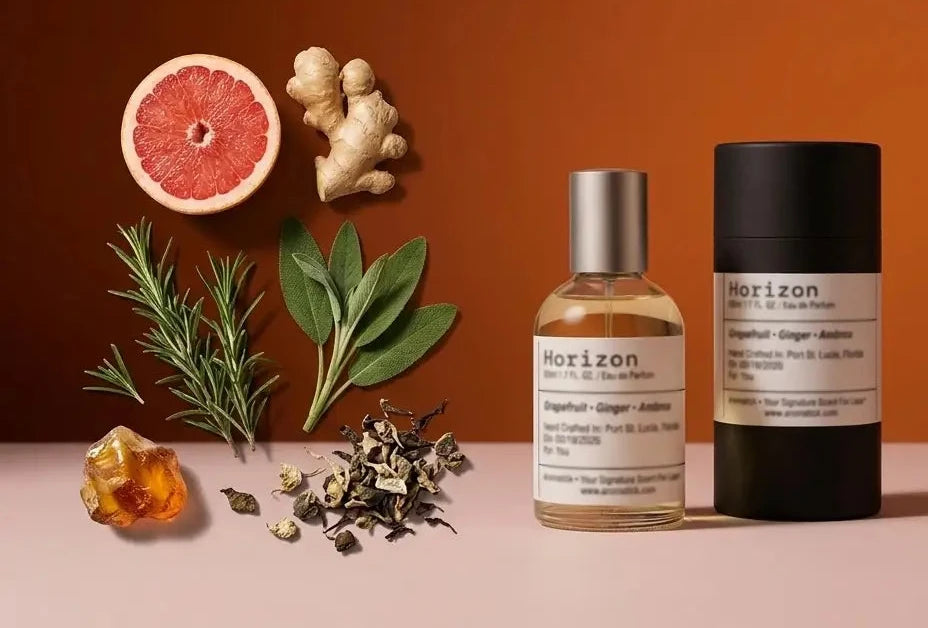

Natural vs Synthetic Perfume: What Actually Differs
Natural perfume ingredients are physically extracted from plants and other natural sources. Synthetic ones are built or modified in a lab. Neither is automatically safer, greener or better smelling. Nearly every fragrance you can buy, designer or niche, uses both, and the better question is how well the whole formula is made and how your skin responds to it.
This guide explains the real difference between the two, how each affects scent, longevity, skin and the environment, and how to read U.S. labels that use words like “natural” and “clean.”
TL;DR
- “Natural” means physically obtained from plants by distillation, expression or extraction. “Synthetic” covers lab-made molecules, including some that copy what exists in nature.
- Most modern perfumes blend both. Synthetics give perfumers more range, consistency and often more staying power.
- Skin reactions come from specific molecules, natural or synthetic. Ylang-ylang oil, a natural, shows up among the most frequent essential-oil allergens in patch testing.
- “Natural” does not guarantee a lower environmental footprint, and in the U.S. the word is not a tightly defined fragrance claim.
- If you are unsure about a scent, sample it first. A decant lets you wear it for a day before you commit to a full bottle.
Table of Contents
- What “natural” and “synthetic” mean in perfumery
- Where the ingredients come from
- How they differ in scent, variety and longevity
- Safety and skin: what natural vs synthetic really changes
- Reading labels: what “natural,” “clean” and “fragrance” mean in the U.S.
- The environmental picture is not what the labels imply
- Cost and value: why synthetics are not “cheap” ingredients
- Our perspective
- How to choose between them when you shop
- Find your scent at Aromatick
- FAQ
- Sources
What “natural” and “synthetic” mean in perfumery
The industry has a working definition. According to Cosmetics & Toiletries, the ISO 9235 standard describes natural aromatic raw materials as those physically obtained from plants through distillation, expression and extraction. Synthetic aromatic raw materials fall into three groups:
- Chemically modified natural materials, where a natural ingredient is changed through a reaction.
- Nature-identical materials, made in a lab but chemically the same as a molecule found in nature.
- Aroma chemicals that do not exist in nature at all.
That third group is where many modern signature scents come from, and it is also why the word “synthetic” can mislead. A synthetic molecule is not a lesser version of a natural one. Often it is the only way to get a note, such as a clean, glassy musk or a mineral freshness, that no plant offers.
If you have ever wondered how a perfume can smell like fresh laundry or a cold stone wall, you are smelling the work of aroma chemistry. For a primer on how those building blocks are organized into top, heart and base layers, see our guide to fragrance notes explained.
Where the ingredients come from
The scale of the palette is larger than most people expect. IFRA reports that more than 8,000 fragrance ingredients are gathered or engineered around the world, and that about three-quarters of global fragrance volume comes from modern synthesis plants, with the remainder sourced from natural ingredients.
So the natural share is real but smaller than the marketing images of flower fields suggest. IFRA also notes that roughly 90,000 hectares of land are devoted to crops such as lavender, rose, patchouli, vetiver and citrus for the natural share of fragrance.

Natural sourcing in practice
Natural materials come from flowers, resins, woods, roots, leaves and peels. Methods include steam distillation for oils like lavender, cold expression for citrus peel, and solvent or CO2 extraction for delicate materials. Because they are crops, they vary with harvest, weather and region. A Princeton chemistry document on fragrance, summarized in the research, lists limited regional availability and dependence on weather and natural disasters among the challenges of natural supply.

Synthetic production in practice
Synthetic ingredients are made by chemists, sometimes starting from petrochemicals and increasingly from renewable feedstocks. One current example reported by Scientific American is Ambrofix, a woody amber-scented molecule that stands in for ambergris from sperm whales. It is now produced by fermenting cane sugar in a bioreactor, using about a hundred times less land than the thousands of acres previously needed to grow enough plants for the same material.

That example breaks a common assumption: the lab route can be the more humane and, in this case, the more land-efficient one.
How they differ in scent, variety and longevity
Here is a side-by-side view of how the two groups tend to behave.
| Factor | Natural materials | Synthetic materials |
|---|---|---|
| Source | Plants, resins, woods, peels | Lab-made, from petrochemical or renewable feedstocks |
| Scent character | Rich, complex, often changes with the harvest | Can be clean, precise and consistent from batch to batch |
| Range of notes | Limited to what nature offers | Far larger palette, including notes with no natural source |
| Longevity | Often lighter and shorter-lived, especially citrus | Frequently stronger and longer lasting |
| Supply | Depends on crops, weather, region | Stable and scalable |
The authors of the Cosmetics & Toiletries piece, Anthony O’Lenick Jr. and Ed Matson, state that synthetic fragrances can be stronger, longer lasting, more complex and less expensive than natural ones, and that the far larger number of available aroma chemicals gives the perfumer more creative freedom.
This matters for how a perfume wears. Fixative-like base molecules help volatile top notes last longer on skin. If you care about how far a scent travels and how long it lingers, read our explainer on perfume sillage. Projection and longevity depend on the whole structure of a formula, not on a single natural-or-synthetic label.
The honest middle ground
Most fine fragrances are built the way a chef builds a dish. A natural rose or vetiver gives depth and a sense of texture. Synthetic molecules add lift, clarity and staying power, and fill gaps where nature has no equivalent. When a house says a scent is “natural-inspired” or “botanical,” it still often relies on both.
Safety and skin: what natural vs synthetic really changes
The popular belief is that natural is gentle and synthetic is harsh. The evidence does not split that cleanly. A 2024 peer-reviewed review of fragrance contact allergy states that more than 150 fragrance materials have been confirmed by in vivo or in vitro studies to be able to sensitize skin, and that fragrances are among the most commonly reported contact allergens because they are used so widely in close contact with skin. The same review found that ylang-ylang oil, a natural essential oil, yielded the highest prevalence among the essential oils tested.
In plain terms: a plant extract is a mixture of many molecules, and some of them are allergens. A synthetic molecule is a single, defined compound, and some of those are allergens too. Reactions track the specific molecule and your own skin, not the origin story.
O’Lenick and Matson make a related point about the market: natural fragrances carry greater perceived value because many consumers believe they are greener and safer, but, in their words, some of these perceptions are not necessarily accurate, even as they drive demand for naturals.
Practical steps if your skin is reactive
- Patch test first. Apply a small amount to the inner forearm and wait 24 to 48 hours before wearing a new scent more widely.
- Note what triggered you. If a past reaction was tied to a specific oil or ingredient, keep that name and look for it on future labels.
- Spray on clothing instead of skin if you want to enjoy a scent while you test your tolerance.
- See a dermatologist if you get repeated rashes, swelling or blistering from fragranced products. Patch testing by a specialist can identify which materials are the cause.
We cover this in more depth in our guide to perfume for sensitive skin, including how to test a new bottle safely.
What the regulators say
The FDA states that fragrance ingredients in cosmetics must meet the same safety requirement as other cosmetic ingredients, but the law does not require FDA approval before products go on the market. Companies carry the legal responsibility to make sure products are safe and properly labeled.
For products that want an extra layer of screening, the EPA’s Safer Choice criteria for fragrances (September 2024) do not allow listed carcinogens, mutagens, reproductive toxicants, persistent bioaccumulative toxic chemicals or known respiratory sensitizers as discrete fragrance chemicals in certified products. That program applies only to products that choose to seek certification, so it is not a rating for perfume in general.
Reading labels: what “natural,” “clean” and “fragrance” mean in the U.S.
The FDA explains that fragrance and flavor ingredients in cosmetics can be listed simply as “Fragrance” or “Flavor,” because the Fair Packaging and Labeling Act cannot be used to force disclosure of trade secrets (see the FDA fragrance page). That means one word on the box can stand for dozens of materials, natural and synthetic alike.
The Environmental Working Group adds that the chemicals in fragrance mixtures are not required to go through FDA review before use, and that the standard-setting body for fragrance is an industry trade group, IFRA.
Rules are also moving. The FDA’s page on the Modernization of Cosmetics Regulation Act of 2022 confirms that fragrance allergen labeling requirements are among the regulations MoCRA requires the agency to establish. Check the FDA page for the current status.
What this means when you shop:
- “Natural,” “clean” and “botanical” are marketing terms on a perfume box, not a guarantee of how the formula is built or how your skin will respond.
- “Fragrance” on an ingredient list does not tell you the share of natural versus synthetic material.
- Specific allergen names, when listed, are the most useful detail if you know your triggers. If you want to decode the other names on a cosmetic label, this guide on reading INCI ingredient names helps.
The environmental picture is not what the labels imply
Many shoppers assume that natural means greener. The research is more nuanced.
A 2023 life cycle assessment of 27 fragrance ingredients in Green Chemistry found that renewable-based ingredients do not necessarily have a lower environmental impact than fossil-based ones. For plant-derived materials, the main hotspots were land use, mechanized cultivation and fertilizer use.
A 2024 review in Chemistry – A European Journal puts numbers on the palette:
- About 54% of the perfumer’s palette is biodegradable (3/5 naturals, 2/5 synthetics).
- About 45% is renewable (2/3 naturals, 1/3 synthetics).
- Only about 24% is both fully renewable and biodegradable, and three-quarters of those are naturals.
So naturals lead on renewability, but the picture overall is mixed. The same review notes the flavor and fragrance industry uses about 820,000 tons of aroma ingredients a year, 640,000 of them for fragrances, a marginal role in the carbon economy.
The direction of travel is encouraging on both sides. A 2025 article in RSC Sustainability argues that one of the most effective ways to cut energy use is to design more potent olfactory molecules that work at lower concentrations. Scientific American also describes upcycled naturals, such as an oakwood material obtained by CO2 extraction from excess barrel wood, which IFF’s Bernard Blerot describes as giving perfumers a note that is dry and warm at the same time.
Cost and value: why synthetics are not “cheap” ingredients
Natural materials depend on harvests, labor and land, and the sources above describe synthetics as often less expensive than naturals. But a lower ingredient cost does not make a perfume lower quality. A fragrance’s value comes from the skill of the composition, the quality control behind the batch and whether the bottle in your hands is genuine.
That last point matters more than any natural-or-synthetic debate. A counterfeit can use unknown materials with no safety oversight, and it will rarely smell or last like the original. Our guides on why fragrance authenticity matters and the role of authenticity in perfumes go deeper on how to protect yourself.
Our perspective
We sell designer and niche fragrances, and we have never thought of the natural-versus-synthetic question as a contest. The perfumes people love most are built from both, and the skill is in how the pieces fit together.
What we do care about is that the bottle you receive is the real thing. Our promise is 100% authentic, batch-verified fragrances at 30% to 60% below retail, because we believe a great scent should not depend on a department-store markup.
We also know that a scent can behave differently on every person. That is why we offer decants: you can live with a fragrance, see how it develops on your skin and how long it lasts, and then decide on a full bottle. If you have sensitive skin, a small decant is a sensible first step.
Ignore the labels that promise purity through a single word. Look at the scent itself, the way it wears, and the authenticity behind it.
Rodney
How to choose between them when you shop
Instead of picking a camp, use these criteria.
- Decide on the character you want. Airy, mineral, clean or sweeping, long-lasting notes often rely on aroma chemistry. Rich, resinous, rosy or green notes often show more natural character. Most perfumes mix them.
- Think about longevity. If you want a scent to last through a workday, look for compositions with strong woody, amber or musky bases rather than citrus-led ones. Our perfume buying guide for beginners covers concentration and wear time.
- Know your triggers. If you have reacted to a certain oil or ingredient before, avoid it and patch test everything else.
- Sample first. Skin chemistry changes how notes develop, so a decant tells you more than a blotter does. Our step-by-step guide to selecting fragrances walks through the process.
- Buy from a seller you can trust. Authenticity is the baseline for safety, value and scent. See our guide to buying perfume online.
If you are shopping for someone else, our advice on choosing a perfume gift helps you match a scent to a person. And if you are unsure whether to look at eau de parfum or cologne, see perfume vs cologne.
Find your scent at Aromatick
Aromatick carries authentic designer and niche fragrances for men and women, along with decants, discovery sets and seasonal collections, at 30% to 60% below retail. We offer a satisfaction guarantee, and free U.S. shipping applies on qualifying orders.
Start with the designer perfumes and colognes collection, browse the men’s cologne and designer fragrances or the women’s perfume collection, or see everything on the Aromatick home page.
FAQ
Is natural perfume safer than synthetic perfume?
Not automatically. A 2024 review found more than 150 fragrance materials can sensitize skin, and a natural oil, ylang-ylang, had the highest prevalence among the essential oils tested. Safety depends on the specific molecules in a formula and your own skin. Patch test new scents, and see a dermatologist if you react repeatedly.
What is the healthiest perfume to use?
There is no single healthiest perfume. A better approach is to pick fragrances from sellers who guarantee authenticity, know your personal triggers, and patch test before regular use. For certified products, the EPA’s Safer Choice program screens fragrance chemicals, but it applies only to products that participate.
Do synthetic perfumes last longer than natural ones?
Often, yes. Industry literature describes synthetic fragrances as frequently stronger and longer lasting than natural ones. Longevity still depends on the full composition, the concentration and your skin, so two perfumes with the same ingredient mix can wear differently.
Does “natural” on a perfume label mean anything legally?
In the U.S., the FDA allows fragrance ingredients to be listed simply as “Fragrance,” and it does not approve cosmetics before sale. Companies are legally responsible for safety and proper labeling, but “natural” on a perfume box does not tell you how the formula is built.
Sources
- Comparatively Speaking: Natural vs. Synthetic Fragrance, Cosmetics & Toiletries
- Where is fragrance sourced? IFRA
- How chemists engineer the signature smells of luxury perfumes, Scientific American
- Fragrance Contact Allergy: A Review Focusing on Patch Testing, PMC
- Fragrances in Cosmetics, FDA
- EPA’s Safer Choice Criteria for Fragrances
- What is fragrance? Environmental Working Group
- Modernization of Cosmetics Regulation Act of 2022 (MoCRA), FDA
- Environmental profile of the production of fragrance ingredients, Green Chemistry
- Sniffing Out the Sustainable Future, Chemistry – A European Journal
- A holistic vision for a sustainable fragrance industry, RSC Sustainability
- How to Read Ingredient INCI Names Like a Pro

Leave a comment
This site is protected by hCaptcha and the hCaptcha Privacy Policy and Terms of Service apply.